In the era of Industry 4.0 and digital transformation in Vietnam, businesses must quickly adapt to stay competitive. AI business automation in Vietnam is no longer a future trend; it has become an essential driver for optimizing workflows, reducing costs, and improving productivity.
With advanced technology and proven implementation experience, TMA Solutions provides AI-powered Business Automation solutions, supporting Vietnamese enterprises on their journey toward smart transformation.
1. Key Business Processes Being Transformed by AI in Vietnam
In Vietnam, key business processes are being reshaped by “AI business automation” to enhance speed, accuracy, and competitiveness, specifically as follows:
1.1. Customer Service & Support
With AI applications such as chatbots and voicebots, Vietnamese businesses can set up systems that automatically receive and categorize customer requests 24/7, handle common support tickets, and forward complex cases to the right staff. This not only reduces repetitive workloads but also speeds up response times and enhances the overall customer experience.
Example: LOTTE Mart Vietnam uses automation to collect data from many sources and create reports automatically. This helps cut the report-making time from about 165 minutes to only 5 minutes each morning.

AI-powered chatbot system automatically responds to customers 24/7, helping enhance the service experience.
1.2. Marketing & Sales
In marketing and sales, AI is used for lead scoring, personalized email messaging, product recommendations, and multichannel ad optimization. By analyzing customer behaviour, historical data, and interactions, Vietnamese businesses can focus resources on high-converting leads, improve ad spending performance, and shorten the sales cycle.
Example: Vietjet Air (a Vietnamese airline) used a CDP platform to analyze around 150 million customer profiles, create over 300 customer segments, and run personalized ads across more than 25 channels. As a result, its sales increased sixfold compared to the same period in 2022, reaching 1.7 million bookings in that single campaign.
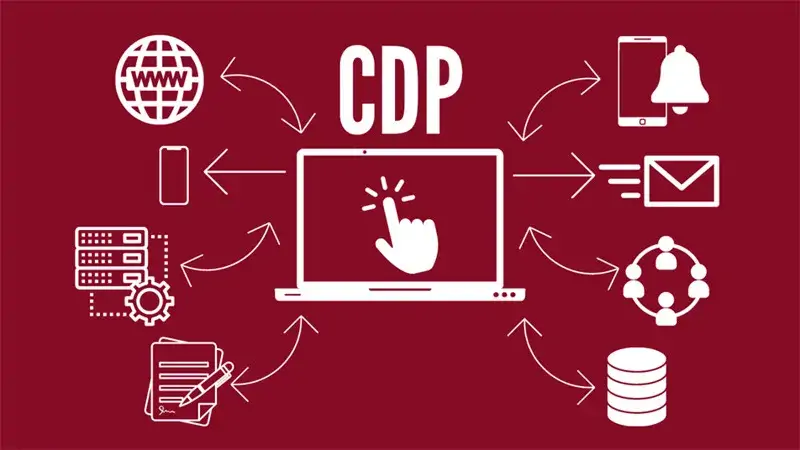
AI applications in marketing help personalize content and optimize advertising campaigns.
1.3. Human Resources (HR)
In the HR department, ai business automation in vietnam helps automate candidate CV screening, provides internal chatbots to handle common employee inquiries, and even supports attendance tracking through facial recognition. These applications help HR teams in Vietnam significantly reduce administrative workload to focus more on talent development strategies, improving both candidate experience and recruitment quality.
Example: Coca-Cola Vietnam partnered to implement the AI-powered HR virtual assistant “AskMi,” which handles HR requests such as downloading payslips, timekeeping, and approving business trips. As a result, the company reduced employee request approval time by 40% and cut employee information access time by 50%.

AI supports automatic CV screening and attendance tracking through facial recognition.
1.4. Finance & Accounting
In finance and accounting, AI automates invoice processing, recognizes and extracts data from documents, and even helps forecast cash flow. This enables Vietnamese businesses to reduce manual errors, shorten the closing cycle, and make faster, more informed decisions.
Example: Bizzi - a Vietnamese SaaS startup specializing in AI + RPA-based invoice automation has helped local businesses cut invoice processing time by up to 80% and reduce processing costs by around 50%.

Automating accounting processes with AI helps handle invoices faster and more accurately.
1.5. Operations & Supply Chain
In operations and supply chain management, AI is used to automatically inspect product quality through images, forecast product demand, and optimize warehouse management and delivery routes. Businesses can rely on AI to improve operational flexibility, reduce inventory, and increase the accuracy of supply planning.
Example: Abivin vRoute, a Vietnamese startup, has developed an AI-powered solution for route optimization and logistics management, which represents a successful case of ai business automation in vietnam, helping businesses lower transportation costs, boost productivity, and enhance competitiveness across the supply chain.

AI applications help optimize warehouse management, demand forecasting, and product quality inspection.
2. Understanding the Levels of AI Automation
When adopting AI business automation, companies need to understand the different levels of AI-driven automation to identify their current capability and define an appropriate optimization roadmap.
2.1. Assisted Automation
At this level, AI acts as a virtual assistant that supports humans in gathering, analyzing data, and suggesting actions. Humans still make the final decisions, ensuring accuracy and control throughout the process.
2.2. Partial Automation
AI starts to replace humans in repetitive tasks, performing most of the work based on learned data. Humans take on supervisory roles, handling exceptions and fine - tuning the system - making processes faster while maintaining safety and flexibility.
2.3. Full Automation
At the highest stage, AI can operate and make decisions independently within a closed process from data collection and analysis to result optimization. The system continuously learns and adapts, minimizing human intervention and paving the way for a fully AI-driven business model.
3. Case Studies: AI Automation Success Stories in Vietnam
The following case studies show how AI business automation in Vietnam is being widely applied across industries, helping Vietnamese companies solve real-world problems and achieve measurable operational improvements.
3.1. E-commerce & Retail Sector
Overview: TMA Solutions implemented the AI-Driven Smart Locker Solution for Secure Storage for a retail chain in Vietnam to support retail operations.
Challenge: The client faced challenges in managing parcel storage and pick-up using paper-based processes. Printed pick-up slips could be lost, damaged, or get wet, which caused inconvenience for customers. When issues happened, the customer service team had to handle complaints and reprint documents, leading to higher operational costs and slower service. The manual process also made it difficult to support flexible, after-hours pick-up.
Solution: TMA implemented an AI-powered smart locker system integrated with sensors and facial recognition technology. In the retail version, the system does not use QR codes. Instead, customers can send and collect items through secure face authentication. This allows automated access control and enables 24/7 pick-up and drop-off without on-site staff.
Benefits: By removing paper-based processes, the retailer reduced printing costs and customer service workload related to lost or damaged slips. Customers can collect their items faster and more conveniently using facial recognition, improving the overall experience. At the same time, automated access and real-time monitoring improve operational efficiency and security across retail locations.

TMA Solutions implemented an AI Smart Locker project for the retail sector in Vietnam.
3.2. Logistics
Overview: In the project Innovative IoT applications for container environmental management, TMA Solutions implemented an IoT-based monitoring system for a logistics company in Vietnam. The solution enables real-time tracking of temperature and humidity inside containers, helping the company maintain proper transport conditions and protect cargo more effectively.
Challenge: Data extraction from SAP and manual processing in Excel made reporting slow and error-prone, limiting timely decision-making.
Solution: TMA applied RPA combined with Microsoft Power Automate and VBA to automatically extract, format, and compile financial data from SAP into Excel reports.
Benefits: Processing time was reduced by up to 80%, financial errors significantly decreased, and the business gained timely insights to support faster and more strategic decision-making.
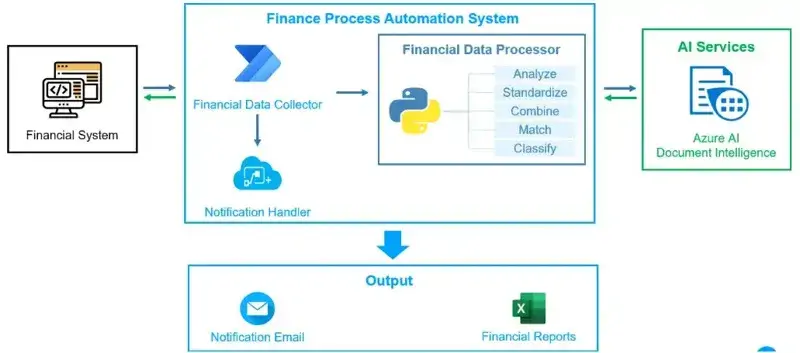
The AI-powered financial report automation project optimized logistics operations.
3.3. Manufacturing Sector
Overview: In manufacturing, TMA Solutions carried out the AI Sound-Based Fault Detection System in Manufacturing for a construction materials factory in Vietnam. The solution applies sound analysis and artificial intelligence to enhance product quality control and optimize production efficiency.
Challenge: Manual quality inspection couldn’t keep up with production expansion, leading to product defects, rising error rates, and increased downtime.
Solution: The system records machine sounds (e.g., valve noise) during production, uses AI models to classify normal and faulty sounds, and automatically removes defective products using robotic arms.
Benefits: The defect rate dropped dramatically (faultless product rate ~99%), productivity increased, inspection labor costs decreased, and the factory could scale up production without adding more workers.
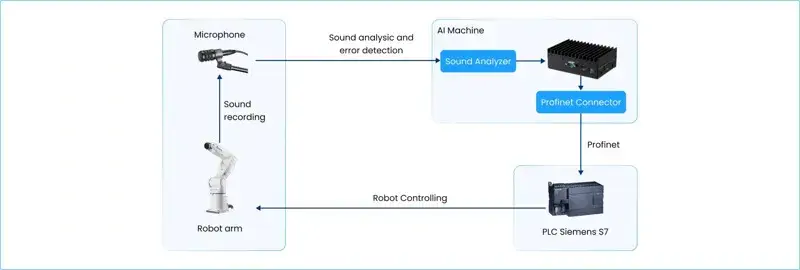
The AI sound-based fault detection system helped the factory minimize product defects.
3.4. Marketing & Sales
Overview: TMA Solutions developed the Insights for Brand Monitoring with Social Listening Solution for a major Vietnamese brand to analyze social media data and customer feedback in real time.
Challenge: The brand struggled to process massive amounts of data from social platforms, blogs, manual monitoring made it hard to respond quickly to emerging trends or potential PR crises.
Solution: The system gathers data from multiple channels (Facebook, TikTok, YouTube, etc.), analyzes sentiment and trends using NLP, monitors competitors and influencers, and provides a real-time dashboard for marketing and PR teams, an example of how AI business automation in Vietnam supports smarter data-driven decision making.
Benefits: The brand can now react quickly to trends and crises, gain deeper customer insights, and fine-tune marketing and sales campaigns more clearly boosting campaign performance and competitiveness.
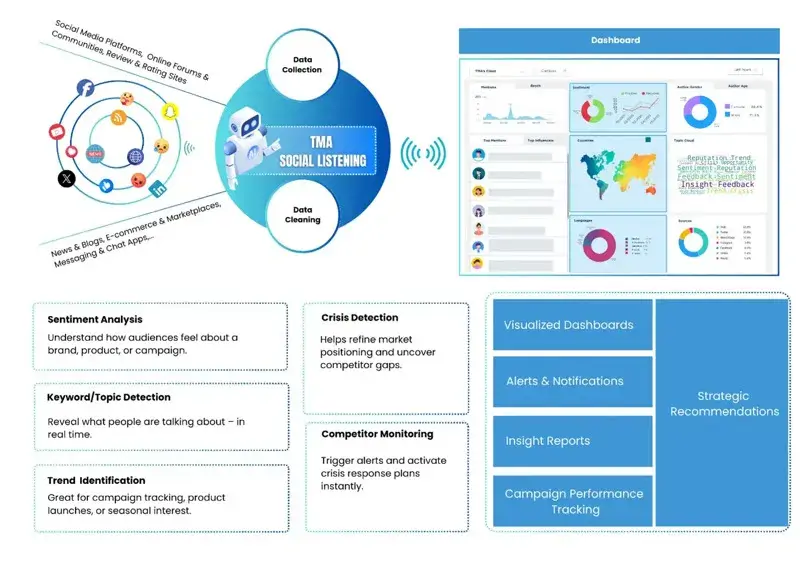
The Social Listening AI solution helps businesses monitor and analyze brand feedback
4. A 5-Step Roadmap to Implement AI Automation in Your Business
To implement AI automation successfully, businesses need a clear and structured roadmap. In recent years, the trend of AI business automation in Vietnam has gained strong momentum as companies aim to optimize operations and enhance productivity through intelligent technologies.
4.1. Step 1: Identify High-Impact Processes for Automation
Start by identifying processes that directly influence business performance from operations and accounting to customer service. The goal is to pinpoint bottlenecks or repetitive tasks that consume excessive time. These are areas where AI can deliver clear and measurable value, such as data entry, report processing, or customer request handling.
4.2. Step 2: Define Clear Objectives & KPIs
After identifying the key processes, businesses need to set specific objectives and key performance indicators (KPIs). This step helps provide clear direction for the entire AI project. For example, if the goal is to reduce operational costs, an appropriate KPI could be the cost savings rate after six months of applying AI. On the other hand, if the focus is on improving customer experience, you should track response time or customer satisfaction levels. Regardless of the goal, the metrics need to be measured specifically, closely linked to business value, and aligned across departments to ensure the implementation process is consistent and well-directed.
4.3. Step 3: Choose the Right Technology & Partner
At this stage, selecting the right technology and implementation partner is key. Evaluate how well new AI platforms integrate with existing systems, along with security and scalability. A reliable partner not only provides technical expertise but also offers strategic guidance and long-term support ensuring AI solutions are applied correctly and deliver practical value.
4.4. Step 4: Implement a Pilot Project
After defining the strategy and choosing the right tools, begin with a pilot project. This trial phase helps validate the feasibility of the AI solution on a small scale, assess integration and performance, and make necessary adjustments before full deployment.
4.5. Step 5: Scale, Monitor, and Optimize
In the final step, expand AI deployment across the organization but remember, scaling is not just replication.It requires continuous monitoring and optimization. Track system performance, update AI models as data evolves, and train teams regularly to ensure stability and long-term success.
5. Why Partner with TMA Solutions for AI Automation in Vietnam?
With more than 28 years of experience, TMA Solutions is one of the pioneering companies delivering AI-driven business automation solutions in Vietnam. With a team of over 4,000 engineers working across seven countries, TMA provides both specialized expertise and flexible implementation capabilities for large-scale projects.
In addition, TMA has developed a wide range of ready-to-deploy solutions for multiple industries such as Healthtech, Smart Manufacturing, Logistics, and Retail. This extensive solution portfolio enables businesses to accelerate digital transformation and quickly implement AI-powered systems tailored to their operational needs.
One of TMA’s core strengths is a robust quality management foundation, built on international standards such as CMMI Level 5, ISO 9001:2015, and ISO/IEC 27001:2013. This quality management system enables TMA to meet the strict requirements of global partners, ensuring that every AI project achieves optimal performance and absolute security.
TMA is also recognized for its diverse technical capabilities, from Machine Learning, Computer Vision, and Natural Language Processing to cloud platforms like AWS, Azure, and Google Cloud. As a result, businesses can deliver flexible AI solutions, customized to the specific needs of each industry, from retail and finance to manufacturing.
TMA Solutions has also been acknowledged by the tech community with numerous prestigious awards, including being honored by VINASA (Vietnam Software Association) in the Top 10 Software Outsourcing & IT Services Enterprises, Top 10 Fintech Enterprises, and Top 10 AI & IoT Enterprises the Vietnam IT Enterprises Awards in 2022, as well as being recognized among Vietnam’s Top 10 Digital Technology Companies 2024.

TMA Solutions was awarded the Top 10 AI & IoT Enterprises in Vietnam by VINASA.
AI business automation in Vietnam is an inevitable trend that helps businesses enhance productivity, optimize costs, and maintain a competitive advantage. However, for AI to truly create value, companies need a partner with real-world experience, multi-industry expertise, and mastery of core technologies.
TMA Solutions with over 12 years of implementing AI & Data projects for global clients is ready to accompany Vietnamese businesses on their intelligent automation journey.
>> Contact TMA Solutions to discover the most suitable AI Automation solution. Please fill out the form here: https://www.tmasolutions.com/contact-us
Contact information:


.webp_2026-10-01-18-27-07-971.webp)
.webp_2026-10-01-18-17-11-290.webp)
.webp_2026-10-01-18-08-26-854.webp)
.webp_2026-10-01-17-47-32-240.webp)