Clinical Context – Digital Transformation in Clinical Data Capture
Modern hospitals and healthcare facilities generate massive volumes of data daily from patient monitors, diagnostic analyzers, ventilators, and bedside medical devices. However, much of this data still requires manual transcription into hospital information systems (HIS) by nurses or technicians. This process is time-consuming, error-prone, and diverts valuable clinical time away from patient care.
A study from the UK’s National Health Service Blood and Transplant (NHSBT) found that transcription errors accounted for approximately 0.5% of quality-related incidents in specialist services, with some posing serious risks to patient safety. Similarly, international surveys show that healthcare professionals spend up to 60% of their working week on repetitive administrative tasks like updating records or completing forms, with 37% reporting that paperwork directly cuts into patient care time. In high-pressure clinical environments, even minor mistakes—such as a misplaced decimal point or missed entry—can lead to delayed diagnoses or incorrect treatments.
The Rise of AI-Driven OCR in Healthcare
The growing shift toward AI-powered automation is transforming how hospitals capture and process clinical data. Optical Character Recognition (OCR), enhanced by machine learning and neural networks, now enables the instant digitization of printed or screen-displayed values from medical devices. For instance, although modern hospitals are increasingly adopting digital systems, only about one-third of bedside devices (e.g. infusion pumps, ventilators, vital sign monitors) are fully integrated with HIS platforms; the rest still rely on manual transcription by staff.
Several cutting-edge studies have introduced camera-based OCR systems in clinical settings. One example is the ROMI robot deployed in intensive care units: equipped with cameras, it automatically identifies and reads numeric values on bedside monitors, then transmits the digitized results to a central dashboard. The system uses three core steps—localizing number zones, classifying characters, and annotating results—using deep learning models to ensure accuracy. Similarly, other systems allow patients to take a photo of their personal health device (e.g. blood pressure or glucose monitor), after which the OCR engine extracts key values and auto-fills their medical record — eliminating the need for manual input.
In practical use, OCR has proven to be significantly faster and more accurate than manual data entry. A study in Japan comparing OCR-based versus hand-typed entries for vital signs and prescriptions found compelling results: entering six medications via OCR took just 18 seconds, compared to 144 seconds when typed manually. The error rate for OCR was also markedly lower, confirming the technology’s potential for both speed and accuracy in structured medical documentation.
TMA Solutions – Applying Smart OCR to Healthcare
TMA Solutions, a Vietnam-based HealthTech innovator with nearly 30 years of software excellence, is advancing healthcare digitalization through intelligent automation and AI-powered data processing.
TMA Solutions incorporates these innovations into its Smart Medical OCR platform — designed to automate medical data capture from a wide range of clinical devices. The system uses machine vision and AI to extract readings from over 40 commonly used devices (e.g. blood pressure monitors, ECGs, lab machines), whether from screens, printouts, or captured photos.
Core capabilities include:
- Medical Data Digitization: Automatically captures and converts readings from medical devices or printed reports into accurate, structured digital records — eliminating manual entry and ensuring data consistency across systems.
- 24/7 Automated Parameter Monitoring and Alerts: Continuously monitors patient health indicators, instantly detects abnormal values, and notifies healthcare staff in real time to enable timely clinical intervention.
- Seamless Integration with HIS: Standardized digital outputs are securely synchronized with Hospital Information Systems (HIS) and Electronic Medical Records (EMR), ensuring interoperability, traceability, and full audit compliance.
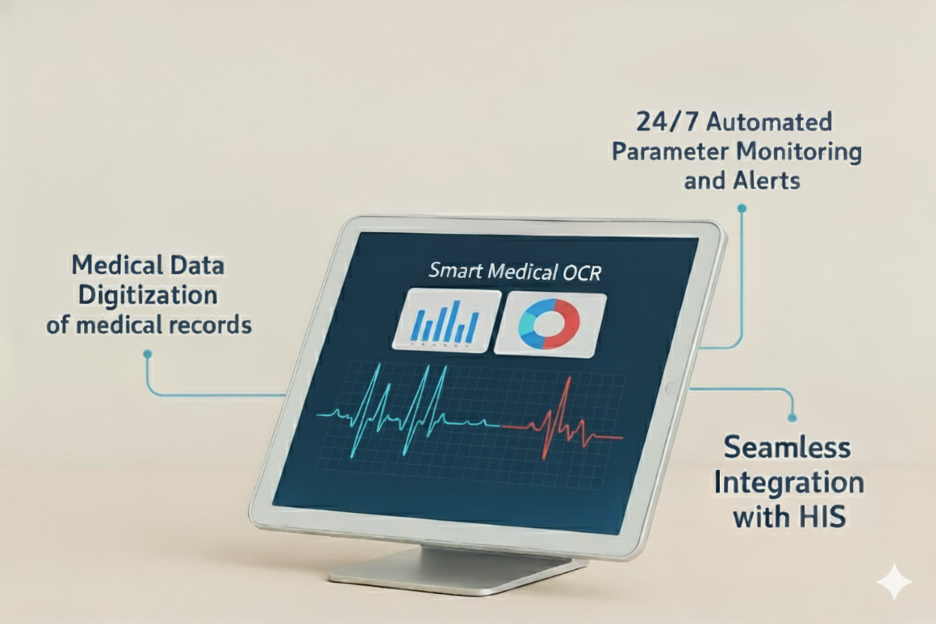
By automating this critical bridge between medical devices and digital hospital systems, TMA’s Smart Medical OCR improves data accuracy, enhances clinical workflows, and accelerates timely clinical decision-making. With nurses and clinicians freed from administrative burden, they can dedicate more time to patient care while reducing the risk of documentation errors — leading to a safer, smarter, and more connected healthcare system.
Application
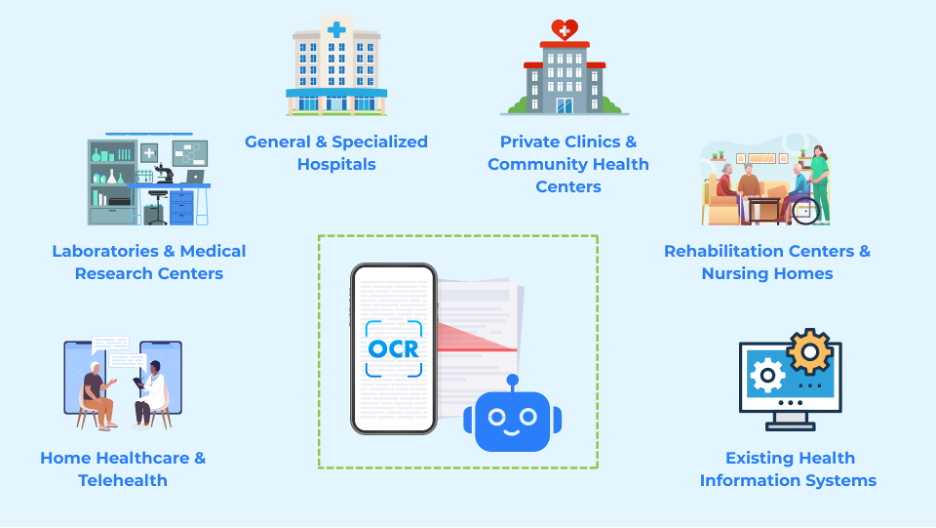
General & Specialized Hospitals
In hospitals, vast amounts of patient data flow continuously from bedside monitors, ventilators, and diagnostic devices — yet much of it still requires nurses to manually enter readings into the hospital information system. Smart Medical OCR bridges this gap by automatically capturing values directly from device screens, recognizing numeric fields, and mapping them into digital records in real time. This automation delivers measurable clinical and operational improvements across hospital environments:
- Reduces nurses’ manual data-entry workload by up to 60–80%.
- Eliminates transcription errors and delays in patient monitoring.
- Enables real-time alerts, particularly valuable in critical care (ICU).
- Proven use of camera-based OCR in clinical studies has shown high recognition accuracy for monitor digits under real hospital lighting conditions.
Private Clinics & Community Health Centers
At private clinics and local health facilities, physicians often rely on portable medical devices or printed reports to assess patient conditions. Smart Medical OCR enables staff to instantly capture these readings with a mobile device and convert them into structured, searchable data fields. By streamlining this process, clinics experience significant gains in efficiency and data reliability:
Benefits:
- Cuts per-patient documentation time by 40–50%.
- Simplifies record-keeping and supports consistent patient tracking.
- Enhances data accuracy, especially for clinics with limited administrative staff.
- Enables faster consultations and smoother coordination between general practitioners and specialists.
Home Healthcare & Telehealth
In remote and home-care settings, patients or caregivers can easily photograph readings from personal health devices such as glucometers, blood pressure monitors, or SpO₂ trackers. The OCR engine instantly extracts, validates, and synchronizes results with the telehealth platform. This capability strengthens continuity of care and early detection of health risks:
- Enables continuous 24/7 monitoring without requiring IoT-enabled devices for every patient.
- Early detection of anomalies such as hypertension spikes or hypoglycemia.
- Bridges the gap between patients and providers, strengthening long-term telecare models.
- Studies show home-collected data can improve chronic-disease management by 20–30% when integrated with automated alerting.
Laboratories & Medical Research Centers
In laboratories, where thousands of test results are generated each day, Smart Medical OCR automates the extraction of data from analyzer printouts, PDFs, and scanned reports. It recognizes test names, results, and units before feeding them directly into Laboratory Information Systems (LIS). This automation accelerates analytical workflows and ensures data integrity across devices:
- Reduces data transcription errors by up to 90%.
- Ensures data integrity and traceability across multiple analyzers.
- Speeds up throughput for high-volume testing (hundreds of results/hour).
- Facilitates trend analysis and clinical research by providing structured, standardized datasets.
Rehabilitation Centers & Nursing Homes
Rehabilitation and elder-care facilities require frequent tracking of patient vitals to ensure safe recovery. Smart Medical OCR allows caregivers to capture readings or paper notes with a mobile device, automatically converting them into structured digital records. This digital transformation empowers staff to act faster and focus more on patient well-being:
- Provides early warnings for elderly or recovering patients (e.g., low BP, rising temperature).
- Enhances staff responsiveness and reduces emergency incidents.
- Cuts documentation time by half, allowing more focus on patient interaction.
- Supports compliance reporting and remote supervision for large facilities.
Existing Health Information Systems (HIS, EMR, LIS, etc.)
Smart Medical OCR acts as an intelligent data gateway, transforming unstructured inputs — such as screenshots, printed results, or PDF reports — into structured, standardized data compatible with FHIR or HL7 formats. Through seamless integration with existing digital systems, healthcare organizations gain stronger connectivity and data consistency:
- Creates a unified and interoperable healthcare data ecosystem.
- Reduces data silos across departments and improves interoperability.
- Enhances auditability, regulatory compliance, and reporting accuracy.
- Increases administrative efficiency and speeds up billing/claims workflows.
Research-Backed Clinical Impact
- Time Efficiency: OCR-based data automation reduces data entry time by up to 70–80%, allowing healthcare professionals to focus more on patient care.
- Error Reduction: Studies show that automated OCR workflows reduce transcription errors by up to 90% compared to manual entry, ensuring higher accuracy in vital data capture.
- Faster Response: Real-time anomaly detection shortens the delay between abnormal readings and clinical action — potentially improving patient outcomes and safety.
- Operational Savings: Automation reduces administrative workload and staff overtime, delivering ROI within the first operational year for most healthcare facilities.
- Improved Staff Experience: By minimizing repetitive documentation, hospitals report lower nurse burnout and higher satisfaction with workflow efficiency.
Clinical and Business Implications
AI-powered OCR technology is redefining hospital operations by bridging the gap between medical devices and digital records. TMA’s Smart Medical OCR transforms how data flows within hospitals — making it faster, cleaner, and more reliable.
For healthcare providers, this means:
- Improved operational efficiency through automated data workflows.
- Enhanced data quality and compliance across patient records.
- Reduced clerical burden and increased focus on clinical tasks.
- Accelerated decision-making through timely, structured insights.
For TMA Solutions, Smart Medical OCR marks a vital step toward the next generation of healthcare data automation — integrating AI, OCR, and predictive analytics into a unified ecosystem that supports hospitals, clinics, and diagnostic centers worldwide.
In short, TMA Solutions is well-positioned to lead the digital transformation of healthcare data management, delivering faster, safer, and more intelligent systems that empower clinicians and improve patient outcomes.


.webp_2026-10-01-18-27-07-971.webp)
.webp_2026-10-01-18-17-11-290.webp)
.webp_2026-10-01-18-08-26-854.webp)
.webp_2026-10-01-17-47-32-240.webp)