Hospital readmissions create significant clinical and financial pressure. Wearable devices can help healthcare providers monitor patients beyond clinical settings, but their value comes from connecting measurements with clinical records and monitoring applications. TMA Data Platform supports enterprise data integration and real-time processing, while TMA's FHIR Transformation Service converts supported clinical data formats into FHIR-compliant resources, helping healthcare organizations connect wearable data with existing systems.
Wearable devices and real-time alerts
Remote patient monitoring is moving beyond collecting measurements at home. Healthcare organizations need to process incoming readings, maintain data consistency, and make relevant information available to care teams through compatible applications.
Wearable health data integration solutions connect data from devices and clinical systems. Without a reliable integration layer, readings may remain fragmented, limiting their usefulness for continuous monitoring and follow-up care.
TMA Data Platform and its FHIR Transformation Service support this architecture by converting legacy clinical formats into FHIR-compliant resources, enabling seamless real-time processing. Together, these capabilities provide a foundation for connecting wearable data with healthcare systems and supporting remote patient monitoring workflows.
Building an interoperable data pipeline
Effective wearable health data integration solutions must handle multiple data formats, preserve patient context, and deliver information to existing healthcare systems. Several technologies support different parts of this architecture:
MQTT: A lightweight publish/subscribe protocol for messaging in connected device and IoT environments.
Apache Kafka: A distributed event streaming platform for processing and routing continuous data flows.
HL7 and FHIR: Healthcare interoperability standards that help systems exchange structured clinical data. FHIR resources such as Patient and Observation can represent patient identities and vital sign measurements.
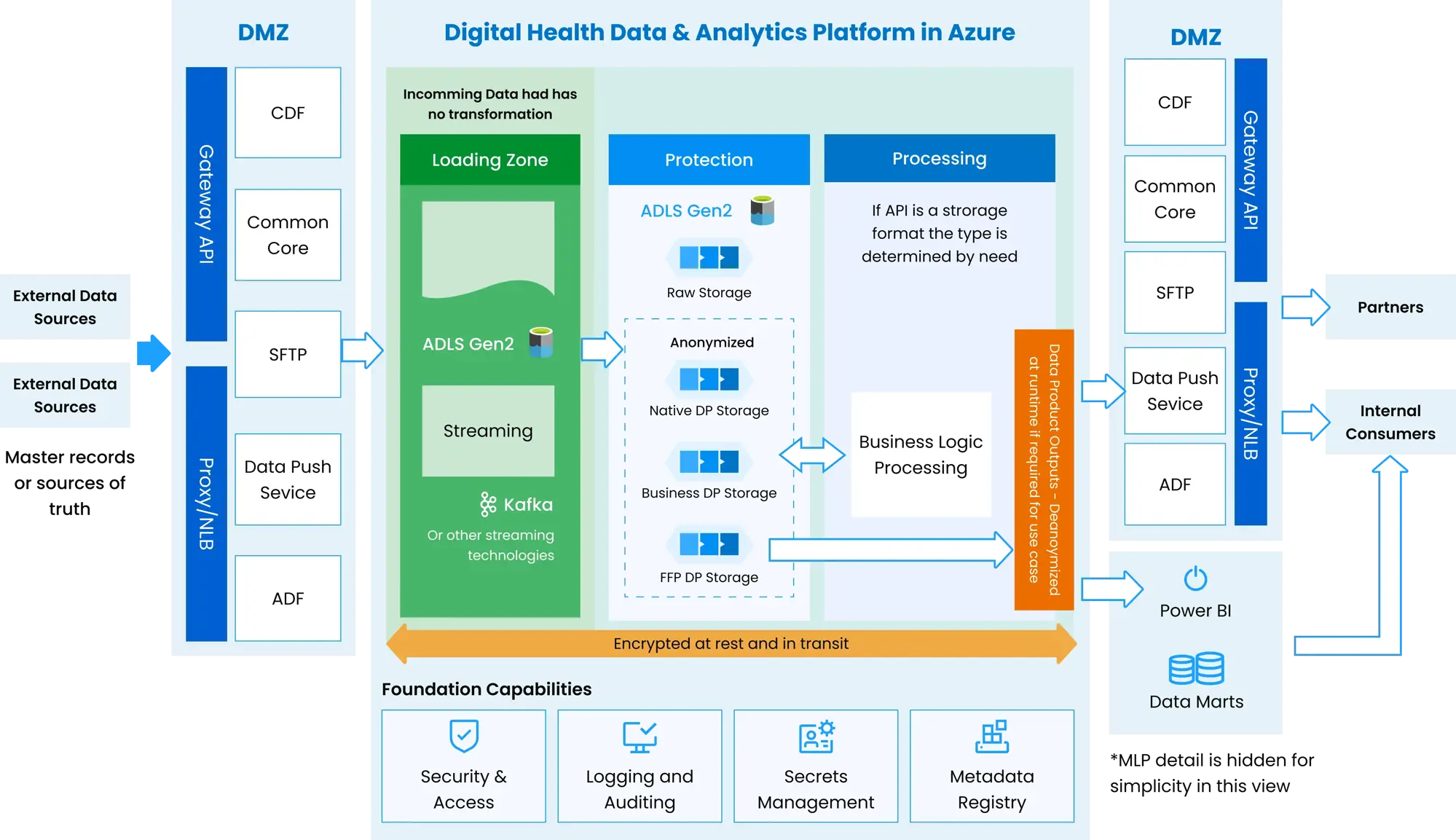
A typical pipeline receives wearable readings through supported device interfaces, processes incoming events, and transforms data into formats that downstream applications can consume. A healthcare data platform connects data ingestion, processing, storage, security, and analytics to make information available across healthcare systems. Data mapping and validation help maintain consistent patient identifiers, timestamps, measurement units, and device metadata, while standards such as HL7 FHIR support structured data exchange with compatible applications.
Supporting continuous vital signs monitoring
Continuous vital signs monitoring gives clinicians greater visibility into patient measurements between appointments. For remote monitoring for senior care, integrating wearable readings with relevant clinical records can help care teams review changes over time and prioritize follow-up.
A reliable monitoring architecture should address four requirements:
Data completeness: Identify missing readings and transmission gaps.
Data consistency: Maintain standardized units, timestamps, and patient associations.
Data availability: Make processed information accessible to authorized applications.
Data traceability: Preserve relevant metadata for investigation and monitoring operations.
TMA Data Platform supports the integration and processing layer behind these workflows, helping connect and organize data for use across compatible healthcare systems.
Turning real-time data into actionable alerts
Remote monitoring systems can apply configured thresholds or streaming rules to flag readings for review. Alerts can then be routed to the appropriate application or care team, with timestamps and patient context to support investigation.
These workflows require clear alert ownership, escalation paths, and response tracking. Healthcare organizations must also distinguish technical issues, such as delayed transmissions, from clinical alerts generated by monitoring rules. TMA Data Platform's real-time processing and integration capabilities can support the data flows behind these workflows.
Security must also be considered. Access controls, encryption, and audit trails help protect health information, alongside applicable regulatory requirements such as the HIPAA Security Rule in the United States.
Early intervention: Evidence from wearable-based heart failure monitoring
The BMAD clinical trial evaluated wearable monitoring for patients recently hospitalized with heart failure. Researchers enrolled 522 patients across 93 sites. In the intervention group, clinicians received wearable sensor data and alerts to support treatment decisions, while the control group's monitoring data remained blinded.
The study reported a 38% relative reduction in the rate of heart failure hospitalization over 90 days in the intervention group compared with the control group. The findings were published in JACC: Heart Failure.
The study illustrates how wearable measurements can support care when connected to clinical workflows. Reliable data ingestion, structured measurements, timely alerts, and clinician access help make monitoring information more actionable.
Measuring monitoring performance
Healthcare organizations can evaluate remote monitoring using operational and clinical indicators.
Metric | What it measures |
| 30-day or 90-day readmission rate | Readmissions within a defined follow-up period |
| Data latency | Time between measurement capture and availability for review |
| Alert review time | How quickly care teams review flagged events |
| Data completeness | Availability of expected measurements |
| Follow-up completion | Whether required calls, assessments, and appointments occur |
Tracking these indicators helps providers assess pipeline reliability, review alert handling, and identify opportunities to improve the monitoring process.
TMA Data Platform for healthcare data integration
TMA Data Platform provides enterprise data integration and real-time processing capabilities using technologies such as Apache Kafka, NiFi, and Google Dataflow. TMA's FHIR Transformation Service converts supported clinical data formats, including HL7 v2, CDA, and DICOM, into FHIR-compliant resources.
These capabilities support key requirements for wearable health data integration solutions:
- Data integration: Connect supported data sources and downstream systems.
- Real-time processing: Process and route data flows that require timely delivery.
- Healthcare data transformation: Convert supported clinical data formats into FHIR-compliant resources.
- Application connectivity: Make integrated information available to compatible healthcare applications.
_2026-11-06-15-40-45-090.webp)
Integrated healthcare data becomes more useful when accessible through the applications care teams use daily. Patient profiles, communication tools, and appointment management interfaces illustrate how connected information can support care coordination. Integrating wearable data with downstream applications can help make relevant patient information available to authorized users within existing workflows.
Connecting wearable data to better-informed care
Wearables can extend patient monitoring beyond hospitals, but their value relies on reliable data integration with clinical systems. Wearable health data integration solutions combine device connectivity, event streaming, healthcare data standards, and monitoring workflows to create a connected foundation for remote patient care.
Looking to integrate wearable health data across healthcare systems? Contact TMA Solutions to discuss your data architecture, interoperability requirements, and remote monitoring objectives.