Financial institutions need to deliver digital services faster without compromising transaction reliability, data protection or integration with established systems. For many organizations, the challenge is bigger than building a standalone application: they need an engineering partner who can understand financial workflows, connect complex platforms and support the product as requirements change.
Vietnam fintech software development gives financial businesses another way to access experienced software engineering teams and build long-term delivery capacity. Established in 1997, TMA Solutions publicly reports 4,000 engineers, customers in 30 countries and 600 engineers in Finance & Insurance. Its finance portfolio spans payments, wealth management, capital markets, AI in finance and Web3.
This guide explains what buyers should look for in fintech outsourcing Vietnam, when custom fintech solutions make sense, and how TMA’s documented capabilities and project examples can help organizations assess a potential delivery partner.
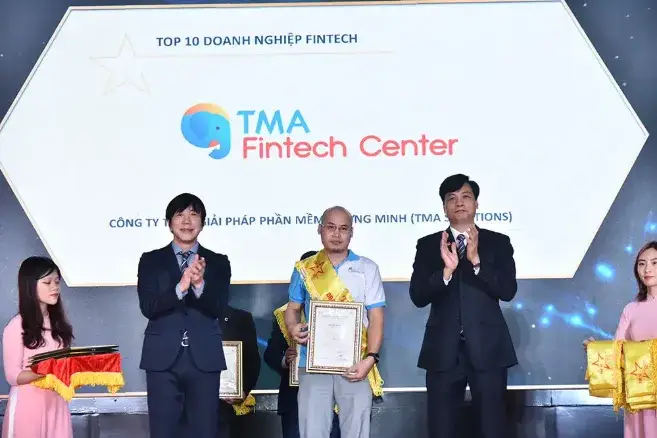
TMA Fintech Center recognized among the Top 10 Fintech Companies in Vietnam
1. Why Consider Vietnam for Fintech Software Development?
Fintech products depend on more than front-end features. Digital wallets, lending platforms, investment applications and banking portals must coordinate data, APIs, transaction processing, reporting and operational controls. Teams need to understand how these components work together and how a change in one system may affect the wider service.
Vietnam has developed a software engineering sector serving international customers across web, mobile, enterprise, cloud and data-driven applications. For financial services companies, working with a Vietnam-based team can provide access to engineering capacity while supporting a distributed delivery model. The right fit still depends on domain knowledge, communication, governance and the partner’s experience with systems similar to the planned product.
A useful partner evaluation should go beyond hourly rates. Buyers should review architecture and integration experience, quality practices, security responsibilities, delivery transparency and the ability to maintain software after launch. These considerations are especially important where an application handles payments, personal financial data or time-sensitive investment activity.
TMA’s published company profile lists customers in 30 countries and a dedicated Fintech Center. This combination of international delivery experience and financial-domain specialization makes TMA a candidate for organizations exploring custom fintech solutions or an ongoing software engineering partnership. TMA Finance Services
2. Why TMA Solutions for Fintech Outsourcing?
Engineering scale and international delivery experience. Established in 1997, TMA Solutions publicly reports a workforce of 4,000 engineers and customers across 30 countries. Its technology capabilities include specialized centers such as Fintech and AI. For projects requiring multiple disciplines, this scale can help bring application development, integration, quality assurance, cloud and data engineering into a coordinated delivery plan.
Scale alone does not guarantee a successful engagement. Buyers should confirm the proposed team structure, relevant experience, ownership of architecture and security decisions, acceptance criteria and communication cadence before work begins. A clearly defined delivery model helps both parties understand responsibilities and manage change.
600 engineers in Finance & Insurance
TMA’s corporate capability profile identifies 600 engineers in Finance & Insurance. Its published capital-markets case study also describes a dedicated Fintech Center with more than 18 years of financial-services experience. This domain background matters because financial software must handle transaction states, exceptions, reconciliation, permissions and operational continuity consistently.
Domain knowledge is most useful when it is reflected in practical engineering decisions. A payment product must account for failed or repeated transactions; a lending workflow needs traceable decisions and reliable customer information; and a banking integration must work within the constraints of existing platforms. These details should be discussed early, not left until testing or deployment.
Quality processes and information security
TMA’s official company materials list ISO 9001:2015, ISO/IEC 27001:2022 and CMMI Level 5 among its quality and process credentials. These credentials can inform a buyer’s review of organizational quality management and information-security practices.
They do not mean that every application is automatically compliant with every banking, payment, privacy or financial-market regulation. The relevant controls, evidence, audits and responsibilities should be agreed for each product and jurisdiction.
Experience across financial use cases
TMA’s finance portfolio includes examples related to cash flow management, buy-now-pay-later, wealth management, branded card issuing, digital product trading and capital-markets post-trade processing. Published project examples help prospective customers compare a provider’s experience with their own product and integration needs.
The following sections outline TMA’s service capabilities, explain how to approach fintech outsourcing, and revisit two representative case studies that can be retained as evidence of delivery experience.
3. Custom Fintech Solutions and Engineering Capabilities
TMA’s published Finance Services portfolio covers Fintech Application Development, Banking Integration, Web3 and AI in Fintech, alongside domain expertise in Wealth Management, Capital Markets, Payment, AI Finance and Web3. Depending on the project, these capabilities can support a new digital product, the modernization of an existing platform or integration across financial systems.
3.1 Wealth Management
TMA supports wealth management providers with technology for retirement plan administration and model portfolio management. Its published capabilities include flexible administration procedures for different plan structures, investment plan creation and maintenance, online workflows, and individual or bulk processing.
These capabilities are relevant to firms modernizing investment administration or connecting financial products with back-office operations. Organizations considering AI-supported advisory or wealth workflows can also explore TMA’s published finance capabilities and discuss the scope required for their use case. TMA Finance Services
3.2 Capital Markets
TMA’s capital-markets expertise spans pre-settlement, clearing and settlement, and trade accounting. Its published offering covers international settlement, corporate actions, multiple asset classes and integration with financial messaging and transaction protocols, including FIX, CTM and SWIFT.
Trade accounting capabilities include general-ledger integration, commission attribution and transaction-tax accounting. TMA’s post-trade transformation case provides an example of work involving securities-processing workflows and intelligent reconciliation, including the integration challenges that often accompany legacy modernization.
3.3 Payment
TMA’s payment experience includes Buy Now, Pay Later (BNPL), international remittance and digital wallets. Its published portfolio describes customer, merchant and administration portals; merchant integration; domestic and international payment flows; multilingual and multicurrency experiences; and wallet functions such as transfers, bill payments and reporting.
For an Australian payments provider, TMA delivered customer-facing web and mobile applications, administrator and merchant portals, APIs, and Magento/WooCommerce integration plugins for a BNPL solution. The example illustrates how custom fintech development may combine customer experience, operational tooling and integration with an existing commerce ecosystem.
3.4 AI in Finance
TMA’s AI Finance domain includes document intelligence, AI and OCR, financial report generation and AI chatbots. Described capabilities include text recognition and labeling, searchable documents, automated report preparation, AI-generated insights and multilingual conversational experiences.
When introducing AI into financial workflows, buyers should assess data quality, privacy, explainability, human oversight and applicable regulations. A clear use case and evaluation criteria help distinguish a useful workflow improvement from AI added without a defined business need.
3.5 Web3 and Blockchain
TMA’s Web3 expertise includes NFT trading platforms, blockchain-based letters of guarantee and Australian-dollar stablecoin-related systems. Its finance portfolio describes wallet and chain support, smart-contract-based access control, and user, transaction, wallet and asset management.
Published projects include digital product trading with cryptocurrency payments and NFTs, as well as blockchain-based document certification. Blockchain should be selected only where its architecture fits the product’s operating model, security needs and regulatory context.
Banking Integration Across Financial Services
Banking integration is a core consideration for many custom fintech solutions. New applications may need to connect with core banking systems, accounting software, payment services, identity providers or enterprise platforms. Integration planning should cover authentication, data consistency, monitoring, error handling, testing and responsibility for changes to connected systems.
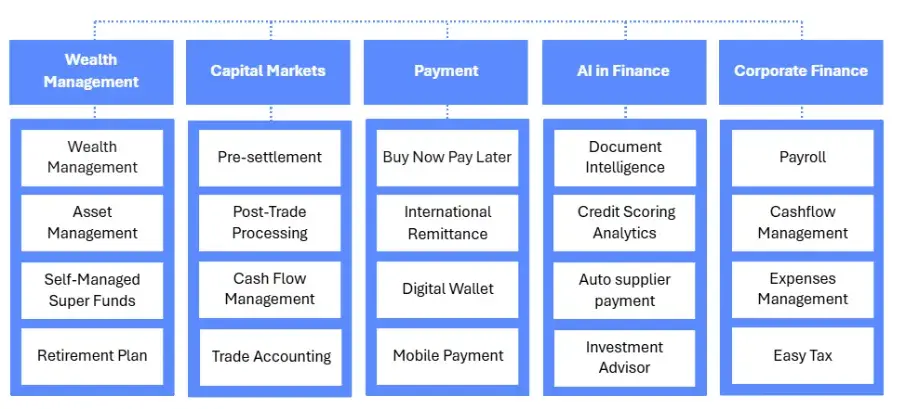
TMA fintech domains include wealth management, capital markets, payment, AI finance and Web3
4. TMA Fintech Case Studies: Practical Examples
Case studies provide context for evaluating whether a software partner has addressed similar technical and operational challenges. The examples below focus on cash flow management and capital-markets post-trade transformation, and can be retained as evidence alongside the wider service overview.
4.1 Cash Flow Management Application
TMA Solutions developed a cash flow management application for a technology-focused provider of credit and payment solutions serving more than 7,000 Australian businesses. The project illustrates experience building financial software that connects operational information with credit and payment workflows.
The solution included synchronization across accounting systems, automated payment reminders, customer and supplier credit-risk monitoring, credit checks and assessments, and real-time statistics with cash-flow trend analysis. Together, these capabilities brought financial information and everyday credit-management activities into a single application.
By connecting financial data and automating selected workflows, the application helps users track payment obligations, monitor credit conditions and access timely cash-flow information. It is a practical example of how custom software can address specific operational needs rather than forcing a business to adapt entirely to a generic product.
Explore the Cash Flow Management Application in TMA’s official Finance Services portfolio and review the related case study for more context. TMA Finance Services Capital Markets Post-Trade Case Study
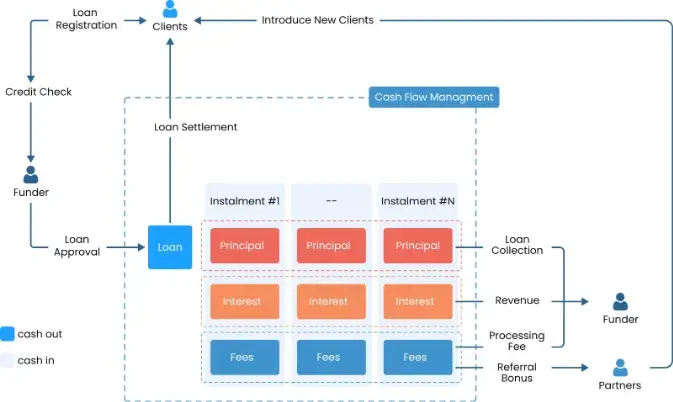
Cash flow management application workflow illustrating loan processing, cash flow monitoring, and payment collection
4.2 Capital Markets: Post-Trade Transformation
TMA Solutions worked with a leading provider of securities processing and post-trade infrastructure to modernize complex capital-markets operations. The engagement addressed legacy processing systems, manual reconciliation, high transaction volumes and integration requirements across financial-market participants.
The engineering scope covered post-trade processing, clearing and settlement, securities trade accounting, and intelligent trade reconciliation. The published solution included multi-asset transaction workflows, integration with settlement protocols and market infrastructure, and AI- and RPA-supported reconciliation and exception management.
The project reported 50% faster settlement and reconciliation processing, a 70% reduction in manual intervention, and 99.99% uptime with disaster-recovery readiness. These are results reported for this specific project, not guarantees of outcomes for other engagements.
This case demonstrates TMA’s experience with high-availability financial systems and complex post-trade workflows. It also shows why fintech outsourcing should be evaluated against the operational requirements of the product, rather than on team size or cost alone.
Capital-markets post-trade processing architecture illustrating trade allocation, clearing, settlement and reconciliation workflows
5. How to Structure a Fintech Outsourcing Engagement
A productive fintech outsourcing engagement starts with the business outcome and the constraints of the existing environment. The following checklist is practical guidance for buyers evaluating a potential partner; it is not a claim that every TMA project follows a single mandatory process.
First, define the product scope and success measures. Identify target users, critical workflows, transaction volumes, required integrations, availability expectations and reporting needs. Separate essential launch capabilities from enhancements that can be delivered later.
Second, agree on architecture, security and compliance responsibilities. Discuss data residency, identity and access controls, audit logs, encryption, backup, recovery and integration testing. Determine which regulations and standards apply to the product and market, and clarify who owns each control.
Third, validate domain experience using relevant project examples. Ask how the team has handled similar workflows, legacy integration, transaction exceptions and operational support. The cash-flow and post-trade cases illustrate different use cases and should be assessed separately against the proposed project.
Fourth, establish delivery governance. Agree on roles, decision-making, acceptance criteria, change control, test coverage, documentation, incident response and post-launch support. Clear ownership on both sides reduces ambiguity and makes progress easier to evaluate.
Finally, plan for product evolution. Financial products change as payment networks, customer expectations, threat models and regulations evolve. Maintainability, observability, knowledge transfer and a realistic roadmap should be considered from the start.
6. Choosing TMA for Vietnam Fintech Software Development
For organizations comparing Vietnam fintech software development providers, TMA Solutions brings publicly documented engineering scale, customers in 30 countries, 600 engineers in Finance & Insurance, a dedicated Fintech Center and experience across wealth management, capital markets, payments, AI finance and Web3. Banking integration is also part of its published service offering.
The case studies add practical context to these capabilities. The cash-flow application demonstrates integration of accounting and credit-related workflows, while the post-trade project describes measurable outcomes in capital-markets processing. Together, they give buyers a starting point for assessing TMA against their own product requirements.
If your organization is evaluating fintech outsourcing in Vietnam, building a custom financial application or modernizing existing systems, review TMA’s finance services and contact the team to discuss the technical scope, delivery model and business objectives. Contact TMA Solutions