A financial app is only as useful as the work it helps people complete. Customers may want to pay in a few taps, merchants need a clear view of transactions, and operations teams need accurate records when something fails or requires review. The application has to connect these experiences to the systems and controls behind the scenes.
That is why fintech application development involves more than designing a mobile interface. Product teams need to map financial journeys, connect APIs and data sources, manage exceptions, and test how the software behaves when transactions are delayed, rejected or reversed.
TMA Solutions develops financial software across payments, wealth management, capital markets, AI finance and Web3. This article looks at fintech applications through the problems they solve, the engineering decisions that shape them, and examples from TMA’s published portfolio.
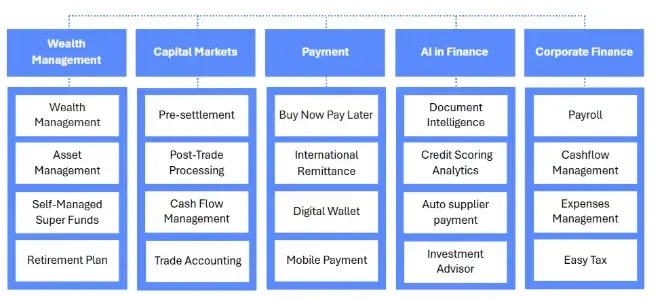
TMA’s fintech application landscape spans wealth management, capital markets, payment, AI finance and Web3
1. Start with the Financial Journey, Not the Screen
Before choosing features or technology, map what each user is trying to do. A wallet customer may need to add funds, transfer money and resolve a failed payment. A merchant may need transaction status and settlement reports. An investment adviser may need to review a client profile, update a portfolio and generate a report.
Each journey crosses several layers: the interface, business rules, data storage, identity and permissions, external services, notifications and operational reporting. Missing one of these layers can leave a polished app that is difficult to operate or support.
For teams assessing fintech app development services, a useful early deliverable is a prioritized journey map with integration points, exception paths and measurable acceptance criteria. It helps separate the first release’s essential capabilities from features that can follow later.
TMA’s published Finance Services portfolio provides examples across payment, wealth management, capital markets, AI finance and Web3. These examples can help buyers identify relevant experience before defining the scope of a new engagement.
2. What Makes Financial Applications Different?
Financial applications have to preserve trust while moving information and transactions between people, platforms and institutions. The design must account for authorization, traceability, data consistency, service availability and clear handling of exceptions—not just the happy path.
A project team should make these decisions explicit early: which system owns each data item, how transaction states are represented, what happens when a third-party API times out, who can approve sensitive actions, and how support teams investigate a disputed transaction.
600 engineers in Finance & Insurance
TMA’s corporate capability profile identifies 600 engineers in Finance & Insurance. Its finance portfolio covers multiple operating models, from customer-facing payment experiences to investment administration and post-trade processing.
That range is relevant when a new application must fit into an existing financial ecosystem. For example, a mobile experience may depend on payment services and merchant systems, while an investment portal may rely on portfolio data, reporting workflows and established market infrastructure.
Quality, security and delivery governance
TMA’s official company materials list ISO 9001:2015, ISO/IEC 27001:2022 and CMMI Level 5 among its quality and process credentials. Buyers can use these as starting points for a project-specific discussion about engineering practices, access controls, testing and information-security responsibilities.
Certifications at company level do not automatically make an individual application compliant with every financial regulation. The project team and client should define applicable requirements, evidence, control ownership and any independent assessments for the target market.
Look for evidence tied to the use case
A relevant portfolio should show how the team has handled workflows similar to the planned product. TMA’s published examples include cash flow management, buy-now-pay-later, branded card issuing, digital product trading and capital-markets post-trade solutions.
The next sections connect these application patterns to TMA’s published capabilities and selected project examples, rather than treating every fintech product as the same kind of build.
3. Application Types TMA Can Help Develop
TMA lists Fintech Application Development, Banking Integration, Web3 and AI in Fintech as service offerings. Its domain expertise spans Wealth Management, Capital Markets, Payment, AI Finance and Web3. The right mix depends on the customer journey and the systems the product needs to work with.
3.1 Mobile and Web Apps for Everyday Financial Tasks
Mobile and web applications can give customers and business users access to balances, transfers, payment histories, account services and self-service workflows. Depending on the product, the same platform may also need merchant tools, an administrator portal or an internal operations console.
For fintech mobile app development, plan for more than device layouts. Authentication, session management, accessibility, release compatibility, API behavior, error messages and support diagnostics all affect whether users can complete a financial task reliably.
3.2 Payment, Wallet and Buy Now, Pay Later
TMA’s published payment capabilities include Buy Now, Pay Later (BNPL), international remittance and digital wallets. The portfolio describes customer, merchant and administrator portals, merchant integration, local and international payments, multi-currency experiences and wallet functions such as transfers and bill payments.
In a published BNPL project for an Australian payments provider, TMA delivered customer-facing web and mobile applications, administrator and merchant portals, APIs, and Magento/WooCommerce plugins. The example shows how a financial product can require several connected interfaces and integration points—not just a standalone app.
3.3 Wealth and Investment Applications
TMA’s wealth management capabilities include retirement plan administration and model portfolio management. Published functions include flexible plan administration, investment-plan creation and maintenance, and online workflows that support individual or bulk processing.
For organizations building an investment experience, key questions include how portfolio information is sourced, how changes are approved, how reports are generated and how the application supports advisers as well as end customers. Read TMA’s insight on AI in wealth management software solutions for related context.
3.4 AI Features for Financial Workflows
TMA’s AI Finance portfolio includes document intelligence, AI and OCR, financial report generation and AI chatbots. These capabilities can support document classification, data extraction, search, report preparation and agent assistance when they are connected to trusted financial information.
AI should be introduced to solve a defined workflow problem, with appropriate review for data quality, privacy, explainability and human oversight. TMA has also published a Finance AI Chatbot case study describing agent-facing assistance, knowledge retrieval and response validation for financial customer service.
3.5 Blockchain and Web3 Use Cases
TMA’s finance portfolio includes NFT trading platforms, blockchain-based letters of guarantee and Australian-dollar stablecoin-related systems. Described capabilities include wallet and asset management, support for multiple wallets and chains, and smart-contract-based access control.
Blockchain is not a default requirement for every fintech product. It is worth evaluating when shared records, programmable assets or verifiable document flows address a specific business need and when the operating and regulatory implications are understood.
Banking Integration: Connecting the New with the Existing
Many financial applications need to exchange data with core banking systems, accounting software, payment services or other enterprise platforms. TMA lists Banking Integration as a separate service. A sound integration plan defines ownership of data, authentication, monitoring, retries, reconciliation and the process for resolving failed exchanges.
4. What TMA’s Published Projects Demonstrate
The following examples illustrate different application challenges: coordinating cash-flow information, supporting installment payments and processing complex securities transactions. They are separate engagements, so their results should be assessed in the context of each project.
4.1 Cash Flow Management Application
TMA developed a cash flow management application for a technology-focused provider of credit and payment solutions serving more than 7,000 Australian businesses. The application connected accounting information with credit and payment workflows used in day-to-day business operations.
The published scope included accounting-system synchronization, automated payment reminders, monitoring of customer and supplier credit risk, credit checks and assessments, and real-time statistics with cash-flow trend analysis.
This case is relevant to applications that need to bring fragmented financial information together and make it actionable. Instead of treating reporting as a separate task, the product connected data visibility with reminders, credit review and cash-flow monitoring.
See TMA’s Cash Flow Management Application in the official Finance Services portfolio for the published features and project context.
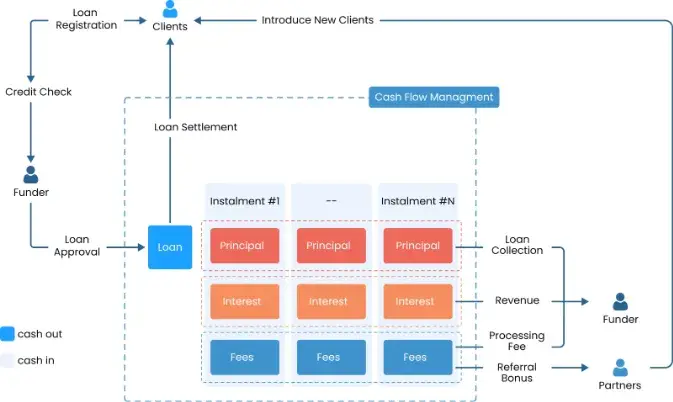
Cash flow management workflow showing loan processing, installment components, collection and cash-flow monitoring
4.2 Buy Now, Pay Later Application
TMA’s published BNPL case involved an Australian payments company offering customers the option to pay in four equal monthly installments. The solution required coordinated experiences for customers, merchants and administrators.
TMA delivered web and mobile applications, administrator and merchant portals, an API for merchant integration, and plugins for Magento and WooCommerce. These components allowed the service to connect with merchant e-commerce websites as well as customer-facing channels.
The example demonstrates why custom financial application development often includes a wider ecosystem: customer journeys, merchant onboarding, administration and third-party integration must work together.
For organizations planning installment payments or embedded finance, this case offers a concrete reference point for discussing channel coverage and integration scope with the engineering team.
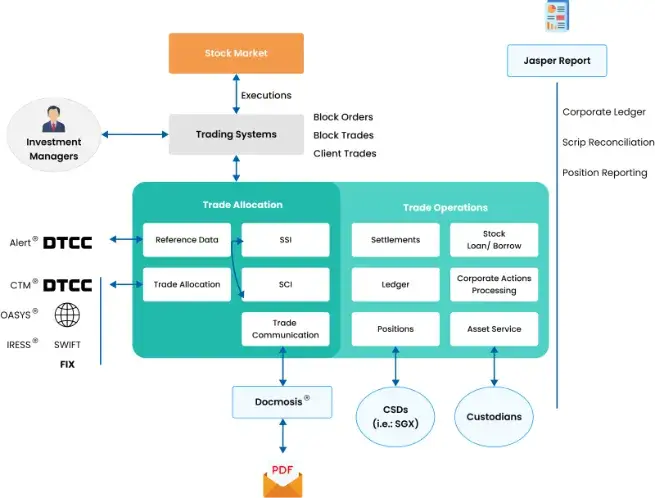
Capital-markets post-trade architecture illustrating trade allocation, clearing, settlement and reconciliation workflows
5. Questions to Settle Before Development Starts
A short set of decisions can prevent expensive rework later. Use these questions to align business owners, product teams and engineers before implementation begins.
What is the first user journey to improve? Define the target users, the task they need to complete and how success will be measured. Avoid treating every requested feature as equally urgent.
Which systems must the application connect to? Identify APIs, data owners, authentication requirements, transaction states, third-party dependencies and how errors will be handled.
What does secure operation mean for this product? Agree on access roles, audit trails, encryption, monitoring, recovery expectations and the regulations relevant to the target market.
How will the team prove the application is ready? Define acceptance criteria, test coverage, performance expectations, release responsibilities, documentation and post-launch support.
What is likely to change after launch? Plan for new payment methods, product rules, markets, devices and reporting needs. Maintainability and knowledge transfer should be part of the delivery plan, not an afterthought.
Build Your Next Financial Application with TMA Solutions
For organizations evaluating fintech app development services, TMA brings published experience across payment, wealth management, capital markets, AI finance and Web3, supported by a broader software engineering organization and a dedicated finance capability.
The portfolio examples show different types of work: cash-flow monitoring and accounting integration, customer and merchant applications for BNPL, and complex post-trade processing. Use the examples most relevant to your roadmap as a starting point for technical discussion.
If you are planning fintech mobile app development, a custom financial application or integration with existing banking infrastructure, explore TMA’s Finance Services portfolio and contact the team to discuss your product requirements.