According to the 2026 survey by the American Medical Association (AMA), 81% of physicians now use AI in their work, up from 38% in 2023. This number shows that AI has become a common tool in medical care. This article covers 6 common types of AI software in healthcare, 7 factors to consider before you choose one, and how to decide whether to build or buy.
1. Types of AI software for healthcare
AI software in healthcare is grouped by the problem it solves, and each type uses a different technology, such as machine learning, deep learning, natural language processing (NLP) or conversational AI.
1.1. AI clinical decision support systems
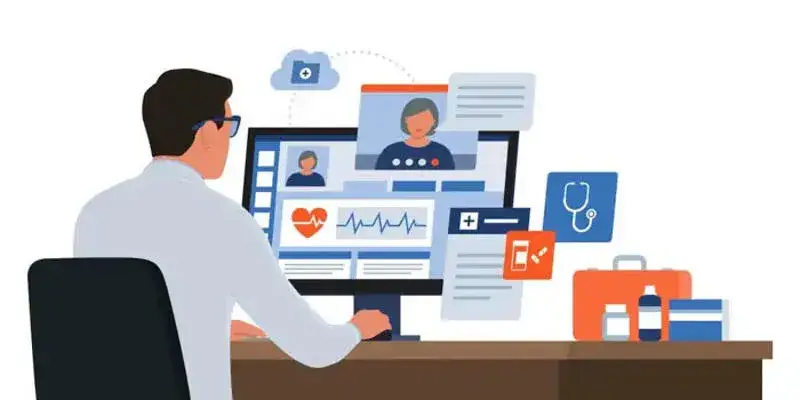
An AI clinical decision support system (CDSS) is a system that analyzes patient data and gives doctors alerts or suggestions during their normal clinical workflow.
How it works: Traditional systems use "if-then" logic based on clinical guidelines. Newer systems add machine learning to learn from past data and assess the level of risk for each patient.
Example: Alerts for drug interactions, contraindications or missing information in the electronic health record (EHR).
Benefits: It reduces the mental workload of doctors, lowers the risk of medical errors and helps staff follow clinical guidelines.
1.2. AI medical imaging software
AI medical imaging software is software that uses deep learning to read and analyze medical images, such as X-rays, CT scans, MRI scans and pathology slides.
How it works: A neural network learns from thousands of labeled images so that it can find signs of disease. The results appear in the PACS system, where radiologists review them and make the final decision.
Example: It can find lung nodules on CT scans, set priorities for emergency cases, or measure bone angles and lengths on X-rays for surgical planning.
Benefits: Medical imaging accounts for about 76% of the 1,430 AI devices that the FDA authorized from 1995 to 2025. The main reason is that AI helps doctors read images faster and find small signs that are easy to miss, especially as the number of images keeps growing.
1.3. AI medical documentation
AI medical documentation is software that uses NLP and generative AI to record, summarize and code the content of medical visits. People often call it an AI scribe.
How it works: The system records the conversation between the doctor and the patient, turns speech into text and creates a note in SOAP format. The doctor checks, edits and approves the note before it goes into the EHR.
Example: AI scribes helped doctors at The Permanente Medical Group (USA) save an estimated 15,791 hours of documentation time in one year, across about 2.5 million patient visits.
Benefits: It cuts paperwork time, reduces burnout and lets doctors focus more on their patients. You can learn more about how AI agents support clinical notes and EHR automation in real settings.

1.4. AI remote patient monitoring software
AI remote patient monitoring (RPM) software is software that collects vital signs from wearables and home medical devices, and then uses AI to detect warning signs.
How it works: Devices that measure blood pressure, blood sugar, SpO2 or ECG send data to the platform. AI analyzes trends, sorts patients by risk level and sends alerts to the care team when a reading goes above a set limit.
Example: The RPM program at Michigan Medicine reduced hospital admissions by 59% among high-risk patients, from 1.38 to 0.57 admissions in the six months after they joined.
Benefits: It helps detect problems early, reduces readmissions and gives patients with chronic diseases continuous care at home. If your hospital wants to build its own solution, our guide on how to build a telehealth and remote patient monitoring platform is a useful place to start.

1.5. AI predictive analytics platforms
An AI predictive analytics platform is a platform that uses machine learning on clinical and operational data to predict treatment outcomes or the resources a hospital will need.
How it works: The model learns from past EHR data, insurance data and operational data. It then gives each patient a risk score or predicts patient volume over time.
Example: It can predict the risk of readmission or sepsis, bed capacity, or staff needs for each shift.
Benefits: It helps hospitals act early for high-risk patients and plan beds and staff more effectively. This type of software needs a strong big data and analytics platform to handle data from many sources.
1.6. AI healthcare chatbots
An AI healthcare chatbot is a chatbot or virtual assistant that uses conversational AI to talk with patients by text or voice.
How it works: The chatbot uses a large language model (LLM) together with hospital data to understand questions. It answers based on approved scripts and passes the conversation to a staff member when a case is complex.
Example: It can answer common questions, book appointments, send medication reminders or ask about first symptoms before the patient sees a doctor, as in the patient intake assistant model.
Benefits: It reduces the workload of the front desk and call center, and gives patients support 24/7.

2. How to choose AI software for healthcare: 7 factors
AI software that looks good in a demo may not fit your hospital. Below are 7 factors that help your selection team assess software based on real risks.
2.1. Define the healthcare problem
Hospitals need to define the problem they want to solve before they look at any software. The reason is that many AI projects start because of new technology, not because of real clinical needs. As a result, the software goes live, but few doctors use it and it brings no clear improvement.
Questions to ask:
Which departments, staff groups and how many patients does this problem affect?
Which metrics will you use to measure success after 6 or 12 months?
Will doctors and nurses take part in the selection process?
2.2. Evaluate AI accuracy and clinical validation
A 2021 study in JAMA Internal Medicine found that the Epic sepsis model missed 67% of sepsis cases when Michigan Medicine tested it independently, even though it sent alerts for 18% of all hospital patients. The reason is that vendors usually measure accuracy on their own data, not on your patients. For this reason, hospitals need to test a model on their own real data before a wide rollout.
Questions to ask:
At which hospitals and on which patient groups has the model been externally validated?
Does the product have approval from the FDA, CE or a similar regulator?
Can the hospital test the model on its own data during a pilot phase?
2.3. Check integration with existing healthcare systems
AI software is only useful when its results appear where doctors already work, such as the HIS, EMR/EHR or PACS. If doctors have to open a separate app or enter data again by hand, they will soon stop using the tool. For this reason, hospitals need to check whether the software supports health data standards such as HL7 and FHIR.
Questions to ask:
Which standards or APIs does the software support, such as HL7, FHIR or DICOM?
What changes does the integration need in the current HIS/EMR system?
Who is responsible when the data flow between the two systems fails?
2.4. Identify and reduce bias to improve health equity
A 2019 study in the journal Science found that, after researchers adjusted a risk algorithm, the share of Black patients who received extra care rose from 17.7% to 46.5%. The original algorithm used healthcare costs to measure care needs, so it underestimated how sick these patients were. This example shows that AI learns from past data and can repeat the inequalities that already exist in that data.
Questions to ask:
Which countries, age groups and populations does the training data come from?
Does the vendor report model performance for each patient group?
Does the model predict the illness directly, or does it use a proxy such as cost?
2.5. Ensure data security
According to IBM's Cost of a Data Breach Report 2026, healthcare has the highest average cost per data breach of any industry, at USD 6.64 million. Health data is an attractive target for hackers, and one incident can cause serious financial and reputational damage. AI software often needs access to large amounts of patient data, so it can create new weak points if security is not part of the design from the start.
Questions to ask:
Where is the data stored, is it encrypted, and does it leave the hospital's systems?
Does the vendor use patient data to train its own models?
Which standards does the software meet, such as HIPAA, GDPR or ISO 27001?
2.6. Analyze total cost
The price is only one part of the total cost of ownership. Hospitals also need to count the costs of integration, infrastructure, staff training, model monitoring and upgrades over time. If you only compare the upfront price, you may choose a solution that is cheap to buy but expensive to run.
Questions to ask:
Is the price based on users, usage or sites?
Does the quote include integration, training and support?
How will the cost change when you expand to other departments or sites?
2.7. Monitor post-deployment performance and evaluate vendor viability
The performance of an AI model can drop over time when patient groups, clinical guidelines or devices change. This problem is called model drift. For this reason, hospitals need a way to monitor the model after launch, and they need to make sure the vendor is stable enough to support the product for many years.
Questions to ask:
How and how often does the vendor monitor and report model performance?
What is the process for model updates and for testing the model again after each update?
Can the hospital take back its data and move to another solution if the partnership ends?

If your hospital needs a partner to review these criteria from the start, you can talk to the TMA team for advice.
3. Build vs. buy: which path fits your hospital?
Buying ready-made software suits common problems and hospitals that need a fast launch. Building your own software, often with a development partner, suits hospitals with special workflows, a need for deep integration, or a wish to own their data and models. The table below sums up the pros and cons of the two options, based on the selection criteria in section 2.
| Criteria | Buy ready-made software | Build your own software |
| Time to launch | Fast, from a few weeks to a few months | Longer, usually several months or more, depending on the scope |
| Upfront cost | Lower, paid as a subscription or license | Higher, because of development and validation costs |
| Long-term cost | Grows with the number of users, sites or usage | Mainly operation, maintenance and upgrade costs |
| Workflow fit | The hospital has to adjust its workflows to the software | Designed around the hospital's own workflows and needs |
| HIS/EMR integration | Depends on the connections the vendor already supports | Deep integration with existing systems is possible |
| Control of data and models | Data may sit on the vendor's infrastructure | The hospital owns its data, models and source code |
| Clinical validation | Usually already approved, but needs local testing | The hospital is responsible for validation and approval if needed |
| Vendor dependence | High | Lower, the hospital can change its maintenance partner |
Self-assessment checklist: If your hospital ticks three or more items, you should seriously consider building your own solution (or customizing an existing platform).
Your clinical or operational workflows have many special features.
The software needs deep integration with your HIS, EMR, PACS or medical devices.
Patient data must stay on site or in the country.
Products on the market do not support your language or patient groups well.
Your hospital wants to own its AI models and expand them to more departments in the future.
Your hospital has, or can hire, a technical team to run and monitor the models.
4. TMA Solutions: building custom AI software for healthcare
For hospitals that choose to build, a development partner with experience in both AI and healthcare can save time and reduce risks. TMA Solutions is a Vietnamese software development company, founded in 1997 in Ho Chi Minh City. TMA's Healthtech center has more than 700 engineers and over 16 years of experience in healthcare, with clients in Australia, the USA, Ireland, Sweden, New Zealand and Vietnam.
When you work with TMA, your hospital gets the following benefits, in line with the selection criteria above:
A focus on clinical problems: TMA has built many AI solutions for specific needs, such as an AI scribe for medical visits, an AI surgical planner for X-rays and AI that detects atrial fibrillation (AFib) from real-time ECG.
Proven results in real settings: TMA's AI scribe is live in 3 hospitals and writes notes directly into existing systems with no API changes. TMA's medical document OCR solution helped a 24/7 healthcare provider cut manual data entry by 80%.
Integration with healthcare systems: The solutions support HL7 and FHIR, and connect with HIS/EMR, PACS and more than 50 medical devices and wearables, thanks to TMA's hardware integration expertise.
Responsible AI governance: TMA's AI/ML development process includes training data checks, bias checks, clinical review before release and model monitoring after launch.
Data security: The solutions are designed to be ready for HIPAA and GDPR, with on-premise or private cloud options and locally hosted LLMs. TMA also offers security application development for sensitive systems.
Quality control at every stage: TMA's software development services can come with software testing services to check quality at each stage.
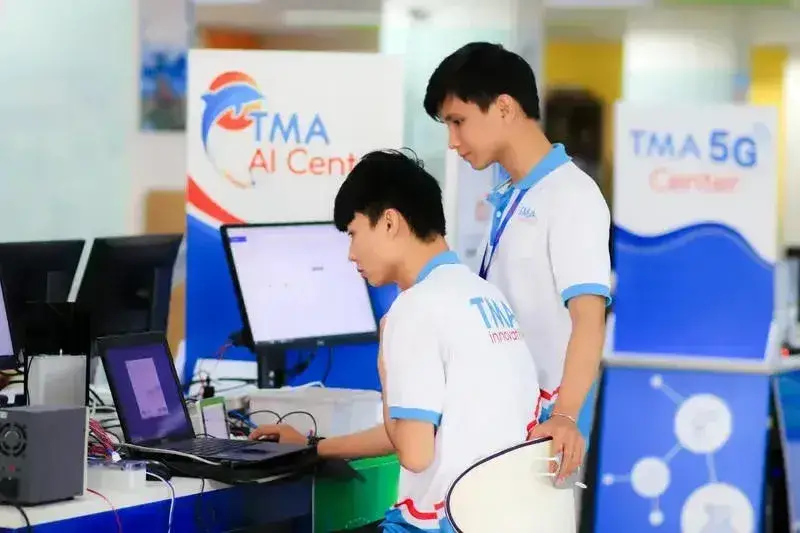
If your hospital plans to build its own AI solution, TMA's Healthtech team can work with you to define the problem, review your available data and propose a suitable delivery roadmap.
5. Frequently asked questions about AI software for healthcare
5.1. Will AI replace doctors in healthcare?
No. According to the AMA's 2026 survey, 85% of physicians want to be consulted or directly involved in decisions about AI adoption. This shows that doctors want to stay in control, while AI mainly supports tasks such as note-taking, image reading, risk alerts and answers to common questions. Final decisions on diagnosis and treatment still belong to doctors, and solutions such as AI scribes always require a doctor to check the note before it goes into the record.
5.2. How much does AI software for healthcare cost?
The cost varies widely, depending on the type of software, the scale of the rollout and the choice to buy or build. Ready-made software usually charges a subscription fee per user, per use or per site. The cost of custom software depends on the complexity of the model, the number of systems to integrate, the amount of data to prepare and the validation requirements. For a realistic figure, hospitals should start with a small pilot project and ask for a detailed quote for each work item.
5.3. Do small clinics need AI software, or is it only for large hospitals?
According to the AMA survey, 64% of physicians in private practice already use AI, not far below the 72% of physicians who work for hospitals and health systems. This shows that small clinics can also benefit from AI, especially for administrative tasks such as notes, appointment booking and follow-up reminders. For small clinics, a ready-made subscription tool or a custom tool with a narrow scope is usually a cost-effective choice.
AI software for healthcare comes in many types, from clinical decision support and medical imaging to automated documentation, remote monitoring, predictive analytics and chatbots. To choose the right solution, hospitals need to start from a specific problem, test accuracy on their own data, and check integration, security, bias and total cost. After that, they can decide whether to buy ready-made software or build their own solution.
With more than 700 Healthtech engineers and over 16 years of experience in healthcare, TMA Solutions can support hospitals from problem definition to development, integration and AI model monitoring.
>> Contact TMA to discuss your project.
Contact information:
TMA SOLUTIONS - The leading AI Software for Healthcare company in Vietnam Email: sales@tmasolutions.com Website: https://www.tmasolutions.com/ Linkedin: TMA Solutions TMA Tower address: Street #10, Quality Tech Solution Complex (QTSC), Trung My Tay Ward, Ho Chi Minh City. |