Every invoice represents a payment obligation, but preparing it for approval often involves several disconnected tasks. Finance employees open attachments, identify suppliers, enter invoice details, locate purchase orders, check receiving records, and follow up with colleagues. When documents arrive through different channels and use different layouts, even routine invoices can require considerable attention.
These challenges become more visible as a business grows. More suppliers bring more document variations, while higher transaction volumes increase the effort needed to track exceptions and maintain consistent records. Small errors can lead to repeated checks, approval delays, or questions about what should be paid.
AI invoice processing helps connect these activities into a more consistent workflow. It captures relevant information, checks it against supporting records, and directs discrepancies to reviewers, allowing finance teams to focus on decisions that require their judgment.
Why Manual Invoice Handling Becomes a Bottleneck
Invoices rarely arrive in one standard format. A supplier may send a digital PDF, another a scanned document, and another a photograph attached to an email. Invoice references, tax details, descriptions, and totals may appear in different places or use inconsistent naming conventions.
The work also extends beyond reading the document. Employees need to establish whether the supplier is recognized, whether the purchase was authorized, and whether the goods or services were received. Missing references or incomplete records can trigger additional communication across purchasing, operations, and finance.
Without a coordinated process, it becomes difficult to distinguish invoices ready for approval from those awaiting clarification. Teams may repeatedly check the same information while urgent exceptions remain buried in shared folders or inboxes.
How AI Invoice Processing Works
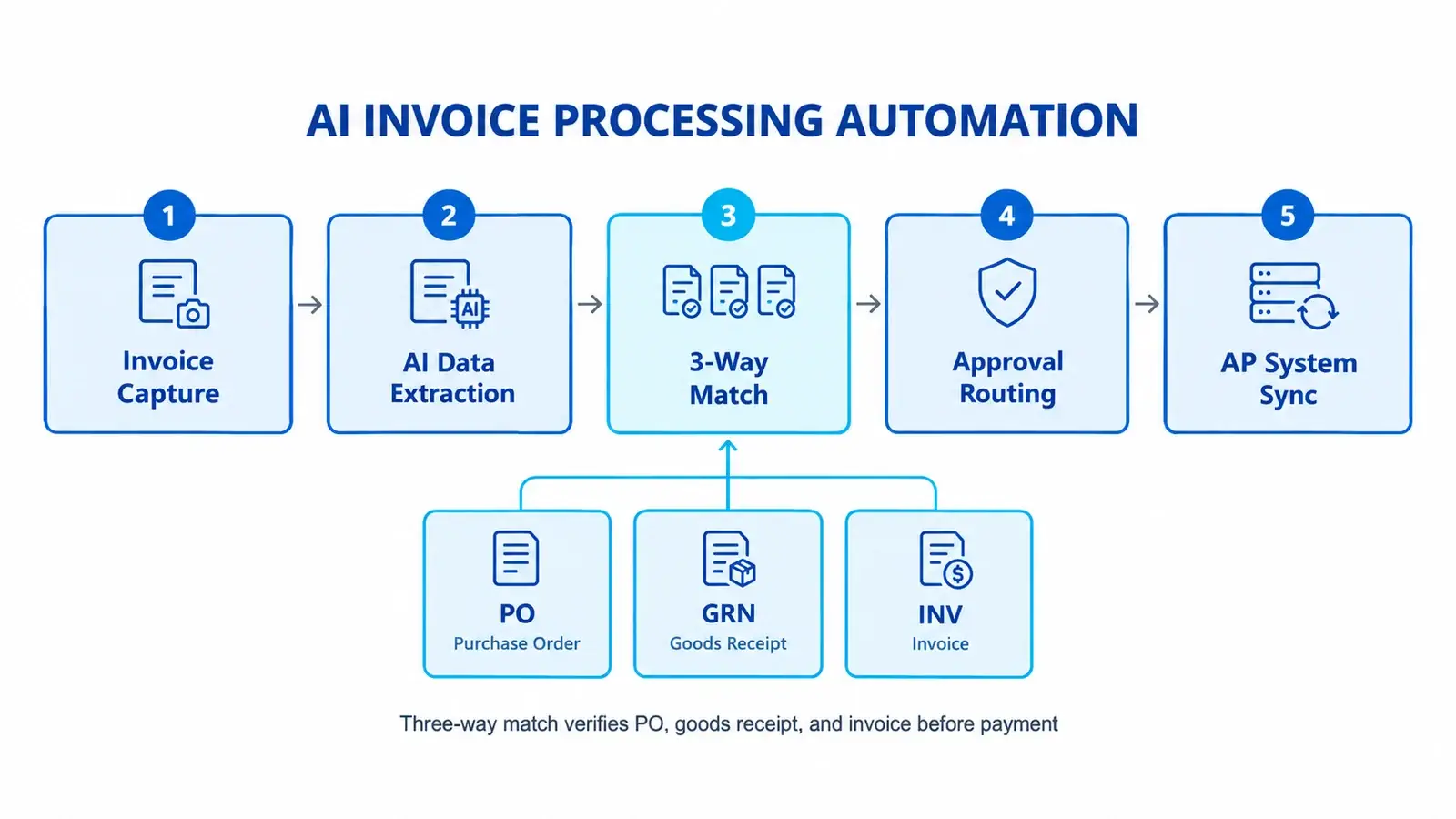
The workflow begins when a document enters the system through an agreed channel, such as an upload interface, monitored mailbox, or connected business application. The document is prepared for extraction, with checks for readability and supported formats where configured.
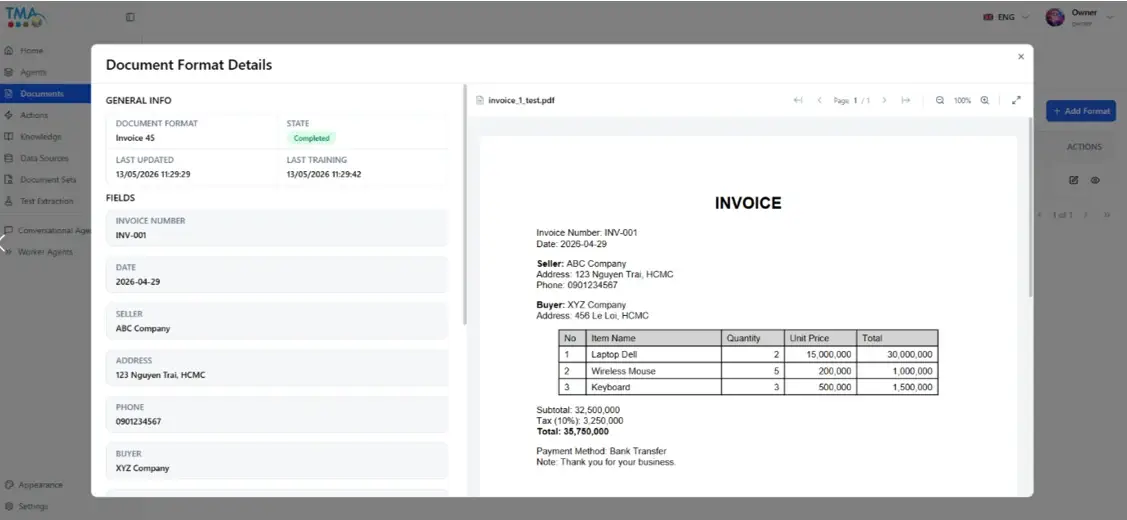
OCR and AI models identify relevant content and interpret its layout. They capture fields such as supplier names, invoice numbers, issue dates, payment terms, currency, tax amounts, totals, and individual line items.
The extracted information is organized into a defined schema. Dates and numerical formats can be standardized, and supplier descriptions can be mapped to internal records when suitable reference data is available.
This approach to automated invoice processing reduces repeated transcription across supported supplier formats. However, performance should be tested against representative documents, including unfamiliar layouts, poor-quality scans, and invoices containing complex tables.
Validating Information Before It Moves Forward
Capturing a value does not establish whether it is correct or appropriate for payment. Validation adds another layer by checking extracted information against document totals, required fields, reference records, and business rules.
For example, the system may check whether line items reconcile with the stated total, whether a purchase order reference exists, or whether an invoice number has already been recorded for the same supplier. These checks depend on the available data and configured policies.
In AI invoice processing, confidence scores help prioritize extracted fields that may need verification. They should be considered alongside validation results rather than treated as a guarantee of accuracy.
Unclear values, missing information, or conflicting records can be routed to a reviewer. Presenting the source document beside the extracted fields helps reviewers investigate discrepancies and record corrections.
Three-Way Matching and Business Rule Checks
Three-way matching compares an invoice with its purchase order and goods receipt. The objective is to establish whether the requested payment aligns with what was ordered and recorded as received.
For goods purchases, this may involve checking item references, quantities, unit prices, and amounts. Partial deliveries require particular attention because the invoiced quantity may legitimately differ from the original order.
Service invoices may require different supporting evidence, such as an approved completion record or contract milestone. The validation workflow should reflect these differences rather than applying identical checks to every transaction.
Matching rules can include agreed tolerances and escalation conditions. A minor rounding difference might follow one review path, while an unexpected charge or missing receipt follows another.
When checks pass, the invoice moves to the next authorized stage. Required approval and payment controls still apply.
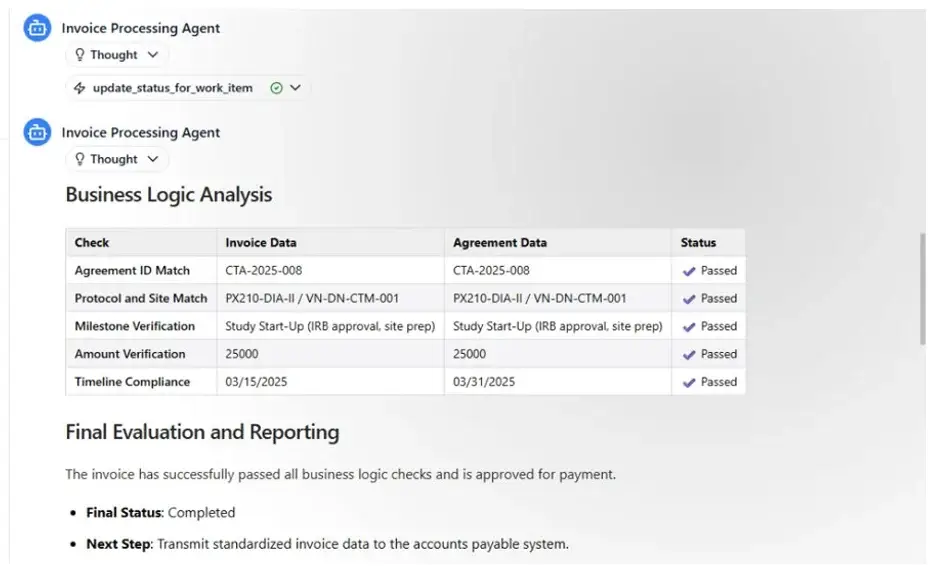
Connecting the Workflow with T-DocAgent
TMA offers T-DocAgent to support AI invoice processing by connecting document extraction with validation, matching, exception handling, and enterprise system integration.
Consider a B2B business receiving invoices from multiple suppliers. Extracted invoice information needs to be associated with purchasing and receiving records before finance can determine the next action. A coordinated workflow helps keep those activities connected.
Validated data can be transferred to an existing AP or ERP system through configured interfaces. Exceptions can follow a separate review path, with processing status and reviewer decisions retained where supported.
This supports accounts payable automation while keeping existing finance systems and approval responsibilities in place. The implementation scope should be established around confirmed product capabilities, available interfaces, and the organization’s operating requirements.
Business Benefits for Finance Teams
The value of AI invoice processing should be assessed across the complete workflow, including the time spent reviewing exceptions and resolving missing information.
- Less repetitive data entry: Capturing supported fields directly from documents reduces the need to retype information into multiple systems.
- Faster preparation for approval: Consistent extraction and checking help invoices reach the appropriate reviewer sooner.
- More focused exception handling: Finance employees can concentrate on discrepancies instead of checking every document with the same level of manual effort.
- Better operational visibility: Processing statuses help teams understand which documents are complete, awaiting review, or blocked by missing information.
- Greater traceability: Recorded extraction results, validation outcomes, corrections, and approval actions can support internal reviews and investigations.
Actual improvements depend on document quality, reference data, integration coverage, and the proportion of invoices requiring intervention.
Conclusion
A practical starting point is one invoice category or a defined group of suppliers. This keeps the scope manageable while providing enough variation to evaluate performance.
Before implementation, establish a baseline for processing time, field accuracy, exception rates, and manual review effort. Define which discrepancies require escalation and who is responsible for resolving them.
Run representative documents through the proposed workflow and compare results with verified records. Review both successful cases and exceptions before expanding to additional suppliers or business units.
Contact TMA Solutions to explore how AI invoice processing can support your finance workflows and connect validated data to enterprise systems.
Frequently Asked Questions
Can AI invoice processing handle different supplier formats?
Yes. Multiple layouts can be supported, but representative samples should be tested to confirm performance across expected formats, languages, and image quality.
What happens when an invoice does not match its purchase order?
The discrepancy is flagged and routed according to configured review rules. An authorized reviewer investigates the difference before the invoice proceeds.
Does implementation replace the existing accounts payable system?
It can integrate with the existing AP or ERP system. Integration requirements depend on available interfaces, data mapping, and approval processes.
How should extraction accuracy be measured?
Compare extracted fields with verified results on representative documents. Track field accuracy, exception rates, and review effort separately to assess practical performance.