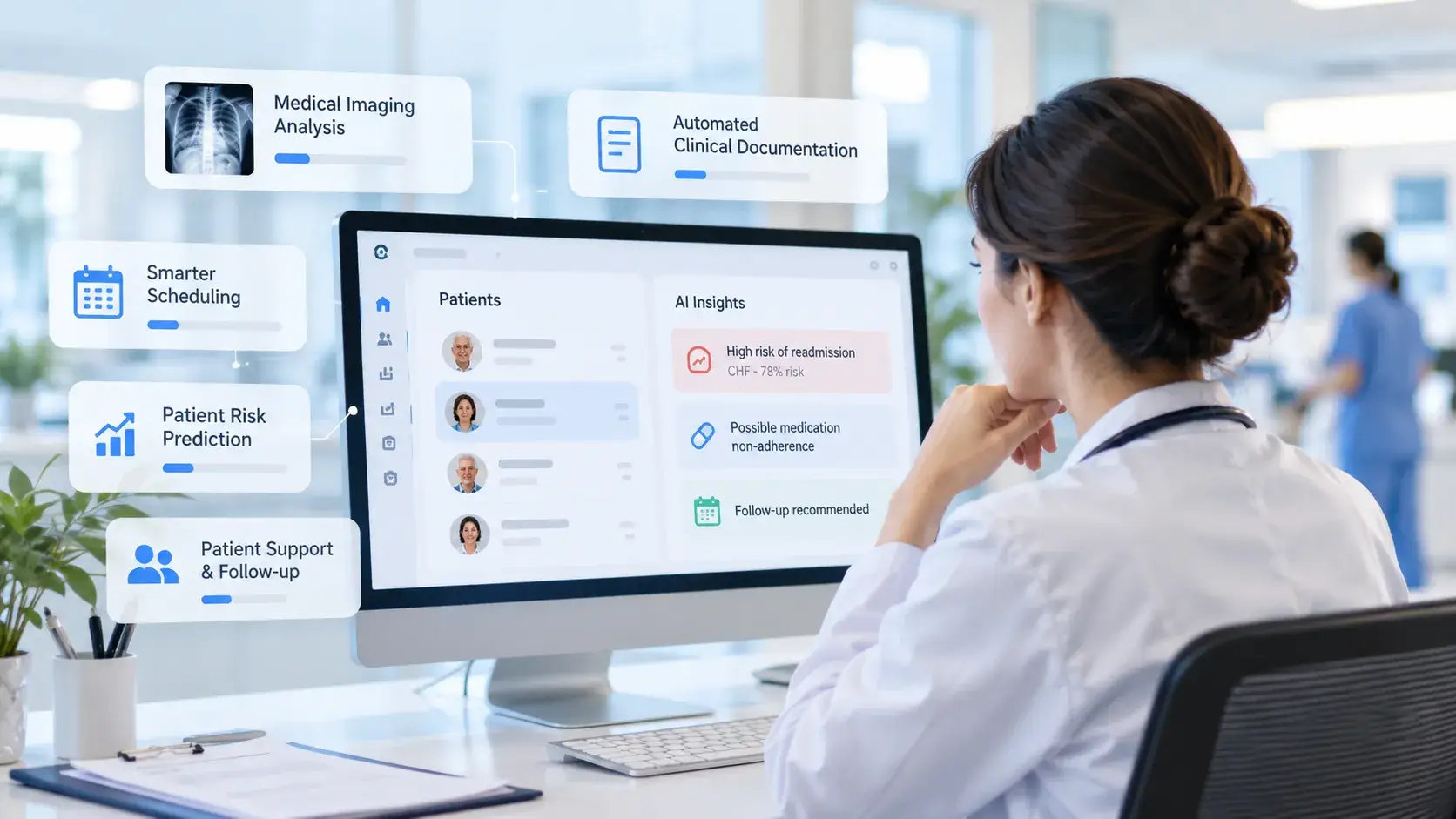
Physicians now spend nearly twice as much time on EHR and desk work as they spend with patients during clinic hours [1] — and with the WHO projecting a global shortage of 10 million healthcare workers by 2030 [2], that administrative load is unsustainable. The fastest-growing answer is agentic AI: software that doesn't just record but acts — drafting notes, prioritizing tasks, and automating EHR workflows. The Permanente Medical Group's ambient AI scribes saved 15,000 physician hours in a single year across 2.5 million uses [3]. For CTOs, CIOs, and operations leaders, the question is no longer whether to deploy AI agents, but where to start and how to keep them safe.
AI Scribes for Doctors: Ambient Documentation to Clinical Notes
AI scribes for doctor workflows listen to patient encounters and generate structured clinical notes in real time. The engineering depth sits below the demo: specialty templates so an oncology note looks different from a pediatric one; terminology models trained on clinical vocabulary, abbreviations, and medication names where general-purpose models mishear; and a sign-off workflow where every AI-drafted note requires physician review and electronic signature before it enters the record. The evidence is strong: ambient scribe adoption cut burnout from 51.9% to 38.8% within 30 days in a JAMA Network Open study [4], and two-thirds of U.S. hospitals using Epic have adopted ambient AI [5]. The build-vs-buy decision hinges on specialty fit, EHR integration depth, and who owns the transcription data.
AI Agent for Nurse Assistant
An AI agent for nurse assistant work targets the coordination burden that consumes nursing time: shift handover summaries generated automatically from EHR events, so nothing critical is lost between shifts; vitals logging that captures device readings into structured records without manual transcription; task prioritization that ranks pending work by patient acuity; and bedside voice UI for hands-free documentation in sterile or mobility-constrained settings. Because nursing workflows are interrupt-driven, the agent must be ambient-first — surfacing information when asked, not pinging constantly. TMA's healthcare AI work in elderly care — from AI nurse assistant operations to 24/7 elderly monitoring with automated alerting — shows these patterns already running in production environments [6].
AI Agent for Clinical Operation Automation
Clinical operations are where agents deliver ROI fastest because they optimize constrained resources: scheduling agents that rebalance appointments against no-show predictions; resource allocation for rooms, equipment, and staffing across fluctuating demand; and discharge planning that coordinates follow-ups, transport, and documentation so beds free up sooner. Unlike rule-based automation, agents handle the exceptions — the delayed transport, the bed blocked by an unplanned admission — which is precisely where manual coordination burns staff hours. TMA's four-step deployment model (data foundation review, workflow design, agent integration, quality control) reflects how mature delivery teams stage this complexity [7].
AI Agent for EHR Automation
EHR automation agents attack the documentation backlog directly: data entry that extracts structured values from forms, faxes, and device outputs via medical OCR; coding assistance that suggests billing codes for human coder confirmation; summarization that compresses long charts into pre-visit briefs; and inbox triage that routes patient messages, results, and refill requests to the right queue with urgency scoring. Every one of these writes to — or gates actions on — the medical record, so each needs deterministic audit trails and confidence-based human review. The business case is large: McKinsey estimates generative AI could automate a significant share of healthcare administrative work, saving the U.S. system billions annually [8].
Healthcare RPA Solutions Provider in Vietnam
Not every workflow needs a language model. A healthcare RPA solutions provider in Vietnam typically automates the high-volume, rules-driven layer: claims processing with payer-specific validation, billing reconciliation, data migration during EHR transitions, and eligibility checks. Vietnam's combination of an AI-ready workforce (18,000+ AI developers, 530,000+ IT engineers [9]) and mature RPA delivery makes it a practical sourcing destination for this layer — and Vietnam rates of $25–$65/hour let organizations automate more workflows within fixed budgets [Source needed for vendor-specific pricing]. TMA, with 29 years of process-mature delivery (CMMI, ISO 9001, ISO 27001) and a dedicated healthcare practice, combines RPA and AI agent engineering under one governance model [10].
From RPA to Intelligent Document Processing in Healthcare
The evolution from RPA to intelligent document processing (IDP) follows a capability ladder: scripted bots copy structured fields; OCR handles typed documents; IDP extracts meaning from the messy middle — handwritten intake forms, referral letters, lab reports with inconsistent layouts. Healthcare documents are the hardest IDP case because errors propagate to clinical decisions, so mature pipelines pair extraction models with validation rules (allergy fields can never be empty-silently) and route low-confidence extractions to human review. The comparison below shows when each automation class fits:
Rule-Based RPA vs. AI Agent Automation
Dimension | Rule-based RPA | AI agents |
Input data | Structured fields, fixed screens | Unstructured text, audio, images, events |
Adaptability | Breaks when UI or workflow changes | Context-aware; handles variation and ambiguity |
Decision scope | Executes predefined rules only | Prioritizes, summarizes, recommends actions |
Failure mode | Silent breakage on layout change | Confidence thresholds route uncertainty to humans |
Best workloads | Claims entry, billing, migration at volume | Documentation, triage, inbox triage, coordination |
Governance need | Bot run logs | Human-in-the-loop approvals plus full audit trails |
Rule of thumb: RPA for high-volume structure, AI agents for variability and judgment, IDP where documents meet decisions.
Guardrails: Human-in-the-Loop Approval, Audit Trails & Safety
Healthcare agents act on records that affect lives, so the guardrail architecture is the product. Three non-negotiables: human-in-the-loop approval for any AI output that writes to the chart, triggers a patient communication, or influences care priority — with confidence thresholds that route uncertainty to people; immutable audit trails recording every agent action, input, model version, and approving user, so any decision is reconstructable; and scope containment — agents operate through permissioned APIs with hard action allowlists, never through screen-scraped free access to the EHR. These controls also anchor HIPAA-aware delivery for U.S. deployments [11]: PHI access is minimized, encrypted, and logged by default.
Integration Patterns: FHIR/HL7, EHR, HIS, On-Premise vs Cloud
FHIR-first writes. Agents write notes and observations as FHIR resources through R4 APIs, keeping the record standards-based and portable [12].
HL7 v2 where legacy demands it. ADT and ORM feeds still run hospitals; interface engines translate between agent events and legacy messaging.
SMART on FHIR embedding. Agent outputs surface inside the EHR UI as embedded apps — clinicians adopt what they don't have to switch windows to use.
On-premise vs cloud. Cloud maximizes model quality and elasticity; on-premise or VPC-isolated deployment serves PHI-boundary constraints and latency-critical bedside use. The right architecture is per-workload, not per-organization.
Measured Impact: Hours Saved per Shift, Error Reduction
Published results set the benchmark: 15,000 physician hours saved in one year at The Permanente Medical Group [3], 13–16 minutes less EHR time per session in peer-reviewed measurement [4], and burnout reductions in the range of 13 percentage points [4]. Operationally, hospitals report faster documentation cycles and fewer transcription errors once agents replace manual re-entry — with the biggest gains in high-volume documentation and inbox management. Organization-specific ROI depends on workflow mix and adoption depth, which is why pilot measurement design (below) matters as much as the technology. Client-specific TMA ROI figures: [Source needed].
Pilot Program Design & Rollout Roadmap
Weeks 1–2 — Workflow selection. Pick one workflow with a clean baseline (documentation time, inbox backlog, handover duration) and measurable success criteria.
Weeks 3–4 — Integration groundwork. Map FHIR/HL7 surfaces, define the agent's permissioned action set, and set up audit logging.
Weeks 5–8 — Shadow operation. Run the agent alongside staff without acting — measure note quality, prioritization accuracy, and staff trust.
Weeks 9–12 — Assisted operation. Agent acts with human approval on every write; tune thresholds and escalation rules from real usage.
Weeks 13–16 — Graduated autonomy. Expand to autonomous low-risk actions (drafts, queue routing) while keeping human approval on high-risk writes; publish the measured impact and go/no-go.
Because each stage gates the next, teams that skip shadow-mode consistently pay for it in clinician trust — the scarcest deployment resource.
Lessons Learned from the Field
- Terminology debt. Generic teams deploy off-the-shelf models that mishear medication names; TMA-style delivery trains and evaluates on specialty vocabulary before go-live.
- Alert fatigue mirrors documentation fatigue. Agents that ping nurses constantly get disabled; ambient-first interaction design is a requirement, not a preference.
- Fragile integration vs. contract-first APIs. Low-cost ODCs screen-scrape EHRs and break at every upgrade; disciplined teams build on FHIR contracts with versioned interfaces.
- Ownership ambiguity on agent actions. Every automated action needs a named accountable owner and an audit trail — without them, incident response stalls.
FAQ
1. What are AI scribes and how accurate are they?
AI scribes listen to patient encounters and draft structured notes for physician sign-off. Specialty-tuned models reach production-grade accuracy; every note still requires clinician review before entering the record.
2. How do AI agents integrate with Epic or Cerner EHRs?
Through FHIR R4 APIs, SMART on FHIR embedding, and HL7 v2 interface engines — permissioned, audit-logged, and never via screen scraping. Confirm the vendor's integration references before contracting.
3. Can AI agents be used safely with patient data?
Yes, with PHI-aware architecture: encryption, minimized access, immutable audit trails, human-in-the-loop approvals, and BAA-ready hosting inside your compliance boundary.
4. How much time do AI scribes actually save?
Peer-reviewed results show 13–16 minutes less EHR time per session and 15,000 hours saved in one year across a large medical group [3][4] — with burnout reductions around 13 percentage points.
5. How do I evaluate a healthcare AI automation partner?
Require healthcare domain tenure, FHIR/HL7 delivery evidence, guardrail architecture (audit trails, human-in-the-loop), and process maturity such as CMMI and ISO 27001. Ask for measured pilot outcomes, not demos.
Conclusion
AI agents are healthcare's answer to its deepest operational math problem — too much administrative work, too few people. Scribes, nurse assistants, and EHR automation agents are delivering measured hours-and-burnout gains today, but only where guardrails, integration discipline, and human-in-the-loop design are engineered from the start. TMA Solutions combines a 700-engineer healthcare practice, AI and RPA delivery under CMMI/ISO-governed processes, and production healthcare AI experience across the U.S., Australia, Europe, and Japan.
Ready to automate your clinical operations? Contact TMA Solutions at www.tmasolutions.com to design an AI agent pilot with measurable success criteria — and a rollout roadmap your clinicians will trust.
References
[1] Sinsky C. et al. – Allocation of Physician Time in Ambulatory Practice (Annals of Internal Medicine) – 2016
[2] World Health Organization – Health Workforce: 10 Million Shortage by 2030
[3] American Medical Association – AI Scribes Save 15,000 Hours and Restore the Human Side of Medicine
[4] Olson KD et al. – Use of Ambient AI Scribes to Reduce Administrative Burden (JAMA Network Open) – 2025
[5] AJMC – Ambient AI Tool Adoption in US Hospitals and Associated Factors – 2026
[6] TMA Solutions – AI-Powered Health Monitoring: Case Studies – 2026
[7] TMA Solutions – AI Agent for Healthcare: Optimizing Intelligent Medical Workflows – 2026
[8] McKinsey & Company – Generative AI in Healthcare Administration
[9] Saigon Technology – Vietnam AI Ecosystem: Policy, Talent Pool & Market Growth – 2026
[10] TMA Solutions – AI Agents for Healthcare Operations and EHR Automation – 2026
[11] U.S. Department of Health & Human Services – HIPAA for Professionals
[12] HL7 International – FHIR Release 4 Specification & SMART on FHIR