In today's digital-first business environment, enterprises process an overwhelming volume of documents every day. From invoices, purchase orders, contracts, insurance claims, and shipping documents to medical records and customer applications, these documents contain valuable business information that drives critical operations. Yet, despite ongoing digital transformation efforts, document processing remains one of the most labor-intensive and error-prone tasks across industries.
For many organizations, document handling still relies heavily on manual data entry or traditional Optical Character Recognition (OCR) systems. While OCR has helped digitize paper documents, it often struggles with varying document layouts, handwritten content, tables, or complex business forms. As document volumes continue to grow, these limitations lead to higher operational costs, slower processing times, and increased risks of human error.
Artificial Intelligence (AI) is transforming this process by enabling systems to do much more than simply recognize text. AI-powered document extraction can understand document context, identify key information, validate extracted data, and integrate seamlessly with enterprise applications. The result is a faster, more accurate, and scalable approach to managing business documents.
This article explores how AI document extraction works, the technologies behind it, key enterprise use cases, and how organizations can leverage intelligent document processing to accelerate digital transformation.
What Is AI Document Extraction?
AI document extraction is the process of using Artificial Intelligence, Machine Learning, Computer Vision, and Natural Language Processing (NLP) to automatically identify, extract, classify, and validate information from structured, semi-structured, and unstructured documents.
Unlike conventional OCR, which simply converts images into text, AI document extraction understands document context and business meaning.
For example, when processing an invoice, AI can automatically identify:
- Supplier name
- Invoice number
- Purchase order number
- Due date
- Currency
- Tax amount
- Line items
- Total payment
- Payment terms
Similarly, when processing contracts, AI can recognize:
- Parties involved
- Contract duration
- Renewal clauses
- Confidentiality terms
- Payment obligations
- Risk indicators
The extracted information can then be automatically integrated into ERP, CRM, finance, healthcare, or workflow systems without manual data entry.
The Evolution from OCR to AI Document Extraction
Traditional OCR | AI Document Extraction |
Reads characters | Understands document meaning |
Fixed templates | Handles dynamic layouts |
Manual verification | Intelligent validation |
Limited context | Context-aware extraction |
Low adaptability | Learns from new document types |
Simple digitization | End-to-end automation |
Table 1: OCR vs AI Document Extraction
For decades, OCR has been the foundation of document digitization. It converts printed or handwritten text from scanned documents or images into machine-readable text, making information searchable and editable. While this technology has significantly reduced paper dependency, it was never designed to understand the meaning of the content it captures.
Traditional OCR works well with standardized templates, but enterprise documents rarely follow a single format. An invoice from one supplier may look completely different from another, contracts often vary in structure, and forms may contain handwritten notes, tables, or stamps. As a result, organizations frequently spend additional time reviewing and correcting OCR outputs manually.
AI document extraction addresses these challenges by combining OCR with advanced technologies such as Computer Vision, Natural Language Processing (NLP), and Large Language Models (LLMs). Instead of simply reading characters, AI interprets the document as a human would—understanding layouts, recognizing relationships between different fields, and identifying the business context behind the information.
For example, rather than extracting every number from an invoice, an AI-powered system can determine which value represents the invoice total, distinguish it from tax amounts or subtotals, and validate the extracted information against business rules. Similarly, when processing contracts, AI can identify clauses related to payment terms, renewal dates, or confidentiality obligations without relying on predefined templates.
This shift from text recognition to document understanding is what makes AI document extraction a key component of modern Intelligent Document Processing (IDP).
Why Enterprises Are Investing in AI Document Extraction
Across industries, organizations are under increasing pressure to improve operational efficiency while maintaining accuracy and compliance. Document-intensive processes often become bottlenecks because they require repetitive manual work, especially when dealing with high volumes of information from multiple sources.
The Growing Challenge of Managing Enterprise Documents
Consider a manufacturing company receiving thousands of supplier invoices each month. Each invoice may have a different layout, language, or currency. Finance teams must manually verify supplier details, match purchase orders, validate payment amounts, and enter data into ERP systems. Even with traditional OCR, employees often need to review and correct extracted information before processing can continue.
The same challenge exists across many industries. Healthcare providers process patient registration forms, laboratory reports, insurance claims, and medical records from multiple sources. Banks and financial institutions review loan applications, Know Your Customer (KYC) documents, and financial statements that require strict verification. Logistics companies handle shipping documents, customs declarations, and delivery receipts from partners around the world, while insurance providers process thousands of claims supported by diverse document types.
As document volumes continue to increase, relying on manual processing becomes increasingly difficult to sustain. AI document extraction addresses these challenges by automatically capturing, validating, and routing information to enterprise systems, helping organizations accelerate workflows while improving data quality and operational efficiency.
The Business Impact of Manual Document Processing
Although manual document handling remains common in many organizations, it often creates hidden operational costs that affect productivity, customer experience, and business scalability. As document volumes grow, these challenges become even more significant.
- High Processing Costs: Employees spend valuable time reviewing documents and manually entering information into ERP, CRM, or other enterprise applications instead of focusing on higher-value activities.
- Human Errors: Repetitive data entry increases the likelihood of mistakes, leading to incorrect records, delayed approvals, and additional time spent on verification and corrections.
- Slow Turnaround Times: Manual processing slows critical business operations such as invoice approvals, insurance claims, customer onboarding, and loan processing, ultimately impacting service quality and customer satisfaction.
- Compliance and Audit Risks: Industries such as healthcare, banking, insurance, and government require accurate records and complete audit trails. Manual processes make it more difficult to maintain consistency and regulatory compliance.
- Limited Scalability: As organizations grow, document volumes increase proportionally. Without automation, businesses often need to hire additional staff simply to keep pace with administrative workloads, driving up operational costs.
These challenges explain why Intelligent Document Processing (IDP) has become a strategic investment for enterprises pursuing digital transformation. According to research by McKinsey and IBM, AI-powered document processing can reduce document processing costs by 60–80%, while significantly improving processing speed, accuracy, and operational efficiency. Organizations adopting AI document extraction are not only reducing manual effort, they are building more scalable, resilient, and data-driven business processes.
How AI Document Extraction Works
Although different solutions may vary in implementation, most enterprise AI document extraction platforms follow a similar workflow.
The process begins with document ingestion, where files are collected from multiple sources such as email attachments, scanners, mobile applications, cloud storage, enterprise portals, or APIs. Since incoming documents often vary in quality, AI first performs image enhancement tasks such as noise reduction, deskewing, contrast adjustment, and page orientation correction to improve readability.
Next, OCR converts the document into machine-readable text. Unlike traditional OCR-only solutions, this stage is enhanced by Computer Vision, which analyzes the visual structure of the document. It identifies tables, headers, paragraphs, signatures, stamps, checkboxes, and other layout elements that help AI understand the document's organization.
Once the document structure has been identified, Natural Language Processing and Large Language Models analyze the extracted text to determine its meaning. Instead of simply identifying isolated words or numbers, AI recognizes entities such as company names, invoice numbers, addresses, purchase order references, payment terms, dates, product descriptions, and monetary values.
Business rules are then applied to validate the extracted information. For example, an invoice total can be compared against the sum of line items, purchase order numbers can be verified within the ERP system, or mandatory fields can be checked before further processing.
Finally, the validated information is automatically integrated into enterprise applications such as ERP, CRM, accounting software, electronic health record systems, or document management platforms. This end-to-end automation eliminates repetitive manual data entry while maintaining consistency across business processes.
Rather than replacing existing enterprise systems, AI document extraction enhances them by providing accurate, structured data that enables faster workflows and better decision-making.
From Document AI to Intelligent Business Decisions
As AI technologies continue to evolve, document extraction is becoming much more than an automation tool. Modern enterprise solutions combine multiple AI technologies to understand documents, make contextual decisions, and trigger downstream business workflows with minimal human intervention.
At the core of these solutions are several complementary technologies that work together throughout the document processing pipeline.
Large Language Models Bring Context to Documents
Large Language Models (LLMs) have significantly enhanced traditional document processing by enabling systems to understand the meaning behind extracted information rather than simply identifying text.
For example, when reviewing a supplier contract, an LLM can identify payment terms, renewal clauses, penalties, confidentiality agreements, or delivery obligations even when the wording differs across documents. Instead of relying on predefined templates, the model interprets business intent, making it more adaptable to diverse document formats.
This contextual understanding is especially valuable for enterprises managing contracts, financial reports, regulatory documents, and customer correspondence, where critical information may appear in different sections or be expressed in different ways.
When combined with Retrieval-Augmented Generation (RAG), AI can also answer natural language questions such as:
- Which contracts expire within the next 90 days?
- What invoices remain unpaid?
- Which medical reports mention diabetes complications?
Rather than searching manually, employees receive accurate answers generated from enterprise documents in seconds.
Real-World Enterprise Applications
Document AI delivers value across industries because nearly every business process begins with a document. By transforming unstructured information into structured data, organizations can automate workflows that previously depended on manual effort.
Healthcare: Accelerating Clinical and Administrative Workflows
Healthcare organizations generate enormous volumes of patient information every day, including registration forms, laboratory reports, referral letters, discharge summaries, insurance claims, and electronic medical records.
Manually processing these documents not only consumes valuable administrative resources but may also delay patient care.
AI document extraction enables hospitals to automatically digitize patient information, classify medical records, extract clinical data, and integrate it into Electronic Health Record (EHR) systems. This reduces administrative burden while improving data accessibility for healthcare professionals.
TMA Solutions in Healthcare
Healthcare has long been one of TMA Solutions' strategic industries. With more than 16 years of experience developing healthcare software and a dedicated team of over 700 engineers, TMA has delivered digital healthcare solutions for hospitals, medical device manufacturers, and healthcare providers worldwide.
Leveraging expertise in AI, Computer Vision, and enterprise integration, TMA develops intelligent healthcare solutions capable of processing medical documents, supporting clinical decision-making, and streamlining administrative workflows. These solutions help healthcare organizations improve operational efficiency while maintaining data accuracy and regulatory compliance.
TMA Case Study: Automating Medical Data Collection with AI OCR
Healthcare organizations face a unique document challenge: patient records, prescriptions, laboratory reports, and medical device outputs often exist in different formats and require strict accuracy. Manual transcription not only consumes clinicians' time but also increases the risk of documentation errors.
TMA Solutions has developed AI-powered OCR solutions that automatically extract clinical information from medical devices, prescriptions, and healthcare documents. The platform can digitize readings from more than 30 types of medical devices, recognize handwritten and printed information, and convert it into structured electronic records for integration with hospital information systems.
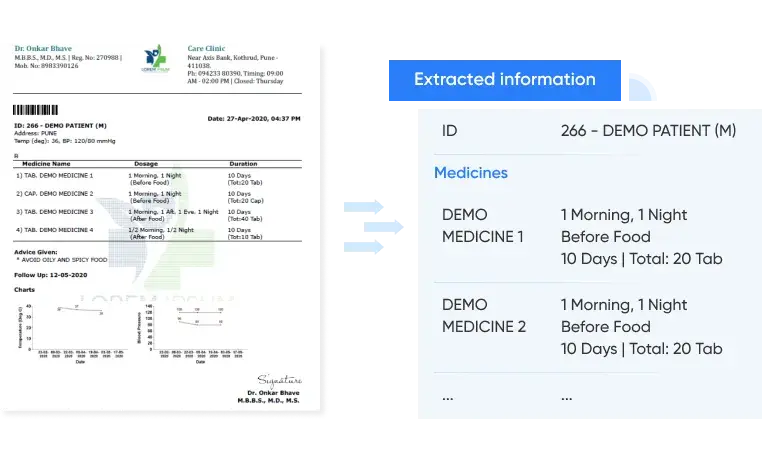
The solution has been deployed across multiple healthcare providers in Vietnam, helping automate medical data collection, reduce manual documentation workloads, and improve the consistency of patient records. Beyond healthcare, the same OCR platform has been adapted for finance, insurance, manufacturing, logistics, education, and retail applications, demonstrating the flexibility of AI document extraction across industries.
Explore more: Case Study: Automating Healthcare Data Collection with OCR
Financial Services: Faster and More Accurate Document Processing
Banks and financial institutions process thousands of customer documents every day, including loan applications, Know Your Customer (KYC) documents, identity verification records, bank statements, and financial reports.
Traditional manual verification often slows customer onboarding and increases operational costs.
AI-powered document extraction automatically captures customer information, validates identities, extracts financial data, and routes applications for approval, significantly reducing processing times while improving compliance with regulatory requirements.
Manufacturing and Supply Chain: Automating Procurement Processes
Manufacturers exchange large volumes of invoices, purchase orders, shipping documents, certificates, and supplier contracts across global supply chains.
Processing these documents manually creates bottlenecks that delay procurement and increase the risk of data inconsistencies.
AI document extraction automates invoice matching, supplier verification, goods receipt validation, and inventory updates, enabling finance and procurement teams to work more efficiently.
TMA Solutions in Manufacturing
TMA Solutions has extensive experience delivering software solutions for manufacturers, including ERP integration, warehouse management systems, factory automation, Industrial IoT, and AI-powered quality inspection.
By integrating AI document extraction with enterprise resource planning platforms, TMA enables manufacturers to digitize procurement workflows, reduce manual processing, and improve visibility across supply chain operations.
Logistics: Managing Global Shipping Documentation
International logistics involves numerous document types, including bills of lading, customs declarations, packing lists, delivery receipts, and freight invoices.
Because these documents originate from multiple countries and partners, layouts and languages vary significantly.
AI-powered document extraction automatically classifies shipping documents, extracts shipment details, validates customs information, and synchronizes data with transportation management systems.
This helps logistics providers accelerate cross-border operations while minimizing manual document handling.
TMA Case Study: AI-Powered Invoice Processing for a Global Logistics Company
One example is TMA Solutions' intelligent invoice processing solution developed for a logistics client handling a large volume of invoices every day. The client relied on employees to manually read invoice documents and enter information into its logistics application, a repetitive process that consumed valuable time and increased the likelihood of human error.
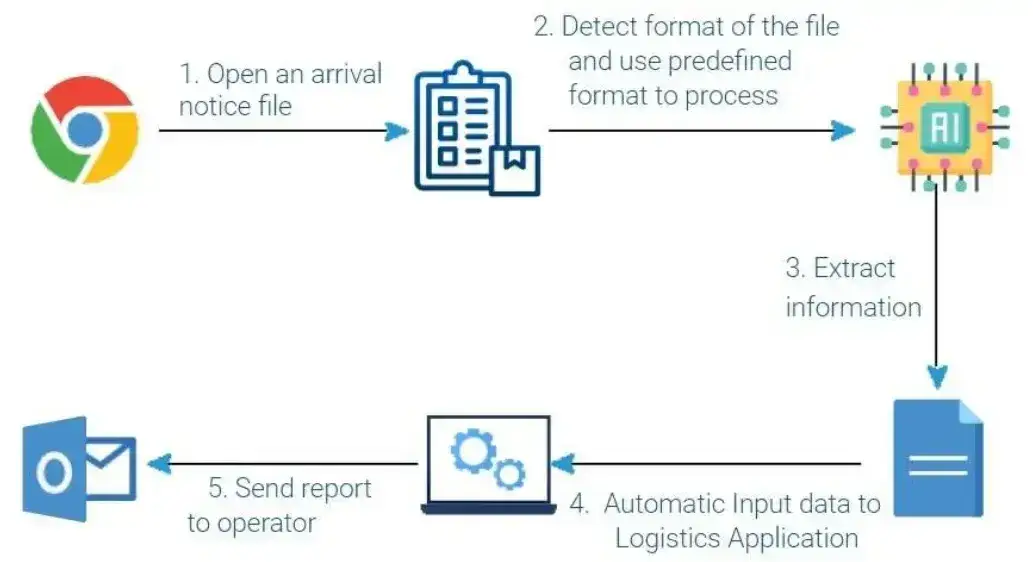
To address this challenge, TMA implemented an AI-powered document processing workflow using Microsoft AI/OCR and Microsoft Power Automate. The solution automatically identifies invoice documents, extracts key information such as supplier details, shipment information, invoice numbers, dates, and container references, then validates and uploads the extracted data directly into the client's logistics system.
By replacing manual data entry with AI-driven automation, the client reduced document processing time by up to 90%, improved data accuracy, and enabled 24/7 processing while allowing employees to focus on higher-value operational tasks. This project demonstrates how AI document extraction can become the foundation of intelligent logistics operations rather than simply digitizing paperwork.
Explore more: Speeding up Logistics process with RPA in Logistics Data Process | TMA Solutions
Why TMA Solutions
Successfully deploying AI document extraction requires more than selecting an OCR engine or an LLM. It demands deep expertise in enterprise software engineering, AI model development, systems integration, and industry-specific business processes.
With nearly 30 years of software development experience, TMA Solutions has helped organizations worldwide build scalable digital platforms across healthcare, manufacturing, finance, logistics, telecommunications, and other industries. This strong engineering foundation enables TMA to deliver AI solutions that integrate seamlessly into complex enterprise environments rather than functioning as standalone applications.
TMA's AI capabilities span the entire document intelligence lifecycle, from document ingestion and AI-powered OCR to intelligent classification, data extraction, workflow automation, and enterprise integration. Leveraging technologies such as Computer Vision, Natural Language Processing, Large Language Models (LLMs), Retrieval-Augmented Generation (RAG), and MLOps, TMA develops customized solutions tailored to each organization's operational requirements.
Whether automating invoice processing, digitizing medical records, managing logistics documentation, or streamlining regulatory compliance, TMA helps enterprises transform document-intensive operations into intelligent, automated workflows that improve efficiency, accuracy, and business agility.


.webp_2026-10-01-18-27-07-971.webp)
.webp_2026-10-01-18-17-11-290.webp)
.webp_2026-10-01-18-08-26-854.webp)
.webp_2026-10-01-17-47-32-240.webp)