Home
Search
Found 797 results for “ “ keyword
icon
Agentic AI Development in Vietnam: Emerging Enterprise Trends Enterprise AI is evolving beyond content generation to intelligent task execution. Instead of simply responding to prompts, AI agents can understand business objectives, plan the necessary steps, and interact with enterprise systems to complete complex workflows with minimal human intervention. Since 2025, agentic AI development in Vietnam has gained significant momentum as organizations accelerate their digital transformation initiatives. Gartner predicts that task-specific AI agents will be embedded in 40% of enterprise applications by 2026, while one-third of enterprise software is expected to incorporate agentic AI capabilities by 2028. This article explores how agentic AI is transforming enterprise operations, the business scenarios where it delivers the greatest value, how modern multi-agent systems are built, and how TMA Solutions helps organizations move from AI experimentation to production-ready enterprise solutions. What is Agentic AI? For many organizations, AI has evolved from answering questions to completing work. Instead of generating a response to a single prompt, agentic AI is designed to pursue an objective, determine the steps required, and execute tasks across multiple systems with minimal human intervention. A typical enterprise agent can resolve a customer billing issue, extract and validate data from invoices, generate software test cases, or coordinate approvals across business applications. To achieve this, it combines reasoning, planning, memory, and tool integration, allowing it to interact with enterprise data, APIs, and business workflows rather than operating as a standalone chatbot. This capability marks a significant shift in how AI delivers value. Rather than acting as an assistant that supports employees, agentic AI functions as a digital worker that can independently execute well-defined business processes while keeping humans involved for oversight and exception handling. As interest grows, organizations should also distinguish genuine agentic systems from conventional automation. Gartner has highlighted the rise of "agent washing," where chatbots, RPA solutions, or AI assistants are marketed as AI agents despite lacking autonomous planning and execution. For enterprises evaluating AI solutions, the key question is not whether a vendor claims to offer agents, but whether the system can reliably complete multi-step tasks with minimal human guidance. Generative AI vs Agentic AI Generative AI and agentic AI serve different purposes within the enterprise. Generative AI is designed to create content, answer questions, summarize information, and support knowledge workers. It produces outputs based on user prompts, leaving the next decision or action to people. Agentic AI builds on these capabilities by taking action instead of simply providing information. Given a business objective, it can break the work into multiple steps, retrieve data from enterprise systems, interact with business applications, and execute tasks with minimal human intervention. Rather than assisting employees with individual requests, AI agents automate end-to-end workflows while keeping humans involved for oversight and exception handling. This distinction becomes increasingly important as organizations move from AI experimentation to enterprise adoption. While generative AI improves individual productivity, agentic AI helps streamline business operations by reducing manual effort, accelerating decision-making, and enabling more consistent execution across complex processes. Ultimately, the choice is not between generative AI and agentic AI. The two technologies are complementary: generative AI provides intelligence and content creation, while agentic AI applies that intelligence to execute real business processes and deliver measurable operational outcomes. Comparing Generative AI and Agentic AI Enterprise Applications of Agentic AI As enterprises move beyond AI experimentation, the focus is shifting from isolated productivity gains to end-to-end business automation. Organizations are increasingly deploying AI agents in processes that involve multiple systems, repetitive decision-making, and high volumes of operational data. Rather than replacing employees, these systems augment human teams by automating routine work, accelerating decision-making, and improving service quality. Across industries, the most successful deployments share a common characteristic: they automate structured workflows that previously required significant manual effort while maintaining governance, traceability, and human oversight. The following examples illustrate how agentic AI is creating measurable business value in real enterprise environments. Customer Service and Client Support Customer service is one of the most mature applications of agentic AI. Instead of simply answering customer questions, AI agents can understand customer intent, retrieve information from enterprise systems, recommend appropriate actions, and resolve routine requests without requiring continuous human intervention. TMA's Client Services Agentic solution demonstrates this approach by automating customer interactions across web chat, email, and messaging platforms such as Zalo. When a request requires human expertise, the system automatically transfers the case to the appropriate support team with complete conversation history and relevant context, enabling faster resolution and a more consistent customer experience. Agentic AI streamlines end-to-end customer support workflows This same architecture has been extended to industries including retail, education, and financial services, where organizations need to handle large volumes of customer inquiries while maintaining service quality and operational efficiency. Corporate Document Intelligence Enterprise document processing has evolved far beyond traditional OCR. Modern AI agents can classify documents, extract key information, validate data against business rules, and route it directly into enterprise applications without manual intervention. TMA applies this approach through its Document Processing solutions, combining OCR, natural language processing (NLP), and large language models to transform unstructured documents into actionable business data. For a logistics client, TMA implemented an AI-powered document processing solution that automatically identifies invoices, extracts shipment and supplier information, validates the data, and synchronizes it with operational systems. By eliminating manual data entry, the solution reduced processing time by up to 90% while improving data accuracy and operational efficiency. Intelligent Invoice Processing for Logistics Operations The same document intelligence capabilities have also been applied in healthcare, where TMA's AI-powered OCR platform digitizes data from 30+ types of medical devices, as well as prescriptions and laboratory reports, enabling faster clinical workflows and more reliable healthcare data management. Manufacturing and Financial Services Manufacturing and financial services represent two industries where AI agents can deliver immediate operational value because many business processes are data-intensive, repetitive, and governed by clearly defined rules. In manufacturing, TMA has developed AI solutions for quality inspection, acoustic fault detection, and predictive maintenance. These solutions continuously analyze production data to identify anomalies, improve equipment reliability, and support maintenance teams with timely recommendations before failures occur. In financial services, AI-powered credit scoring and risk assessment solutions help organizations evaluate applications more efficiently while maintaining transparency and regulatory compliance. Rather than replacing human decision-makers, AI agents provide consistent analysis and decision support that enables financial institutions to process applications faster and with greater confidence. AI-powered intelligent document processing for financial operations Across these industries, the objective remains consistent: automate repetitive business workflows, improve operational efficiency, and allow employees to focus on higher-value activities that require judgment, collaboration, and domain expertise. Multi-Agent Systems: How TMA Builds Agentic AI Enterprise workflows rarely rely on a single AI agent. A customer support request, for example, may require one agent to understand the user's intent, another to retrieve account information, a third to generate a response, and a fourth to trigger follow-up actions. Multi-agent systems coordinate these specialized agents so they can work together as a unified solution rather than as isolated AI tools. This orchestration model enables organizations to automate complex business processes while maintaining consistency, governance, and visibility across every step. Instead of relying on one large AI model to perform every task, enterprises can assign responsibilities to multiple purpose-built agents that collaborate through shared context, business rules, and enterprise data. As demand for https://www.tmasolutions.com/ai-agent agentic AI development in Vietnam continues to grow, TMA has established a dedicated AI Center and AI Agent Factory that provide the building blocks required for production-scale AI solutions. The platform combines machine learning, computer vision, and large language models with a low-code agent development framework, an enterprise data platform, and a multi-agent orchestration layer. This modular architecture enables organizations to rapidly develop, deploy, and scale AI agents across different business functions while maintaining security, governance, and operational control. Rather than building isolated solutions for individual projects, TMA focuses on reusable frameworks and industry-specific components that accelerate implementation and simplify long-term maintenance. This allows enterprises to move beyond proof-of-concept initiatives and build AI capabilities that can evolve alongside changing business needs. TMA AI Agent Factory Architecture Future Trends: What's Next for Agentic AI in Vietnam Deploying AI agents is only the first step. Long-term success depends on redesigning business processes around intelligent automation rather than simply adding AI to existing workflows. As enterprises mature their AI strategies, the focus is shifting from isolated use cases to AI-first operating models, where people, data, and intelligent systems work together to improve decision-making and operational efficiency. However, adoption alone does not guarantee business value. McKinsey reports that while 88% of organizations now use AI in at least one business function, only 39% have realized a measurable impact on EBIT, and fewer than 10% have successfully scaled AI agents within a single function. Gartner also predicts that more than 40% of agentic AI projects will be canceled by 2027 due to unclear business value, inadequate governance, or weak risk controls. These findings highlight that successful AI adoption requires more than technology; it requires a clear business strategy and a strong operational foundation. Governance is becoming another critical differentiator. According to McKinsey, only around 30% of organizations consider their AI governance capabilities to be mature. As AI agents gain greater autonomy, enterprises will need robust security controls, data governance, and human oversight to ensure reliability, compliance, and trust. For this reason, TMA integrates governance, security, and multi-agent orchestration into its AI Agent Factory from the beginning of every engagement. Rather than retrofitting controls after deployment, enterprises can build scalable AI solutions on a secure and well-governed foundation, reducing implementation risks while accelerating long-term adoption. Conclusion Agentic AI represents the next stage of enterprise AI, shifting from assisting employees to executing business processes autonomously. As organizations move beyond experimentation, success will depend not only on adopting AI agents but also on building the right foundation—connected data, robust governance, and scalable architectures that enable AI to operate reliably across the enterprise. With proven experience across customer service, document intelligence, manufacturing, and financial services, TMA Solutions helps enterprises design, build, and scale production-ready AI solutions that deliver measurable business outcomes. By combining deep engineering expertise with industry knowledge, TMA enables organizations to accelerate AI adoption while maintaining security, governance, and long-term scalability. Ready to turn AI initiatives into measurable business value? Whether you're exploring your first AI use case or scaling enterprise-wide adoption, https://www.tmasolutions.com/technologies/ai-ml-and-data-sciences TMA Solutions can help you build a practical roadmap from AI strategy and solution design to production deployment and continuous optimization....
icon
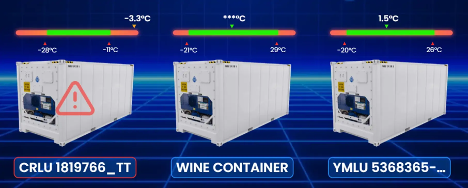
Agentic AI in Logistics: The Dawn of a Truly Autonomous Supply Chain Conclusion Agentic AI is not an incremental improvement; it is a paradigm shift that enables the creation of resilient, efficient, and self-adapting supply chains. By automating entire workflows and empowering employees to focus on high-value strategic tasks, agentic solutions are becoming a critical lever for competitive advantage. As this technology matures, the companies that embrace it today will be the ones to define the future of autonomous logistics. TMA's Solutions: Building the Foundation for an Agentic Future While the vision of a fully autonomous, agent-driven supply chain represents the future, the foundational technologies enabling this transformation are already delivering immense value today. TMA Solutions specializes in providing the critical AI and IoT building blocks that turn real-time data into intelligent, automated actions—paving the way for more advanced agentic systems. Case Study 1: Enhancing Cold Chain Logistics for a Leading Container Provider We partnered with one of Vietnam's leading providers of container solutions and logistics services. The company manages an extensive fleet, including specialized refrigerated (reefer) units essential for transporting sensitive goods across the cold chain. Challenge : The client needed to guarantee the integrity of goods like seafood, pharmaceuticals, and food during transit. Their manual monitoring processes were costly, labor-intensive, and often failed to detect temperature deviations in time, leading to a high risk of cargo spoilage. Solution : TMA developed a Reefer Monitoring System, an end-to-end IoT solution. Real-time Monitoring & Control : The system continuously tracks temperature and humidity, sending data to a central dashboard accessible via web and mobile apps. It also allows for remote adjustment of freezer settings. Automated Alerts : Any deviation from preset conditions triggers instant alerts via SMS, Zalo, or Skype, enabling immediate intervention. Data & Location Services : The solution provides comprehensive data logging for reports and compliance, along with GPS tracking to monitor the container's location on a digital map. Outcome : The system provided our client with effective remote monitoring capabilities, significantly reducing management costs, human error, and the risk of damaged goods. It also boosted their competitiveness by enabling them to offer customers reliable, transparent, and verifiable data on cargo conditions. Reefer Monitoring System Case Study 2: Precision Monitoring for a Major Tobacco Producer Our client is a major state-owned corporation in Vietnam's tobacco industry. A critical part of their quality control involves a specialized treatment process for raw tobacco leaves, requiring stringent environmental controls. Challenge : The client needed to treat raw tobacco, which could be infested with pests, by storing it in refrigerated containers at a precise low temperature for several weeks. Their Quality Control department required a highly reliable system to ensure absolute temperature stability, which is vital for both effective pest extermination and preserving the quality of the tobacco for future production. Solution : TMA deployed a specialized Refrigerated Tobacco Container Monitoring solution. Precision Monitoring : The IoT-based system ensures the required cold temperature is strictly maintained, which is critical for the pest control process and creating optimal conditions for the tobacco's natural fermentation. Centralized Management : A central dashboard provides a complete overview of all containers, with detailed charts and status updates for temperature and humidity. Proactive Alerts & Control : The system automatically detects and warns of any anomalies, allowing operators to remotely control the refrigeration equipment and ensure the process remains optimal. Outcome : The solution provides the client with precise control over their preservation process, guaranteeing product quality and consistency. The ability to monitor and manage the containers remotely optimizes the entire workflow, from pest treatment to long-term storage of the tobacco. Refrigerated Tobacco Container Monitoring With our deep expertise in IoT, AI, and cloud technologies, TMA is committed to accompanying logistics businesses on their journey to conquer the digital future. Core Capabilities of Agentic AI Solutions in Logistics Agentic AI isn't just a single technology but a collection of capabilities that create a self-governing logistics network. 1. Autonomous Decision-Making and Execution The core strength of Agentic AI is its ability to act. For example, an agent can detect a shipment delay due to a storm, autonomously query databases for alternative carriers, renegotiate rates within predefined limits, and update all relevant systems without a human needing to intervene. This moves beyond simple automation to handle complex, end-to-end processes like order fulfillment, customs compliance, and returns management. 2. Dynamic Optimization and Planning Agentic systems excel at real-time optimization. AI agents can continuously process live data—including traffic, weather, and warehouse capacity—to dynamically reroute shipments, reallocate inventory, and optimize loading configurations. This ensures maximum efficiency, reduces fuel consumption, and enhances delivery timeliness. 3. Proactive Risk Management and Resilience Instead of just reporting issues, Agentic AI anticipates them. By analyzing performance data, agents can predict when a vehicle or piece of warehouse machinery requires maintenance, preventing costly downtime. They can also monitor supplier behavior, geopolitical events, and market trends to identify potential disruptions and proactively adjust the supply chain strategy to mitigate risk. 4. Redefining the Human-Machine Partnership Agentic AI acts as a force multiplier for the human workforce, not a replacement. It takes over repetitive, data-intensive tasks, freeing human planners to focus on strategic thinking, creative problem-solving, and managing complex exceptions. In this new model, the role of a logistics professional evolves from a manual operator to a strategic orchestrator who guides and collaborates with a team of intelligent AI agents. Why Agentic AI is the Future of Logistics Today's supply chains face unprecedented volatility, from geopolitical disruptions to sudden shifts in consumer demand. Traditional systems struggle to keep pace, often reacting to problems rather than preventing them. Agentic AI offers a solution by creating an "autonomous business" framework where systems can run and adapt themselves. These intelligent agents can analyze vast, real-time data streams, communicate with each other, and execute multi-step workflows to optimize operations dynamically. For logistics leaders, this is no longer a theoretical opportunity; it's a strategic imperative that promises to reduce logistics costs by up to 15%, optimize inventory levels by 35%, and significantly boost service levels by 65%. The logistics industry is on the cusp of a monumental shift, moving beyond traditional automation and predictive analytics into a new era of genuine autonomy. At the heart of this revolution is Agentic AI—intelligent, goal-oriented systems capable of perceiving their environment, making independent decisions, and executing complex tasks without human intervention. Unlike previous AI models that primarily assisted humans, Agentic AI operates as a proactive workforce, set to fundamentally reshape the entire supply chain....
icon
Agentic AI: The Future of Supply Chain Autonomy and Resilience What is Agentic AI? Unlike traditional AI, which primarily analyzes data and offers insights, Agentic AI introduces a new level of autonomy. These are intelligent agents that don’t just predict outcomes—they sense, plan, act , and learn continuously to achieve business goals with minimal human intervention. Imagine a supply chain agent that not only forecasts a delivery delay but also reroutes the shipment , notifies affected partners, and reschedules warehouse slots—all in real-time, with zero human input. In today’s volatile global economy, supply chains face relentless challenges—from sudden weather disruptions and fluctuating client demand to geopolitical instability and growing ESG expectations. Traditional supply chain systems, which rely heavily on static planning and manual decision-making, are rapidly losing ground. Enter Agentic AI —a new class of artificial intelligence poised to redefine how supply chains operate. Getting Started: How to Implement Agentic AI Spot the Bottlenecks: Identify manual, repetitive decisions in your operations. Define Agent Objectives: Link each agent’s mission to a clear business KPI. Test in a Sandbox: Use simulations or shadow environments to validate behavior. Start with Assisted Mode: Let agents make suggestions before granting full autonomy. Scale Modularly: Use TMA’s framework to plug in more agents as success grows. Closing Thoughts Agentic AI isn’t science fiction—it’s here, and it’s already reshaping the supply chain landscape. With platforms like TMA Solutions’ Agent Builder and multi-agent orchestration framework, businesses are no longer just optimizing—they’re autonomizing . The future supply chain is intelligent, proactive, and resilient—and it’s being built today. Business Outcomes: Why It Matters Faster Response Times Lower Operational Costs Improved Service Levels Reduced Human Workload Higher Decision Accuracy TMA Solutions: Enabling Agentic AI at Scale To bring the vision of autonomous supply chains to life, TMA Solutions offers a powerful https://www.tmasolutions.com/technologies/ai-ml-and-data-sciences AI Agent Builder —a flexible toolkit for creating, deploying, and scaling intelligent agents rapidly. Designed for seamless integration, this builder empowers businesses to launch domain-specific AI agents efficiently, supporting both standalone and collaborative use cases. But TMA doesn’t stop there. TMA’s multi-agent orchestration framework takes the next step toward the vision of https://www.tmasolutions.com/technologies/ai-ml-and-data-sciences Agentic AI . It enables multiple AI agents to collaborate, negotiate, and co-execute tasks toward complex business goals, mimicking how real-world supply chain nodes interact across time zones and ecosystems. Examples of AI Agents in Logistics at TMA: Client Service Agent: Handles inquiries, escalates issues, and communicates delivery updates automatically. Reduced Average Handle Time (AHT) from 5 minutes to just 5 seconds , significantly enhancing responsiveness and client satisfaction. Client Service Agent Booking Support Agent: Manages slot allocations, appointment confirmations, and reschedules with minimal friction. Management Assistant Agent: Tracks KPIs, flags anomalies, and provides real-time status reports. Container Optimization Agent: Uses AI to self-organize items in containers for optimal space and weight distribution. Reduced planning time from 5 working days to just 3 hours. Automatic Container Loading Together, these agents form a distributed, intelligent layer that acts as the nerve center of modern logistics operations. The Tech Behind Agentic AI Systems To support such smart agents, a robust technology stack is essential: Streaming Data Infrastructure (e.g., Kafka, Kinesis) Reinforcement Learning Engines Orchestration Frameworks (LangChain, AutoGen) ERP/API Integrations Human-in-the-Loop Controls and Dashboards TMA’s solutions are designed to work seamlessly with these technologies, ensuring rapid deployment and reliable performance across enterprise-scale supply chains. The Core Loop: Sense, Plan, Act, Learn At the heart of Agentic AI lies a feedback loop that enables continuous optimization: Sense: Real-time data is gathered from ERP, IoT devices, GPS trackers, market feeds, and more. Plan: The agent evaluates alternative strategies and chooses the most optimal one. Act: It executes its decisions—updating routes, triggering restocks, or adjusting supplier terms. Learn: Based on outcomes, the system fine-tunes its behavior for future actions. This allows the supply chain to evolve with changing conditions, not just react to them. Agentic AI vs. Traditional AI Where Agentic AI Shines in the Supply Chain Smart Inventory Management: Agents monitor real-time demand signals and autonomously adjust restocking decisions, reducing carrying costs and stockouts. Dynamic Logistics: Intelligent route agents adapt to live traffic, weather, and vehicle status, optimizing delivery accuracy and reducing fuel costs. Autonomous Procurement: Agents negotiate better deals, flag underperforming suppliers, and adapt sourcing strategies based on market trends. Predictive Manufacturing & Maintenance: Planning agents reschedule production automatically during disruptions, while predictive maintenance agents reduce downtime. Compliance Monitoring: From tariffs to ESG metrics, agents ensure supply chains stay compliant and aligned with regulations, even as they change. ...
icon
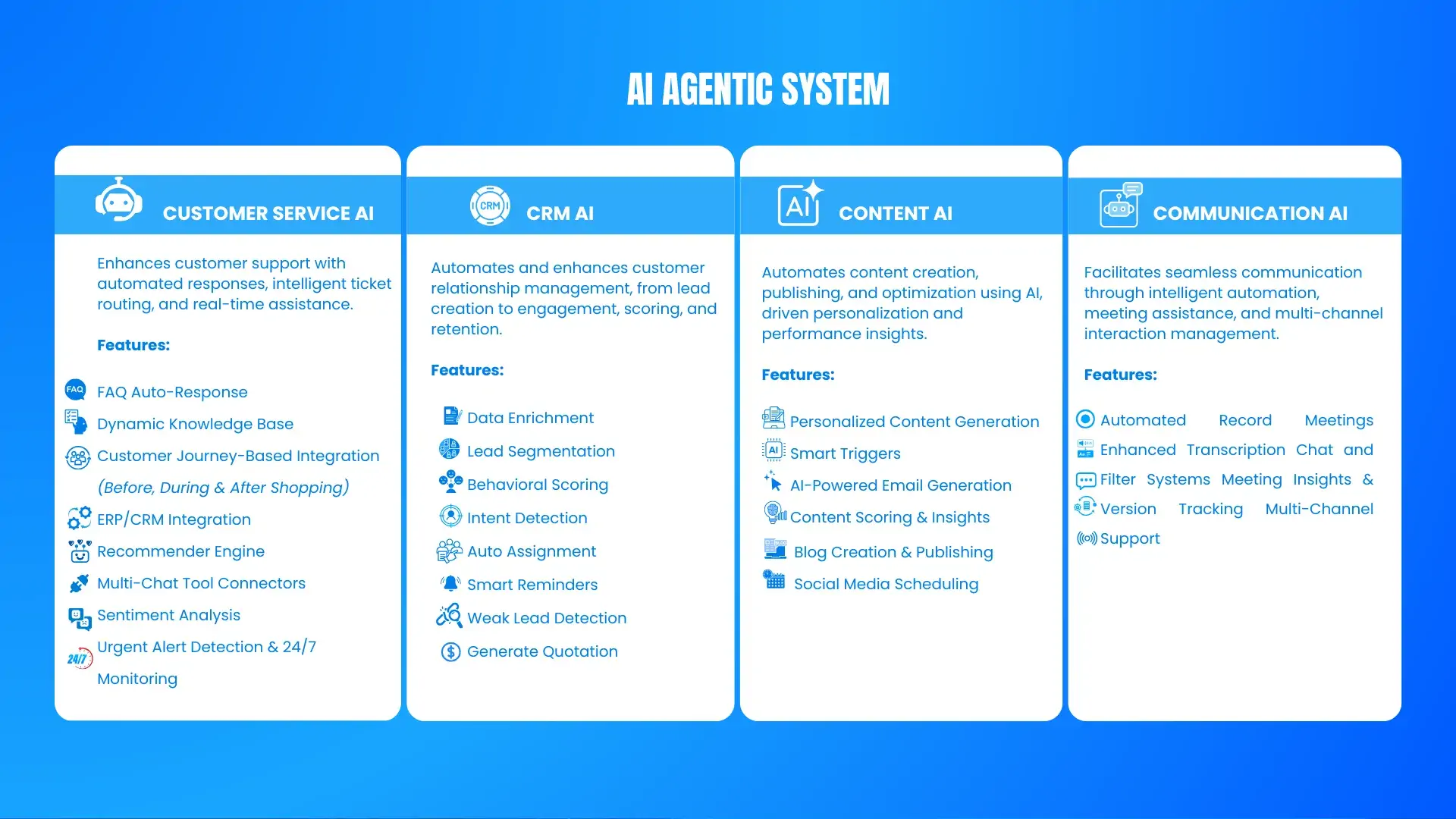
Agentic AI: The Next Evolution of Enterprise Intelligence Conclusion: Building the Future, One Agent at a Time Agentic AI is more than an AI solution - it’s a vision for how enterprises will work in the next decade. It empowers people to focus on innovation, enhances productivity across departments, and turns data into real business value. As global industries embrace Agentic AI, TMA Solutions continues to lead the way - building intelligent, secure, and scalable systems that redefine what’s possible in enterprise AI. The Road Ahead: From Automation to Collaboration Agentic AI represents a profound shift - from automation as a tool to automation as a teammate. The future enterprise will not only rely on intelligent systems but also collaborate with them. By merging human creativity with AI precision, TMA Solutions is helping businesses enter a new era of collaborative intelligence - where humans and machines learn, decide, and grow together. TMA’s Approach to Agentic AI: Building Intelligent Enterprises Pioneering Agentic Intelligence for the Enterprise As one of the leaders in technology innovation, TMA Solutions is driving the future of enterprise intelligence with the Agentic AI framework, a unified platform for developing intelligent, domain-specific AI agents. Each AI Agent is designed to address a core area of enterprise operation, enabling automation, insight, and efficiency across departments. AI Agentic System The Five Specialized AI Agents from TMA 1. Customer Service AI Agent for automated customer care Transforms customer care through automation, providing instant and personalized responses around the clock. It learns from each interaction, ensuring faster resolution times and consistent service quality. 2. CRM AI Agent for smarter sales and customer management Empowers sales and marketing teams with predictive insights. It can track customer behavior, recommend engagement strategies, and even automate outreach campaigns - making every interaction more data-driven. 3. Content AI Agent for automated content creation and publishing Simplifies the content creation process. From generating product descriptions to crafting social posts, it ensures brand consistency and timely publication across platforms. 4. Communication AI Agent for meeting, messaging, and collaboration support Acts as a smart collaborator for meetings, emails, and team coordination. It can summarize discussions, extract key actions, and schedule follow-ups - streamlining enterprise communication. Together, these agents form the backbone of TMA’s Agentic AI ecosystem - working in harmony to drive productivity and innovation. 5. Billing AI Agent for automated financial operations Optimizes the billing lifecycle from invoice generation to payment reconciliation. It integrates with ERP and accounting systems to detect anomalies, track payments, and provide real-time insights that strengthen financial control and cash flow visibility. Core Principles of Agentic AI 1. Collaborative Intelligence: Humans and AI as Partners Agentic AI supports people rather than replacing them. It reduces manual workloads, helps process data, and delivers insights that guide better human decision-making. Teams gain efficiency without losing creativity or judgment. 2. Intelligent Automation: From Data to Action Automation is powerful, but intelligence gives it direction. Agentic AI combines automation with contextual understanding, turning data into actionable insights. Examples include: Following up with leads based on behavior patterns Adjusting marketing campaigns in real time Detecting inefficiencies in supply chains and recommending solutions This is intelligent automation in practice, where data directly drives outcomes. 3. Human-Centered Design: Making AI Accessible Effective AI must be transparent, intuitive, and easy to use. Agentic AI is designed with humans in mind, focusing on natural interaction, simple integration, and explainable decision-making. This ensures trust, adoption, and long-term usability. Key Benefits of Agentic AI: Beyond Automation Enhanced Productivity By automating repetitive workflows and low-value tasks such as data ingestion, initial triage, and routine decision rules, teams are freed to focus on creativity, innovation, and strategic work. Instead of spending hours on manual tasks, employees can engage in higher-value activities. Smarter Decision-Making Agentic AI systems operate on real-time data, context, and cross-system inputs, ensuring decisions are not only fast but also accurate and context-aware. This elevates decision quality while reducing latency. Seamless Collaboration These AI agents connect different systems such as CRM, ERP, chat, and email platforms, creating a unified intelligence layer across departments. This eliminates data silos and improves cross-team coordination. Personalized Customer Experience From marketing to customer support, Agentic AI enables businesses to deliver tailored, proactive interactions that build loyalty and trust. For example, the system can detect customer behaviour patterns, anticipate needs, and act pre-emptively. Continuous Improvement Rather than one-off automation, Agentic AI systems are designed to learn and evolve through feedback loops, performance data, and usage over time. The longer they operate, the smarter and more effective they become. Overview of the Market: Global and Vietnam Trends Global Outlook The global Agentic AI market is expanding at a remarkable speed. Research estimates the market could reach USD 7.06 billion by 2025 and surge to USD 93.20 billion by 2032, with a CAGR of 44.6%. (MarketsandMarkets) Other forecasts suggest it will grow from USD 2.58 billion in 2024 to USD 24.50 billion by 2030, maintaining a CAGR of around 46.2%. (Grand View Research). Also, according to a report, by 2028, around 33% of enterprise software applications are expected to include agentic AI (up from less than 1% in 2024). (Gartner) These figures reveal that agentic AI is becoming a major strategic focus, not just an experimental technology. Vietnam Market Vietnam’s AI sector is also gaining strong momentum. In 2024, the country’s enterprise AI market was valued at roughly USD 122 million, with projections to reach USD 1.5 billion by 2033 (CAGR 32.3%) (IMARC Group). Another data point: Vietnam’s AI market reached about USD 750 million in 2024 with annual growth of 15-18%. (VnEconomy) Although specific data on agentic AI in Vietnam is still limited, the trend toward automation, digitalization, and smart decision systems makes Vietnam a fertile ground for enterprise-level AI applications. Key takeaway: Globally, agentic AI is evolving into a mainstream enterprise capability. In Vietnam, enterprises are actively digitalising and embracing AI, setting the stage for agentic AI adoption. For companies like TMA Solutions operating in Vietnam/ASEAN, this is a strategic moment to lead in Agentic AI implementation....
icon
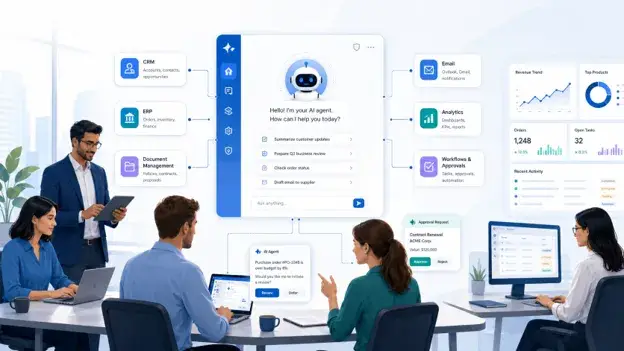
AI Agent Development Company from Vietnam for Enterprise Automation Artificial Intelligence is moving beyond simple chatbots and rule-based automation. Enterprises are now looking for AI systems that can understand business context, connect with internal tools, reason across enterprise data, and support employees in completing complex workflows faster. This is where AI Agents become a powerful foundation for the next generation of enterprise automation. https://www.tmasolutions.com/ai-agent TMA AI Agent Factory helps businesses build, deploy, and scale AI agents by combining reusable agent frameworks, enterprise connectors, knowledge ingestion, workflow orchestration, and secure delivery practices. What is an AI Agent? An AI Agent is an intelligent software system that can understand user intent, reason through a task, access enterprise knowledge, use tools or APIs, and take action within a business workflow. Unlike a traditional chatbot that mainly responds to questions, an AI Agent can plan, execute, coordinate, and complete multi-step processes with human oversight when needed. For example, a sales AI Agent can analyze a customer profile, search CRM history, summarize previous interactions, prepare a proposal draft, recommend next actions, and create follow-up tasks. A finance AI Agent can extract invoice data, validate business rules, route approvals, and generate management reports. In an enterprise environment, AI Agents become a flexible automation layer that improves productivity, reduces manual work, and supports faster decision-making, making AI agent development services a growing priority for enterprises pursuing digital transformation. Why Enterprises Need AI Agents? Enterprise teams often work across many disconnected systems: CRM, ERP, HRM, ticketing platforms, document repositories, data warehouses, email, chat tools, and workflow engines. AI Agents help connect these systems into task-oriented workflows that can understand requests, retrieve trusted knowledge, call tools, and support users with actionable outcomes. By combining enterprise knowledge, business context, and workflow automation, AI Agents can deliver measurable operational outcomes across the organization, including: Automate repetitive tasks while keeping humans involved in important decisions. Provide context-aware answers based on enterprise documents and business data. Accelerate response time for customers, employees, suppliers, and internal teams. Reduce operational friction across front-office, back-office, IT, finance, HR, and healthcare workflows. Turn existing enterprise data and systems into intelligent automation capabilities. TMA AI Agent Development Factory https://www.tmasolutions.ai/ TMA AI Center and https://www.tmasolutions.com/ai-agent AI Agent Development Factory provide a structured way to build AI agents faster and more consistently. With hundreds of AI engineers and more than 100 available AI solutions, TMA can support businesses from AI consulting and prototype development to enterprise integration, deployment, monitoring, and continuous improvement. The factory approach is designed to reduce the effort of building agents from scratch. It combines reusable components, a standardized development process, agent templates, enterprise data ingestion, connector libraries, workflow orchestration, and security/governance controls. This helps organizations create task-specific AI Agents while maintaining quality, scalability, and maintainability. To operationalize this factory approach, organizations need a structured platform that provides the tools, integration capabilities, and governance mechanisms required to build and manage AI Agents at scale. TMA AI Agent Framework supports the creation of new AI Agents through several core building blocks: Knowledge Management & Agent Monitoring Build intelligent knowledge bases using data from existing business systems, including databases, documents, and enterprise applications. AI Agents can access trusted information, provide accurate answers, and continuously monitor performance to ensure reliable outcomes. Enterprise System Integration Connect AI Agents with your existing business applications through APIs and standard integration frameworks. This allows agents to securely access data, trigger workflows, and automate tasks across multiple systems without disrupting current operations. Industry-Specific AI Agents Develop specialized AI Agents tailored to specific business functions and industries, such as healthcare, ERP, customer service, finance, HR, or operations. Organizations can accelerate deployment using pre-built templates or customize agents based on unique requirements. Multi-Agent Workflow Automation Enable multiple AI Agents to collaborate across complex business processes. An orchestration layer coordinates tasks, manages decision flows, and ensures agents work together efficiently to complete end-to-end workflows. Continuous Learning & Optimization Monitor agent performance through real-time analytics and feedback mechanisms. This helps organizations continuously improve accuracy, enhance user experience, and optimize business outcomes as operational needs evolve. Which Enterprise Functions Can Be Enhanced with AI Agents? AI Agent development services can support many business functions across the enterprise. Based on TMA AI Agent solution portfolio, common use cases can be grouped into front-office, back-office, IT/technology, and healthcare scenarios. AI Agents can support multiple enterprise functions, from customer support and sales to finance, HR, project management, IT operations, and analytics. Front-Office AI Agent Solutions Sales: CRM Assistant, Market Intelligence, Sourcing Supplier Finder, and Dashboard Generation to support lead management, supplier discovery, market insights, and data-driven sales decisions. Marketing: Ads Design Generation, Content Generation Agent, CDP and Customer Segmentation to accelerate campaign creation, personalize engagement, and improve marketing performance. Customer Support: Customer Support Chatbot, Call Agent Assistant, Fake Call Detection, and Customer Order Assistant to improve response speed, service consistency, fraud detection, and ordering experience. Supply Chain: WMS Assistant, AR Packaging Assistant, Container Loading Optimization, and Virtual Staging to optimize warehouse, packaging, logistics, and commerce operations. Back-Office AI Agent Solutions Human Resources and Facility Management: Receptionist Assistant, Agent for HR, CV Matching, Virtual Training Assistant, Agentic Vision AI, and Video Management System. Example of an AI Agent CV Matching Workflow Finance, Accounting and Procurement: Document Intelligence Agent, Financial Report Generation, Credit Scoring System, and Personal Finance Assistant. Legal and Compliance: Enterprise Knowledge Base and intelligent document review to centralize knowledge, support document search, and improve productivity. IT and Technology: IT Operation Assistant, Testing Assistant, Note Taker Assistant, and Project Management AI Assistant to accelerate development, operations, meetings, testing, and delivery governance. IT Operations Assistant Agent Workflow Healthcare AI Agent Solutions Healthcare is one of the strongest areas for AI Agent adoption because many workflows involve documentation, patient communication, triage, clinical operations, and care coordination. TMA healthcare AI agent examples include: Patient Intake Assistant, Kiosk Patient Journey Agent, Voice Input on Nursing Home, Eye-Care Clinical Management Agent, Clinical Project Management Agent, and Companion for Elderly Care. Patient Intake Assistant helps collect symptoms via text or image uploads and connects with hospital, scheduling, HIS, and EMR systems. Voice Input on Nursing Home supports hands-free clinical data entry, automatic transcription, and EHR mapping for nursing workflows. Clinical Project Management Agent supports document ingestion, OCR, discrepancy detection, approval workflows, risk monitoring, and vendor oversight. Companion for Elderly Care provides voice-first conversations, personalized routines, proactive engagement, and emotional support for elderly users. How TMA Supports Enterprise AI Agent Development? TMA helps organizations move from AI ideas to production-ready enterprise automation solutions. With experience across https://www.tmasolutions.com/technologies/ai-ml-and-data-sciences AI/ML and Data Sciences , Generative AI, AI Agents, Machine Learning, Computer Vision, Data Engineering, Intelligent Document Processing, Cloud Platforms, and MLOps, TMA can support the full AI lifecycle from consulting and proof-of-concept development to enterprise integration and long-term optimization. AI opportunity assessment and use case prioritization. AI Agent architecture design and solution roadmap. RAG, enterprise knowledge, and document intelligence integration. LLM orchestration, tool usage, workflow automation, and API integration. Front-office, back-office, healthcare, IT, finance, supply chain, and industry-specific AI agents. Security, governance, access control, and compliance setup. Cloud deployment, monitoring, LLMOps/MLOps, and continuous improvement. Conclusion AI Agents are becoming a strategic capability for enterprise automation. They help organizations connect people, data, systems, and workflows through intelligent, context-aware automation. With the right architecture, security controls, and delivery partner, AI Agents can move beyond experimentation and become a scalable foundation for enterprise productivity and digital transformation. For businesses looking to build secure and scalable AI Agent solutions, Vietnam offers a strong combination of engineering talent, delivery flexibility, and cost efficiency. TMA can help enterprises turn AI Agent opportunities into practical, production-ready solutions that deliver measurable business value. Ready to build enterprise AI Agents? Contact TMA today to explore how our AI Agent Development Factory can help your enterprise automate workflows, improve productivity, and turn AI opportunities into scalable business value. https://www.tmasolutions.com/contact-us Contact our AI experts...

icon
AI Agent Development Factory by TMA Solutions AI Agents are changing how businesses work. They automate complex tasks and make smart decisions. So, what exactly is an AI Agent? And how can TMA Solutions' AI Agent Development help your business build its own digital team? 1. What is AI Agent? An https://www.tmasolutions.com/ai-agent AI Agent is a software system that uses artificial intelligence (AI) to do tasks for a user. It can think, plan, remember, and make decisions on its own without constant human help. A special feature of AI Agents is their ability to process multiple data types simultaneously - text, voice, video, and images - and to collaborate with other agents when tackling complex problems. How AI Agents Work An AI Agent typically follow a four-step cycle: Perception: The agent gathers information about its environment, such as processing text, voice, or video; analyzing data from sensors; or reading databases and source code. Reasoning and Planning: Using that input, the Agent uses its "brain" to analyze and think. It will create a step-by-step action plan to reach the goal. This process often uses Large Language Models (LLMs) to handle complex requests. Action: The agent executes the plan. The action can be digital (sending an email, updating a database, writing a piece of code) or physical (controlling a robot or a connected system). Learning: After each action, the Agent evaluates the result. It learns from both successes and failures, and refines its future behavior to improve performance. An AI Agent is a software system that uses artificial intelligence (AI) to perform tasks and achieve goals for a user. 2. AI Agent vs. Chatbot Comparison While AI Agents and chatbots both use artificial intelligence to communicate, they are built for very different purposes and have different capabilities. Here is a detailed comparison to help explain the key differences between them. Criteria AI Agent Chatbot Goal To take action and make autonomous decisions to complete tasks. To chat and answer user questions. Technology Based on AI/ML, LLM, RPA – able to learn and adapt. Based on scripts or basic NLP. Capability Understands context, plans, calls APIs, analyzes data, sends automatic alerts. Only responds based on pre-set conversation patterns. Proactivity Proactively suggests or performs actions. Passive; only responds when asked. Applications Health assistant, data analysis, automated operations (e.g., TMA's AI Health Agent). Customer support, information lookup (e.g., Healthcare Chatbot). Based on the comparison, the outstanding advantages of an AI Agent are: Takes Action: An AI Agent doesn't just talk; it completes tasks and makes independent decisions. Smarter Technology: It uses advanced AI (like LLMs and ML) to learn and adapt over time, unlike a chatbot that usually follows a fixed script. Proactive: An Agent can start actions on its own or suggest things without waiting for a command. A chatbot is passive and only reacts. Wider Capability: It can understand complex situations (context), create plans, analyze data, and connect with other tools (using APIs) to solve difficult problems. AI Agent vs. Chatbot Comparison 3. Transform Your Operations with Our AI Agent Development Service Using custom AI Agents can bring major changes, helping your business operate more efficiently and smartly. Automate complex tasks and reduce manual work: AI Agents can handle difficult business processes. This helps companies cut down on repetitive and time-consuming tasks. Improve decision-making speed and accuracy: By analyzing large volumes of data in real time, AI Agents deliver precise insights and recommendations. Instead of guessing, leaders can make faster decisions based on reliable data insights. Personalize customer experience at every touchpoint: AI Agents help analyze the behavior and preferences of each customer to offer a tailored experience. According to McKinsey, businesses that personalize interactions can increase revenue by 3–15% and improve sales effectiveness by 10–20% . Optimize long-term operational costs: With automation, businesses can lower costs for repetitive jobs and avoid human errors. According to McKinsey, a company can expand its operations by up to 40% without a proportional increase in staff costs. Support business innovation and scalability: When daily work is automated, employees gain more time for creative thinking and improvement initiatives. The AI system also helps businesses scale up quickly without operational issues. Enhance monitoring and prediction capabilities: AI Agents continuously monitor systems, detect potential risks, and forecast trends in real time. This proactive approach helps businesses forecast market demand and make faster, more accurate decisions. Using custom AI Agents can bring major changes, helping your business operate more efficiently and smartly. 4. Custom AI Agents For Every Industry Each industry has special processes that can be optimized with custom-built AI Agents. Healthcare: In healthcare, AI Agents help automate both administrative work and professional support. Automate administrative tasks: Schedule appointments, process bills, and enter patient data into the system automatically. Support diagnosis: Analyze medical images (like X-rays and MRIs) to detect early signs of problems. Assist patients: Answer frequently asked questions, provide medication reminders, and give basic care instructions. Finance: The finance industry uses AI Agents to improve security, compliance, and operational efficiency. Automate customer onboarding: Extract information from ID documents (KYC) and detect signs of fraud. Assess credit risk: Analyze data to score credit and quickly make loan recommendations. Create automatic financial reports: Collect data from multiple sources to generate compliance reports and analyze performance. E-commerce: In e-commerce, AI Agents focus on personalization and smarter operations. Give personalized product suggestions: Analyze shopping history and browsing behavior to recommend suitable products. Provide 24/7 customer support: Chatbots automatically answer questions about orders, return policies, and common issues. Optimize inventory management: Forecast market demand to automatically place orders, avoiding stockouts or overstocking. Manufacturing: The manufacturing industry applies AI Agents to increase efficiency and reduce operational costs. Automate product quality control (QC): Use cameras and computer vision to find product defects right in real time. Monitor and perform predictive maintenance: Analyze machine data to predict maintenance needs and minimize downtime. Optimize the supply chain: Automatically track and manage raw materials to ensure production is not interrupted. Telecom: In telecommunications, AI Agents help improve service quality and customer experience. Automatically monitor network performance: Detect issues early and make automatic adjustments to ensure stable service quality. Help customers solve problems: Chatbots and voicebots guide customers through common technical issues or billing questions. Predict and retain customers: Analyze usage data to identify customers at risk of leaving and offer them suitable promotions. Education: The education industry uses AI Agents to create more personalized and effective learning experiences. Create personalized learning paths: Based on performance, AI Agents suggest lessons and exercises that match each student's ability. Virtual assistants for teachers and students: Automatically grade multiple-choice tests and answer common questions, giving teachers more time for their core duties. Automate administrative work: Manage schedules and student information to reduce staff workload. Each industry has special processes that can be optimized with custom-built AI Agents. 5. Our AI Agent Development Services TMA offers a complete service ecosystem, called the "AI Agent Factory," to help businesses build, deploy, and manage AI agents effectively. Foundation AI Models Goal: Equip every AI Agent with a powerful and flexible “brain.” Benefits: Shorten development time and ensure high performance for the Agent. How TMA does it: We select and fine-tune top foundation AI models like GPT-4, Llama, and Claude. This makes them suitable for your company's specific data and business needs. AI Agent Development Framework Goal: To standardize and speed up the AI Agent building process. Benefits: Ensure quality and consistency, and make maintenance and upgrades easier. How TMA does it: We provide a framework with a library of pre-built agents. This framework supports both no-code/low-code interfaces for non-technical users and an SDK for developers to build custom agents. Enterprise & Tool Integration Goal: To ensure AI Agents work seamlessly with your company's existing systems. Benefits: Ensures smooth data flow and uninterrupted workflows, avoiding silos or disconnected systems. How TMA does it: TMA builds powerful connectors to securely integrate AI Agents with ERP, CRM, databases, and other third-party tools. Agentic Orchestration & Management Engine Goal: To manage and coordinate multiple AI Agents working together to solve complex problems. Benefits: Improve their learning ability, ensure operational performance, and follow the company's security policies. How TMA does it: We build a central engine to: Assign and manage workflows for multiple Agents. Integrate with a knowledge base (RAG) so Agents can give smarter answers. Continuously monitors performance and ensures security during operation. Cross-Platform Deployment Goal: To bring AI Agents to users on all platforms, from local servers to the cloud. Benefits: Increase flexibility and scalability, and independence from a single infrastructure provider. How TMA does it: TMA uses container technology (like Docker and Kubernetes) to package AI Agents. For fast, consistent deployment across both on-premises and cloud environments. >> For more details, please refer https://www.tmasolutions.com/ai-agent here . AI Agent Factory of TMA Solutions 6. Our AI Agent Development Process We follow a 6-step process powered by TMA AI Agent Factory to ensure a successful project. New Agent Request & Requirements Analysis: TMA works with your business to understand current operations and define clear objectives. This stage creates a detailed requirements document with key performance indicators (KPIs) that guide the entire development process. Agent Design & Architecture Planning: Based on the agreed requirements, the TMA team will design the Agent's overall architecture. We use our existing library and framework to speed up the process and select the best AI model for the project. You will receive a technical design and a prototype for validation before coding begins. Agent Development & Integration: Once the architecture is approved, TMA's engineers will start the coding process. The Agent is built in modules and integrated with your company's existing systems (CRM, ERP) through secure connectors. Sandbox Testing & Validation: A working version of the Agent is deployed in a safe test environment (sandbox). Here, TMA simulates real-world scenarios to fully test its function, performance, and security. This step ensures the Agent works correctly and reliably before its official launch. Production Deployment & Orchestration: After successful testing, TMA deploys the Agent into your live operational environment with minimal disruption. TMA will also configure the orchestration engine so the Agent can start its tasks and scale automatically when needed. Monitoring, Optimization & Continuous Learning: Our commitment extends beyond deployment. Our engineering team will set up a 24/7 performance monitoring system and continuously collect operational data. This data is used to optimize and retrain the Agent, helping it become smarter and more effective over time. The 6-step deployment process of the AI Agent Factory 7. Technology Stack We Use for AI Agent Development TMA Solutions uses a complete set of technologies to develop AI Agents. This ensures our solutions are scalable, accurate, and highly secure for every business. AI and Foundation Models: TMA uses top foundation models like OpenAI GPT, Llama, Gemini, Claude, and Mistral. This helps build AI Agents that can understand context and interact naturally. Our AI team also applies LLM fine-tuning to optimize models for specific fields like healthcare, finance, or logistics. Backend Technologies: TMA's AI projects use Python, Node.js, Java Spring Boot, and .NET Core. These help build a powerful and scalable data processing platform. Combined with RESTful APIs and GraphQL, the system ensures high speed and stability in real-world use. Frontend Technologies: To create a smooth user experience, TMA employs React, Angular, and Vue.js for web apps, and Flutter, Kotlin, and Swift for mobile platforms. Each interface is optimized for smart interaction between the user and the AI Agent. Databases and Storage: We use a multi-layer storage system with PostgreSQL, MongoDB, Redis, and Elasticsearch for dynamic data. For large-scale storage, we use Azure Blob and AWS S3, ensuring the ability to process millions of AI data records quickly and securely. Infrastructure & Deployment: AI Agent projects are deployed flexibly on AWS, Microsoft Azure, and Google Cloud with Kubernetes and Docker ensuring flexibility and scalability. Our CI/CD system automates testing and deployment, which shortens the time to launch a product. Middleware & Streaming: TMA uses Kafka, RabbitMQ, and Azure Service Bus to process data in real-time. This is useful for tasks like monitoring, chatbots, or enterprise virtual assistants. AI Frameworks and Libraries: Our engineers are skilled in using TensorFlow, PyTorch, Scikit-learn, LangChain, Hugging Face, and OpenCV enabling powerful model development and deployment across language, image, and audio processing tasks. Additional Tools & Services: Our development ecosystem also includes MLOps (MLflow, DVC), monitoring tools like Prometheus and Grafana, and DevOps services. These help manage the entire AI model lifecycle, from training and deployment to long-term maintenance. TMA uses a modern and flexible set of technologies to build effective and scalable AI Agent solutions. 8. Why Choose TMA for AI Agent Development When a business starts using AI Agents, choosing the right development partner is key to success. TMA Solutions is an ideal partner because of our long experience and ability to deliver end-to-end AI solutions across diverse industries. Strong AI Agent Factory & AI Center: TMA Solutions has made significant investments in our AI Agent Factory and AI Center - where our AI experts and modern infrastructure come together. As a result, TMA can design, train, and deploy AI Agents at any scale, meeting the specific needs of each business in various fields. Deep integration with enterprise systems: TMA's AI Agent solutions are designed to integrate smoothly with your existing infrastructure, from CRM and ERP to customer care systems. This helps your business use its current data, automate processes, and improve operational efficiency without changing the core architecture of your existing systems. Experienced technical team, modern development methods: With over 4,000 engineers and more than 28 years of experience in software, TMA delivers end-to-end AI projects—from research and proof of concept (PoC) to real-world operation. Our development process follows Agile and CMMI Level 5 standards, ensuring quality, speed, and flexibility at every stage. Multi-agent orchestration and continuous learning: TMA's AI Agents can collaborate with other agents to solve complex business tasks. Equipped with a continuous learning mechanism, the system constantly improves its performance based on new data, becoming increasingly accurate and adaptive over time. Support for multi-platform deployment and optimized security: TMA offers flexible solutions that can be deployed on the web, mobile, cloud, or on-premise, based on your IT infrastructure. All products comply with ISO 27001 standards and international security policies, ensuring data safety and privacy for clients of all sizes. TMA Solutions offers many outstanding advantages. 9. Case Study TMA Solutions Implemented 1 - Document Intelligent Multi-Agent System (DIMS) The Situation: A financial company needed to process thousands of complex documents every day. These included contracts, invoices, and reports in many different formats. The manual process was time-consuming, prone to errors, and difficult to manage. Solution: TMA built a smart multi-agent system. This system operates through an automated workflow. Agent 1 (Collector): Automatically scans and extracts data from both scanned and digital documents. Agent 2 (Validator): Compares the extracted data with business rules and existing databases to find errors. Agent 3 (Integrator): Automatically inputs the validated data into the company's systems, like ERP or CRM. Results: Reduced document processing time by 80% . Increased data accuracy to 99% , eliminating manual data entry errors. Helped employees focus on more analytical tasks instead of paperwork. >> Read more at: https://www.tmasolutions.com/case-studies/document-intelligent-multi-agent-system-dims Document Intelligent Multi-Agent System (DIMS) Case Study: Document Intelligent Multi-Agent System (DIMS) 2 - Customer Service Agent The Situation: An e-commerce company was overloaded with repetitive customer requests via email and chat. This led to longer response times and reduced support quality for more complex issues. Solution: TMA implemented a customer service AI Agent, integrated directly into the website and social media channels (Facebook, Zalo, and Telegram). This Agent can: Automatically answer common questions based on a provided knowledge base. Identify complex issues and route them to the appropriate support team, along with the full chat history. Analyze customer sentiment to improve service quality. Results: Successfully automated 70% of common customer requests. Reduced the average response time by 40% . Increased the customer satisfaction score (CSAT) by 25% . >> Read more at: https://www.tmasolutions.com/case-studies/customer-service-agent Customer Service Agent Case Study: Customer Service Agent 3 - Warehouse Management System (WMS) AI Agent The Situation: Although the logistics company was already using a Warehouse Management System (WMS), the process remained complex. Employees and managers had to go through many steps to find information about goods or order statuses. Solution: TMA developed an AI Agent that acts as a smart virtual assistant for the WMS. Employees can interact with the Agent using natural language (typing or speaking) to: Ask for and receive information about a product's location or stock quantity. Check the status of incoming and outgoing orders. Request instant reports. Results: Increased warehouse staff efficiency by 30% . Reduced the time needed to find information and create reports by 50% . Helped warehouse managers make faster decisions with real-time data access. >> Read more at: https://www.tmasolutions.com/case-studies/warehouse-management-system-wms-ai-agent Warehouse Management System (WMS) AI Agent Case Study Warehouse Management System (WMS) AI Agent 10. FAQs about AI Agent Development Services 1 - What is the cost to develop an AI agent? The cost to develop an AI Agent depends on the project's complexity and scope: Basic (chatbots, simple tasks): Starts from $10,000 USD . Medium (data analysis, machine learning, system integration): Around $50,000–$100,000 USD . Advanced (multi-agent systems, continuous learning, high security): Can be over $300,000 USD . 2 - Is an AI agent the same as an automation tool? No , they are different in their level of intelligence and ability to act on their own. Automation Tool: Works based on pre-programmed rules. It is very effective for repetitive and consistent tasks, like copying data from one file to another. AI Agent: Is much smarter and more flexible. It can understand context, make its own decisions, and adapt to new situations to achieve a goal. 3 - Can AI agents work with the tools I already use? Yes, an AI Agent can work with the tools your business already uses, such as CRM systems (Salesforce, HubSpot), project management software (Jira, Trello), internal communication apps (Slack, Microsoft Teams), or data and ERP platforms. 4 - How much time does it take to create an AI agent? The time it takes to create an AI Agent depends entirely on the project's complexity and scale. Here is a general estimate to give you an idea: Proof of Concept (PoC/MVP): About 1–2 weeks . Pilot Deployment: About 3–6 weeks . Enterprise-Scale Deployment: From 8–16 week s or more. 5 - How much does it cost to start an automation project with TMA? To get started, TMA usually suggests a pilot project to demonstrate value and feasibility quickly. The cost depends on the scope of this pilot project. The exact cost will be determined after we work with you to analyze and choose the most suitable problem to solve, ensuring a clear return on investment (ROI). TMA often starts with a small-scale pilot project to demonstrate value. AI Agent Development Services give businesses the chance to automate processes, improve performance, and create lasting value from data. With our AI Agent Factory platform and 28 years of practical experience, TMA Solutions has the capability to partner with your business to build custom solutions that solve the most complex business challenges. >> Contact TMA Solutions today to start developing the right AI solution for your business. Contact information: TMA SOLUTIONS - The leading ai agent development services in Vietnam Email: sales@tmasolutions.com Website: https://www.tmasolutions.com/ https://www.tmasolutions.com/ Linkedin: https://www.linkedin.com/company/tma-solutions/ TMA Solutions TMA Tower address: Street #10, Quality Tech Solution Complex (QTSC), Trung My Tay Ward, Ho Chi Minh City....
icon
AI Agent for Healthcare: Optimizing Intelligent Medical Operations...
icon
AI agent for nurse assistant: optimizing healthcare workflows...