Enterprise AI is evolving beyond content generation to intelligent task execution. Instead of simply responding to prompts, AI agents can understand business objectives, plan the necessary steps, and interact with enterprise systems to complete complex workflows with minimal human intervention.
Since 2025, agentic AI development in Vietnam has gained significant momentum as organizations accelerate their digital transformation initiatives. Gartner predicts that task-specific AI agents will be embedded in 40% of enterprise applications by 2026, while one-third of enterprise software is expected to incorporate agentic AI capabilities by 2028.
This article explores how agentic AI is transforming enterprise operations, the business scenarios where it delivers the greatest value, how modern multi-agent systems are built, and how TMA Solutions helps organizations move from AI experimentation to production-ready enterprise solutions.
What is Agentic AI?
For many organizations, AI has evolved from answering questions to completing work. Instead of generating a response to a single prompt, agentic AI is designed to pursue an objective, determine the steps required, and execute tasks across multiple systems with minimal human intervention.
A typical enterprise agent can resolve a customer billing issue, extract and validate data from invoices, generate software test cases, or coordinate approvals across business applications. To achieve this, it combines reasoning, planning, memory, and tool integration, allowing it to interact with enterprise data, APIs, and business workflows rather than operating as a standalone chatbot.
This capability marks a significant shift in how AI delivers value. Rather than acting as an assistant that supports employees, agentic AI functions as a digital worker that can independently execute well-defined business processes while keeping humans involved for oversight and exception handling.
As interest grows, organizations should also distinguish genuine agentic systems from conventional automation. Gartner has highlighted the rise of "agent washing," where chatbots, RPA solutions, or AI assistants are marketed as AI agents despite lacking autonomous planning and execution. For enterprises evaluating AI solutions, the key question is not whether a vendor claims to offer agents, but whether the system can reliably complete multi-step tasks with minimal human guidance.
Generative AI vs Agentic AI
Generative AI and agentic AI serve different purposes within the enterprise. Generative AI is designed to create content, answer questions, summarize information, and support knowledge workers. It produces outputs based on user prompts, leaving the next decision or action to people.
Agentic AI builds on these capabilities by taking action instead of simply providing information. Given a business objective, it can break the work into multiple steps, retrieve data from enterprise systems, interact with business applications, and execute tasks with minimal human intervention. Rather than assisting employees with individual requests, AI agents automate end-to-end workflows while keeping humans involved for oversight and exception handling.
This distinction becomes increasingly important as organizations move from AI experimentation to enterprise adoption. While generative AI improves individual productivity, agentic AI helps streamline business operations by reducing manual effort, accelerating decision-making, and enabling more consistent execution across complex processes.
Ultimately, the choice is not between generative AI and agentic AI. The two technologies are complementary: generative AI provides intelligence and content creation, while agentic AI applies that intelligence to execute real business processes and deliver measurable operational outcomes.

Enterprise Applications of Agentic AI
As enterprises move beyond AI experimentation, the focus is shifting from isolated productivity gains to end-to-end business automation. Organizations are increasingly deploying AI agents in processes that involve multiple systems, repetitive decision-making, and high volumes of operational data. Rather than replacing employees, these systems augment human teams by automating routine work, accelerating decision-making, and improving service quality.
Across industries, the most successful deployments share a common characteristic: they automate structured workflows that previously required significant manual effort while maintaining governance, traceability, and human oversight. The following examples illustrate how agentic AI is creating measurable business value in real enterprise environments.
Customer Service and Client Support
Customer service is one of the most mature applications of agentic AI. Instead of simply answering customer questions, AI agents can understand customer intent, retrieve information from enterprise systems, recommend appropriate actions, and resolve routine requests without requiring continuous human intervention.
TMA's Client Services Agentic solution demonstrates this approach by automating customer interactions across web chat, email, and messaging platforms such as Zalo. When a request requires human expertise, the system automatically transfers the case to the appropriate support team with complete conversation history and relevant context, enabling faster resolution and a more consistent customer experience.
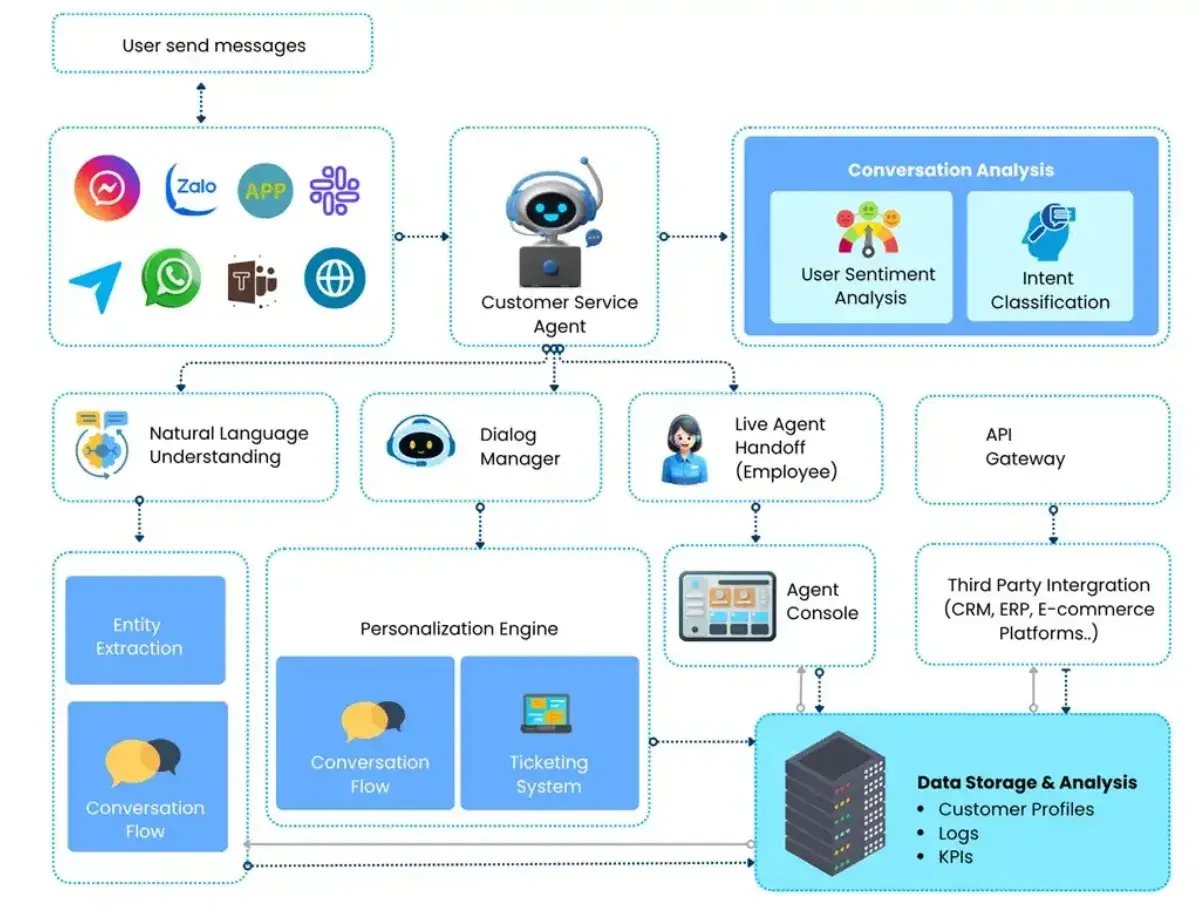
This same architecture has been extended to industries including retail, education, and financial services, where organizations need to handle large volumes of customer inquiries while maintaining service quality and operational efficiency.
Corporate Document Intelligence
Enterprise document processing has evolved far beyond traditional OCR. Modern AI agents can classify documents, extract key information, validate data against business rules, and route it directly into enterprise applications without manual intervention.
TMA applies this approach through its Document Processing solutions, combining OCR, natural language processing (NLP), and large language models to transform unstructured documents into actionable business data.
For a logistics client, TMA implemented an AI-powered document processing solution that automatically identifies invoices, extracts shipment and supplier information, validates the data, and synchronizes it with operational systems. By eliminating manual data entry, the solution reduced processing time by up to 90% while improving data accuracy and operational efficiency.
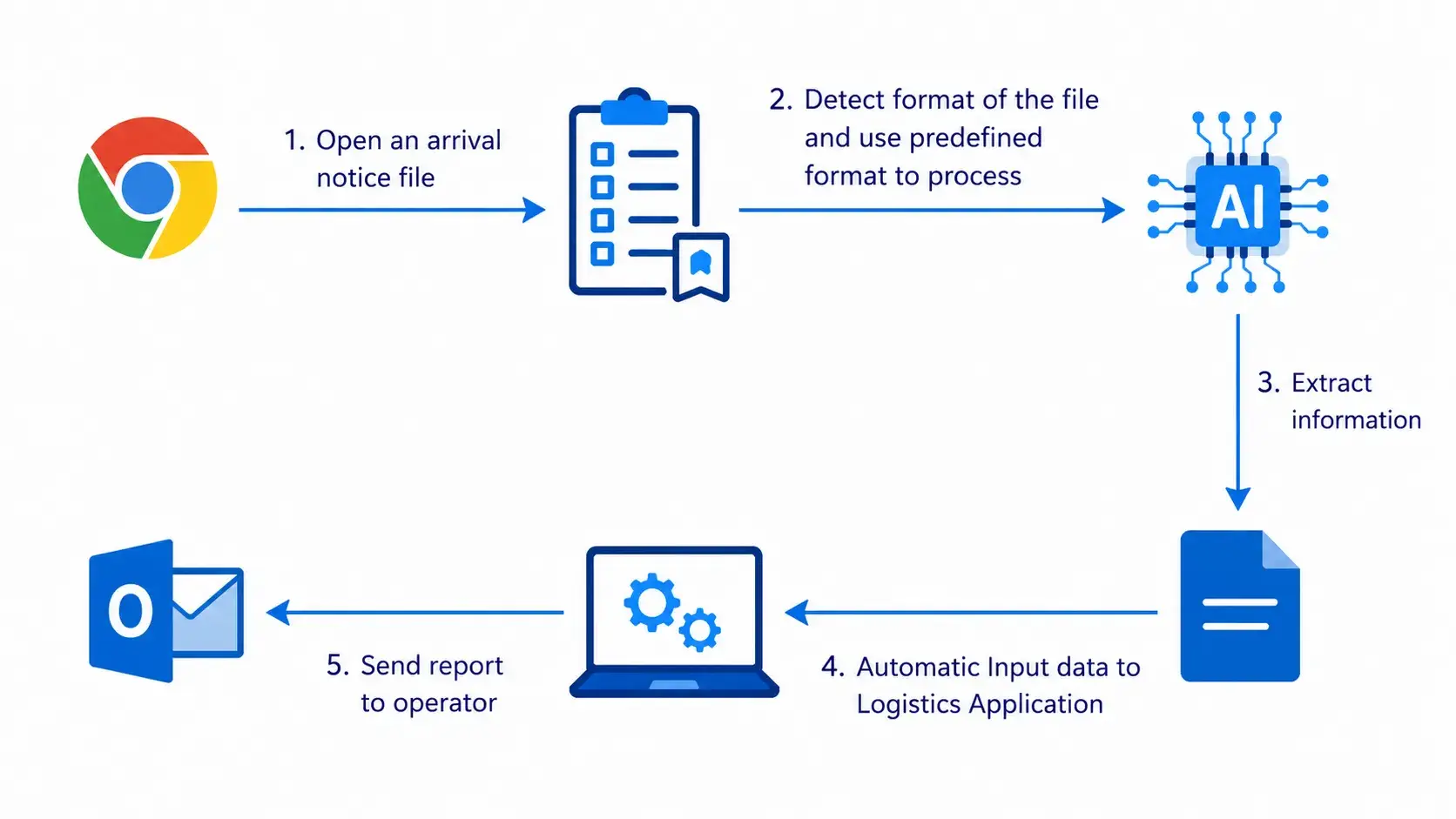
The same document intelligence capabilities have also been applied in healthcare, where TMA's AI-powered OCR platform digitizes data from 30+ types of medical devices, as well as prescriptions and laboratory reports, enabling faster clinical workflows and more reliable healthcare data management.
Manufacturing and Financial Services
Manufacturing and financial services represent two industries where AI agents can deliver immediate operational value because many business processes are data-intensive, repetitive, and governed by clearly defined rules.
In manufacturing, TMA has developed AI solutions for quality inspection, acoustic fault detection, and predictive maintenance. These solutions continuously analyze production data to identify anomalies, improve equipment reliability, and support maintenance teams with timely recommendations before failures occur.
In financial services, AI-powered credit scoring and risk assessment solutions help organizations evaluate applications more efficiently while maintaining transparency and regulatory compliance. Rather than replacing human decision-makers, AI agents provide consistent analysis and decision support that enables financial institutions to process applications faster and with greater confidence.
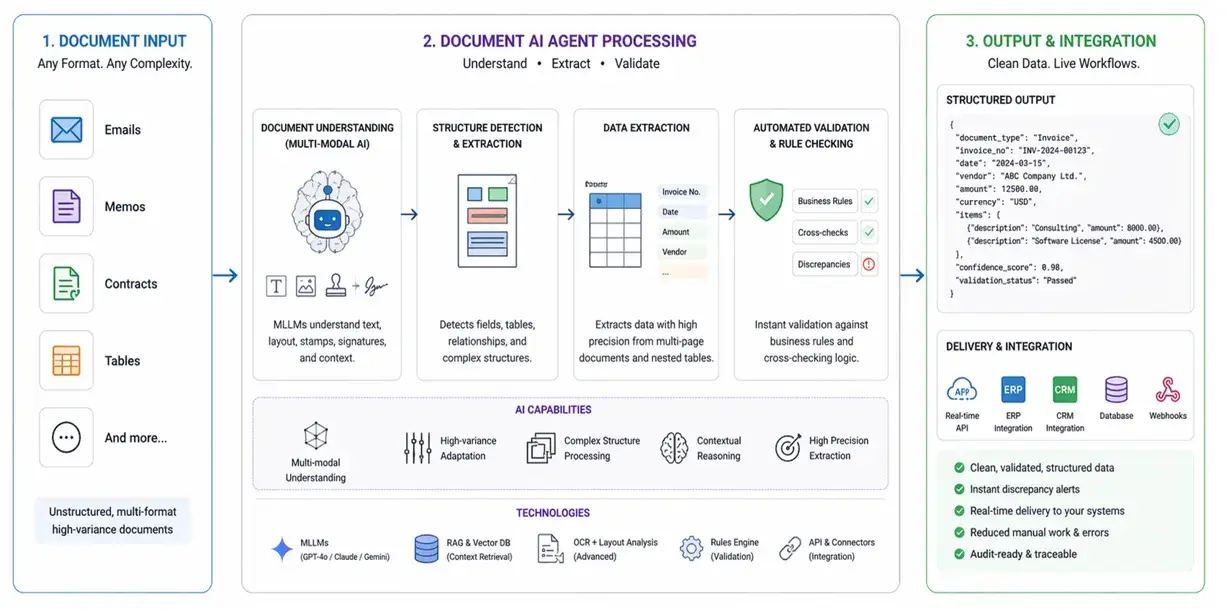
Across these industries, the objective remains consistent: automate repetitive business workflows, improve operational efficiency, and allow employees to focus on higher-value activities that require judgment, collaboration, and domain expertise.
Multi-Agent Systems: How TMA Builds Agentic AI
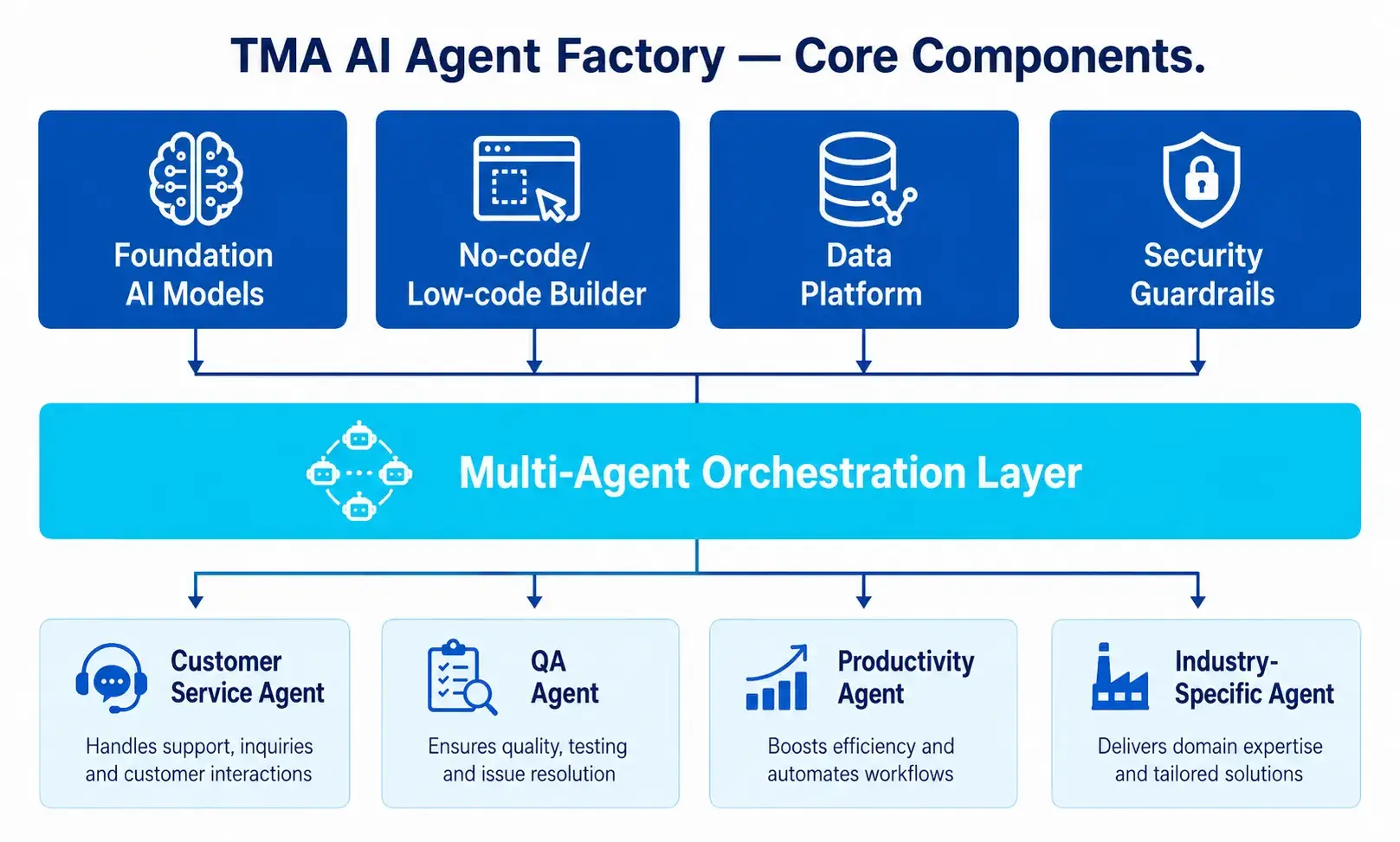
Enterprise workflows rarely rely on a single AI agent. A customer support request, for example, may require one agent to understand the user's intent, another to retrieve account information, a third to generate a response, and a fourth to trigger follow-up actions. Multi-agent systems coordinate these specialized agents so they can work together as a unified solution rather than as isolated AI tools.
This orchestration model enables organizations to automate complex business processes while maintaining consistency, governance, and visibility across every step. Instead of relying on one large AI model to perform every task, enterprises can assign responsibilities to multiple purpose-built agents that collaborate through shared context, business rules, and enterprise data.
As demand for agentic AI development in Vietnam continues to grow, TMA has established a dedicated AI Center and AI Agent Factory that provide the building blocks required for production-scale AI solutions. The platform combines machine learning, computer vision, and large language models with a low-code agent development framework, an enterprise data platform, and a multi-agent orchestration layer. This modular architecture enables organizations to rapidly develop, deploy, and scale AI agents across different business functions while maintaining security, governance, and operational control.
Rather than building isolated solutions for individual projects, TMA focuses on reusable frameworks and industry-specific components that accelerate implementation and simplify long-term maintenance. This allows enterprises to move beyond proof-of-concept initiatives and build AI capabilities that can evolve alongside changing business needs.
Future Trends: What's Next for Agentic AI in Vietnam
Deploying AI agents is only the first step. Long-term success depends on redesigning business processes around intelligent automation rather than simply adding AI to existing workflows. As enterprises mature their AI strategies, the focus is shifting from isolated use cases to AI-first operating models, where people, data, and intelligent systems work together to improve decision-making and operational efficiency.
However, adoption alone does not guarantee business value. McKinsey reports that while 88% of organizations now use AI in at least one business function, only 39% have realized a measurable impact on EBIT, and fewer than 10% have successfully scaled AI agents within a single function. Gartner also predicts that more than 40% of agentic AI projects will be canceled by 2027 due to unclear business value, inadequate governance, or weak risk controls. These findings highlight that successful AI adoption requires more than technology; it requires a clear business strategy and a strong operational foundation.
Governance is becoming another critical differentiator. According to McKinsey, only around 30% of organizations consider their AI governance capabilities to be mature. As AI agents gain greater autonomy, enterprises will need robust security controls, data governance, and human oversight to ensure reliability, compliance, and trust.
For this reason, TMA integrates governance, security, and multi-agent orchestration into its AI Agent Factory from the beginning of every engagement. Rather than retrofitting controls after deployment, enterprises can build scalable AI solutions on a secure and well-governed foundation, reducing implementation risks while accelerating long-term adoption.
Conclusion
Agentic AI represents the next stage of enterprise AI, shifting from assisting employees to executing business processes autonomously. As organizations move beyond experimentation, success will depend not only on adopting AI agents but also on building the right foundation—connected data, robust governance, and scalable architectures that enable AI to operate reliably across the enterprise.
With proven experience across customer service, document intelligence, manufacturing, and financial services, TMA Solutions helps enterprises design, build, and scale production-ready AI solutions that deliver measurable business outcomes. By combining deep engineering expertise with industry knowledge, TMA enables organizations to accelerate AI adoption while maintaining security, governance, and long-term scalability.
Ready to turn AI initiatives into measurable business value? Whether you're exploring your first AI use case or scaling enterprise-wide adoption, TMA Solutions can help you build a practical roadmap from AI strategy and solution design to production deployment and continuous optimization.