In today’s volatile global economy, supply chains face relentless challenges—from sudden weather disruptions and fluctuating client demand to geopolitical instability and growing ESG expectations. Traditional supply chain systems, which rely heavily on static planning and manual decision-making, are rapidly losing ground. Enter Agentic AI—a new class of artificial intelligence poised to redefine how supply chains operate.
What is Agentic AI?
Unlike traditional AI, which primarily analyzes data and offers insights, Agentic AI introduces a new level of autonomy. These are intelligent agents that don’t just predict outcomes—they sense, plan, act, and learn continuously to achieve business goals with minimal human intervention.
Imagine a supply chain agent that not only forecasts a delivery delay but also reroutes the shipment, notifies affected partners, and reschedules warehouse slots—all in real-time, with zero human input.
The Core Loop: Sense, Plan, Act, Learn
At the heart of Agentic AI lies a feedback loop that enables continuous optimization:
Sense: Real-time data is gathered from ERP, IoT devices, GPS trackers, market feeds, and more.
Plan: The agent evaluates alternative strategies and chooses the most optimal one.
Act: It executes its decisions—updating routes, triggering restocks, or adjusting supplier terms.
Learn: Based on outcomes, the system fine-tunes its behavior for future actions.
This allows the supply chain to evolve with changing conditions, not just react to them.
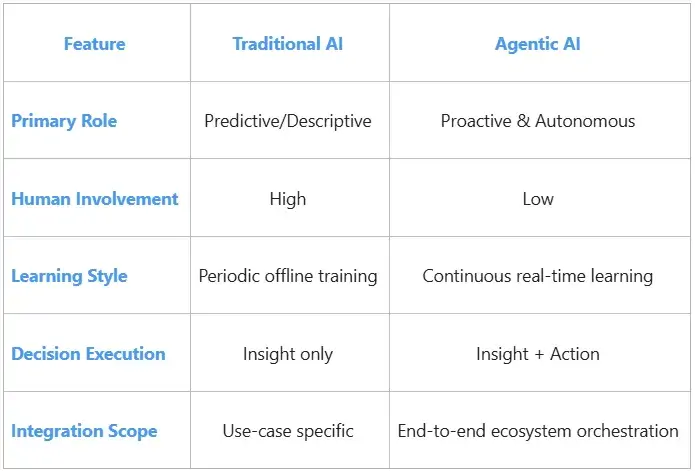
Where Agentic AI Shines in the Supply Chain
Smart Inventory Management: Agents monitor real-time demand signals and autonomously adjust restocking decisions, reducing carrying costs and stockouts.
Dynamic Logistics: Intelligent route agents adapt to live traffic, weather, and vehicle status, optimizing delivery accuracy and reducing fuel costs.
Autonomous Procurement: Agents negotiate better deals, flag underperforming suppliers, and adapt sourcing strategies based on market trends.
Predictive Manufacturing & Maintenance: Planning agents reschedule production automatically during disruptions, while predictive maintenance agents reduce downtime.
Compliance Monitoring: From tariffs to ESG metrics, agents ensure supply chains stay compliant and aligned with regulations, even as they change.
TMA Solutions: Enabling Agentic AI at Scale
To bring the vision of autonomous supply chains to life, TMA Solutions offers a powerful AI Agent Builder—a flexible toolkit for creating, deploying, and scaling intelligent agents rapidly. Designed for seamless integration, this builder empowers businesses to launch domain-specific AI agents efficiently, supporting both standalone and collaborative use cases.
But TMA doesn’t stop there.
TMA’s multi-agent orchestration framework takes the next step toward the vision of Agentic AI. It enables multiple AI agents to collaborate, negotiate, and co-execute tasks toward complex business goals, mimicking how real-world supply chain nodes interact across time zones and ecosystems.
Examples of AI Agents in Logistics at TMA:
Client Service Agent: Handles inquiries, escalates issues, and communicates delivery updates automatically. Reduced Average Handle Time (AHT) from 5 minutes to just 5 seconds, significantly enhancing responsiveness and client satisfaction.

Booking Support Agent: Manages slot allocations, appointment confirmations, and reschedules with minimal friction.
Management Assistant Agent: Tracks KPIs, flags anomalies, and provides real-time status reports.
Container Optimization Agent: Uses AI to self-organize items in containers for optimal space and weight distribution. Reduced planning time from 5 working days to just 3 hours.
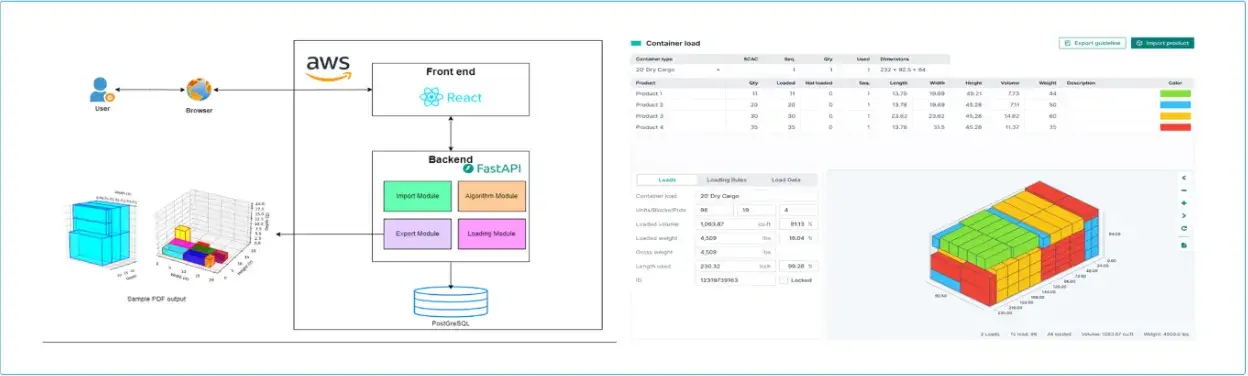
Together, these agents form a distributed, intelligent layer that acts as the nerve center of modern logistics operations.
The Tech Behind Agentic AI Systems
To support such smart agents, a robust technology stack is essential:
Streaming Data Infrastructure (e.g., Kafka, Kinesis)
Reinforcement Learning Engines
Orchestration Frameworks (LangChain, AutoGen)
ERP/API Integrations
Human-in-the-Loop Controls and Dashboards
TMA’s solutions are designed to work seamlessly with these technologies, ensuring rapid deployment and reliable performance across enterprise-scale supply chains.
Getting Started: How to Implement Agentic AI
Spot the Bottlenecks: Identify manual, repetitive decisions in your operations.
Define Agent Objectives: Link each agent’s mission to a clear business KPI.
Test in a Sandbox: Use simulations or shadow environments to validate behavior.
Start with Assisted Mode: Let agents make suggestions before granting full autonomy.
Scale Modularly: Use TMA’s framework to plug in more agents as success grows.
Business Outcomes: Why It Matters
Faster Response Times
Lower Operational Costs
Improved Service Levels
Reduced Human Workload
Higher Decision Accuracy
Closing Thoughts
Agentic AI isn’t science fiction—it’s here, and it’s already reshaping the supply chain landscape. With platforms like TMA Solutions’ Agent Builder and multi-agent orchestration framework, businesses are no longer just optimizing—they’re autonomizing. The future supply chain is intelligent, proactive, and resilient—and it’s being built today.


.webp_2026-10-01-18-27-07-971.webp)
.webp_2026-10-01-18-17-11-290.webp)
.webp_2026-10-01-18-08-26-854.webp)
.webp_2026-10-01-17-47-32-240.webp)