AI Agents are changing how businesses work. They automate complex tasks and make smart decisions. So, what exactly is an AI Agent? And how can TMA Solutions' AI Agent Development help your business build its own digital team?
1. What is AI Agent?
An AI Agent is a software system that uses artificial intelligence (AI) to do tasks for a user. It can think, plan, remember, and make decisions on its own without constant human help.
A special feature of AI Agents is their ability to process multiple data types simultaneously - text, voice, video, and images - and to collaborate with other agents when tackling complex problems.
How AI Agents Work
An AI Agent typically follow a four-step cycle:
- Perception: The agent gathers information about its environment, such as processing text, voice, or video; analyzing data from sensors; or reading databases and source code.
- Reasoning and Planning: Using that input, the Agent uses its "brain" to analyze and think. It will create a step-by-step action plan to reach the goal. This process often uses Large Language Models (LLMs) to handle complex requests.
- Action: The agent executes the plan. The action can be digital (sending an email, updating a database, writing a piece of code) or physical (controlling a robot or a connected system).
- Learning: After each action, the Agent evaluates the result. It learns from both successes and failures, and refines its future behavior to improve performance.
An AI Agent is a software system that uses artificial intelligence (AI) to perform tasks and achieve goals for a user.
2. AI Agent vs. Chatbot Comparison
While AI Agents and chatbots both use artificial intelligence to communicate, they are built for very different purposes and have different capabilities.
Here is a detailed comparison to help explain the key differences between them.
Based on the comparison, the outstanding advantages of an AI Agent are:
- Takes Action: An AI Agent doesn't just talk; it completes tasks and makes independent decisions.
- Smarter Technology: It uses advanced AI (like LLMs and ML) to learn and adapt over time, unlike a chatbot that usually follows a fixed script.
- Proactive: An Agent can start actions on its own or suggest things without waiting for a command. A chatbot is passive and only reacts.
- Wider Capability: It can understand complex situations (context), create plans, analyze data, and connect with other tools (using APIs) to solve difficult problems.
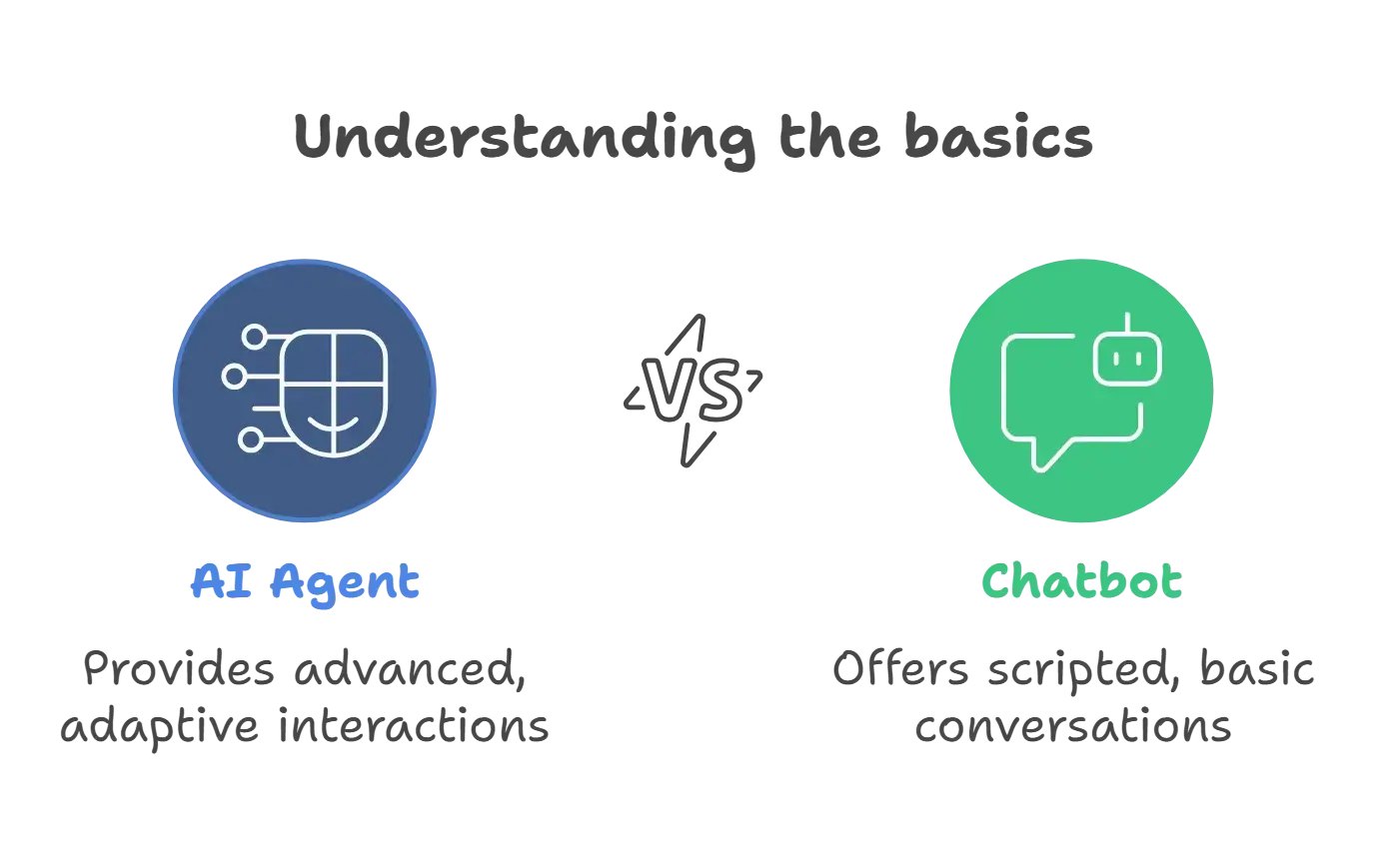
AI Agent vs. Chatbot Comparison
3. Transform Your Operations with Our AI Agent Development Service
Using custom AI Agents can bring major changes, helping your business operate more efficiently and smartly.
- Automate complex tasks and reduce manual work: AI Agents can handle difficult business processes. This helps companies cut down on repetitive and time-consuming tasks.
- Improve decision-making speed and accuracy: By analyzing large volumes of data in real time, AI Agents deliver precise insights and recommendations. Instead of guessing, leaders can make faster decisions based on reliable data insights.
- Personalize customer experience at every touchpoint: AI Agents help analyze the behavior and preferences of each customer to offer a tailored experience. According to McKinsey, businesses that personalize interactions can increase revenue by 3–15% and improve sales effectiveness by 10–20%.
- Optimize long-term operational costs: With automation, businesses can lower costs for repetitive jobs and avoid human errors. According to McKinsey, a company can expand its operations by up to 40% without a proportional increase in staff costs.
- Support business innovation and scalability: When daily work is automated, employees gain more time for creative thinking and improvement initiatives. The AI system also helps businesses scale up quickly without operational issues.
- Enhance monitoring and prediction capabilities: AI Agents continuously monitor systems, detect potential risks, and forecast trends in real time. This proactive approach helps businesses forecast market demand and make faster, more accurate decisions.
Using custom AI Agents can bring major changes, helping your business operate more efficiently and smartly.
4. Custom AI Agents For Every Industry
Each industry has special processes that can be optimized with custom-built AI Agents.
Healthcare: In healthcare, AI Agents help automate both administrative work and professional support.
- Automate administrative tasks: Schedule appointments, process bills, and enter patient data into the system automatically.
- Support diagnosis: Analyze medical images (like X-rays and MRIs) to detect early signs of problems.
- Assist patients: Answer frequently asked questions, provide medication reminders, and give basic care instructions.
Finance: The finance industry uses AI Agents to improve security, compliance, and operational efficiency.
- Automate customer onboarding: Extract information from ID documents (KYC) and detect signs of fraud.
- Assess credit risk: Analyze data to score credit and quickly make loan recommendations.
- Create automatic financial reports: Collect data from multiple sources to generate compliance reports and analyze performance.
E-commerce: In e-commerce, AI Agents focus on personalization and smarter operations.
- Give personalized product suggestions: Analyze shopping history and browsing behavior to recommend suitable products.
- Provide 24/7 customer support: Chatbots automatically answer questions about orders, return policies, and common issues.
- Optimize inventory management: Forecast market demand to automatically place orders, avoiding stockouts or overstocking.
Manufacturing: The manufacturing industry applies AI Agents to increase efficiency and reduce operational costs.
- Automate product quality control (QC): Use cameras and computer vision to find product defects right in real time.
- Monitor and perform predictive maintenance: Analyze machine data to predict maintenance needs and minimize downtime.
- Optimize the supply chain: Automatically track and manage raw materials to ensure production is not interrupted.
Telecom: In telecommunications, AI Agents help improve service quality and customer experience.
- Automatically monitor network performance: Detect issues early and make automatic adjustments to ensure stable service quality.
- Help customers solve problems: Chatbots and voicebots guide customers through common technical issues or billing questions.
- Predict and retain customers: Analyze usage data to identify customers at risk of leaving and offer them suitable promotions.
Education: The education industry uses AI Agents to create more personalized and effective learning experiences.
- Create personalized learning paths: Based on performance, AI Agents suggest lessons and exercises that match each student's ability.
- Virtual assistants for teachers and students: Automatically grade multiple-choice tests and answer common questions, giving teachers more time for their core duties.
- Automate administrative work: Manage schedules and student information to reduce staff workload.
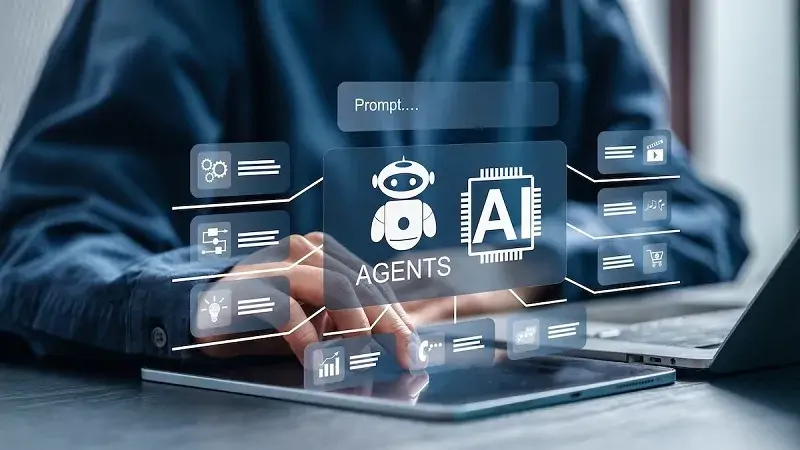
Each industry has special processes that can be optimized with custom-built AI Agents.
5. Our AI Agent Development Services
TMA offers a complete service ecosystem, called the "AI Agent Factory," to help businesses build, deploy, and manage AI agents effectively.
Foundation AI Models
- Goal: Equip every AI Agent with a powerful and flexible “brain.”
- Benefits: Shorten development time and ensure high performance for the Agent.
- How TMA does it: We select and fine-tune top foundation AI models like GPT-4, Llama, and Claude. This makes them suitable for your company's specific data and business needs.
AI Agent Development Framework
- Goal: To standardize and speed up the AI Agent building process.
- Benefits: Ensure quality and consistency, and make maintenance and upgrades easier.
- How TMA does it: We provide a framework with a library of pre-built agents. This framework supports both no-code/low-code interfaces for non-technical users and an SDK for developers to build custom agents.
Enterprise & Tool Integration
- Goal: To ensure AI Agents work seamlessly with your company's existing systems.
- Benefits: Ensures smooth data flow and uninterrupted workflows, avoiding silos or disconnected systems.
- How TMA does it: TMA builds powerful connectors to securely integrate AI Agents with ERP, CRM, databases, and other third-party tools.
Agentic Orchestration & Management Engine
- Goal: To manage and coordinate multiple AI Agents working together to solve complex problems.
- Benefits: Improve their learning ability, ensure operational performance, and follow the company's security policies.
- How TMA does it: We build a central engine to:
- Assign and manage workflows for multiple Agents.
- Integrate with a knowledge base (RAG) so Agents can give smarter answers.
- Continuously monitors performance and ensures security during operation.
Cross-Platform Deployment
- Goal: To bring AI Agents to users on all platforms, from local servers to the cloud.
- Benefits: Increase flexibility and scalability, and independence from a single infrastructure provider.
- How TMA does it: TMA uses container technology (like Docker and Kubernetes) to package AI Agents. For fast, consistent deployment across both on-premises and cloud environments.
>> For more details, please refer here.
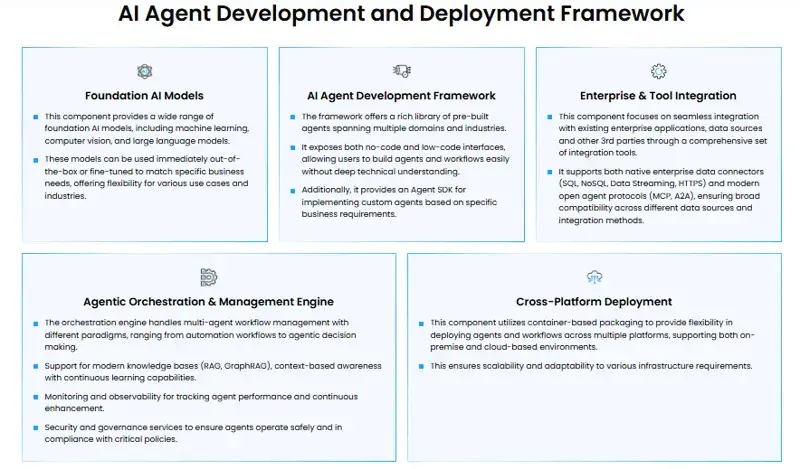
AI Agent Factory of TMA Solutions
6. Our AI Agent Development Process
We follow a 6-step process powered by TMA AI Agent Factory to ensure a successful project.
- New Agent Request & Requirements Analysis: TMA works with your business to understand current operations and define clear objectives. This stage creates a detailed requirements document with key performance indicators (KPIs) that guide the entire development process.
- Agent Design & Architecture Planning: Based on the agreed requirements, the TMA team will design the Agent's overall architecture. We use our existing library and framework to speed up the process and select the best AI model for the project. You will receive a technical design and a prototype for validation before coding begins.
- Agent Development & Integration: Once the architecture is approved, TMA's engineers will start the coding process. The Agent is built in modules and integrated with your company's existing systems (CRM, ERP) through secure connectors.
- Sandbox Testing & Validation: A working version of the Agent is deployed in a safe test environment (sandbox). Here, TMA simulates real-world scenarios to fully test its function, performance, and security. This step ensures the Agent works correctly and reliably before its official launch.
- Production Deployment & Orchestration: After successful testing, TMA deploys the Agent into your live operational environment with minimal disruption. TMA will also configure the orchestration engine so the Agent can start its tasks and scale automatically when needed.
- Monitoring, Optimization & Continuous Learning: Our commitment extends beyond deployment. Our engineering team will set up a 24/7 performance monitoring system and continuously collect operational data. This data is used to optimize and retrain the Agent, helping it become smarter and more effective over time.
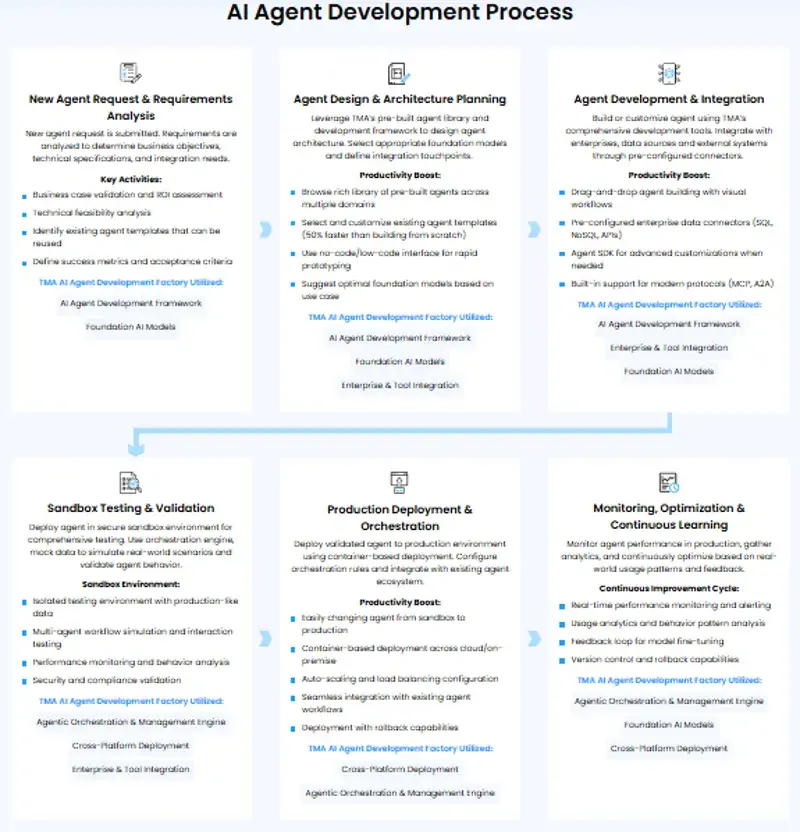
The 6-step deployment process of the AI Agent Factory
7. Technology Stack We Use for AI Agent Development
TMA Solutions uses a complete set of technologies to develop AI Agents. This ensures our solutions are scalable, accurate, and highly secure for every business.
- AI and Foundation Models: TMA uses top foundation models like OpenAI GPT, Llama, Gemini, Claude, and Mistral. This helps build AI Agents that can understand context and interact naturally. Our AI team also applies LLM fine-tuning to optimize models for specific fields like healthcare, finance, or logistics.
- Backend Technologies: TMA's AI projects use Python, Node.js, Java Spring Boot, and .NET Core. These help build a powerful and scalable data processing platform. Combined with RESTful APIs and GraphQL, the system ensures high speed and stability in real-world use.
- Frontend Technologies: To create a smooth user experience, TMA employs React, Angular, and Vue.js for web apps, and Flutter, Kotlin, and Swift for mobile platforms. Each interface is optimized for smart interaction between the user and the AI Agent.
- Databases and Storage: We use a multi-layer storage system with PostgreSQL, MongoDB, Redis, and Elasticsearch for dynamic data. For large-scale storage, we use Azure Blob and AWS S3, ensuring the ability to process millions of AI data records quickly and securely.
- Infrastructure & Deployment: AI Agent projects are deployed flexibly on AWS, Microsoft Azure, and Google Cloud with Kubernetes and Docker ensuring flexibility and scalability. Our CI/CD system automates testing and deployment, which shortens the time to launch a product.
- Middleware & Streaming: TMA uses Kafka, RabbitMQ, and Azure Service Bus to process data in real-time. This is useful for tasks like monitoring, chatbots, or enterprise virtual assistants.
- AI Frameworks and Libraries: Our engineers are skilled in using TensorFlow, PyTorch, Scikit-learn, LangChain, Hugging Face, and OpenCV enabling powerful model development and deployment across language, image, and audio processing tasks.
- Additional Tools & Services: Our development ecosystem also includes MLOps (MLflow, DVC), monitoring tools like Prometheus and Grafana, and DevOps services. These help manage the entire AI model lifecycle, from training and deployment to long-term maintenance.
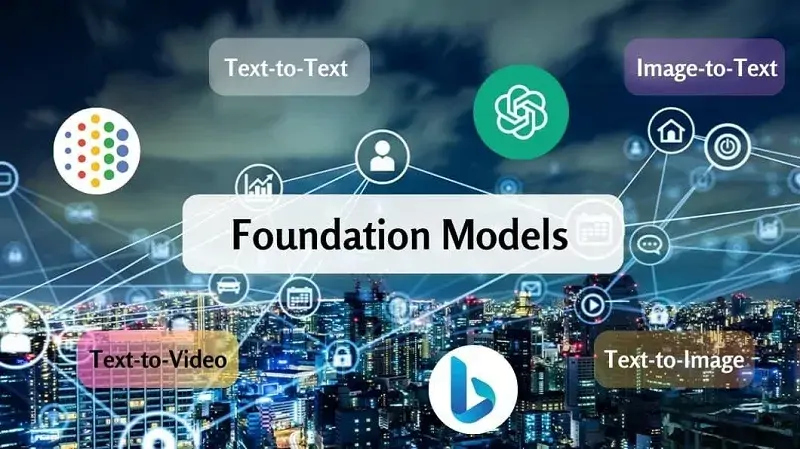
TMA uses a modern and flexible set of technologies to build effective and scalable AI Agent solutions.
8. Why Choose TMA for AI Agent Development
When a business starts using AI Agents, choosing the right development partner is key to success. TMA Solutions is an ideal partner because of our long experience and ability to deliver end-to-end AI solutions across diverse industries.
- Strong AI Agent Factory & AI Center: TMA Solutions has made significant investments in our AI Agent Factory and AI Center - where our AI experts and modern infrastructure come together. As a result, TMA can design, train, and deploy AI Agents at any scale, meeting the specific needs of each business in various fields.
- Deep integration with enterprise systems: TMA's AI Agent solutions are designed to integrate smoothly with your existing infrastructure, from CRM and ERP to customer care systems. This helps your business use its current data, automate processes, and improve operational efficiency without changing the core architecture of your existing systems.
- Experienced technical team, modern development methods: With over 4,000 engineers and more than 28 years of experience in software, TMA delivers end-to-end AI projects—from research and proof of concept (PoC) to real-world operation. Our development process follows Agile and CMMI Level 5 standards, ensuring quality, speed, and flexibility at every stage.
- Multi-agent orchestration and continuous learning: TMA's AI Agents can collaborate with other agents to solve complex business tasks. Equipped with a continuous learning mechanism, the system constantly improves its performance based on new data, becoming increasingly accurate and adaptive over time.
Support for multi-platform deployment and optimized security: TMA offers flexible solutions that can be deployed on the web, mobile, cloud, or on-premise, based on your IT infrastructure. All products comply with ISO 27001 standards and international security policies, ensuring data safety and privacy for clients of all sizes.
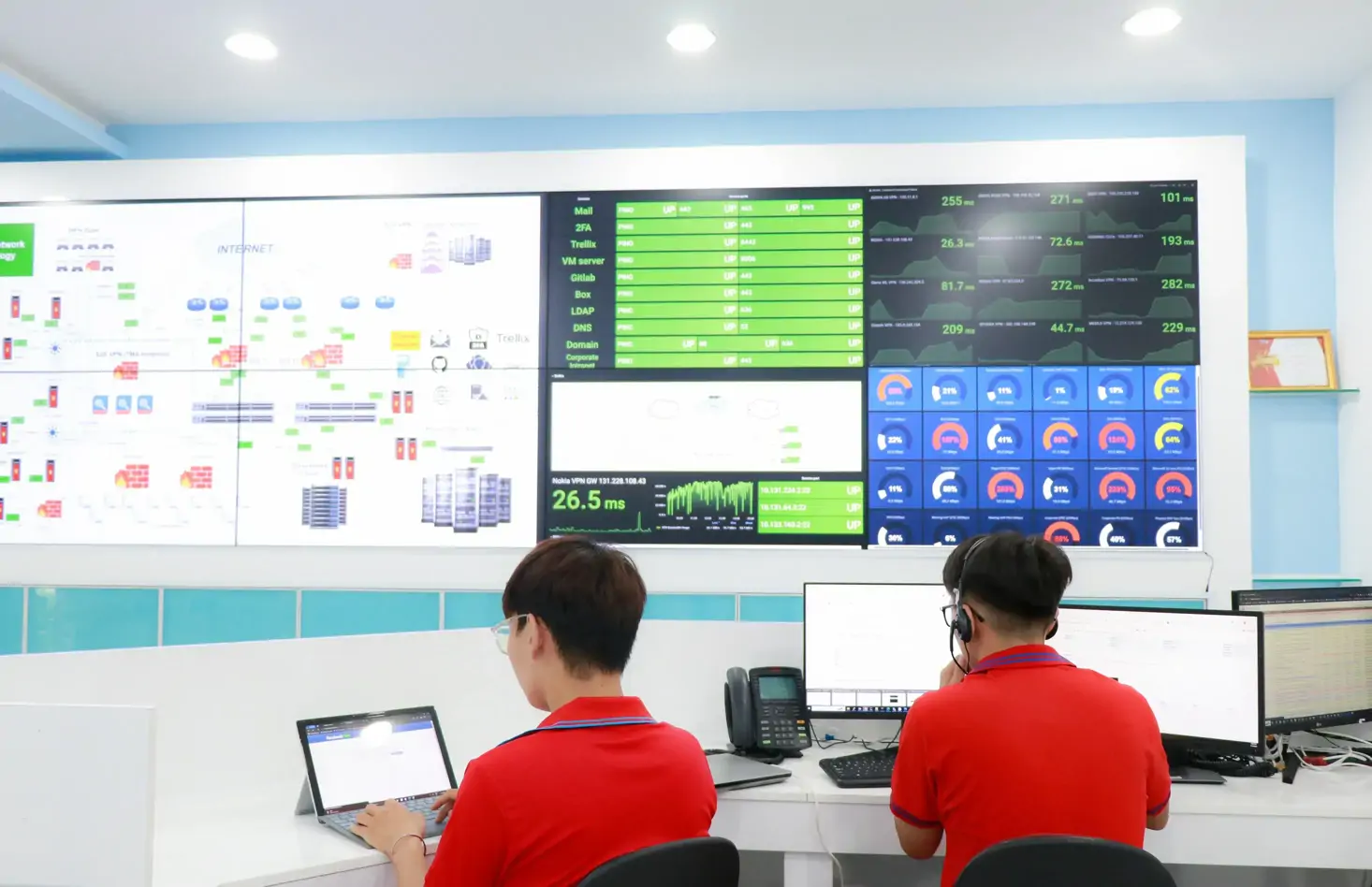
TMA Solutions offers many outstanding advantages.
9. Case Study TMA Solutions Implemented
1 - Document Intelligent Multi-Agent System (DIMS)
The Situation: A financial company needed to process thousands of complex documents every day. These included contracts, invoices, and reports in many different formats. The manual process was time-consuming, prone to errors, and difficult to manage.
Solution: TMA built a smart multi-agent system. This system operates through an automated workflow.
- Agent 1 (Collector): Automatically scans and extracts data from both scanned and digital documents.
- Agent 2 (Validator): Compares the extracted data with business rules and existing databases to find errors.
- Agent 3 (Integrator): Automatically inputs the validated data into the company's systems, like ERP or CRM.
Results:
- Reduced document processing time by 80%.
- Increased data accuracy to 99%, eliminating manual data entry errors.
- Helped employees focus on more analytical tasks instead of paperwork.
>> Read more at: Document Intelligent Multi-Agent System (DIMS)
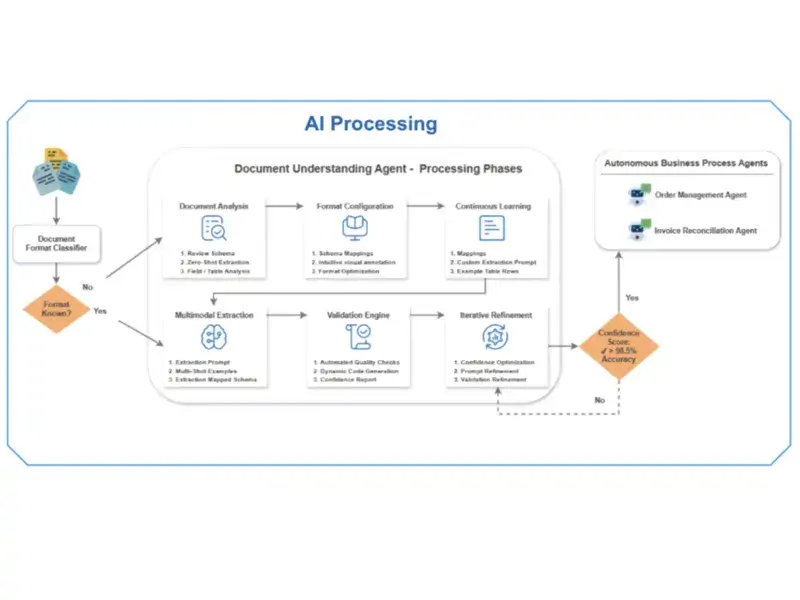
Case Study: Document Intelligent Multi-Agent System (DIMS)
2 - Customer Service Agent
The Situation: An e-commerce company was overloaded with repetitive customer requests via email and chat. This led to longer response times and reduced support quality for more complex issues.
Solution: TMA implemented a customer service AI Agent, integrated directly into the website and social media channels (Facebook, Zalo, and Telegram). This Agent can:
- Automatically answer common questions based on a provided knowledge base.
- Identify complex issues and route them to the appropriate support team, along with the full chat history.
- Analyze customer sentiment to improve service quality.
Results:
- Successfully automated 70% of common customer requests.
- Reduced the average response time by 40%.
- Increased the customer satisfaction score (CSAT) by 25%.
>> Read more at: Customer Service Agent
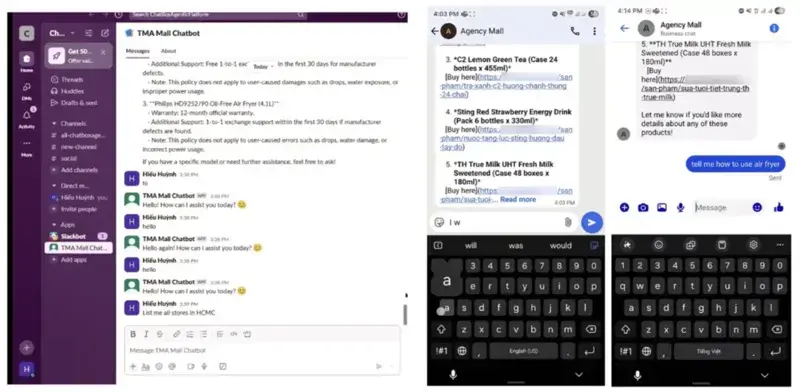
Case Study: Customer Service Agent
3 - Warehouse Management System (WMS) AI Agent
The Situation: Although the logistics company was already using a Warehouse Management System (WMS), the process remained complex. Employees and managers had to go through many steps to find information about goods or order statuses.
Solution: TMA developed an AI Agent that acts as a smart virtual assistant for the WMS. Employees can interact with the Agent using natural language (typing or speaking) to:
- Ask for and receive information about a product's location or stock quantity.
- Check the status of incoming and outgoing orders.
- Request instant reports.
Results:
- Increased warehouse staff efficiency by 30%.
- Reduced the time needed to find information and create reports by 50%.
- Helped warehouse managers make faster decisions with real-time data access.
>> Read more at: Warehouse Management System (WMS) AI Agent
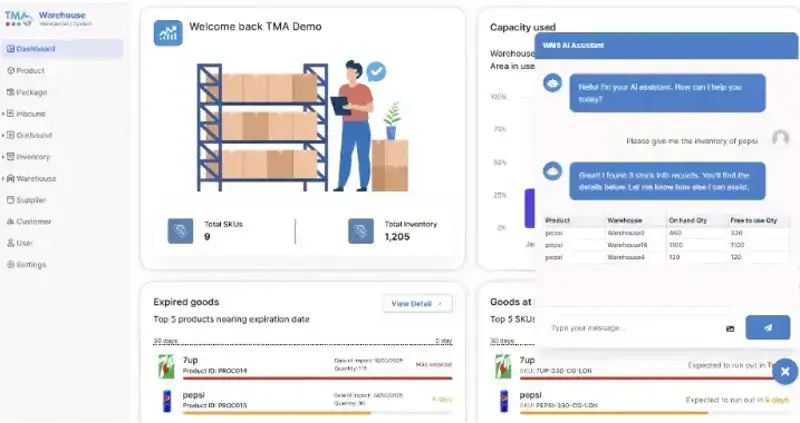
Case Study Warehouse Management System (WMS) AI Agent
10. FAQs about AI Agent Development Services
1 - What is the cost to develop an AI agent?
The cost to develop an AI Agent depends on the project's complexity and scope:
- Basic (chatbots, simple tasks): Starts from $10,000 USD.
- Medium (data analysis, machine learning, system integration): Around $50,000–$100,000 USD.
- Advanced (multi-agent systems, continuous learning, high security): Can be over $300,000 USD.
2 - Is an AI agent the same as an automation tool?
No, they are different in their level of intelligence and ability to act on their own.
- Automation Tool: Works based on pre-programmed rules. It is very effective for repetitive and consistent tasks, like copying data from one file to another.
- AI Agent: Is much smarter and more flexible. It can understand context, make its own decisions, and adapt to new situations to achieve a goal.
3 - Can AI agents work with the tools I already use?
Yes, an AI Agent can work with the tools your business already uses, such as CRM systems (Salesforce, HubSpot), project management software (Jira, Trello), internal communication apps (Slack, Microsoft Teams), or data and ERP platforms.
4 - How much time does it take to create an AI agent?
The time it takes to create an AI Agent depends entirely on the project's complexity and scale. Here is a general estimate to give you an idea:
- Proof of Concept (PoC/MVP): About 1–2 weeks.
- Pilot Deployment: About 3–6 weeks.
- Enterprise-Scale Deployment: From 8–16 weeks or more.
5 - How much does it cost to start an automation project with TMA?
To get started, TMA usually suggests a pilot project to demonstrate value and feasibility quickly. The cost depends on the scope of this pilot project.
The exact cost will be determined after we work with you to analyze and choose the most suitable problem to solve, ensuring a clear return on investment (ROI).

TMA often starts with a small-scale pilot project to demonstrate value.
AI Agent Development Services give businesses the chance to automate processes, improve performance, and create lasting value from data. With our AI Agent Factory platform and 28 years of practical experience, TMA Solutions has the capability to partner with your business to build custom solutions that solve the most complex business challenges.
>> Contact TMA Solutions today to start developing the right AI solution for your business.
Contact information:


.webp_2026-10-01-18-27-07-971.webp)
.webp_2026-10-01-18-17-11-290.webp)
.webp_2026-10-01-18-08-26-854.webp)
.webp_2026-10-01-17-47-32-240.webp)