Vietnamese enterprises are expanding their workforce while facing increasing demands for employee development, compliance training, and continuous upskilling. Traditional training models that rely on spreadsheets, manual scheduling, and classroom coordination can become difficult to manage as the number of employees and training requirements grows. For organizations looking for vietnam enterprise e-learning solutions, the priority is building a digital training environment that can scale while giving L&D teams better visibility into learning progress, compliance, and training costs. LinkedIn Learning's Workplace Learning Report also highlights the increasing importance of upskilling and developing employees as organizations respond to changing skills requirements, making scalable training infrastructure increasingly relevant for growing enterprises.

Why Traditional Training Can't Scale
For mid-sized and large enterprises, training administration involves many activities beyond delivering courses. L&D teams may need to identify employees who require training, assign courses, schedule sessions, track attendance, manage assessments, and maintain certification records.
As organizations grow, these activities become increasingly difficult to coordinate manually. Common challenges include:
- Training information spread across spreadsheets and separate systems.
- Different learning requirements across departments and job roles.
- Manual course assignment and scheduling.
- Difficulty tracking mandatory training and certification status.
- Limited visibility into participation and learning progress.
- Challenges in measuring the cost and effectiveness of training.
This is particularly important in regulated industries such as banking and insurance, where employees may need to complete specific training and maintain certifications. A centralized digital environment can reduce the administrative effort involved in managing these requirements while providing a more consistent training experience across the organization.
Digital-First Training Infrastructure
For enterprises evaluating vietnam enterprise e-learning solutions, a digital training environment can centralize learning activities and provide a consistent structure for employees across departments and locations.
Smart Corporate Training can support this model by organizing learning around employee profiles, roles, courses, assessments, and training requirements. A typical learning flow can be structured as:
Employee profile → Role-based learning path → Courses → Assessment → Progress tracking → Certification
Instead of assigning the same training to every employee, organizations can create learning paths based on job role, department, experience, or specific development requirements. This makes it easier to provide relevant training while giving managers a clearer view of employee progress.
For enterprises operating across multiple locations, digital delivery can also provide a consistent way to deliver self-paced learning, virtual sessions, assessments, and other training activities. This creates a shared training infrastructure that can support employees across different teams and locations.
Supporting Compliance and Certification
Compliance training requires more than simply making courses available. Organizations need to know who has completed required training, which employees are overdue, and when certifications need to be renewed.
A centralized training system can connect employees with their required courses and maintain records of completion and assessment results. Managers can then monitor compliance status through centralized reporting instead of collecting information from different teams.
For regulated industries, the process can be structured as:
Training requirement → Employee assignment → Course completion → Assessment → Certification → Renewal tracking
This gives L&D and compliance teams a consistent way to manage mandatory training while keeping employee records and certification information accessible through the same training environment.
Scaling Training Without Adding Headcount
A growing workforce does not necessarily need to result in a proportional increase in training administration when routine activities such as course assignment, progress tracking, assessment management, and reporting are handled through a centralized system. Vietnam enterprise e-learning solutions can extend this model beyond basic course management by combining role-based learning paths, employee data, personalized recommendations, and training analytics.
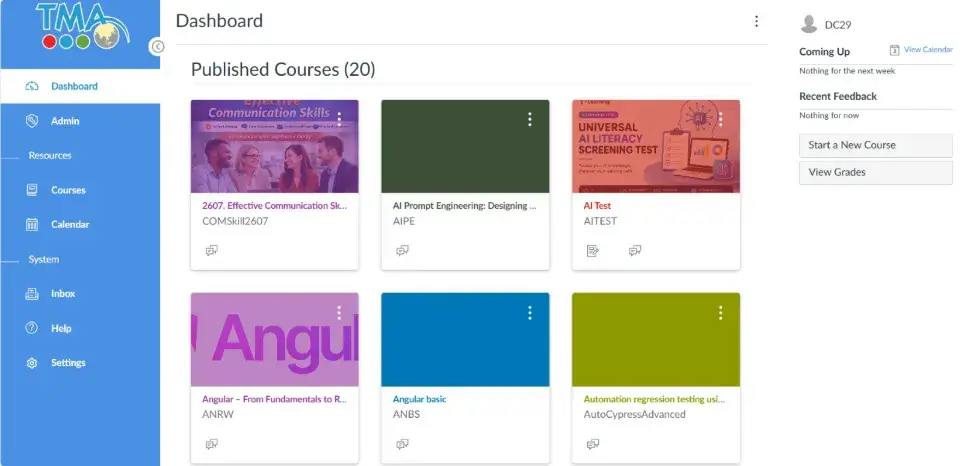
A technology services organization with several thousand engineers across multiple delivery centres faced this challenge as technical skills became outdated within months and continuous upskilling became a business requirement. Training had been organized course by course rather than around the capabilities required for each role, while training remained inconsistent across roles and teams, learning paths were not personalized by skill level, and progress was difficult to track.
The resulting learning platform introduced role-based personalized learning paths, a recommendation engine matched to learning progress, and a scalable microservices architecture. Employees received more personalized learning experiences, progress became visible across teams, and the organization reduced manual training administration.
The case illustrates how a role-based digital learning model can support continuous workforce development when training needs to keep pace with changing skills and a large employee base.
Measuring Training ROI
Training investment should be evaluated through more than course completion rates. Enterprises also need to understand training costs, participation, mandatory requirements, and how efficiently training resources are being used.
Useful metrics include:
- Training completion rate: Percentage of assigned employees completing required training.
- Certification rate: Percentage of employees obtaining required certifications.
- Cost per trainee: Total training expenditure divided by the number of employees trained.
- Training hours: Learning time completed across teams or roles.
- Assessment performance: Results from tests and other evaluations.
- Compliance status: Number or percentage of employees meeting mandatory training requirements.
Learning analytics can bring these measurements together and help L&D teams identify gaps between training plans and actual participation. McKinsey research on capability building and workforce transformation also emphasizes the importance of developing organizational capabilities as business requirements change, reinforcing the value of connecting employee development with business roles and skills rather than managing training as a collection of disconnected courses.
Building a More Scalable Training Model
For Vietnamese enterprises with 500 to 5,000 employees, training becomes increasingly complex as the workforce grows and organizations introduce more roles, learning requirements, and compliance obligations. Manual processes can make it harder for L&D teams to maintain consistent training delivery while keeping accurate records and reporting.
A digital-first approach allows organizations to centralize learning activities while maintaining role-specific requirements. With Smart Corporate Training, organizations can structure learning paths, manage courses and assessments, track employee progress, and monitor training outcomes through a connected digital environment.
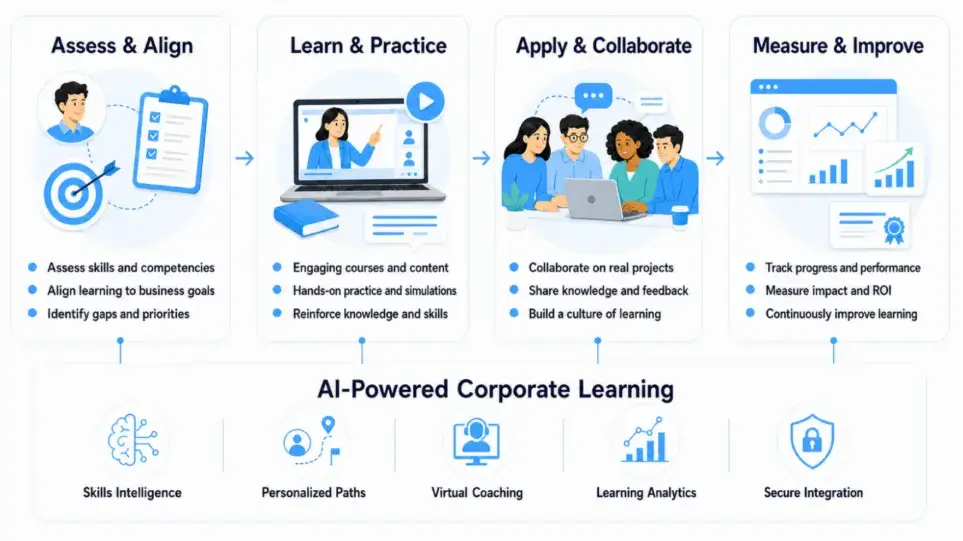
The focus is therefore not simply on moving classroom courses online. A scalable training model connects learning delivery with employee roles, development requirements, compliance, and measurable training data, giving both employees and L&D teams a clearer structure for continuous development.
Conclusion
For enterprises in Vietnam, scaling employee development requires more than adding courses or increasing training sessions. The underlying training infrastructure needs to support different roles, growing employee numbers, compliance requirements, and continuous changes in required skills.
Smart Corporate Training provides a foundation for this model through role-based learning paths, personalized recommendations, centralized progress tracking, assessment management, and training analytics. Combined with a structured approach to measuring completion, certification, cost per trainee, and learning outcomes, digital training can help L&D teams manage a larger workforce without increasing administrative complexity at the same pace.
For organizations evaluating vietnam enterprise e-learning solutions, the key consideration is how effectively the platform connects employee development with the operational requirements of the business.


.webp_2026-10-01-18-27-07-971.webp)