Healthcare delivery has undergone a major transformation in recent years, driven by advances in digital technologies and changing patient expectations. Telehealth platforms have emerged as a key enabler of remote patient care, allowing healthcare providers to deliver consultations, monitor patients, and maintain continuous engagement beyond traditional clinical settings.
According to the World Health Organization (WHO), digital health technologies are critical to improving healthcare accessibility and supporting universal health coverage. The COVID-19 pandemic further accelerated the adoption of telehealth, highlighting its role in expanding access to care while reducing pressure on healthcare systems.
Today, telehealth platform development is becoming a strategic priority for hospitals, clinics, homecare providers, and digital health organizations seeking to deliver more connected and patient-centered care.
What Is a Telehealth Platform?
A telehealth platform is a digital solution that enables healthcare providers and patients to communicate, exchange medical information, and deliver healthcare services remotely through secure technologies.
The impact of telehealth extends beyond improving access to care. A meta-analysis of 127 randomized controlled trials found that telehealth interventions reduced hospitalizations and improved patient outcomes, with condition-related admissions falling by 37 cases per 1,000 patients, demonstrating the potential of telehealth to improve clinical outcomes and reduce healthcare utilization.
Enabling Virtual Healthcare Delivery
Modern telehealth platforms go far beyond simple video calls. They function as comprehensive digital ecosystems that support continuous care, remote diagnostics, and personalized treatment.
Core Functions of Telehealth Platforms
In addition, a 2024 study reported that 75% of telehealth users were satisfied with their virtual care experiences, highlighting the growing acceptance and effectiveness of remote healthcare delivery.
Modern telehealth platforms provide a broad range of capabilities that support virtual care delivery and ongoing patient engagement. These functions typically include:
- Video consultations and secure messaging.
- Appointment scheduling.
- Electronic prescriptions.
- Patient health record management.
- Remote patient monitoring integration.
- Medication reminders and follow-up care.
Supporting Continuous Patient Engagement
Unlike traditional episodic care, telehealth platforms enable healthcare providers to maintain ongoing communication with patients, improving treatment adherence and care coordination.
Expanding Access to Healthcare Services
Telehealth is helping bridge gaps in healthcare access, particularly for populations that face geographical, mobility, or resource constraints. According to the World Health Organization (WHO), at least 4.5 billion people, more than half of the global population, were not fully covered by essential health services in 2021. By enabling virtual care and reducing the need for travel, telehealth platforms can help healthcare providers extend services to a broader patient population while improving continuity of care.
Improving Healthcare Reach
Telehealth platforms are particularly beneficial for populations that face geographical, mobility, or healthcare resource limitations. By extending care beyond traditional clinical settings, these solutions help providers reach a broader range of patients, including:
- Rural and underserved communities.
- Elderly populations.
- Patients with chronic diseases.
- Homecare and long-term care services.
Reducing Barriers to Care
In addition to expanding access, telehealth helps remove many of the logistical challenges associated with in-person healthcare visits. Remote care offers several advantages for patients, such as:
- Minimize unnecessary hospital visits.
- Save travel time and costs.
- Access specialists more conveniently.
- Receive timely follow-up care.
Emerging Trends in Telehealth Platform Development
Telehealth platform development is shifting from simple video-calling tools to comprehensive digital ecosystems. Key trends include the integration of Generative AI for clinical note-taking, expanded Remote Patient Monitoring (RPM) via wearable IoT devices, hybrid care models blending in-person and virtual visits, and the standardization of cross-platform EHR interoperability.
AI and Remote Patient Monitoring Integration
Artificial intelligence and connected devices are expanding the capabilities of telehealth beyond virtual consultations.
AI Applications in Telehealth
AI technologies are helping healthcare organizations improve clinical decision-making and patient engagement through capabilities such as:
- Predictive analytics for early risk detection.
- AI-assisted clinical decision support.
- Personalized care recommendations.
- Automated alerts and reminders.
Supporting Data-Driven Healthcare
The integration of telehealth with remote patient monitoring enables more continuous and personalized care. These technologies help providers:
- Monitor patient conditions in real time.
- Identify abnormalities earlier.
- Prioritize high-risk patients.
- Deliver more proactive interventions.
Connected Healthcare Ecosystems
Healthcare organizations are increasingly moving toward interoperable digital ecosystems that connect patients, providers, and medical devices.
Technologies Driving Innovation
Several technologies are accelerating telehealth transformation, including:
- Wearable devices and IoT sensors.
- Cloud computing platforms.
- Mobile health applications.
- Electronic health records (EHRs).
- AI and advanced analytics.
Creating Seamless Patient Experiences
Connected ecosystems enable healthcare providers to deliver more coordinated and patient-centric services by supporting:
- Continuous access to patient data.
- Improved care coordination.
- Faster clinical decision-making.
- More personalized healthcare experiences.
Key Components of Telehealth Platform Development
Developing an effective telehealth platform requires more than enabling virtual consultations. Healthcare organizations must build secure, interoperable, and scalable solutions that support seamless communication, efficient care coordination, and regulatory compliance.
Communication and Collaboration Tools
Reliable communication capabilities are fundamental to delivering high-quality remote care and maintaining continuous patient engagement.
Essential Communication Features
Modern telehealth platforms typically incorporate a variety of communication and care management functions, including:
- Secure video consultations and messaging.
- Voice calls and virtual interactions.
- Electronic referrals and prescriptions.
- Appointment scheduling and notifications.
Supporting Better Care Coordination
Integrated communication tools help connect healthcare providers, patients, and caregivers throughout the care journey. These capabilities can facilitate:
- Multidisciplinary collaboration.
- More efficient information sharing.
- Improved continuity of care.
- Enhanced patient engagement.
Data Integration and Interoperability
Telehealth platforms must be able to exchange information seamlessly across different healthcare systems and devices to support coordinated and data-driven care.
Integration Capabilities
To create connected healthcare ecosystems, telehealth solutions should support integration with:
- Electronic Health Records (EHRs).
- Wearable devices and remote monitoring systems.
- Laboratory information systems.
- Pharmacy management platforms.
- Third-party healthcare applications.
Building Connected Digital Ecosystems
Strong interoperability enables healthcare organizations to establish a unified view of patient information and achieve:
- Better clinical decision-making.
- Reduced information silos.
- Improved care coordination.
- More personalized treatment plans.
Security and Regulatory Compliance
Given the sensitivity of healthcare information, protecting patient data and ensuring regulatory compliance are essential requirements for telehealth platform development.
Modern telehealth platforms should incorporate robust security mechanisms such as:
- End-to-end encryption.
- Role-based access controls.
- Audit logs and monitoring capabilities.
- Secure cloud infrastructure.
- Regulatory Compliance: Adherence to data protection frameworks such as HIPAA in the United States, GDPR in Europe, or corresponding national health ministry guidelines.
According to the U.S. Department of Health and Human Services (HHS), maintaining privacy and security is a critical foundation for the successful adoption of telehealth and digital health technologies.
Benefits of Telehealth Platforms for Remote Patient Care
Telehealth platforms revolutionize remote patient care by removing geographic barriers, cutting travel times, and lowering healthcare costs. Research published in Health Affairs Scholar found that telehealth use was associated with an average reduction of $1,814 in medical costs per patient, along with 88.6 fewer emergency department visits and 32.4 fewer inpatient admissions.
Key Advantages for Patients
- Maximized Accessibility: Patients in rural or underserved areas can access specialists without undertaking long, expensive journeys.
- Convenience & Efficiency: Eliminates time spent commuting or waiting in crowded clinics, allowing individuals to easily schedule appointments around work or childcare.
- Better Chronic Management: Remote patient monitoring (RPM) allows for the continuous tracking of conditions like diabetes, heart failure, and hypertension, leading to better health outcomes.
- Improved Safety: Reduces the spread of contagious infections (like COVID-19) by limiting contact in waiting rooms.
Key Advantages for Providers
- Increased Reach & Efficiency: Doctors can see more patients by eliminating physical transition times and reducing appointment cancellations.
- Lower Operational Costs: Reduced reliance on physical office space, waiting rooms, and administrative overhead.
- Enhanced Work-Life Balance: Flexibility in scheduling virtual consultations allows for remote working opportunities and more manageable clinic hour
Challenges in Telehealth Platform Development
Despite its growing adoption, telehealth implementation presents several technical and operational challenges. Telehealth platform development requires navigating strict regulatory compliance (like HIPAA), achieving seamless interoperability with legacy Electronic Health Record (EHR) systems, and securing highly sensitive medical data against breaches. Developers must also overcome technical constraints, varying digital literacy, and provide robust multi-language support.
Interoperability and Data Integration
Healthcare data is often fragmented across different systems, making seamless information exchange difficult.
Common Technical Barriers
Building a secure platform means adhering to a complex web of healthcare laws. Organizations frequently encounter obstacles such as:
- Data Protection: Platforms must comply with privacy regulations, such as HIPAA in the US or GDPR in Europe, to prevent costly data breaches.
- Data Encryption: All patient data, both at rest and in transit, requires rigorous end-to-end encryption.
- Authentication: Implementing secure, multi-factor authentication (MFA) is mandatory for both providers and patients to verify identities.
Achieving Interoperability
Telehealth apps cannot operate in a silo; they must sync seamlessly with existing healthcare infrastructure. To create connected healthcare ecosystems, organizations should focus on:
- EHR Integration: Integrating with established EHR systems allows doctors to access medical histories, prescriptions, and lab results without disrupting their workflow.
- Health Data Standards: Utilizing standardized protocols like HL7 and FHIR (Fast Healthcare Interoperability Resources) is critical for enabling data exchange between different medical software and diagnostic tools.
Patient Adoption and Digital Literacy
Successful telehealth programs depend not only on technology but also on patient engagement and accessibility. A telehealth platform is only as good as its adoption rate among patients and doctors.
Barriers to Adoption
Patients may face various challenges when using telehealth services, including:
- Limited digital literacy.
- Language barriers.
- Poor internet connectivity.
- Lack of access to smartphones and digital devices.
Improving Accessibility and Engagement
Healthcare providers can improve adoption by prioritizing:
- Digital Divide: Developers must account for varying levels of technological literacy and limited broadband access for patients in rural or disadvantaged communities.
- Intuitive Interfaces: Both patient and provider dashboards must be incredibly easy to use and navigate.
- Accessibility: Incorporating features like adjustable font sizes, screen-reader compatibility, and multi-language interfaces ensures inclusivity.
How TMA Solutions Supports Telehealth and Remote Patient Care with mCare
As healthcare organizations increasingly embrace digital health, TMA Solutions has developed mCare, a digital health platform designed to support telehealth services, remote monitoring, and continuous patient engagement.
mCare Telehealth Capabilities
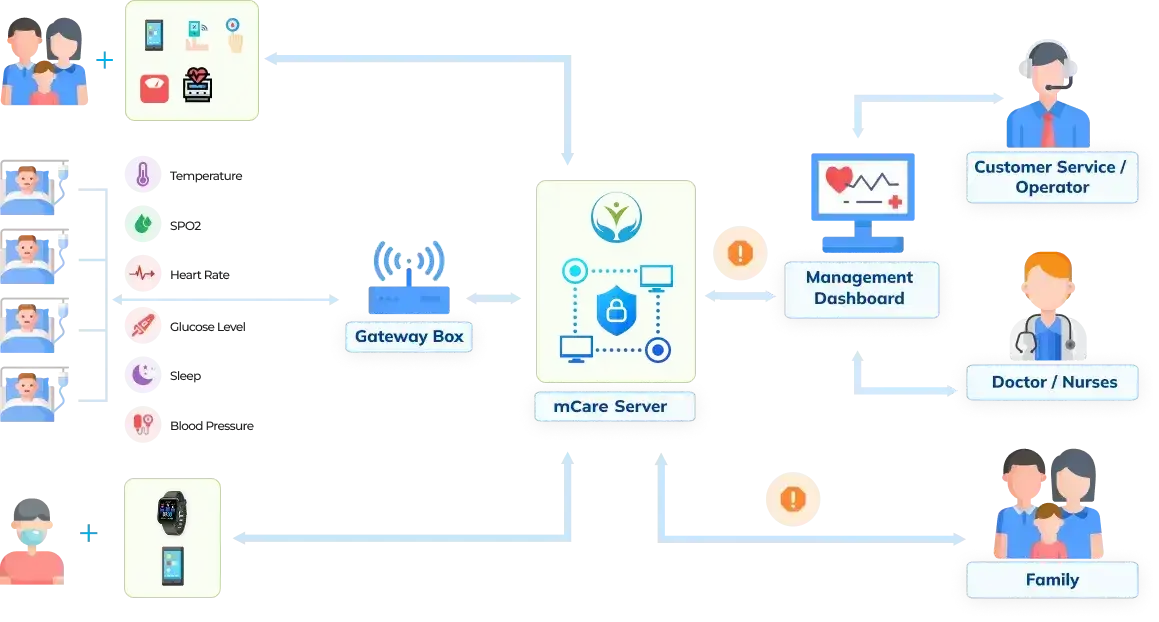
mCare enables healthcare providers to deliver remote care while maintaining strong connections with patients.
Virtual Care and Patient Engagement
mCare offers a variety of features that facilitate remote healthcare delivery, including:
- Video consultations and telehealth services.
- Appointment scheduling and reminders.
- Medication management and notifications.
- Secure communication between patients and healthcare professionals.
Remote Monitoring and Chronic Disease Management
The platform also supports continuous monitoring and home-based care through capabilities such as:
- Integration with wearable devices and medical sensors.
- Real-time health data collection.
- Personalized care plans.
- Alert mechanisms for timely interventions.
Enabling Digital Healthcare Transformation
Beyond telehealth, mCare integrates remote monitoring capabilities that allow providers to track patient health continuously through connected devices and real-time data sharing. The platform supports chronic disease management, homecare services, and proactive interventions, helping improve patient outcomes while reducing unnecessary hospital visits.
By combining telehealth, AI, IoT, and data-driven technologies, mCare enables healthcare organizations to build more connected and patient-centered care ecosystems.
Supporting Homecare Providers
For homecare and long-term care organizations, mCare helps:
- Extend care beyond hospitals and clinics.
- Improve chronic disease management.
- Enhance collaboration among caregivers and healthcare professionals.
- Increase patient engagement and treatment adherence.
Delivering Personalized Care Experiences
Through continuous connectivity and intelligent health insights, mCare empowers providers to deliver:
- More proactive healthcare services.
- Better patient experiences.
- Greater care accessibility.
- Improved long-term health outcomes.
Conclusion
Telehealth platforms are reshaping the future of healthcare by enabling more accessible, efficient, and patient-centered care. From virtual consultations and remote patient monitoring to AI-powered insights and connected healthcare ecosystems, telehealth technologies are helping organizations deliver continuous care beyond the walls of traditional healthcare facilities.
As demand for homecare and chronic disease management continues to grow, healthcare providers must invest in scalable and interoperable digital platforms that can support long-term transformation. Solutions such as mCare from TMA Solutions demonstrate how telehealth, remote monitoring, and intelligent technologies can work together to improve patient outcomes, optimize clinical workflows, and create more connected healthcare experiences.
Organizations that embrace telehealth platform development today will be better positioned to meet the evolving needs of patients and build more resilient healthcare systems for the future.


.webp_2026-10-01-18-27-07-971.webp)
.webp_2026-10-01-18-17-11-290.webp)
.webp_2026-10-01-18-08-26-854.webp)
.webp_2026-10-01-17-47-32-240.webp)