For many organizations, the biggest challenge in AI is no longer deciding whether to adopt the technology, but determining how to sustain its impact over time. While early AI initiatives can deliver promising results, transforming isolated successes into enterprise-wide capabilities requires far more than deploying sophisticated models. Long-term AI transformation demands continuous optimization, strong governance, and the ability to adapt to evolving business priorities. As enterprises move beyond experimentation, managing AI as an ongoing strategic capability has become essential for achieving lasting competitive advantages.
Managing a long-term AI transformation requires shifting from fragmented, ad-hoc technology pilots to an organization-wide, business-led strategy This pattern is not unique to AI.
Over the past decade, research from McKinsey, BCG, and Harvard Business Review has consistently shown that around 70% of transformation initiatives fail to achieve their intended goals. In many cases, the obstacles are not technological but organizational, involving strategy, governance, talent, and change management. As enterprises scale their AI adoption, managing long-term AI transformation projects has become critical to achieving sustainable business outcomes.
Why Long-Term AI Transformation Projects Are Different
Unlike traditional IT initiatives, AI transformation is not a one-time deployment. AI systems continuously evolve as business priorities, data, regulations, and customer expectations change. As a result, organizations must manage AI as an ongoing capability rather than a standalone project.
AI Requires Continuous Optimization
AI models can degrade over time due to changing data patterns and business environments. Maintaining performance requires ongoing monitoring, retraining, and governance.
Organizations should focus on:
- Continuous model evaluation.
- Data quality management.
- Feedback loops and retraining.
- Human oversight and accountability.
According to PwC, organizations that operationalize Responsible AI practices are more likely to realize sustained benefits, with 58% reporting improved ROI and organizational efficiency.
Success Depends on More Than Technology
Many AI initiatives fail not because of model limitations, but because organizations underestimate the importance of culture, leadership, and operational readiness.
Long-term AI transformation requires:
- Clear business objectives.
- Executive sponsorship.
- Cross-functional collaboration.
- Strong governance frameworks.
Research on AI readiness suggests that AI success is fundamentally an organizational learning challenge rather than simply a technology investment. Organizations that treat AI as a capability-building journey are more likely to generate measurable business impact.
Governance Becomes Increasingly Important at Scale
As AI systems become more deeply embedded into operations, governance can no longer be treated as an afterthought. Enterprises must establish clear policies for data management, accountability, security, and responsible AI usage.
Key priorities include:
- Risk management and compliance.
- Transparency and explainability.
- Privacy and cybersecurity.
- Ethical AI principles.
PwC emphasizes that Responsible AI helps organizations scale AI while protecting value, improving trust, and managing risks throughout the AI lifecycle
Common Challenges in Long-Term AI Transformation Projects
While many organizations successfully launch AI pilots, maintaining momentum and delivering value over several years remains difficult.
Moving Beyond Experimental Projects
A common challenge is turning isolated AI initiatives into enterprise-wide capabilities. Many organizations achieve promising early results but struggle to operationalize AI across business functions.
Typical obstacles include:
- Fragmented data environments: Data is often stored across disconnected systems, making it difficult to build reliable AI models.
- Lack of internal AI expertise: Many organizations do not have sufficient in-house skills to develop and maintain AI solutions effectively.
- Weak integration with existing workflows: AI applications may fail to deliver value if they are not seamlessly embedded into day-to-day operations.
- Unclear ownership and governance: Without clearly defined responsibilities and governance frameworks, AI initiatives can lack direction and accountability.
Recent industry analysis indicates that more than 90% of AI pilots never progress into production environments, highlighting the gap between experimentation and long-term value creation.
Organizational Readiness and Workforce Adoption
AI transformation changes how people work, make decisions, and collaborate. However, many organizations are not fully prepared for these shifts.
Challenges often include:
- Resistance to change: Employees may be hesitant to adopt new ways of working driven by AI technologies.
- Skill shortages: Organizations frequently struggle to find and retain talent with the necessary AI and data expertise.
- Misaligned expectations: Differences between business goals and technical capabilities can lead to unrealistic expectations and disappointing outcomes.
- Lack of accountability: Unclear roles and decision-making processes can slow AI adoption and hinder long-term success.
An IBM survey found that only 11% of CIOs and CTOs feel fully prepared for large-scale AI deployment, while 77% believe current governance frameworks are inadequate for supporting AI at scale.
Maintaining Trust and Compliance
As AI capabilities become more powerful, concerns around privacy, transparency, and regulatory compliance continue to grow.
Organizations must address:
- Data governance: Effective data management helps ensure the accuracy and reliability of AI systems.
- Security and access controls: Strong safeguards are necessary to protect data and maintain system integrity.
- Responsible AI practices: Ethical and transparent AI development helps minimize risks and build user trust.
- Evolving regulatory requirements: Keeping up with changing regulations is essential to ensure compliance and avoid legal challenges.
Strong governance frameworks not only reduce risks but also help organizations build trust and support sustainable AI adoption over the long term.
Best Practices for Sustaining AI Transformation Over the Long Term
Successfully managing long-term AI transformation projects requires organizations to focus on business value, scalability, and adaptability. Rather than pursuing isolated use cases, enterprises should establish a foundation that supports continuous innovation and operational improvement.
Align AI Initiatives with Business Objectives
AI projects should begin with clearly defined business problems and measurable outcomes. Organizations that prioritize business value over technology experimentation are more likely to achieve sustainable results.
Key considerations include:
- Defining specific use cases.
- Establishing measurable KPIs.
- Prioritizing high-impact opportunities.
- Continuously evaluating business outcomes.
According to Deloitte's State of Generative AI report, organizations that closely align AI initiatives with strategic business priorities are significantly more likely to achieve expected returns from their AI investments.
Invest in Data and Infrastructure Foundations
High-quality data and scalable infrastructure are essential for long-term AI success. Without strong foundations, organizations may struggle to operationalize AI solutions or maintain performance as requirements evolve.
Important areas of focus include:
- Cloud-based architectures.
- Data governance frameworks.
- MLOps capabilities.
- Secure and scalable platforms.
Gartner predicts that organizations adopting AI engineering practices will achieve at least three times better operational performance than those relying on ad hoc AI development approaches.
Build Cross-Functional Teams
AI transformation extends beyond IT departments. Successful initiatives often involve collaboration between technical teams, business leaders, domain experts, and end users.
Cross-functional teams help organizations:
- Improve communication and alignment.
- Accelerate AI adoption.
- Address operational challenges.
- Increase user acceptance.
According to Accenture, organizations with strong collaboration between business and technology teams are better positioned to scale AI and capture greater value from their investments.
Why Enterprises Are Turning to AI Development Companies from Vietnam
As demand for AI expertise continues to increase, many organizations are partnering with external providers to accelerate implementation and reduce risks. Vietnam has emerged as a highly attractive destination for AI development due to its growing talent pool and strong engineering capabilities.
Access to Experienced AI Developers in Vietnam
Vietnam's technology ecosystem has expanded rapidly over the past decade, supported by investments in STEM education and digital transformation. Today, many enterprises are leveraging AI developers in Vietnam to access specialized skills and scale projects more efficiently.
Benefits include:
- Cost-effective development models.
- Strong software engineering expertise.
- Flexible team scaling.
- Experience supporting global clients.
According to Kearney's Global Services Location Index, Vietnam continues to rank among the world's most attractive outsourcing destinations due to its talent availability and financial competitiveness.
Accelerating Time-to-Value
Working with an AI development company from Vietnam enables enterprises to shorten development cycles and focus internal resources on strategic priorities. External AI teams can provide expertise across the entire AI lifecycle, from data engineering and model development to deployment and optimization.
This approach helps organizations:
- Reduce implementation risks.
- Accelerate AI adoption.
- Improve scalability.
- Achieve faster time-to-market.
TMA Solutions: A Leading AI Company in Vietnam
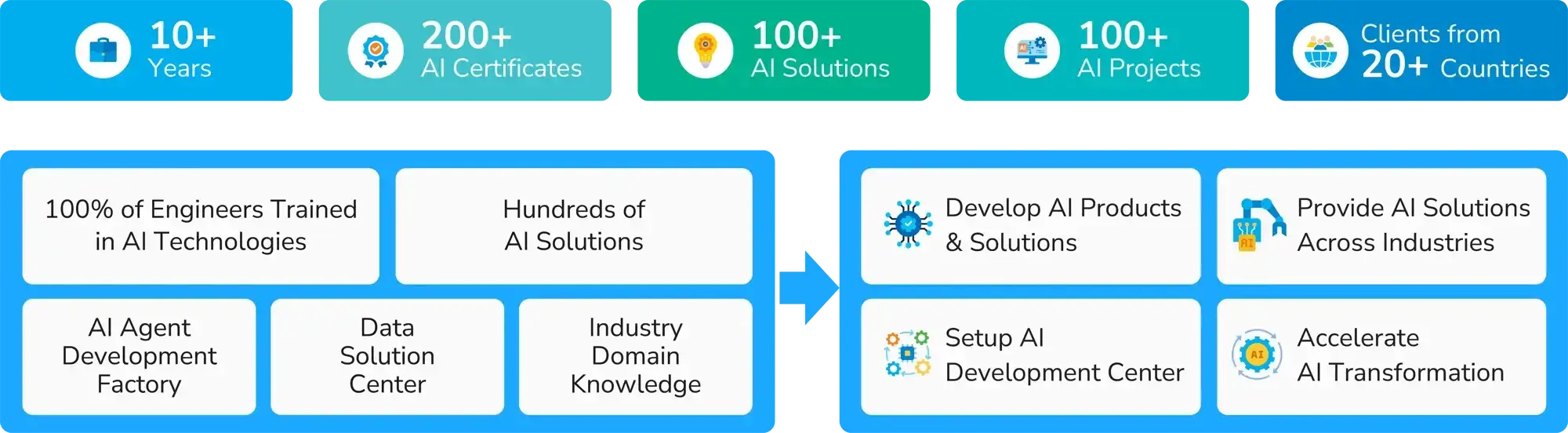
Organizations pursuing sustainable AI transformation often require technology partners with strong engineering capabilities and extensive implementation experience. With nearly 30 years of software development expertise, TMA Solutions has established itself as a leading AI company in Vietnam, supporting enterprises across industries in building intelligent and scalable solutions.
AI Expertise Built Over More Than a Decade
TMA Solutions has invested in artificial intelligence (AI), machine learning, and data science for over ten years through its AI Center and AI Agent Factory. Today, the company offers more than 100 AI solutions and services that support enterprise modernization and intelligent automation.
With 10 years of experience, our team is familiar with a wide range of AI technologies and platforms, including:
- Machine Learning (ML)
- Computer Vision (CV)
- Edge AI
- Generative AI | LLMs | NLP
- Speech & Voice Recognition
- Cloud AI & Services
Supporting Long-Term AI Transformation
As one of the experienced AI development companies from Vietnam, TMA Solutions helps enterprises move beyond pilot projects and build scalable AI capabilities. By combining domain expertise, engineering excellence, and flexible delivery models, TMA enables organizations to accelerate innovation and create sustainable competitive advantages.
Conclusion
Managing long-term AI transformation projects requires more than deploying advanced technologies. Sustainable success depends on strong data foundations, organizational readiness, governance, and continuous optimization. Enterprises that approach AI as an ongoing capability rather than a one-time initiative are better positioned to unlock long-term value and maintain their competitive edge.
For organizations seeking experienced AI partners, working with AI developers in Vietnam offers access to specialized expertise and scalable delivery models. As a leading AI company in Vietnam, TMA Solutions continues to help global enterprises navigate AI transformation and build more intelligent, resilient, and future-ready businesses.


.webp_2026-10-01-18-27-07-971.webp)
.webp_2026-10-01-18-17-11-290.webp)
.webp_2026-10-01-18-08-26-854.webp)
.webp_2026-10-01-17-47-32-240.webp)