Retail chains operating across multiple locations and sales channels face a persistent inventory challenge: demand changes quickly, while inventory data is often distributed across POS systems, warehouses, stores, e-commerce platforms, and other business systems. According to IHL Group, inventory distortion, including overstocks and out-of-stocks, costs retailers more than $1 trillion globally each year. For retailers looking for data solutions for retail, the priority is creating a connected data environment that provides timely inventory visibility, supports accurate forecasting, and enables faster decisions.
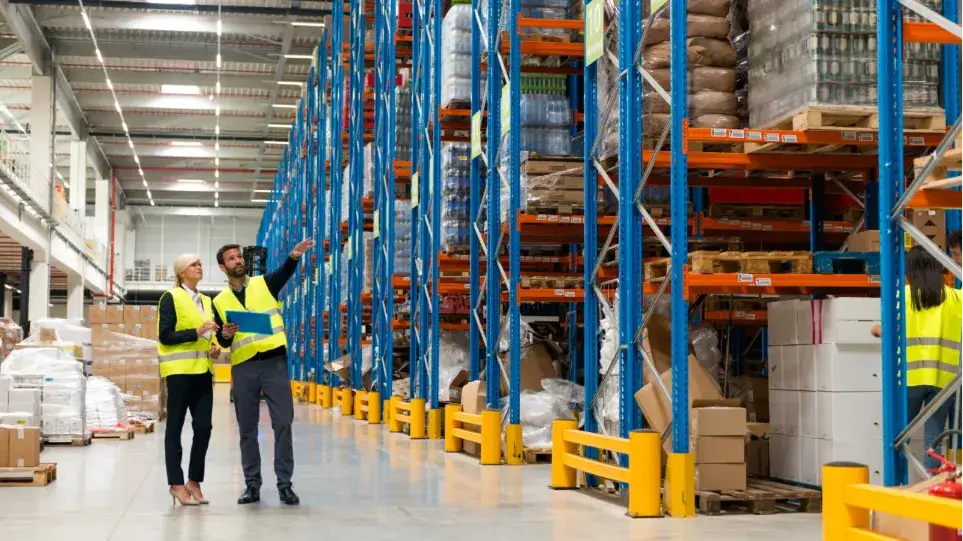
The inventory visibility problem
Inventory decisions become more difficult when sales and stock information is spread across different systems. One store may have available inventory while another is experiencing a shortage, but without a consolidated view, reallocating stock can depend on delayed reports or manual coordination.
The challenge is greater in an omnichannel operation, where customers purchase through physical stores, websites, marketplaces, and other channels. Retailers need omnichannel inventory visibility to understand product availability across locations and channels rather than viewing each source separately.
An integrated data environment connects POS, warehouse, inventory, and e-commerce data to create a consistent view of product availability and movement. This gives retail teams a stronger basis for replenishment, allocation, and fulfillment decisions.
Real-time data and forecasting
Real-time inventory visibility starts with connecting operational data as it is generated. POS transactions provide demand signals, while warehouse and inventory systems show available stock, incoming goods, and product movement.
POS analytics can help teams identify sales patterns across products, stores, and channels. Combined with inventory data, these insights support better replenishment and stock allocation decisions.
Forecasting can then build on this connected data foundation. Historical sales, current demand signals, and inventory positions can help identify changes in demand and support more responsive planning. McKinsey research has highlighted the value of advanced analytics in improving forecasting and supply chain decision-making.
POS data + Warehouse data + Inventory data → Real-time inventory view → Demand analysis → Replenishment and allocation decisions
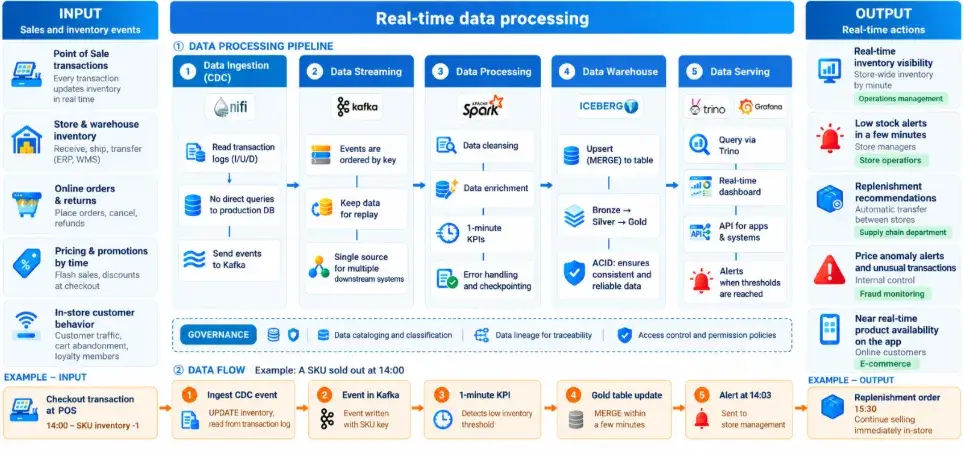
Connecting these stages allows retailers to respond to demand changes before shortages or excess inventory become larger operational problems.
Reducing waste and improving inventory ROI
Preventing stockouts is only part of inventory optimization. Retailers also need to avoid holding unnecessary inventory, particularly when demand is uncertain or products have limited selling windows.
A connected inventory environment can reveal patterns such as products selling faster in one location than another or inventory accumulating where demand is weaker. Combined with POS analytics, these signals support earlier redistribution and more targeted replenishment.
Retailers can measure performance through:
- Stockout rate: How frequently products become unavailable when demand exists.
- Inventory turnover: How efficiently inventory moves through the business.
- Days of inventory: How long current stock is expected to support demand.
- Sell-through rate: How effectively available inventory converts into sales.
- Inventory value: How much working capital remains tied up in stock.
IHL Group's research on inventory distortion highlights the importance of balancing lost sales from out-of-stocks with the costs of excess inventory.
Building a real-time inventory data foundation
For multi-location retailers, real-time inventory management requires more than a dashboard. Data needs to be collected from relevant systems, integrated into a consistent structure, and made available to the teams and applications that use it.
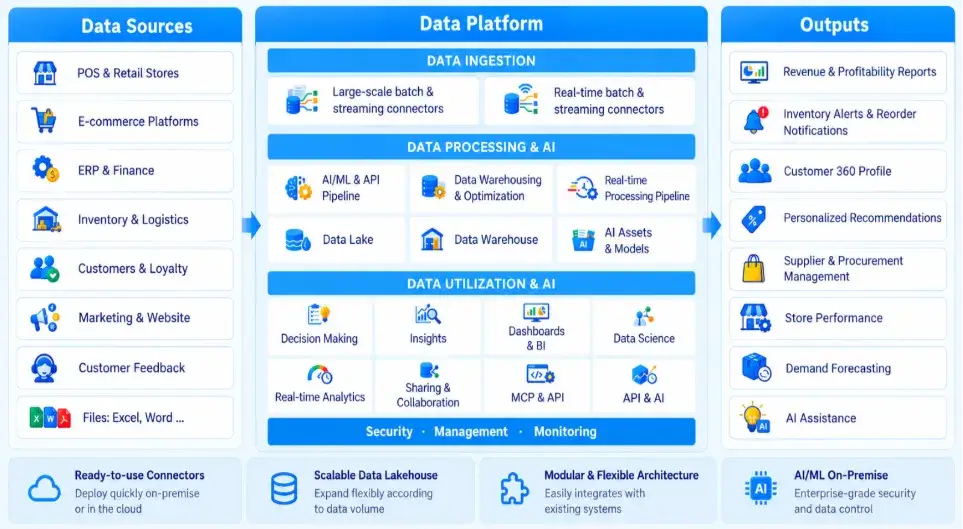
The TMA Data Platform by TMA Solutions provides data integration and analytics capabilities that can connect operational systems such as POS, inventory, warehouse, and other enterprise applications. This creates a unified data foundation for inventory visibility and downstream analytics.
The architecture can be approached as:
POS / E-commerce / Warehouse / Inventory systems → Data integration → Unified data layer → Analytics and forecasting → Business decisions
This approach allows retailers to build on existing systems rather than replacing every operational platform. It also supports a broader omnichannel inventory strategy by providing a consistent view of product availability across the network.
What retail teams should measure
Retailers should evaluate inventory performance across multiple dimensions rather than focusing only on product availability. A practical measurement framework includes:
- Availability: Are products available where and when customers need them?
- Inventory efficiency: Is stock moving through the network at an appropriate rate?
- Forecasting: Are demand signals reflected in replenishment and allocation decisions?
- Working capital: Is the business avoiding unnecessary inventory accumulation?
These targets should be established against the retailer's own operational baseline and business objectives.
Moving from visibility to proactive inventory control
Real-time data can help inventory management move from a reactive process toward a more responsive operating model. Instead of waiting for periodic reports to identify shortages or excess stock, teams can work with more current information and respond to changes in sales and inventory positions.
For retailers with multiple stores and sales channels, combining omnichannel inventory visibility with forecasting, POS analytics, and inventory planning creates a stronger foundation for replenishment, allocation, and fulfillment decisions.
For organizations looking to strengthen their data solutions for retail, this approach also makes it possible to connect existing operational systems without requiring every platform to be replaced.
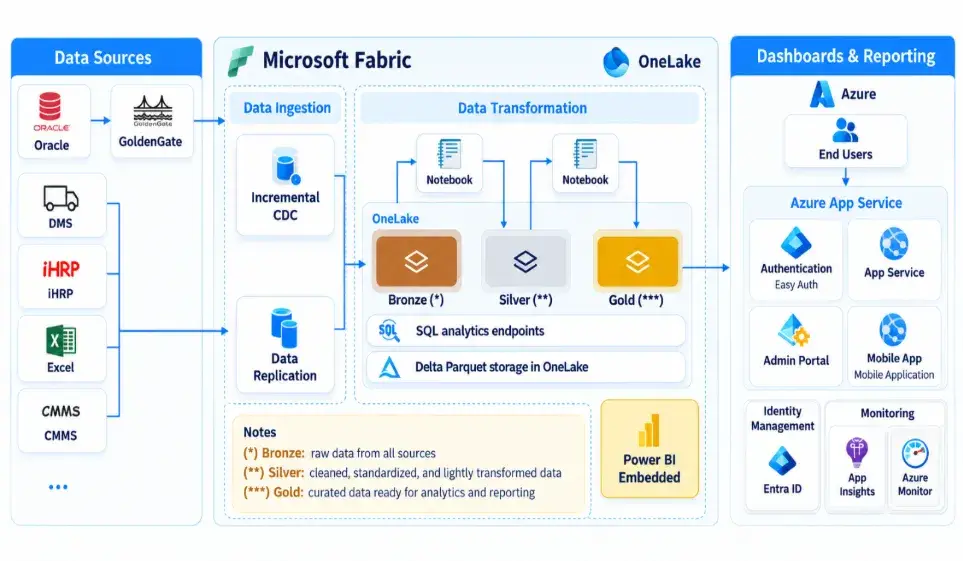
Turn retail data into better inventory decisions
Reducing stockouts is ultimately a data visibility and decision-making challenge. When POS, warehouse, inventory, and sales-channel data remain disconnected, retail teams have fewer timely signals for identifying demand changes and reallocating stock.
TMA Data Platform helps connect these data sources into a unified foundation for analytics and forecasting. For multi-location retailers, this creates a practical path toward more responsive omnichannel inventory management, better stock utilization, and improved inventory ROI.


.webp_2026-10-01-18-27-07-971.webp)
.webp_2026-10-01-18-17-11-290.webp)
.webp_2026-10-01-18-08-26-854.webp)