Modern enterprises rely on ERP systems, CRM platforms, finance applications, warehouse management systems (WMS) and e-commerce platforms. However, these systems often use different data formats, product identifiers and update schedules. Teams may see conflicting inventory figures, spend hours reconciling reports and make decisions using outdated information. An enterprise data integration solution connects these sources while making data consistent, manageable and accessible for business use. TMA Data Platform supports data integration, processing, storage and analytics, helping organizations build a connected data environment without automatically replacing existing applications.
What are data silos and why do they matter?
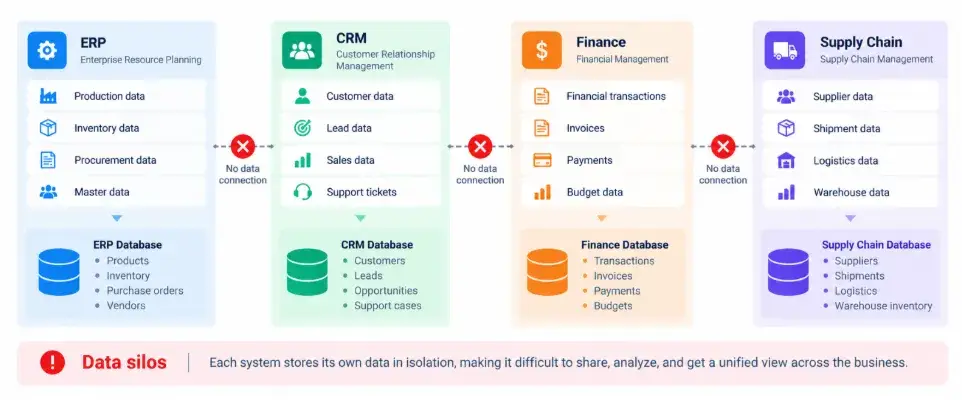
Data silos occur when business systems store information separately, making it difficult for teams to access and use data across departments. Sales may rely on CRM records, finance on transaction reports, and operations on inventory data from ERP or warehouse systems. Without a consistent view, teams can struggle to understand overall business performance.
This fragmentation creates several business challenges:
- Limited visibility: Leaders cannot easily combine information across departments or subsidiaries to understand performance, identify risks and spot opportunities.
- Manual work and higher costs: Employees spend time collecting, reconciling, and validating data instead of analyzing it or acting on it.
- Slower, less reliable decisions: Conflicting records and outdated reports make it harder to respond quickly to changes in demand, inventory, or financial performance.
- Barriers to analytics and AI: Inconsistent, inaccessible data makes it harder to develop reliable dashboards, forecasts, and AI applications.
The financial impact can be significant. Forrester's 2024 report on poor data quality found that more than one-quarter of surveyed data and analytics employees who identified poor data quality as an obstacle to data literacy estimated annual losses exceeding $5 million. Seven percent reported losses of $25 million or more.
Effective data silos consolidation involves more than connecting systems. Businesses also need consistent data definitions, quality controls, appropriate access permissions, and reliable processes for keeping information up to date.
How TMA Data Platform supports enterprise data integration
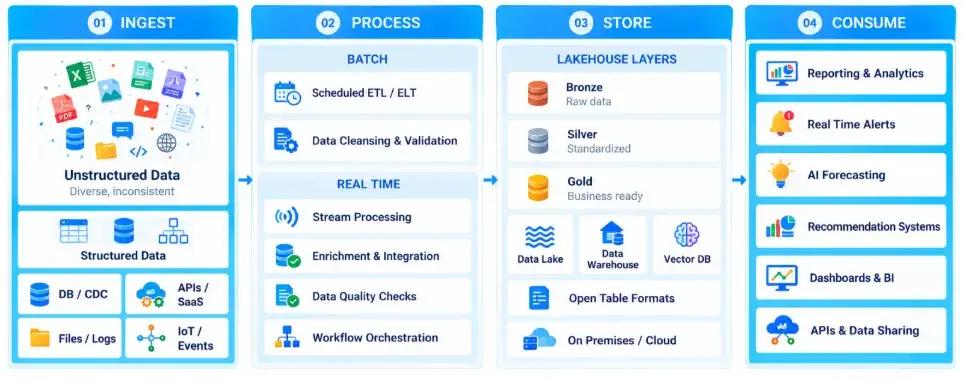
TMA Data Platform helps businesses integrate information from multiple sources, prepare it for use and make it available for reporting, analytics, and AI. Its data architecture supports batch processing and streaming analytics, with technologies including Apache NiFi and Kafka for ingestion, and Spark and Trino for processing and analytics.
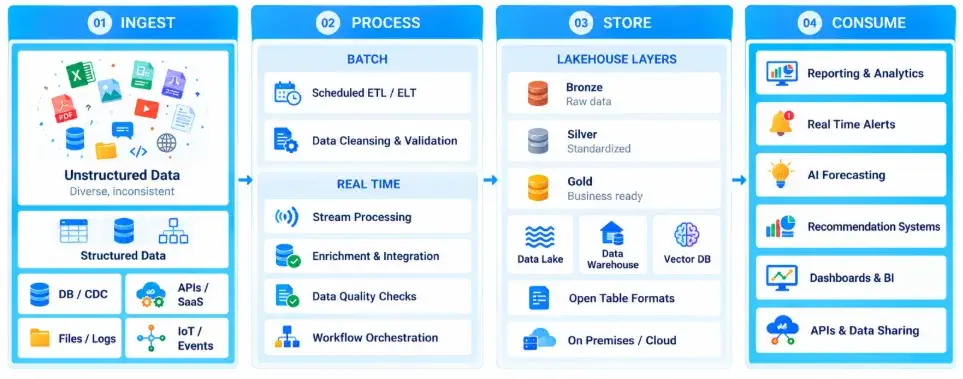
A typical implementation follows four stages.
1. Ingest: Collect data from business systems
TMA Data Platform integrates data from diverse sources, including enterprise systems, databases, files, and IoT devices. It supports batch ingestion and real-time streaming, allowing businesses to choose an approach based on their data sources and latency requirements.
For example, ERP data integration can bring ERP records together with information from CRM, finance, warehouse management, and e-commerce systems, helping businesses connect operational data for broader reporting and analysis.
2. Process: Improve data quality and consistency
After data is ingested into the system, it goes through batch ETL/ELT pipelines or stream processing, where it is cleaned, validated, and standardized. This process ensures that data is consistent, reliable, and of high quality, providing a solid foundation for data analytics, reporting, and AI applications.
3. Store: Organize data for different business needs
TMA Data Platform consolidates and organizes data from multiple sources on a unified platform, enabling businesses to manage, access, and retrieve information efficiently whenever needed. Data is organized into three layers: raw data, cleaned and standardized data, and business-ready data for analytics and AI applications. The platform supports different storage solutions to meet diverse business needs: Data Lakes for storing diverse data types, Data Warehouses for business reporting and analytics, and Vector Databases (Vector DBs) for intelligent search and knowledge retrieval in AI applications.
4. Consume: Turn integrated data into business value
Once prepared, data can be made available to business intelligence dashboards, analytics tools, operational applications, and AI workloads through appropriate interfaces and access controls.
Business teams can use the resulting data to monitor sales and inventory, compare performance across business units, identify operational issues, and improve forecasting. For example, a retailer can combine sales and stock information to identify replenishment needs, while executives can review consolidated performance across subsidiaries. By making trusted data easier to access and reuse, businesses can reduce manual reporting effort, improve operational visibility, and provide a stronger foundation for data-driven decisions.
Addressing complex data consolidation across business units
For large enterprises, data consolidation often involves more than connecting applications. A group may operate across multiple industries, with subsidiaries using different systems and managing separate datasets. Leadership needs a consolidated view of group performance, while individual business units must retain control over who can access their data.
TMA Data Platform can support an integration approach informed by Data Fabric and Data Mesh principles, helping organizations connect information across the enterprise while addressing governance and domain-based ownership. The approach can include:
- Centralized data integration: Connect data from subsidiaries and business systems to support group-wide reporting and analysis.
- Flexible access control: Define permissions according to roles, departments, subsidiaries, and authorized data scopes.
- Consistent data governance: Apply shared policies for data quality, security, and management across the organization.
- Business-unit ownership: Allow subsidiaries to manage their own data while sharing approved information for broader analysis.
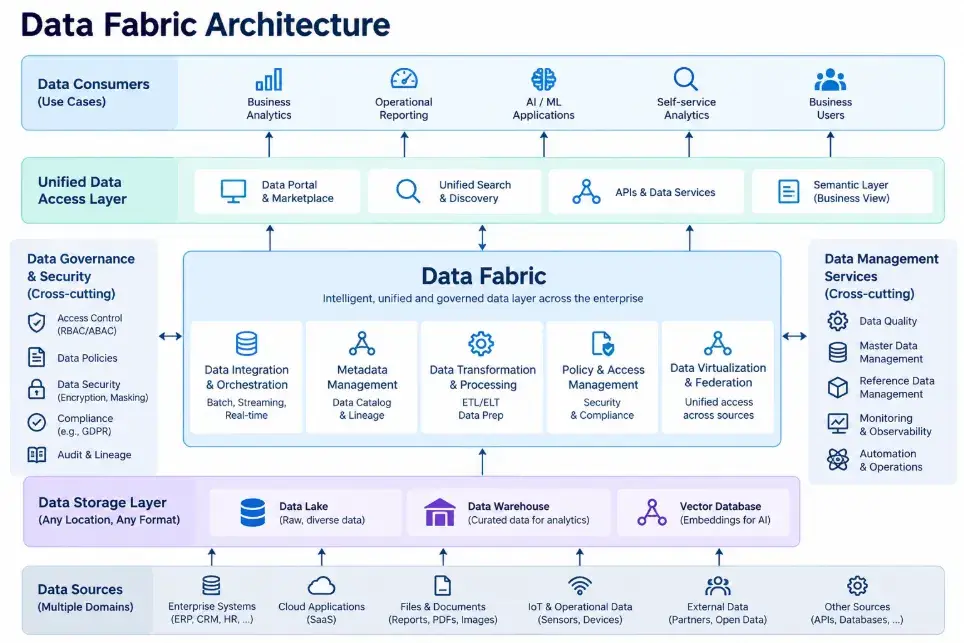
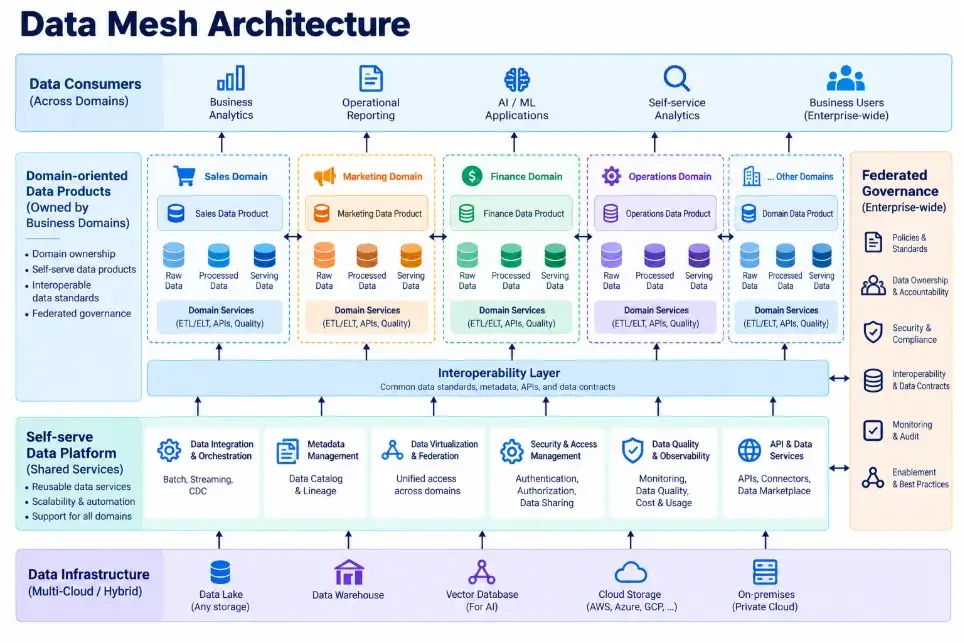
Data Fabric focuses on connecting and managing data across systems, while Data Mesh emphasizes domain-based ownership and responsibility under shared governance standards. These principles can complement each other, helping organizations improve enterprise-wide visibility while preserving appropriate control over data access and ownership.
Integrating data without replacing existing systems
Replacing established applications to resolve data fragmentation can introduce unnecessary cost and operational disruption. TMA Data Platform supports customizable data architectures and deployment across on-premises and multi-cloud environments, allowing integration designs to accommodate existing infrastructure.
Enterprises can start with a priority use case, such as consolidating sales and inventory data, then expand to finance, procurement or other business domains as needs to evolve.
TMA project example: Centralizing genetic data
An Australian agriculture client faced challenges involving fragmented genetic data, information security and biological parentage verification. TMA developed a solution comprising a Centralized Data Repository (CDR), a Genetic Evaluation System (GES), and machine learning algorithms to predict breeding values. By bringing specialized datasets together, the solution supported genetic evaluation and predictive analytics.
Building a unified data foundation for analytics and AI
Integrated data is an important foundation for scaling AI across an enterprise. In its June 2026 article, AI Data Readiness: The Key to Scaling Impact, McKinsey reports that only 7% of companies have fully scaled AI across their organizations. The article highlights the need for a governed, reusable data foundation that connects structured and unstructured information.
For businesses, this means preparing data that is not only accessible but also reliable, traceable, and governed appropriately. TMA Data Platform supports data integration, processing, storage and analytics, helping organizations prepare connected datasets for business intelligence, predictive analytics, and AI workloads.
A practical roadmap for enterprise data integration
A successful data silos consolidation initiative starts with a defined business objective rather than connecting every system at once.
- Map data sources: Identify systems, data owners, update schedules, API limitations, and inconsistencies.
- Prioritize use cases: Select a business problem, such as reconciling inventory across ERP, WMS, POS, and e-commerce.
- Design the architecture: Choose suitable integration and storage methods, then define data quality rules, ownership and access controls.
- Measure and expand: Evaluate data accuracy, reporting speed, pipeline reliability and manual reconciliation effort before expanding to additional systems, making connected data more dependable and reusable.
Build a more connected enterprise with TMA
An effective enterprise data integration solution must address disconnected systems, inconsistent records and the management of data after integration. TMA Data Platform supports this goal through data ingestion, processing, storage and analytics capabilities tailored to existing systems and business needs.
Contact TMA to discuss your enterprise data integration requirements and explore how TMA Data Platform can help consolidate data silos and prepare trusted data for analytics and AI.


.webp_2026-11-09-17-47-26-954.webp)
.webp_2026-11-09-17-00-55-331.webp)
.webp_2026-11-09-16-48-35-330.webp)