Traditional camera systems are increasingly revealing their limitations due to an over-reliance on manual human monitoring. The emergence of AI surveillance systems - combining real-time threat detection & prevention with advanced data processing - has marked a major turning point, allowing businesses and modern cities to shift from passive video recording to proactive risk prevention.
Overview of AI Surveillance Systems
Definition and Mechanism of Smart AI Cameras
An AI surveillance system integrates security cameras with Deep Learning algorithms and Computer Vision to automatically analyze video streams as soon as images are captured. Instead of simply storing raw footage, the system extracts key entities such as people, vehicles, objects, and behaviors in real time.
The operational pipeline begins with data acquisition and preprocessing, where high-resolution video frames are extracted directly from the camera feed. Next, advanced AI analytics models - including YOLO and Convolutional Neural Networks - analyze spatial patterns, identify objects, and track movement trajectories. Finally, the system executes real-time alerting by triggering immediate local alarms, sending SMS notifications, or pushing real-time incident reports to a Security Operations Center (SOC) within milliseconds.
Key Differences Between Traditional CCTV and Real-Time AI Surveillance
Traditional surveillance models suffer from inherent weaknesses that often lead to delayed responses. The comparison table below highlights the advantages of AI-integrated systems:
Criteria | Traditional Surveillance (CCTV) | Real-Time AI Surveillance |
Monitoring Method | Manual human monitoring of screens. | Automated 24/7 analysis via AI algorithms. |
Accuracy | High risk of missed events due to fatigue or distraction. | Precise identification; significantly reduces false alarms. |
Incident Response | Passive; reviewing footage after an incident occurs. | Instant alerts within milliseconds to prevent active threats. |
Scalability | High labor costs when scaling up camera counts. | Easily scalable through software and edge AI hardware. |
Core Capabilities in Real-Time Threat Detection & Risk Prevention
Behavioral Analytics and Intrusion Detection
Behavioral analytics forms the backbone of next-generation security systems, allowing computer vision models to evaluate spatial interactions in real time. Key applications include:
- Intrusion Detection: Deep learning architectures - as highlighted in research published in IEEE Transactions on Pattern Analysis and Machine Intelligence (TPAMI) - enable automated video analytics to flag unauthorized individuals crossing virtual perimeters with high accuracy.
- Anomalous Behavior Identification: Empirical studies show that CNN-based models can recognize sudden crowd gatherings, loitering, physical fights, and public property damage in real time.
- Automated Weapon Detection: Advanced object detection algorithms identify hazardous objects like firearms or knives, instantly triggering automated emergency lockdown protocols before situations escalate.
Early Warning Systems for Fire Hazards and Occupational Safety
Beyond security enforcement, AI cameras play a critical role in mitigating industrial hazards and enforcing workplace safety standards:
- Smoke & Fire Detection: Testing standards by fire safety research institutes indicate that vision-based algorithms can identify rising smoke plumes or sparks up to 90 seconds faster than traditional ceiling thermal sensors, preventing catastrophic property loss.
- PPE Compliance Monitoring: Leveraging specialized ppe detection solutions and a robust industrial safety monitoring system, platforms utilizing frameworks like NVIDIA Metropolis continuously enforce Occupational Safety and Health Administration (OSHA) compliance. The system automatically verifies whether workers wear Personal Protective Equipment (PPE) - such as hard hats, high-visibility vests, and protective masks - while functioning as a smart emergency alert solution to issue instant compliance reminders.
The Edge AI Breakthrough in Modern Security Monitoring
Ultra-Low Latency and Internet-Independent Operation
Edge AI technology revolutionizes video processing by shifting algorithmic workloads from centralized cloud servers directly onto localized hardware, such as smart cameras and AI Boxes. By processing data locally, these systems achieve ultra-low latency, reducing response times to milliseconds - a critical factor during active security breaches or fast-spreading fires. Additionally, Edge AI guarantees complete offline functionality, ensuring that threat analysis and perimeter protection continue uninterrupted even during severe network outages or internet disconnections.
Bandwidth Optimization and On-Device Data Privacy
Processing video streams directly on edge devices delivers significant economic and privacy benefits. Localized processing drastically optimizes bandwidth consumption because the system transmits only event metadata or violation snapshots rather than streaming continuous HD video feeds over corporate networks. Furthermore, performing analysis on-device fortifies data privacy, ensuring that raw video recordings remain stored within secure local parameters and minimizing exposure to external cyber threats during data transmission.
Featured Real-World Case Studies by TMA Solutions
As a top AI development company in Vietnam, a recognized enterprise AI company, and a trusted custom AI development company, TMA Solutions translates theoretical computer vision models into field-tested, enterprise-grade security deployments. By delivering tailored industrial AI surveillance solutions, deployable edge devices (AI Boxes), and lightweight computer vision models over camera networks, TMA stands out among top AI solutions companies in Vietnam to deliver real-time threat detection across two key domains:
Case 1: Public Safety Monitoring & AI Road Damage Detection
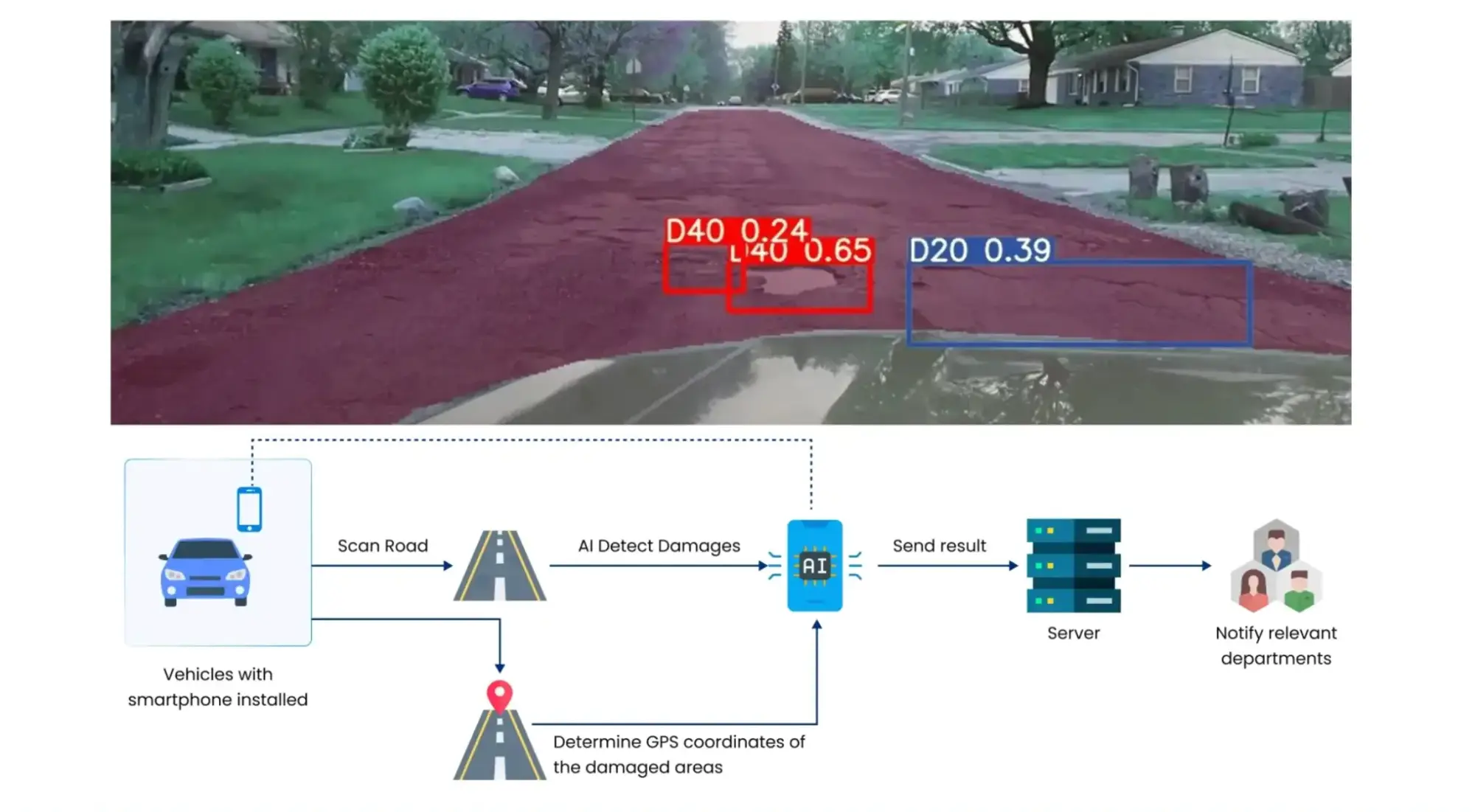
Overview & Challenge: Ensuring public safety and maintaining municipal infrastructure across vast road networks requires continuous monitoring, but traditional manual inspection is slow, labor-intensive, and prone to missing critical hazards.
TMA's AI Surveillance Solution: TMA engineered a real-time computer vision system integrated with smart cameras and mobile Edge AI units. The system automatically identifies road damages (such as potholes and surface cracks) with over 85% accuracy across diverse global environments (including India, Japan, and Europe), while simultaneously performing drivable area segmentation.
Real-Time Operational Impact: Operating in real time, the platform maps precise GPS coordinates of road hazards onto a digital dashboard. This allows municipal maintenance teams and public safety authorities to dispatch repair crews instantly to critical areas, preventing traffic accidents and optimizing resource allocation without relying on manual inspections.
Source: TMA Case Study: AI for Road Damage Detection & Quality Control
Case 2: In-Cabin Automotive Security & Dangerous Situation Detection (T-DMS)
Overview & Challenge: Vehicle fleets and transport operators face severe security and safety risks from driver fatigue, distraction, and potential physical threats or armed escalation inside the vehicle cabin.
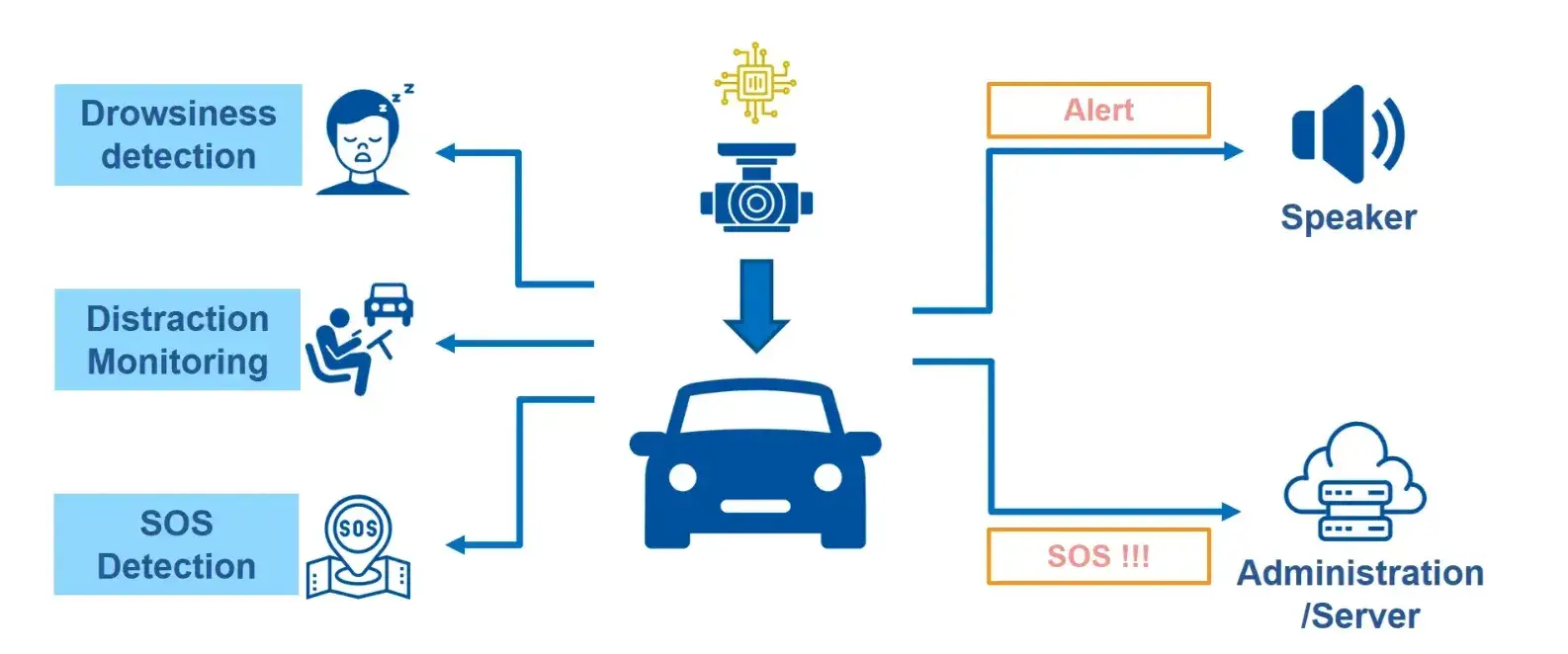
TMA's AI Surveillance Solution: Recognized as a leading AI development company in Vietnam, TMA developed a lightweight AI architecture through its T-DMS (Driver Monitoring System) platform, combining TensorFlow Lite and computer vision solutions for factories and fleets running directly on edge hardware. As a comprehensive AI surveillance solution for factories and commercial transport, the system continuously monitors in-cabin activity in real time to detect dangerous situation anomalies, including physical aggression, driver distraction, and threats involving weapons.
Real-Time Operational Impact: Upon recognizing a weapon or high-risk threat, the AI model instantly triggers an emergency communication workflow. It captures snapshot evidence, exact GPS coordinates, and timestamps, transmitting SOS alerts to central servers via lightweight APIs within milliseconds to initiate rapid emergency response.
Source: TMA Insights: AI and Automotive Security & Real-Time Driver Safety Systems
Conclusion
AI surveillance systems represent a fundamental shift from reactive video recording to proactive threat prevention, providing organizations with ultra-low latency alerts, minimal false alarms, and resilient localized Edge AI security. By converting raw, unmonitored video streams into actionable real-time intelligence through robust surveillance solutions in manufacturing, enterprise facilities and modern cities can now intercept perimeter intrusions, workplace hazards, and in-cabin transport threats within milliseconds, long before irreversible damage or operational downtime occurs.
To capture these competitive advantages without embarking on costly hardware overhauls, enterprises should adopt a structured, phased implementation strategy, starting with an audit of existing camera infrastructure, deploying targeted edge devices like TMA Solutions' AI Box for high-risk zones, and seamlessly integrating real-time computer vision into central management systems (SOC, BMS, or ERP). Embracing this data-driven security evolution transforms traditional CCTV networks from passive cost centers into proactive, intelligent assets that ensure continuous compliance, operational efficiency, and absolute peace of mind.