Overview Of AI In Demand Forecasting And Inventory Optimization
What Is AI Demand Forecasting?
AI Demand Forecasting utilizes Machine Learning (ML), Artificial Neural Networks (ANN), and Deep Learning to process millions of real-time data points. Unlike traditional methods that rely purely on internal historical sales data, AI-driven systems absorb dynamic external variables, including:
- Competitor pricing shifts and broader market signals.
- Weather conditions, seasonality, and promotional campaigns.
- Consumer trends from social media channels and macroeconomic metrics.
By analyzing complex relationships, AI allows organizations to accurately predict SKU-level (Stock Keeping Unit) demand down to individual retail outlets or fulfillment centers.
What Is AI Inventory Optimization?
AI Inventory Optimization continuously balances target Service Levels/ Fill Rates with Holding Costs. Instead of maintaining static safety stock calculations based on subjective assumptions, AI continuously updates dynamic safety stock thresholds. It adjusts daily according to real-time demand fluctuations and vendor lead-time variability. According to market research by Intel Market Research (2026), the global AI Inventory Optimization market reached $3.5 billion in 2026 and is projected to expand to $7.8 billion by 2034, growing at a CAGR of 9.0%.
Why Legacy Inventory Forecasting Methods Are Outdated
Core Limitations Of Traditional Forecasting
Traditional inventory management practices, relying heavily on static spreadsheets, simple Moving Averages, or Exponential Smoothing, struggle to perform in volatile market environments due to several critical flaws:
- Heavy Reliance on Manual Processing: Planners spend up to 40%-60% of their time aggregating data from disconnected ERP and WMS platforms.
- High Forecast Error Rates (High MAPE): Classical statistical approaches frequently exhibit Mean Absolute Percentage Error (MAPE) rates between 35% and 45%, leading to chronic overstocking or understocking.
- Amplified Bullwhip Effect: Delayed, batch-processed data creates mismatches between real consumer demand and upstream production orders.
Legacy Forecasting vs. AI-Driven Forecasting
Feature/ Criteria | Legacy Statistical Methods | AI Demand Forecasting |
Data Inputs | Historical internal sales history only | 50-100+ exogenous variables (weather, trends, market inputs) |
Update Frequency | Batch processing (Weekly or Monthly) | Continuous real-time stream processing |
Forecast Error (MAPE) | 35% - 45% (High volatility) | 8% - 15% (High precision) |
Safety Stock Calculation | Static buffer levels | Dynamic, daily automated recalibration |
New SKU Handling | Heuristics or manual assignment | Clustering algorithms learning from similar market signals |
Measurable Benefits And Real-World Impact Of AI In Inventory Management
- Significant Reduction in Working Capital: Adjusting inventory based on real-time customer demand helps businesses avoid keeping too many extra products. This frees up cash tied up on warehouse shelves. According to a study by McKinsey & Company, using AI for demand forecasting helps companies reduce tied-up money by 20% to 35%, giving them more ready cash to grow their business.
- Lower Inventory Holding Costs: Holding extra stock leads to heavy ongoing costs for warehouse rent, insurance, labor, and product damage. Research by Gartner shows that AI models automatically find the best reorder points, helping companies cut storage costs by 18% to 28% and prevent products from going bad or becoming outdated.
- Accelerated Inventory Turns: Processing demand signals automatically helps products move much faster from main warehouses to store shelves. According to Harvard Business Review, real-time predictions prevent items from sitting unsold for too long, driving a 15% to 30% boost in stock turnover so products sell out and refresh faster.
- Minimized Stockout Sales Losses: Running out of stock frustrates customers and causes lost sales to competitors. A study by Deloitte Insights shows that AI predicts sudden demand spikes and delivery delays in advance, reducing lost sales from stockouts by up to 65% while keeping order fulfillment rates above 97%.
Case Study: How TMA Solutions Optimized Inventory Through Azure Demand Forecasting
Business Challenge & Solution Approach
One of the most practical demonstrations of AI for demand forecasting & inventory optimization comes from a real-world case study developed by TMA Solutions for a major logistics service provider in Australia.
- The Core Challenge: The client was struggling with fragmented transactional data scattered across isolated enterprise systems. Lacking a centralized, automated forecasting engine, they experienced frequent demand miscalculations - resulting in critical stockouts at high-demand regional nodes while suffering from capital-draining excess inventory in others.
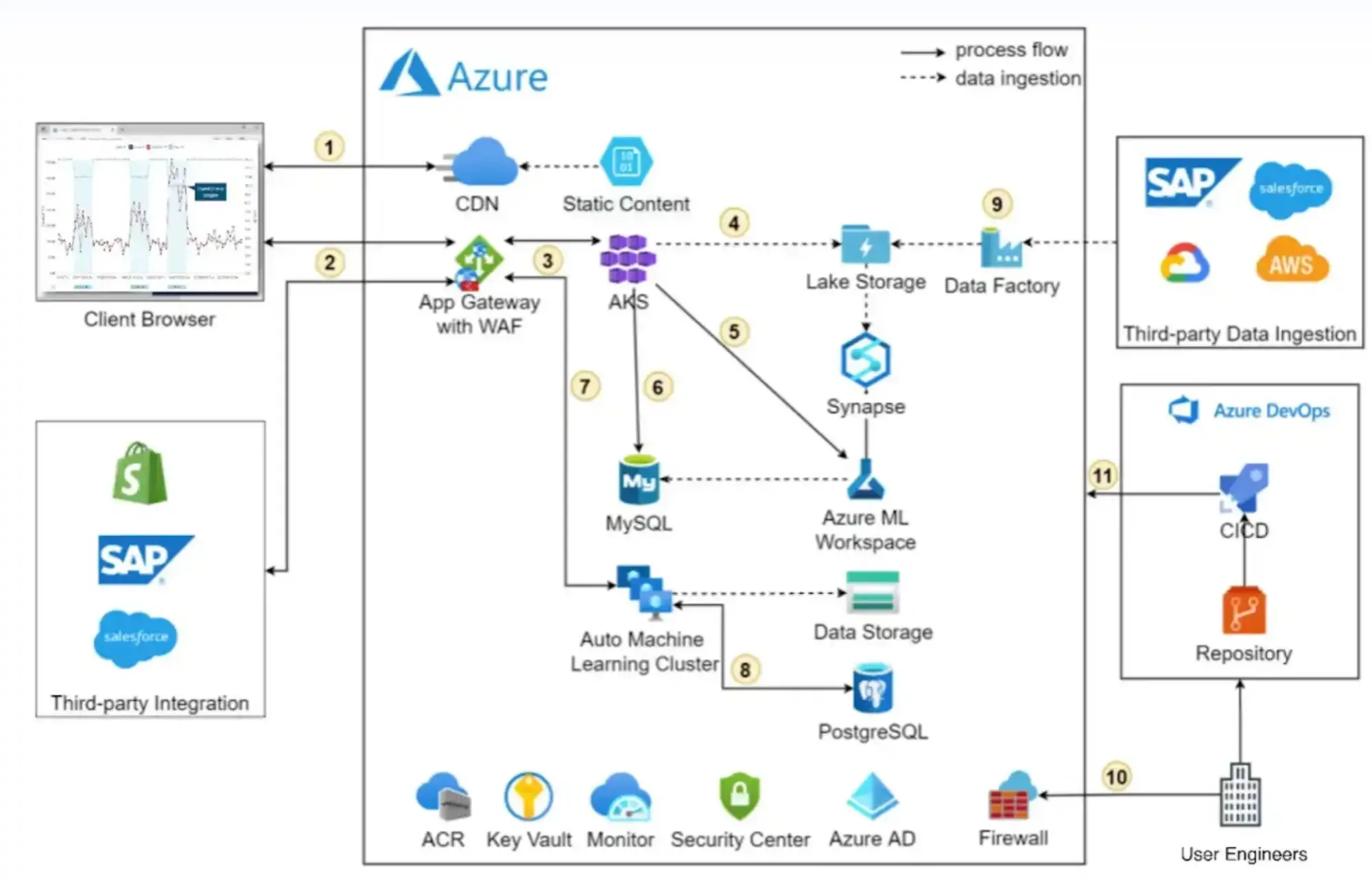
- The Strategic Solution: To solve this structural inefficiency, TMA engineered and deployed an end-to-end, real-time demand forecasting and inventory replenishment architecture leveraging cloud-native infrastructure on Microsoft Azure.
Technical Architecture
The engineering team at TMA Solutions integrated several modern cloud-native components to create a scalable, low-latency prediction pipeline:
- Azure Data Factory & Azure Synapse Analytics: Unified disparate operational datasets, historical sales logs, and inventory snapshots into a centralized, clean data platform for downstream analytics.
- Azure Machine Learning: Built and continuously trained advanced predictive algorithms to evaluate multi-variate demand signals and forecast SKU-level requirements in real time.
- Power BI, RabbitMQ, & Azure Kubernetes Service (AKS): Implemented high-throughput message queuing with RabbitMQ, managed containerized deployment using AKS for auto-scaling during traffic surges, and rendered interactive Power BI dashboards for real-time executive decision-making.
Key Measurable Outcomes:
- Optimized Stock Allocation: Balanced inventory distribution across regional warehouses, significantly curbing localized stockouts while liquidating surplus stock.
- Accelerated Decision Cycles: Enabled supply chain managers to monitor demand fluctuations via dynamic dashboards and automate inventory replenishment triggers.
- Enterprise Infrastructure Scalability: Built a resilient, future-proof Azure cloud platform capable of processing millions of real-time transactions as business volume grows.
Conclusion
Transitioning to AI for demand forecasting & inventory optimization is no longer just an operational upgrade; it is a critical strategy for staying competitive in modern commerce. By replacing static spreadsheets with dynamic machine learning algorithms and cloud-native solutions, businesses can dramatically reduce storage costs, eliminate revenue-draining stockouts, and free up vital capital. As market volatility continues to rise, early adopters of predictive supply chain technologies will lead the industry in agility, profitability, ad customer satisfaction.