Traditional BI remains valuable for monitoring business performance, but enterprise analytics now often goes beyond historical dashboards to include data engineering, advanced analytics, real-time processing, forecasting, and AI/ML for specific business problems that reporting alone cannot solve. In this context, a data analytics solution development company plays a key role by helping enterprises connect fragmented data, build reliable data pipelines, develop analytics and AI/ML capabilities, and integrate insights into existing systems. For Heads of Analytics, the goal is not to “predict the future” in a general sense, but to establish a robust data and analytics foundation that supports specific forecasting, monitoring, and decision-support use cases.
Why Traditional BI Reporting No Longer Supports Enterprise Growth
Traditional BI tools are effective for tracking historical performance, but they are limited when enterprises need forward-looking intelligence. The core issue is not visualization, but the underlying data architecture and lack of advanced analytics capability.
Dashboards only explain what already happened
Most BI dashboards focus on standard business KPIs such as revenue, sales performance, customer acquisition, inventory levels, operational costs, and workforce productivity. These metrics are important for visibility, but they are inherently descriptive.
For a Head of Analytics, the real challenge is no longer reporting performance, but answering forward-looking questions:
- Which products will see increased demand in the next quarter?
- Which customer segments are at high risk of churn?
- How can supply chain routes be optimized to reduce operational delay?
Addressing these questions requires predictive and prescriptive analytics capabilities, not just descriptive reporting. In short, descriptive analytics explains what happened, predictive analytics estimates what will happen, and prescriptive analytics recommends what should be done. Each layer adds more value but requires more advanced data engineering.
Data silos reduce the value of BI systems
Even the most advanced BI platform cannot deliver reliable insights if enterprise data remains fragmented. In most organizations, data is distributed across ERP systems, CRM platforms, POS systems, e-commerce platforms, operational databases, IoT devices, and data warehouses.
When these systems are not properly integrated, analytics teams spend significant time on data preparation instead of generating insights. This reduces both speed and accuracy of decision-making across the enterprise.
This is why data engineering is the foundation of enterprise analytics success. A modern analytics environment must ensure reliable ingestion, transformation, integration, storage, and data quality management before any advanced analytics or AI model can deliver value. TMA Solutions positions Big Data, Data Engineering, and Analytics as a core capability area, covering data warehousing, BI, visualization, predictive analytics, machine learning, and large-scale data processing.
The Shift From Historical Reporting to Predictive Analytics
Enterprise analytics is evolving from reporting what happened to predicting what will happen and enabling better decisions. This shift is not optional anymore, because business environments are becoming more dynamic and competitive. This does not mean replacing BI dashboards. It means expanding the analytics stack so that enterprises can support higher-value use cases where prediction and action are required.
From descriptive to predictive analytics
A modern analytics maturity model typically includes multiple layers of intelligence. Each layer builds on the previous one and increases business value.
Analytics Type | Core Question | Enterprise Example |
Descriptive | What happened? | Sales performance reporting |
Diagnostic | Why did it happen? | Root cause analysis of revenue drop |
Predictive | What will happen? | Demand forecasting |
Prescriptive | What should we do? | Inventory optimization |
For example, a retail enterprise may already track inventory levels through BI dashboards. However, the next step is to predict future demand by product, region, and channel to optimize stock planning.
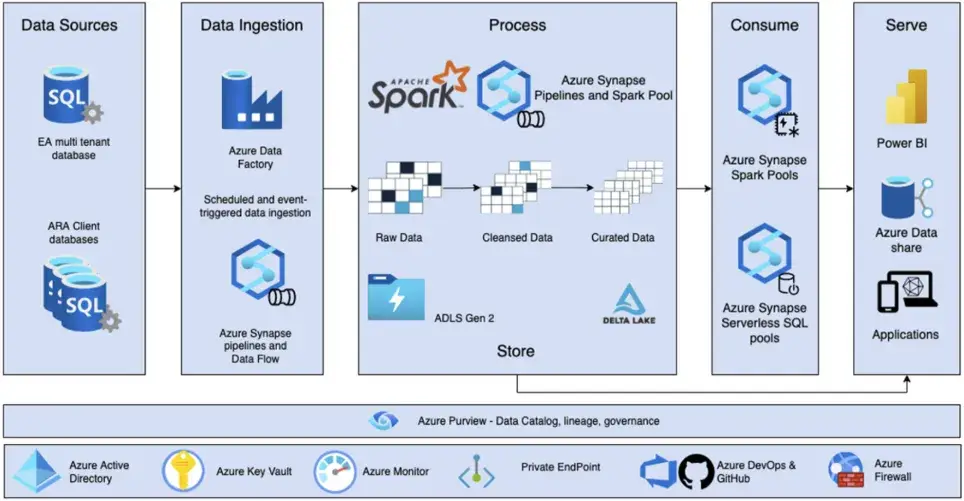
TMA Solutions has implemented retail demand forecasting solutions using Azure Machine Learning and time-series analytics. These solutions integrate ERP, POS, and e-commerce data to support inventory planning and supply chain visibility. This highlights a key point: predictive analytics is not just about models, it depends on a strong and well-structured data pipeline.
From prediction to operational decision-making
Predictive insights only create value when they influence real business actions. Without execution, even the most accurate model has limited business impact.
A complete decision intelligence loop involves:
- Data Collection: Gathering unstructured and structured data across systems.
- Prediction Generation: Applying AI/ML models to forecast trends and risks.
- Decision Making: Recommending optimal actions based on business rules.
- Action Execution: Connecting insights directly into operational workflows (ERP/CRM).
- Outcome Measurement: Tracking results to refine future model accuracy.
For example, demand forecasting influences procurement decisions, predictive maintenance triggers equipment inspection, and customer churn prediction drives retention campaigns. Each use case shows how analytics translates directly into operational value. TMA's predictive analytics and automation approach focuses on connecting AI-driven insights directly to operational workflows, enabling organizations to move from insight generation to action execution in a structured, scalable way.
What Enterprises Need From a Data Analytics Solution Development Company
Selecting a data analytics solution development company should not be based only on dashboard development capability. Enterprises need partners that can design and operate the full analytics ecosystem - from raw data to decision execution.
Strong data engineering foundation
Advanced analytics is only as good as the data behind it. If data is incomplete or inconsistent, even the best models will produce unreliable results.
A capable partner should be able to design and implement multi-source data ingestion pipelines, batch and real-time processing, data transformation, and standardized data models. They should also support data lake, data warehouse, or lakehouse architectures depending on enterprise needs.
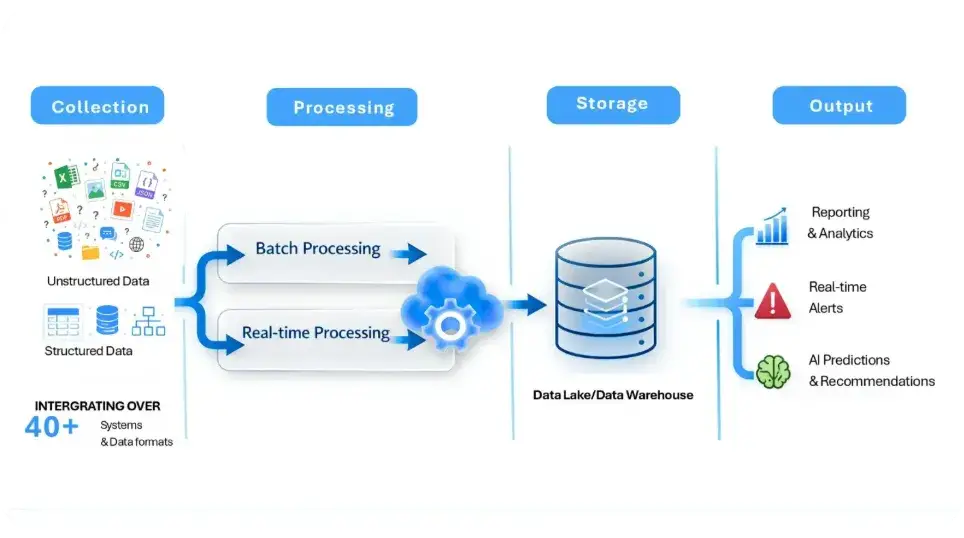
TMA’s Data Platform supports enterprise data infrastructure across on-premise and multi-cloud environments, with capabilities for data lake, data warehouse, data lakehouse, batch processing, real-time analytics, streaming analytics, BI, AI/ML, and data governance.
Advanced analytics and AI capabilities
Beyond BI, enterprises need partners with experience in regression, classification, clustering, time-series forecasting, anomaly detection, machine learning pipelines, and optimization models. These capabilities allow organizations to move from reporting to intelligent decision systems.
TMA’s capabilities include these techniques as part of its AI and data analytics portfolio. The key principle is that the right model should always be selected based on the business problem, not the other way around.
Real-time and operational analytics
Many enterprise decisions cannot wait for batch reporting cycles. In fast-moving environments, delayed insights can lead to missed opportunities or operational risks.
Real-time analytics supports use cases such as inventory tracking, fraud detection, equipment monitoring, customer behavior analysis, and supply chain visibility. These use cases require continuous data processing and fast response times.
Integration with enterprise systems
Analytics cannot operate in isolation because business value comes from connected systems. A strong partner must integrate analytics with ERP, CRM, HR systems, POS platforms, e-commerce systems, IoT devices, and cloud services.
TMA’s enterprise projects demonstrate integration across ERP, POS, and e-commerce systems to enable unified analytics for retail operations. This ensures that decision-making is based on a complete view of enterprise data rather than isolated datasets.
How AI Improves Enterprise Decision Intelligence
AI significantly enhances enterprise analytics by enabling systems to detect patterns, generate predictions, and support decision-making at scale. However, AI effectiveness depends heavily on data quality and architecture.
AI-driven forecasting and anomaly detection
AI and machine learning can be applied to demand forecasting, predictive maintenance, customer churn prediction, fraud detection, quality control, and operational anomaly detection.
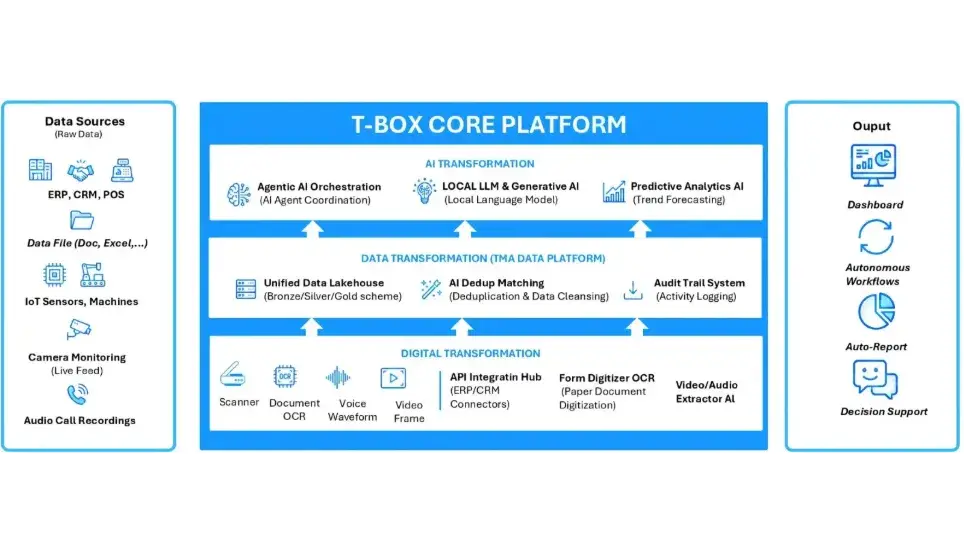
For example, TMA's predictive maintenance solution combines sensor data with Generative AI to provide contextual maintenance insights for operators - improving both the speed and accuracy of decision-making in industrial environments. The key value of AI is not only prediction, but also contextual intelligence directly tied to business operations.
From insights to action
Modern analytics systems must go beyond insight generation and support action execution. A complete decision intelligence loop allows systems to continuously learn and improve over time.
TMA's AI-powered analytics approach focuses on connecting predictive models with APIs, automation systems, and operational workflows - enabling enterprises to operationalize insights instead of only visualizing them.
Choosing Between In-House Analytics Teams and External Data Partners
Enterprises often face a strategic decision between building analytics capabilities internally or working with an external partner. The right choice depends on maturity, resources, and business priorities.
When in-house teams are sufficient
Internal teams are effective when organizations already have strong data engineering talent, data science expertise, cloud architecture capabilities, and established data platforms. In this case, internal teams are best positioned to own long-term analytics strategy.
However, internal teams may face limitations when scaling multiple complex initiatives simultaneously, especially when new technologies or large transformation programs are required quickly.
When external partners add value
External data analytics solution development companies are valuable when enterprises need to:
- Modernize legacy architectures and data silos.
- Build enterprise-scale data lakes or lakehouses.
- Implement complex predictive analytics or real-time streaming systems.
- Accelerate AI adoption and scale engineering capacity rapidly.
The value is not just additional manpower, but access to specialized domain experience and proven enterprise delivery capability. TMA Solutions operates a dedicated Data Solution Center, providing deep expertise across data engineering, AI/ML, cloud, and analytics.
Hybrid model for enterprise analytics
In most cases, a hybrid model is the most effective approach. Internal teams focus on business requirements, governance, analytics strategy, and domain expertise, while external partners handle architecture, engineering, and implementation.
This model allows enterprises to maintain control while leveraging external expertise for complex technical execution. It also improves speed and reduces risk in large transformation programs.
When evaluating top data solutions companies, enterprises should prioritize real-world experience, integration capability, predictive analytics expertise, and proven enterprise delivery rather than only toolsets or team size.
Conclusion
Enterprise analytics is shifting from descriptive reporting to predictive and operational intelligence. This shift requires more than BI tools - it requires a complete, end-to-end data and analytics ecosystem.
Among top data solutions companies, a dedicated data analytics solution development company plays a critical role in building this foundation by combining data engineering, AI/ML, real-time processing, and cloud architecture into a unified system that supports decision-making at scale. TMA Solutions brings together Big Data, AI, cloud, and enterprise engineering capabilities with documented use cases in retail demand forecasting, predictive maintenance, and enterprise data and analytics.
For Heads of Analytics, the key question is no longer whether BI is enough. The real question is whether the organization is ready to move from reporting the past to predicting and shaping the future and that is where the right analytics engineering partner becomes a decisive strategic advantage.