Enterprise social platforms fail less often because of a missing “like” button and more often because the product cannot keep video smooth, feeds relevant, communities safe, and releases predictable under real user load. In North America, that risk is commercially significant: Pew Research Center’s 2025 U.S. survey reports that 84% of U.S. adults use YouTube, 71% use Facebook, 50% use Instagram, and 32% use TikTok, with YouTube reaching 95% of adults ages 18-29. For CTOs, CIOs, product leaders, and sourcing managers, this means social app development is now a platform engineering challenge, not only a mobile UI project.
A scalable social, video, and livestream app requires four connected capabilities: real-time media delivery, personalized discovery, creator/community workflows, and secure cloud operations. TMA Solutions positions itself as a technology and innovation partner and Vietnam software outsourcing company with 29 years of experience, 4,000 engineers, clients from 30 countries, 10+ technology and solution centers, and a quality foundation that includes CMMI, Agile, RUP, ISO 9001, and ISO 27001. That matters because video-first platforms need sustained engineering capacity across mobile, backend, cloud, DevOps, testing, data, and security.
Why Specialized Social Apps Are Winning Audiences
Generic social networks optimize for broad reach. Specialized social apps win when they serve a clearer community: sports fans, enterprise employees, fitness creators, patient communities, alumni networks, learning cohorts, creator marketplaces, or live commerce audiences.
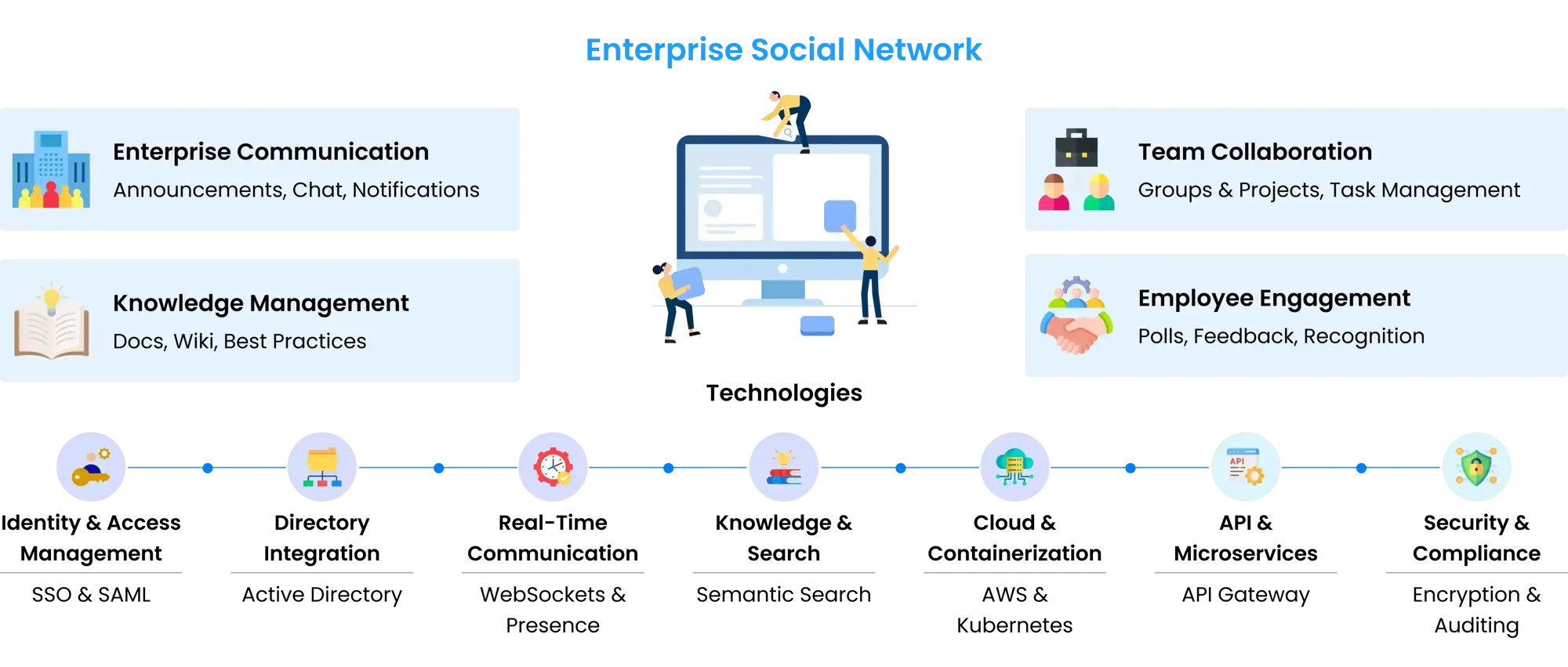
Because the audience is more specific, the product architecture can be more focused. A sports app may prioritize live scores, synchronized comments, highlight clipping, and fan polls. An enterprise social network may prioritize identity management, role-based groups, content governance, audit trails, and integration with Microsoft 365 or internal systems. A creator app may prioritize monetization, moderation workflows, livestream scheduling, and recommendation quality.
The technical constraint is that niche does not mean small. A specialized app may run quietly most of the day and then spike during a game, webinar, product drop, or live event. The mitigation strategy is event-aware architecture: autoscaling backend services, CDN-backed media delivery, queue-based fanout, observability, and graceful degradation for non-critical features. The business outcome is predictable user experience even when audience behavior is uneven.
Must-Have Features for Video-First Social Platforms
A video-first social platform should be designed around participation, not only consumption. The core feature map includes user identity, profiles, follows, posts, video upload, livestream rooms, chat, reactions, recommendations, notifications, moderation, analytics, admin controls, and monetization.
Livestreaming, Chat, Reactions, And Creator Tools
Livestreaming requires a tighter latency budget than on-demand video. Chat, emoji reactions, Q&A, tipping, polls, and live shopping overlays must feel synchronized with the stream. If video arrives 15 seconds later than chat, the room feels broken.
The architecture typically separates media transport from interaction services:
- Media ingest: mobile camera, encoder, RTMP/SRT/WebRTC input, or studio feed.
- Media processing: transcoding, adaptive bitrate renditions, recording, thumbnailing, and clipping.
- Delivery: CDN, low-latency HLS/DASH, or WebRTC for interactive rooms.
- Realtime interaction: WebSocket, MQTT, or managed pub/sub for chat and reactions.
- Creator backend: scheduling, stream keys, analytics, moderation, revenue tools, and replay management.
WebRTC is relevant where real-time peer or group interaction is required; the W3C specification defines browser APIs for sending media and application data between browsers or devices, including NAT traversal using ICE, STUN, and TURN [3]. However, WebRTC is not always the best answer for one-to-many broadcasting. Large public streams often combine low-latency HLS/DASH with CDN delivery, while WebRTC fits video rooms, co-hosting, auctions, telehealth-like interactions, or backstage creator workflows.
Discovery Feeds And Personalized Recommendations
Discovery is the growth engine. A chronological feed is simple, but it rarely optimizes engagement, freshness, safety, and creator diversity at the same time. A modern feed service should support:
- Candidate generation from follows, topics, trending content, location, events, and similar users.
- Ranking models using watch time, completion rate, skips, likes, comments, shares, freshness, and content quality signals.
- Guardrails for blocked users, muted topics, age restrictions, policy status, and regional rules.
- Experimentation through A/B testing, feature flags, and ranking model evaluation.
- Explainability for internal teams, especially when business teams ask why certain content is promoted.
Because recommendation systems can amplify poor content or bias, engineering teams need moderation, human review queues, abuse reporting, and model monitoring. The goal is not only “more watch time”; it is sustainable engagement that protects users, creators, and the brand.
Low-Latency Streaming And Scalable Infrastructure
Low-latency social architecture is a chain. The final experience is only as strong as the slowest link: capture, encoding, ingest, transcoding, origin, CDN edge, player buffer, chat fanout, and client rendering.
A practical deployment pipeline should look like this:
- Define latency tiers: sub-second for co-hosted rooms, 2-5 seconds for interactive live events, and higher tolerance for replay or long-form video.
- Select protocols by use case: WebRTC for real-time interaction, LL-HLS/DASH for scalable broadcast, and standard HLS for replay resilience.
- Build cloud environments with infrastructure as code, separated dev/stage/prod accounts, secrets management, and rollback paths.
- Implement CI/CD for mobile apps, APIs, streaming services, data pipelines, and infrastructure modules.
- Add media observability: startup time, rebuffering ratio, dropped frames, bitrate switches, stream health, chat delay, CDN errors, and device-level crashes.
- Run load tests around event peaks, not only average traffic.
- Add security gates: dependency scanning, API authorization tests, mobile security checks, and abuse-case testing.
- Release with feature flags, staged rollout, canary monitoring, and incident playbooks.
TMA’s DevOps page states that its DevOps services support automation of end-to-end delivery pipelines, CI/CD, cloud managed services, 24/7 monitoring, logging, infrastructure as code, container management, and public cloud operations. For a social video product, these practices reduce release friction and help teams respond quickly when livestream events expose edge-case failures.
Enterprise Social Network And Sports App Use Cases
Enterprise social networks and sports apps share one architectural truth: users care about timing and trust.
For enterprise social networks, buyers typically need secure identity, SSO, RBAC, department or project communities, searchable knowledge posts, content approval, internal livestreams, and analytics for adoption. The technical constraints are governance, privacy, and integration with existing systems. The mitigation strategy is modular architecture with API-first integration, audit logging, encryption, and configurable retention policies. Where GDPR-aware delivery practices or industry-specific privacy expectations apply, they should be treated as design requirements, not late legal review.
For sports apps, the priority shifts toward real-time engagement. Fans expect live match centers, watch parties, athlete or creator livestreams, short-form highlights, fantasy or prediction features, team communities, push alerts, and sponsorship placements. The technical constraint is burst traffic around games. The mitigation strategy is cache-first read architecture, CDN-based media delivery, queue-based notifications, and separate write paths for chat, reactions, and scoring updates.
TMA’s public case-study library shows adjacent capability in centralized data platforms, dynamic segmentation and personalized marketing, semantic search and chat, Azure-based analytics, identity analytics, and cloud data integration. These are relevant building blocks for social discovery, audience segmentation, moderation operations, and enterprise knowledge search, but any specific social app case study should be cited separately if used in final sales collateral.
Outsourcing Social App Development To Vietnam
Outsourcing social app development to Vietnam can support North American buyers when the goal is not simply lower hourly cost, but faster access to multi-disciplinary delivery capacity. TMA’s software development page states that the company provides agile offshore software development and has developed, enhanced, and maintained enterprise products, with 29 years of experience, 3,000 developers, and 1,000+ applications developed.
The comparison buyers should make is not “in-house versus outsourcing” in the abstract. It is “how much product, platform, QA, DevOps, data, and security capacity can we coordinate without slowing down?”
Evaluation Area | Generic Low-Cost ODC | Engineering Partnership Model |
Ownership | Ticket execution | Shared product, architecture, and delivery ownership |
Architecture | Often follows given specs only | Challenges assumptions and designs for scale, resilience, and maintainability |
CI/CD | Basic build scripts | Automated pipelines, IaC, staged releases, observability |
Testing | Manual-heavy validation | API, mobile, performance, security, regression, and media QoE testing |
Scaling | Adds developers reactively | Plans team composition across mobile, backend, cloud, DevOps, QA, data, and security |
Governance | Status reporting | Roadmaps, technical debt tracking, risk reviews, and release governance |
Lessons Learned From The Field
The biggest risk in social app outsourcing is not vendor location. It is shallow engineering ownership.
A common low-cost ODC pattern is to build features quickly while postponing refactoring. That creates technical debt in feed APIs, notification logic, media processing, and mobile state management. The short-term output looks fast; the long-term cost appears when every release breaks another user flow.
Another pitfall is fragile CI/CD. Social platforms change constantly, so manual release steps become a bottleneck. A mature partner should automate builds, tests, infrastructure changes, and rollback paths.
Code ownership ambiguity is equally dangerous. When mobile, backend, streaming, and data teams are separated without clear interface contracts, live-event defects become hard to diagnose. Engineering partnership models reduce this by defining service ownership, SLOs, API contracts, runbooks, and escalation paths.
Security-by-design is also non-negotiable. NIST’s Secure Software Development Framework recommends integrating secure development practices into each SDLC implementation to reduce vulnerabilities and address root causes. OWASP’s Mobile Top 10 highlights mobile risks such as improper credential usage, inadequate supply chain security, insecure authentication/authorization, insecure communication, privacy gaps, and insecure data storage. For social apps, these are not theoretical: weak authentication, exposed media URLs, insecure chat APIs, and poor moderation controls can damage trust quickly.
TMA’s security application development page lists secure coding, cloud security, DevSecOps and CI/CD security integration, penetration testing, vulnerability scanning, OWASP ASVS/MASVS, NIST SP 800-218, ISO 27034, and related practices among its standards, tools, and skill sets. That gives enterprise buyers a more concrete basis for evaluating security maturity than a generic “we follow best practices” claim.
Launch Your Social App With TMA Solutions
A successful social, video, and livestream app is a living platform. The launch version must be usable, but the architecture must also support new communities, new media formats, recommendation tuning, moderation improvements, and event-driven traffic growth.
For North American product and technology leaders, TMA Solutions offers a practical engagement model: use Vietnam-based engineering scale, mature delivery processes, cross-domain technology centers, and long-term software outsourcing experience to extend internal teams without reducing architectural discipline. The right starting point is a technical discovery workshop: define audience segments, latency targets, feature priorities, security requirements, cloud approach, team structure, and a 90-day MVP-to-scale roadmap.
FAQ
What is social, video, and livestream app development?
It is the engineering of mobile, web, backend, media, cloud, data, moderation, and DevOps systems that support social interaction, video publishing, live broadcasting, personalized feeds, and creator or community workflows.
Which streaming protocol should a social app use?
Use WebRTC for real-time interaction, low-latency HLS/DASH for scalable live broadcasts, and standard HLS for reliable replay. The best architecture often combines multiple protocols by use case.
How should enterprises evaluate an outsourcing partner?
Assess architecture capability, DevOps maturity, testing depth, security practices, team scalability, communication governance, and relevant delivery experience. Avoid evaluating only hourly rates.
Why outsource social app development to Vietnam?
Vietnam offers strong engineering talent and cost efficiency. With a mature partner such as TMA, buyers can access mobile, backend, cloud, QA, DevOps, data, and security skills under one delivery model.
How can TMA support scaling after MVP?
TMA can help expand from MVP to platform operations through dedicated teams, CI/CD, cloud infrastructure, testing, monitoring, security practices, and ongoing product enhancement.
Conclusion
Social, video, and livestream apps are now serious platform engineering programs. The winners combine low-latency media, personalized discovery, secure mobile architecture, reliable cloud operations, and disciplined release governance. TMA Solutions can support enterprise buyers that want more than basic outsourcing: a technology and innovation partner with scale, process maturity, and cross-functional engineering depth.
To explore your roadmap, engage TMA Solutions for a technical consultation on architecture, MVP scope, delivery model, and scale-readiness for your social, video, or livestream platform.