Enterprise retailers are no longer competing only on product assortment or price. They are competing on how quickly a shopper can move from discovery to trust to purchase inside a content-driven journey. Adobe Analytics reported that affiliate and promotional links from influencers and content creators drove about 20% of US e-commerce revenue on Cyber Monday 2024, and affiliate-linked products were six times more likely to convert than non-affiliate social content.
For CTOs, CIOs, product leaders, and sourcing managers, this makes social commerce platform development a strategic architecture decision. A scalable platform must connect shoppable content, livestream engagement, product data, checkout, AI personalization, community interactions, fulfillment, analytics, and governance without creating fragile channel-specific systems.
How Social Commerce Is Changing Online Retail
Social commerce blends content, community, and transaction into one buying path. Instead of sending users from a social post to a separate e-commerce storefront, the platform turns videos, livestreams, creator content, reviews, and community activity into measurable commerce events.
That shift changes the technical requirements. Traditional e-commerce platforms are usually optimized around search, category navigation, product detail pages, cart, and checkout. A social commerce platform must also support real-time interaction, creator attribution, product tagging, behavioral recommendations, moderation, campaign analytics, and multi-channel content distribution.
Because of this, the platform architecture should not be treated as a lightweight front-end extension. It requires a composable commerce foundation, event-driven data flows, secure APIs, scalable media infrastructure, and integration with CRM, ERP, payment gateways, shipping providers, customer data platforms, and marketing automation.
TMA Solutions’ positioning is relevant here because its official profile combines 29 years of software outsourcing experience, 4,000 engineers, clients from 30 countries, 10 solution and technology centers, and a quality foundation including CMMI, Agile, RUP, ISO 9001, and ISO 27001. For North American retailers, that scale matters when a commerce roadmap needs parallel workstreams across mobile, web, AI, cloud, QA, DevOps, and integration.
Essential Features of a Social Commerce Platform
A mature social commerce platform should be designed around four connected layers: experience, transaction, intelligence, and operations. If any layer is weak, the user experience may still look modern, but conversion, reliability, and maintainability will suffer.
Shoppable Content and Live-Stream Shopping
Shoppable content turns posts, short videos, creator reviews, and livestreams into structured product discovery surfaces. Technically, this requires:
- Product tagging mapped to SKU, inventory, price, promotion, and variant data.
- Low-latency content delivery for video and livestream events.
- Real-time chat, reactions, polling, and Q&A moderation.
- Creator, affiliate, and campaign attribution.
- Event tracking for impressions, clicks, add-to-cart, conversion, and returns.
The main architectural constraint is synchronization. If livestream inventory, pricing, or promotion rules are not aligned with the commerce engine, shoppers may see expired offers or unavailable products. The mitigation is to separate content orchestration from commerce-of-record systems while keeping APIs and event streams tightly governed.
Product Tagging, Carts, and Checkout
Social commerce checkout should minimize friction without weakening transaction integrity. Product tags need to resolve into accurate product detail, eligibility, inventory, tax, shipping, payment, discount, and fraud-check workflows.
For enterprise buyers, the key design decision is whether checkout occurs in-app, through an embedded commerce layer, or through a redirected owned storefront. Each option has trade-offs. In-app checkout can reduce drop-off, but it increases API dependency and payment orchestration complexity. Redirected checkout may simplify compliance boundaries, but it can lose context from the social interaction.
TMA’s e-commerce and retail capability includes end-to-end development, dedicated software teams, maintenance and support, payment gateway integration, CRM/ERP connection, shipping provider integration, AI application, and experience with platforms and frameworks such as Magento, Salesforce, Prestashop, Drupal, WordPress, headless commerce, PWA, and hybrid mobile applications. That breadth is useful when retailers need to modernize without replacing every existing commerce asset at once.
AI for Product Discovery and Personalization
AI improves social commerce when it helps shoppers find relevant products faster and helps retailers act on behavioral signals responsibly. The practical use cases include visual search, voice search, product recommendation, dynamic bundles, product description generation, churn prediction, customer segmentation, and personalized campaign triggers.
The capability is attractive, but the technical constraint is data quality. Recommendation engines need clean product attributes, behavioral events, inventory signals, user consent context, and feedback loops. Without that foundation, personalization becomes random merchandising with an AI label.
A robust AI pattern follows this sequence:
- Capture events from content, community, product, cart, checkout, and service interactions.
- Normalize data into customer, product, content, and campaign entities.
- Train or configure models for recommendation, similarity matching, segmentation, and intent prediction.
- Serve recommendations through low-latency APIs.
- Monitor model drift, bias, cold-start performance, and business impact.
TMA’s AI/ML and Data Sciences practice lists 10+ years of AI experience, clients from 20+ countries, 250+ AI certificates, 100+ AI solutions, and 100+ AI projects delivered. Its retail AI capabilities include visual and voice search, virtual try-on, product recommendation, chatbots, inventory alert, people counting, and client behavior monitoring. For social commerce, that means AI can be integrated as a production capability rather than a disconnected proof of concept.
Integrating Commerce, Content, and Community
The core macro-entity is social commerce platform development. Its adjacent micro-entities include headless commerce, content management systems, livestream shopping, creator attribution, product information management, customer data platforms, recommendation engines, payment gateways, CRM, ERP, warehouse management, shipping APIs, moderation workflows, API security, observability, and CI/CD.
A practical enterprise architecture typically includes:
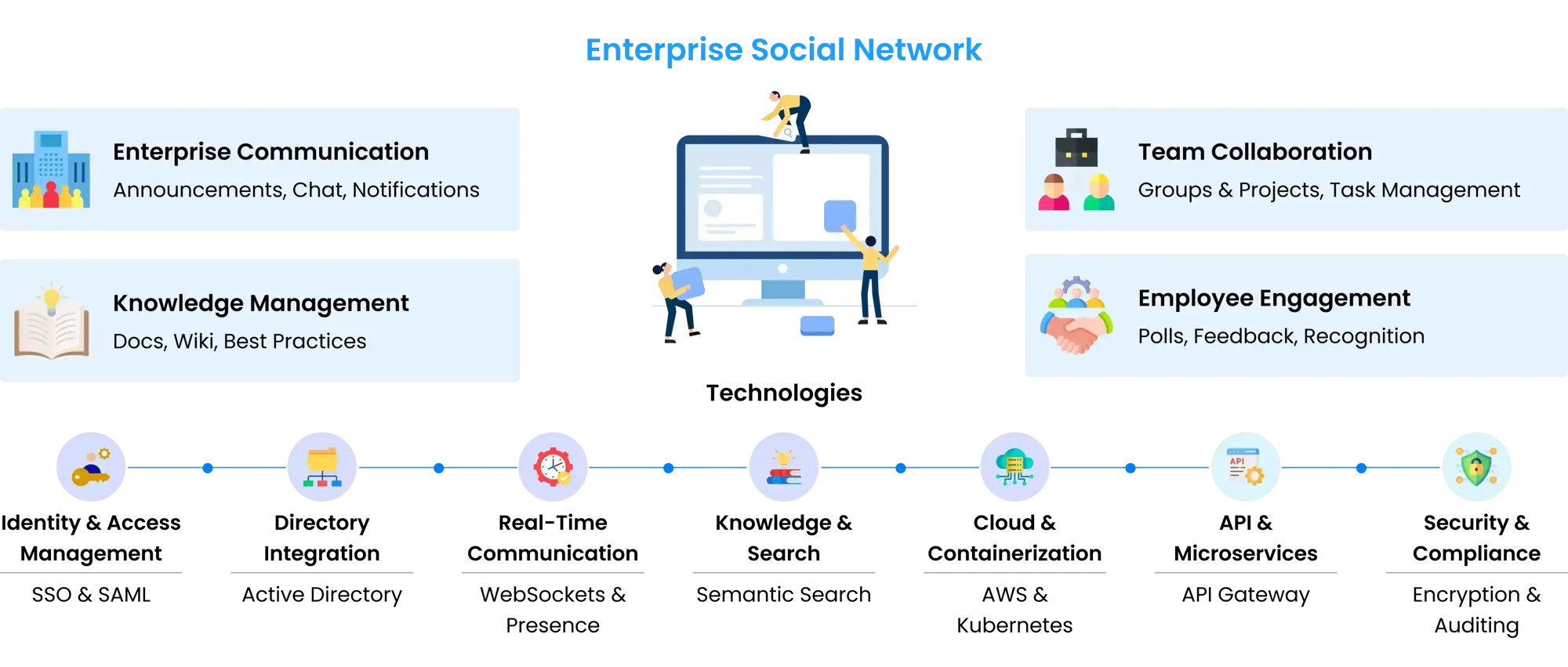
- Front-end experiences: mobile app, web storefront, creator portal, livestream interface, and campaign landing pages.
- Commerce services: catalog, cart, checkout, promotions, pricing, inventory, tax, payment, order, and return workflows.
- Content services: CMS, digital asset management, product tagging, video processing, livestream management, and moderation.
- Community services: reviews, comments, Q&A, social login, user-generated content, creator profiles, and trust signals.
- Intelligence services: CDP, recommendation engine, search, segmentation, attribution, and analytics.
- Platform services: API gateway, identity and access management, logging, monitoring, CI/CD, automated testing, and security controls.
Security must be designed into this architecture early. NIST’s Secure Software Development Framework recommends integrating secure development practices into the SDLC to reduce vulnerabilities and support supplier communication. OWASP’s API Security Top 10 highlights risks such as broken object-level authorization, broken authentication, unrestricted resource consumption, and unsafe API consumption. These are highly relevant because social commerce platforms expose many customer, product, creator, and transaction APIs.
Use Cases for Retail Brands and E-Commerce Startups
Retail brands can use social commerce to connect influencer campaigns, loyalty programs, and product launches with owned commerce infrastructure. For example, a beauty brand may combine livestream demos, AI-powered product matching, shoppable short videos, creator attribution, and post-purchase loyalty journeys.
E-commerce startups often need speed, but speed should not mean disposable architecture. A startup may begin with a headless storefront, social login, product tagging, embedded checkout, analytics, and recommendation APIs, then expand into livestream events, marketplace seller tools, or omnichannel fulfillment.
In both cases, the business outcome depends on integration quality. If product data, inventory, payment, fulfillment, and campaign analytics are disconnected, the platform may generate traffic without reliable revenue attribution.
Technical Delivery Pipeline for Social Commerce Development
A structured delivery pipeline reduces risk:
- Define business model, customer journeys, content formats, checkout flow, and channel priorities.
- Audit existing commerce, CMS, CRM, ERP, payment, inventory, and analytics systems.
- Design target architecture, integration contracts, data model, identity model, and security controls.
- Build MVP modules for shoppable content, product tagging, cart, checkout, tracking, and admin workflows.
- Add AI discovery through search, recommendation, segmentation, or visual/voice features.
- Implement CI/CD, automated regression tests, performance tests, API security checks, and observability.
- Pilot with selected campaigns, creators, product categories, or regional markets.
- Measure conversion, latency, cart abandonment, attribution accuracy, fulfillment exceptions, and customer support issues.
- Scale with feature flags, cloud infrastructure, reusable components, and continuous optimization.
TMA’s software development service covers SDLC, R&D, MVP development, PoC/prototype development, maintenance, product enhancement, porting, and migration [7]. Its QA capability includes 800+ test engineers, functional testing, integration and system testing, performance testing, regression testing, compatibility testing, security testing, automation testing, API testing, and penetration testing tools [8]. This is especially important for social commerce, where frequent campaign changes can otherwise destabilize checkout and analytics.
Generic ODC vs. Engineering Partnership Model
Dimension | Generic Low-Cost ODC | Engineering Partnership Model |
Primary focus | Staff supply and task completion | Product outcomes, architecture quality, and delivery continuity |
Architecture ownership | Often fragmented across client-side leads | Shared ownership across solution architects, engineering leads, QA, DevOps, and domain specialists |
Technical debt control | Reactive fixes after defects appear | Planned refactoring, code review, automated tests, and roadmap governance |
CI/CD maturity | Basic deployment scripts or manual release gates | Pipeline automation, environment control, test automation, rollback planning, and monitoring |
Security approach | Late-stage checklist | Secure-by-design practices, API risk review, access control, and vulnerability testing |
Scaling model | Add people when backlog grows | Add capability pods aligned to platform modules, integration needs, and release priorities |
Lessons Learned from the Field
Social commerce projects often fail for practical reasons, not because the concept is weak.
First, technical debt accumulates when teams rush campaign features without refactoring shared services. The mitigation is modular architecture, reusable tagging components, and disciplined backlog allocation for platform health.
Second, fragile CI/CD pipelines create release anxiety. Social commerce requires frequent updates for promotions, creators, and product launches, so automated testing and deployment governance are not optional.
Third, unclear code ownership slows incident response. A platform touching content, checkout, AI, and fulfillment needs clear module ownership and escalation paths.
Fourth, testing maturity gaps show up during peak traffic. Performance testing, API testing, checkout regression, and payment edge-case validation should be built into the delivery rhythm.
Finally, security-by-design matters because social commerce expands the attack surface. Identity, authorization, rate limiting, input validation, payment boundaries, and third-party API governance should be addressed before launch.
Build Integrated Social Commerce With TMA
TMA Solutions can support social commerce platform development as a technology and innovation partner rather than a generic outsourcing vendor. Its engineering scale, e-commerce experience, AI capability, QA depth, and process foundation make it suitable for retailers that need to connect commerce, content, and community into a reliable platform.
For enterprise buyers, the strategic takeaway is clear: social commerce should be built as a scalable retail system, not a campaign microsite. The right architecture can improve discovery, shorten the path to purchase, strengthen customer data, and support faster experimentation across channels.
To explore a social commerce roadmap, platform modernization plan, or dedicated development team, connect with TMA Solutions for a structured technical consultation.
FAQ
What is social commerce platform development?
It is the design and development of systems that connect social content, community interaction, product discovery, cart, checkout, payment, fulfillment, analytics, and personalization into one commerce experience.
Which features matter most in a social commerce MVP?
Start with shoppable content, product tagging, cart, checkout, campaign tracking, customer identity, analytics, and admin tools. Add livestreaming, AI recommendations, creator tools, and loyalty workflows as the platform matures.
How can AI improve social commerce conversion?
AI can improve product discovery through recommendations, visual search, voice search, segmentation, product matching, chatbots, and personalized journeys. The foundation is clean data, consent-aware tracking, and measurable feedback loops.
How should enterprises evaluate a social commerce outsourcing partner?
Evaluate architecture capability, e-commerce integration experience, QA maturity, DevOps practices, AI expertise, security awareness, communication model, and ability to scale teams without losing ownership clarity.
Is social commerce only for large retailers?
No. Startups can launch focused MVPs, while enterprises can integrate social commerce into existing commerce and customer data ecosystems. The architecture should match scale, risk, and growth plans.