Enterprise AI pilots often perform well in controlled demonstrations but stall when they encounter real systems, permissions, data quality issues, and operational risk. McKinsey’s 2025 survey found that 23% of respondents were scaling an agentic AI system, while another 39% had begun experimenting with AI agents—evidence of strong adoption interest but limited enterprise-wide maturity.
For CTOs, CIOs, product leaders, and sourcing managers, the question is therefore not whether an AI agent can complete a task. It is whether the organization can deploy agents that remain secure, observable, cost-controlled, and accountable while acting across enterprise systems.
Why Agentic AI Is the Next Enterprise AI Wave
Agentic AI is an architectural approach in which AI-enabled software can interpret a goal, create a plan, use tools, retain context, and take actions within defined boundaries. Unlike a conventional chatbot, an agent may query databases, call APIs, coordinate with other agents, or initiate a business workflow.
This capability creates value when work spans multiple systems or requires iterative decisions. However, greater autonomy also expands the failure surface. An incorrect chatbot answer is inconvenient; an incorrect agent action could alter an order, expose restricted data, or trigger an unreliable downstream process.
Because of this risk, production architecture must address four constraints:
- Decision reliability: Models can produce nondeterministic or unsupported outputs.
- Access control: Agents need enough authority to work, but not unrestricted system access.
- Operational resilience: API failures, duplicate actions, and context loss must be recoverable.
- Accountability: Teams need to reconstruct what the agent observed, decided, and executed.
The NIST Generative AI Profile recommends managing AI risks across the lifecycle through governance, mapping, measurement, and continuous management. OWASP’s agentic AI guidance likewise identifies emerging threats associated with autonomous planning, tools, memory, and multi-agent interaction.
Vietnam’s Strength in Deep-Tech AI Development
Vietnam can support agentic AI programs through a combination of software engineering capacity, growing AI specialization, and experience with global delivery. The practical advantage is not simply labor cost. It is the ability to assemble cross-functional teams covering data engineering, model integration, cloud infrastructure, application development, quality engineering, and DevSecOps.
That breadth matters because agentic AI is a systems-engineering problem. A successful implementation may require retrieval-augmented generation, event streaming, identity management, Kubernetes, API gateways, evaluation datasets, and human-approval workflows—not only prompt engineering.
For North American enterprises, a Vietnam-based team can also extend development coverage across time zones. This model works best when ownership, overlap hours, architecture decisions, and escalation paths are explicit.
What to Expect From an Agentic AI Partner
A credible partner should begin with the business process and its risk boundaries, not with a preferred model. The core design sequence is:
Capability → Technical constraint → Mitigation → Business outcome
For example, an agent may automate service-ticket resolution. Its constraint is that it must not modify high-risk infrastructure based on uncertain reasoning. The mitigation is confidence-based routing, least-privilege tools, policy checks, and human approval. The result is faster handling of routine tickets without transferring unrestricted authority to the model.
Multi-Agent Workflow Design
Multi-agent systems divide work among specialized agents such as a planner, retriever, validator, and execution agent. This can improve modularity, but every handoff adds latency, token cost, and another failure point.
Sound architecture should define:
Which tasks genuinely require multiple agents
Typed inputs and outputs for every handoff
Shared-state and memory boundaries
Maximum iteration, time, and spending limits
Conflict-resolution and human-escalation rules
Idempotency controls to prevent duplicate actions
Model-routing policies based on risk, cost, and latency
A deterministic workflow should remain deterministic. Agent autonomy is most useful where rules alone cannot handle the variability.
Enterprise Integration and Observability
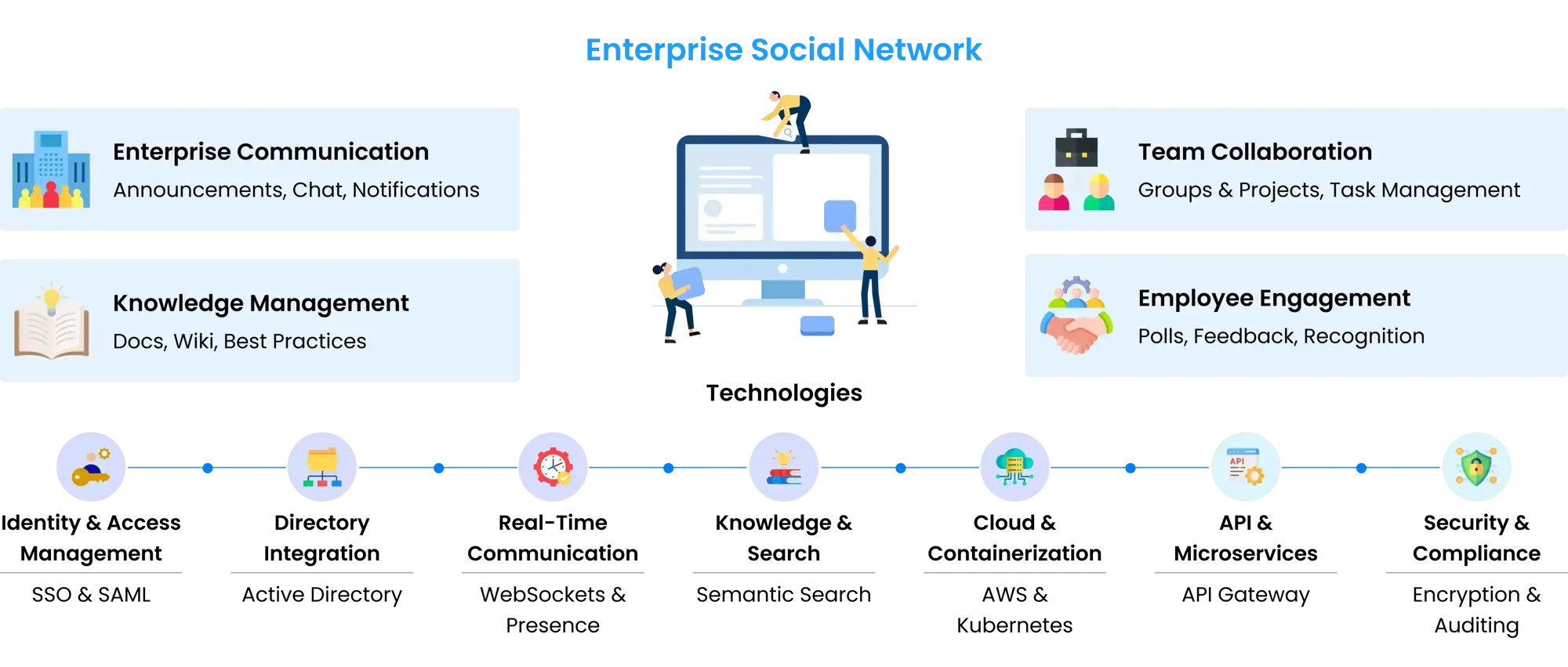
Agents should access enterprise systems through governed adapters rather than direct, broad credentials. Relevant integration entities include APIs, SQL and NoSQL stores, event streams, vector databases, knowledge graphs, Model Context Protocol, and agent-to-agent protocols.
Observability must extend beyond infrastructure uptime. Teams should trace prompts, retrieved evidence, tool calls, model versions, execution paths, latency, token consumption, policy violations, and human overrides. Sensitive data should be redacted or access-controlled within telemetry.
A production-oriented delivery pipeline should include:
Process discovery: Map users, decisions, systems, failure impact, and measurable success criteria.
Architecture and threat modeling: Define agent roles, data boundaries, permissions, human checkpoints, and recovery behavior.
Prototype development: Test the smallest valuable workflow with representative data and mocked integrations.
Evaluation: Measure task completion, groundedness, tool-selection accuracy, latency, cost, and unsafe-action rates.
Sandbox validation: Run adversarial, load, integration, and rollback tests in an isolated environment.
Controlled deployment: Release through staged environments with versioning, approval gates, and canary traffic.
Continuous operations: Monitor behavior, investigate traces, refresh knowledge, and re-evaluate after model or workflow changes.
TMA Solutions’ Agentic AI Capabilities
TMA Solutions’ published AI Agent Factory supports multi-agent orchestration, RAG and GraphRAG knowledge bases, monitoring, governance services, container-based cloud or on-premises deployment, and integrations using SQL, NoSQL, streaming, HTTPS, MCP, and A2A.
Its broader AI practice reports hundreds of AI engineers, more than 100 available AI solutions, and 10 years of work across generative AI, AI agents, computer vision, edge AI, LLMs, OCR, and related technologies.
This specialization sits within TMA’s wider delivery foundation: 29 years of experience, 4,000 engineers, clients from 30 countries, and 10 technology and solution centers. Its published quality foundation includes CMMI, Agile, RUP, ISO 9001, and ISO/IEC 27001.
Together, these capabilities position TMA as a technology and innovation partner able to connect AI experimentation with enterprise software delivery, data platforms, cloud operations, testing, and long-term maintenance.
Cost Advantages Without Compromising Quality
Agentic AI economics should be evaluated through total cost of ownership, not hourly rates. The major cost drivers are engineering rework, inference consumption, integration complexity, production incidents, and long-term support.
A Vietnam delivery model can improve cost efficiency when paired with reusable components, automated testing, disciplined architecture, and elastic team scaling. Lower staffing cost without these controls merely shifts expenditure into technical debt.
Generic Low-Cost ODC | Engineering Partnership Model |
Capacity measured mainly by headcount | Capacity aligned with architecture and outcomes |
Prompt demos prioritized | Production integration and evaluation prioritized |
Broad shared credentials | Least-privilege, auditable tool access |
Testing focused on happy paths | Behavioral, security, regression, and failure testing |
Ambiguous code ownership | Defined ownership, documentation, and succession |
Reactive maintenance | Continuous observability and optimization |
Best-Fit Agentic AI Use Cases
The strongest initial use cases combine repetitive work, accessible evidence, reversible actions, and measurable outcomes:
Knowledge assistants that retrieve cited enterprise information
IT service agents that classify, investigate, and route incidents
Software testing agents that generate and maintain test assets
Document-processing agents with validation and exception handling
Predictive-maintenance workflows connecting sensor insights to work orders
Supply-chain agents supporting planning, exception detection, and coordination
High-impact or regulated decisions should begin with recommendations and human approval rather than full autonomy.
Lessons Learned From the Field
The recurring failure is treating an agent as an isolated AI feature. Fragile CI/CD pipelines then allow prompt or model changes to reach production without regression evidence. Missing refactoring creates duplicated tools and inconsistent policies. Ambiguous ownership leaves no team accountable for data, prompts, integrations, or incidents.
A mature partnership counters these problems with architecture ownership, reusable integration patterns, evaluation suites, security reviews, and explicit operational runbooks. It also treats model replacement as an expected lifecycle event. That engineering discipline is what separates sustainable agentic AI from a low-cost prototype factory.
Partner With TMA Solutions for Agentic AI
The strategic opportunity is not autonomous software at any cost. It is controlled autonomy that improves delivery speed and operational efficiency without weakening governance.
TMA Solutions can help enterprise teams assess use cases, design multi-agent architectures, build secure integrations, validate agents in sandboxed environments, and operate them across cloud or on-premises infrastructure. Engage TMA to define a production-oriented agentic AI roadmap grounded in business value, measurable risk, and scalable engineering.
Frequently Asked Questions
1. What is the difference between generative AI and agentic AI?
Generative AI creates content. Agentic AI uses models, tools, memory, and workflows to pursue goals and take governed actions across systems.
2. When should an enterprise use multiple AI agents?
Use multiple agents when specialized roles, independent validation, or parallel workflows provide clear value. Otherwise, a simpler deterministic workflow is usually easier to secure and operate.
3. How should agentic AI access enterprise applications?
Use authenticated, least-privilege APIs or governed connectors. Separate read and write permissions, validate tool inputs, log actions, and require human approval for high-impact operations.
4. How can companies evaluate an agentic AI outsourcing partner?
Assess production references, architecture depth, security practices, evaluation methods, integration capability, engineering scale, ownership model, and post-deployment support—not only hourly rates or prototype speed.
5. Can agentic AI run on-premises?
Yes. Containerized agents and self-hosted components can support on-premises or hybrid deployment, subject to model availability, infrastructure capacity, integration requirements, and security architecture.