Introduction
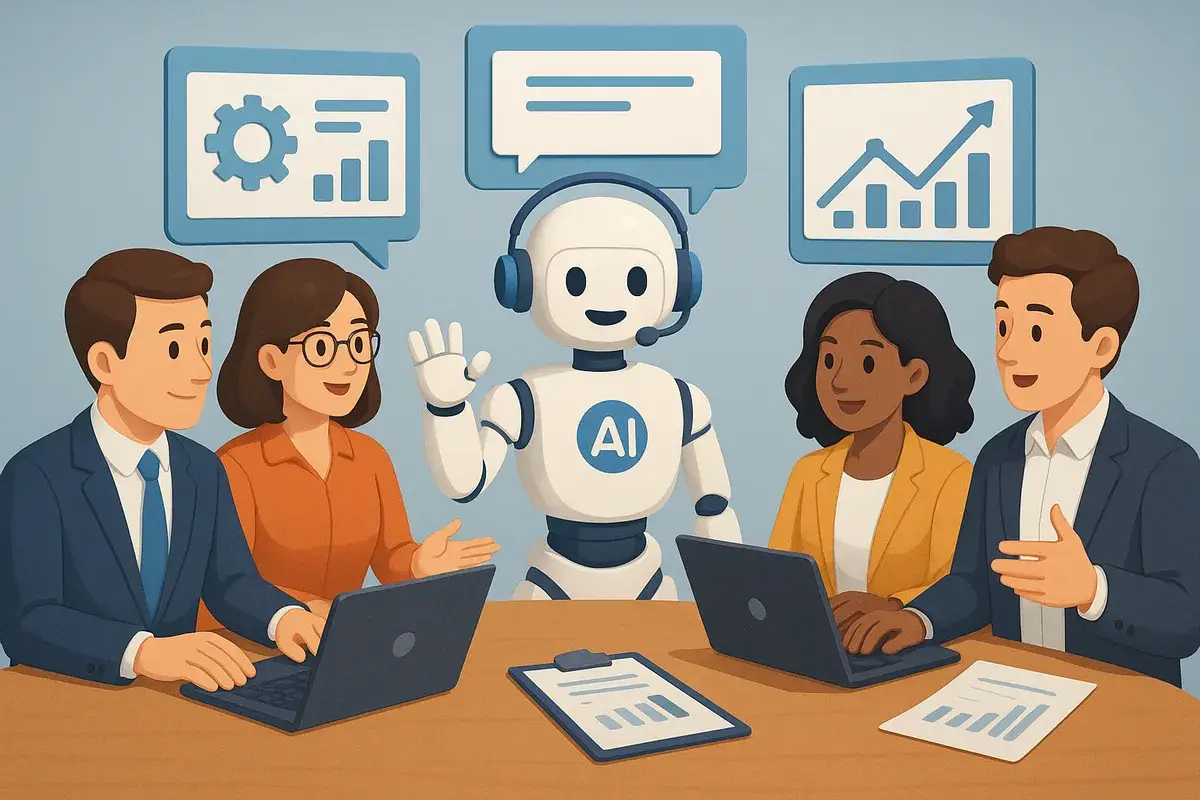
Enterprises across industries are under growing pressure to improve operational efficiency while managing increasing workloads and rising business costs. Many organizations still depend heavily on manual workflows for tasks such as document processing, reporting, customer support, scheduling, and operational coordination. These repetitive activities often slow down business operations, reduce productivity, and create operational bottlenecks that affect scalability.
As a result, businesses are increasingly adopting AI agents to automate workflows, improve operational visibility, and support faster decision making. According to McKinsey, generative AI technologies could contribute up to $4.4 trillion annually to the global economy through productivity improvements and operational optimization. This shift is driving growing demand for an AI Agent development company from Vietnam capable of building scalable enterprise AI systems aligned with long term business transformation goals.
The Limitations of Traditional Workflow Automation
Traditional operational models often rely on repetitive human intervention across multiple departments. While these workflows helped organizations manage operations in the past, they are becoming increasingly difficult to scale efficiently in modern digital environments.
Manual Processes Reduce Operational Efficiency
Employees in many organizations spend significant amounts of time on administrative and repetitive activities such as:
Data entry and validation
Email management
Report generation
Workflow coordination
Customer request processing
These tasks consume operational resources while limiting employee productivity and slowing execution speed. According to Deloitte, organizations adopting AI technologies are already seeing measurable improvements in operational efficiency and workforce productivity.
Business Complexity Continues Increasing
Modern enterprises process larger volumes of data and customer interactions than ever before. Managing these operations manually often creates delays, inconsistencies, and communication gaps between departments. AI agents help organizations reduce these inefficiencies by automating operational processes and improving workflow coordination in real time. This allows enterprises to scale operations more effectively without significantly increasing operational overhead.
How AI Agents Transform Enterprise Operations
AI agents are software systems that can understand objectives, analyze information, make decisions, and execute tasks with minimal human intervention. Rather than following a fixed set of rules, they can adapt to changing conditions, coordinate multiple actions, and continuously improve workflow execution based on context and available data. According to Anwer's research, organizations using agentic AI typically see a 40–60% reduction in manual effort, faster decision cycles, and the reallocation of human capital toward higher-level strategic and creative work.
Intelligent Automation Improves Workflow Speed
Unlike traditional automation tools that rely strictly on predefined rules, AI agents can analyze context, process information dynamically, and support more flexible operational execution.
Organizations are using AI agents to automate:
Customer support operations
Internal workflow management
Financial reporting
Document processing
Operational monitoring
Capgemini Research Institute reveals 82% of organizations plan to integrate AI agents within the next one to three years, while enterprises expect AI agents to automate repetitive tasks, improve operational efficiency, and support more autonomous business processes.
AI Agents Improve Decision Making
Beyond workflow automation, AI agents also help enterprises make faster and more informed decisions. AI systems can analyze operational patterns, identify workflow inefficiencies, and generate real time insights that support business optimization. This allows organizations to improve resource allocation, reduce operational delays, and optimize workforce productivity more effectively. As enterprises continue modernizing infrastructure, many organizations are evaluating partnerships with providers specializing in top AI Agent development in Vietnam because of the region’s growing expertise in enterprise AI technologies.
The Role of Vietnam in Enterprise AI Development
Vietnam is becoming an increasingly attractive destination for enterprise AI development because of its strong engineering talent, competitive costs, and expanding expertise in intelligent automation technologies.
Growing Expertise in Enterprise AI Solutions
Vietnamese technology companies are strengthening capabilities in:
AI integration services
Intelligent automation
Cloud infrastructure
Enterprise software engineering
AI driven analytics
This growing expertise allows businesses to build scalable AI systems while maintaining operational flexibility and cost efficiency.
Long Term Technology Partnership Advantages
Enterprises today are looking beyond short term outsourcing models and searching for long term innovation partners capable of supporting continuous optimization and digital transformation. For organizations seeking scalable enterprise AI systems, partnering with a custom AI Agent development company in Vietnam is becoming an increasingly strategic decision.
Accelerating Enterprise AI Adoption with TMA Solutions
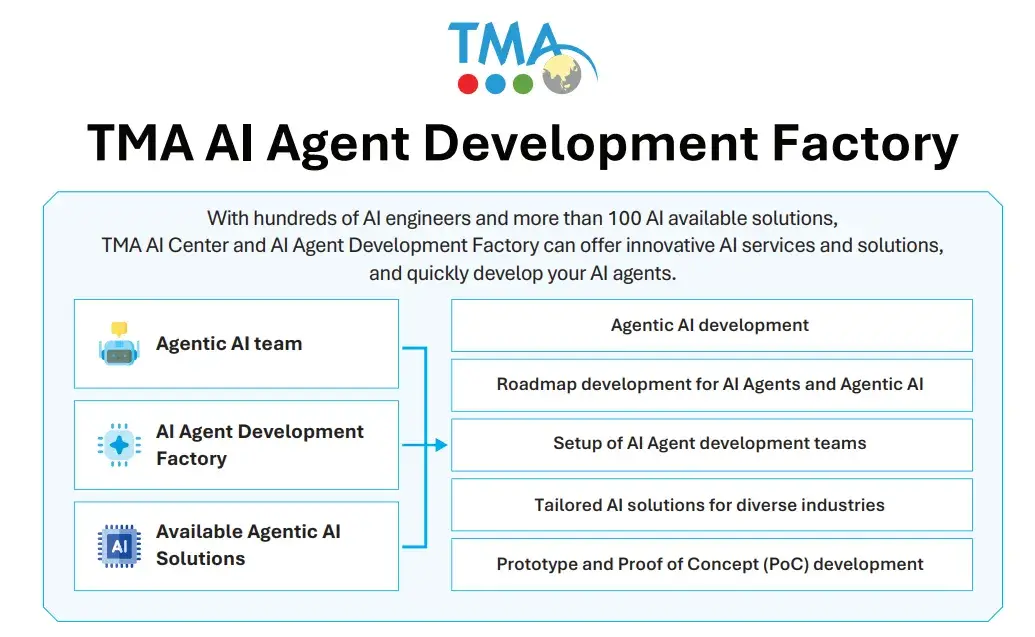
As organizations accelerate AI adoption, success depends on more than implementing standalone AI tools. Enterprises need a trusted technology partner capable of transforming AI concepts into scalable business solutions that deliver measurable operational value.
Leveraging its AI Agent Factory and extensive AI expertise, TMA Solutions helps businesses design, develop, and deploy intelligent AI agents tailored to specific operational needs. These AI agents can automate complex workflows, enhance decision making, improve customer interactions, and support enterprise productivity at scale.
The comprehensive AI Agent framework TMA provides including:
- Foundation AI models: Provides machine learning, computer vision, and language models tailored to business needs.
- AI Agent Development Framework: Enables rapid AI agent creation through no-code, low-code, and custom development options.
- Enterprise & Tool Integration: Connects AI agents with enterprise applications, databases, and business systems.
- Agentic Orchestration & Management Engine: Manages multi-agent workflows, knowledge retrieval, monitoring, and governance.
- Cross-Platform Deployment: Supports flexible deployment across cloud and on-premises environments.
Conclusion
AI agents are transforming enterprise operations by replacing repetitive manual workflows with more intelligent and scalable operational systems. As businesses continue accelerating digital transformation initiatives, AI technologies will play an increasingly important role in improving operational efficiency, reducing costs, and supporting faster business decisions. Organizations investing in enterprise AI today will be better positioned to optimize workflows, improve scalability, and adapt to future operational demands in the evolving digital economy.