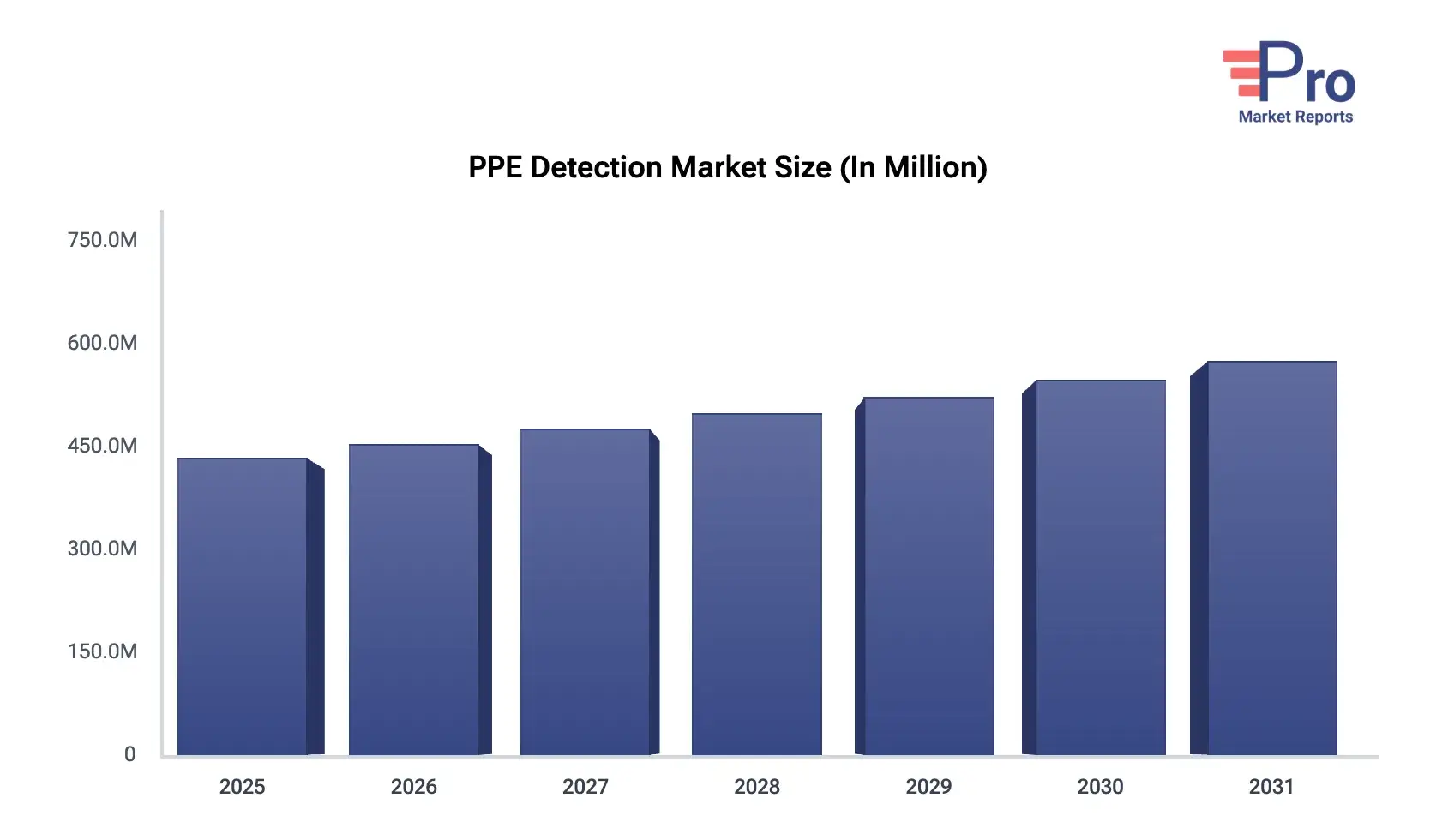
Industrial facilities, construction sites, and manufacturing plants operate under strict regulatory frameworks to protect workers from occupational hazards. However, enforcing Personal Protective Equipment (PPE) compliance across large-scale, multi-site operations remains a persistent challenge for safety managers. The integration of PPE detection with AI, combining computer vision, edge processing, and automated reporting, is transforming occupational health and safety (OHS) from a periodic, manual auditing task into a continuous, real-time compliance system. According to industry analysis by Pro Market Reports, the global PPE detection market size is experiencing steady growth, expanding from over $430 million in 2025 to surpass $550 million by 2031, underscoring a clear global shift as enterprises move from reactive incident reporting to proactive hazard prevention at scale.
The Critical Need for Automated PPE Compliance in Modern Industries
Managing workplace safety across expansive operational footprints requires constant vigilance, yet human-led safety inspection methods face inherent operational limitations.
The vulnerabilities of manual safety auditing
Traditional safety enforcement relies heavily on manual walk-throughs and spot checks conducted by safety officers. This approach presents several systemic weaknesses:
- Sampling Bias and Blind Spots: Manual audits capture only a fraction of total working hours, leaving vast operational windows unmonitored.
- Human Fatigue and Oversight: Safety managers overseeing large production floors or multi-story job sites cannot continuously track dozens of workers simultaneously.
- Delayed Risk Intervention: Non-compliance is often identified long after a violation occurs, exposing workers to unnecessary danger and placing companies at risk of regulatory penalties.
Regulatory demands and cost of non-compliance
Regulatory bodies like the Occupational Safety and Health Administration (OSHA) enforce stringent guidelines mandating specific safety gear based on operational environments. Non-compliance carries severe consequences:
- Regulatory Fines and Legal Liability: Unannounced inspections or incident-triggered audits can result in heavy financial penalties for non-compliant job sites.
- Workplace Injuries and Operational Downtime: Safety breaches lead to preventable injuries, lost-time incidents (LTI), increased insurance premiums, and costly production halts.
- Erosion of Corporate Safety Culture: Inconsistent enforcement undermines safety protocols, making workers less likely to adhere strictly to safety guidelines over time.
Technical architecture of AI-powered PPE detection systems
An AI-driven PPE detection framework leverages advanced computer vision models trained to recognize human bodies and detect whether required protective gear is present and properly worn in real time.
Computer vision models for object detection and segmentation
Modern PPE compliance systems utilize state-of-the-art deep learning models, such as YOLO (You Only Look Once) and Convolutional Neural Networks (CNNs), to perform high-speed object detection and instance segmentation:
- Multi-Class Detection: Models are fine-tuned to recognize complex safety gear items simultaneously, including hard hats, high-visibility reflective vests, safety goggles, protective gloves, face masks, and steel-toe boots.
- Contextual Spatial Verification: Advanced algorithms do not merely detect the presence of a helmet in a camera frame; they verify its spatial relationship to a detected worker's head to ensure it is actually being worn correctly.
- Environmental Adaptability: Edge AI vision models maintain high detection accuracy under challenging conditions, such as low lighting, dusty factory floors, weather variations, and partial physical occlusions.
Edge computing and on-device processing
Deploying PPE detection at scale requires processing high-resolution video streams with minimal latency. Utilizing Edge AI architecture—processing video feeds directly on localized hardware such as smart cameras and AI Boxes—delivers critical operational advantages:
- Real-Time Alert Generation: On-device processing evaluates video frames within milliseconds, triggering immediate visual or audible alerts on site before a worker enters a high-risk zone.
- Bandwidth and Infrastructure Efficiency: Edge devices transmit only violation metadata and image snapshots to central servers, preventing network congestion across corporate infrastructure.
- Data Privacy Compliance: Raw video feeds remain stored locally on secure edge hardware, ensuring worker privacy while transmitting anonymized telemetry for enterprise compliance reporting.
Core operational capabilities: Scaling PPE compliance across enterprise sites
Deploying AI-based PPE detection provides safety teams with automated, scalable oversight across diverse industrial environments through AI solutions for manufacturing.
Real-Time Hazard Zone Protection and Automated Alerts
- Restricted Zone Enforcement: The system continuously monitors entry points to high-hazard areas (e.g., active crane zones, chemical handling areas, high-voltage rooms).
- Multi-Channel Warning Workflows: When non-compliance is detected, the platform functions as a smart emergency alert solution, instantly activating local visual/audio sirens, displaying warning prompts on digital site boards, and dispatching push notifications to site supervisors via mobile applications or SMS.
- Automated Machinery Interlocking: In critical danger zones, the PPE detection engine can integrate with Programmable Logic Controllers (PLCs) or smart access doors to block entry or pause machinery until full compliance is verified.
Centralized Safety Analytics and Audit Trail Reporting
- Enterprise Compliance Dashboards: Safety managers gain a unified view of compliance rates across multiple plants or construction sites, identifying high-risk zones or recurring violation trends.
- Immutable Audit Logs: The platform automatically logs every compliance event with exact timestamps, location tags, and visual snapshot evidence, simplifying OSHA reporting and internal safety audits.
- Behavioral Insights and Training Optimization: Aggregated data highlights specific teams or shifts requiring targeted safety retraining, transforming compliance data into actionable educational initiatives.
How TMA Solutions Automates Industrial PPE Compliance at Scale
Implementing automated compliance systems across complex industrial environments requires deep software engineering expertise and an adaptable integration architecture. As a top AI development company in Vietnam, a recognized enterprise AI company, and a trusted custom AI development company, TMA Solutions (through TMA AI Center and TMA Innovation) engineers robust PPE detection solutions and a comprehensive industrial safety monitoring system utilizing AI first software development practices.
Recognized among the top AI solutions companies in Vietnam, TMA customizes vision models to recognize site-specific gear, color-coded safety helmets (designating worker roles), and specialized industrial uniforms. Instead of replacing existing camera networks, TMA retrofits legacy CCTV setups with compact AI Box units, enabling low-cost, scalable AI adoption without extensive capital expenditure.
Enterprise Case Study: Automated PPE Verification & Access Interlocking
Industry & Environment: Heavy Manufacturing & Smart Factory Operations.
The Operational Challenge: A large-scale manufacturing client faced frequent safety compliance gaps in restricted, high-risk production zones where manual supervision was insufficient to monitor workers entering without required protective gear (e.g., safety goggles, protective gloves, and steel-toe boots).
TMA's AI Vision Solution: Leveraging its expertise as a leading AI development company in Vietnam, TMA deployed an AI surveillance solution for factories utilizing computer vision solutions for factories. Operating through the TMA Agentic Vision Platform, the system continuously analyzes camera streams at entry points to high-hazard areas. When a worker approaches without the required PPE items detected, the platform executes an automated multi-step response:
- Triggers an immediate local audio warning to inform the worker.
- Automatically signals smart access doors to remain locked, preventing unauthorized entry until full compliance is confirmed.
- Sends real-time alert notifications with image evidence directly to plant safety managers via mobile apps and web dashboards.
Tangible Impact: This automated industrial AI surveillance solution eliminated manual inspection friction, significantly reduced workplace safety violations, and established an immutable compliance audit trail for regulatory reporting.
Conclusion
Automating PPE detection with AI represents a fundamental shift in occupational health and safety, enabling industrial enterprises to enforce compliance continuously, objectively, and at scale. By replacing periodic manual audits with real-time computer vision analysis through surveillance solutions in manufacturing, organizations can prevent workplace injuries, eliminate regulatory blind spots, and drastically reduce the operational costs associated with non-compliance.
To achieve continuous workplace safety without undergoing expensive hardware overhauls, enterprise leaders should partner with an experienced AI engineering provider. Deploying targeted edge AI hardware over existing camera networks allows facilities to convert standard CCTV infrastructure into a proactive, intelligent safety system, ensuring a safer working environment and sustainable operational excellence.