Most enterprise training programs assign the same content to everyone in a role and measure success by whether they finish it. Completion rates may improve, but workforce capability gaps remain because training is designed for the average employee rather than each individual's actual skill profile. As one of today's corporate training software solutions, a personalized learning platform for enterprise diagnoses skill gaps before assigning content, adapts learning paths as employees progress, and measures demonstrated competency instead of course completion.
Why Traditional Corporate Training Personalization Often Fails
The word "personalized" appears frequently in corporate training vendor materials. In practice, what most organizations call personalized learning is a self-selection catalog: a library of courses that employees choose from based on interest or managerial recommendations. This is not personalization. It is optional access to standardized content.
 The Linear Curriculum Problem
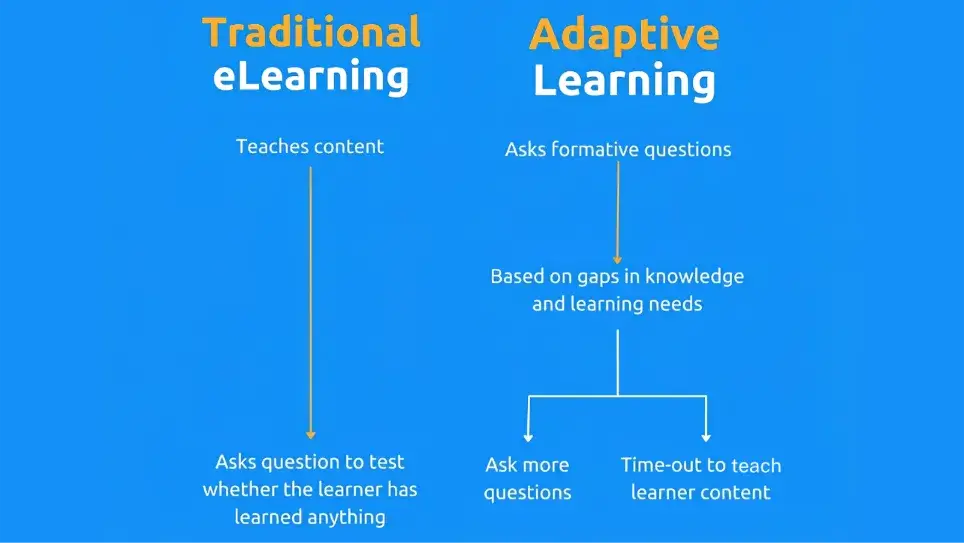
Most enterprise training is structured as a linear curriculum: a fixed sequence of modules that all employees in a role complete in the same order, at the same pace, starting from the same assumed baseline. This design assumes a homogeneity that does not exist. A sales representative with three years of experience in a related industry and a new hire with no sales background will absorb the same onboarding program very differently. The experienced hire wastes time on material they already know. The new hire moves past material they have not yet fully grasped.
Neither employee receives training calibrated to their actual starting point or the adaptive reinforcement needed as learning becomes more complex. The result is a completion statistic that tells the organization nothing meaningful about whether either employee can perform the role effectively.
Why Completion Rates Are the Wrong Primary Metric
When completion rate is the primary measure of training effectiveness, content is designed to be completable rather than to be effective. Modules are kept short, assessments are designed to be passable, and the experience is optimized for the click, not the learning outcome. Employees learn to complete training rather than to develop capability, and the organization accumulates completion data that does not correlate with performance improvement.
The Connection Between Workforce Skill Gaps and Employee Disengagement
Skill gaps and disengagement are not separate problems. They are linked through a common cause: employees who feel underprepared for the actual demands of their role disengage from both the training and the work.
Underprepared Employees Disengage Early
When onboarding fails to bring new hires to actual role readiness before they interact with customers, manage projects, or make operational decisions, the resulting experience is uncomfortable and often embarrassing. Employees who feel unprepared in their first weeks often attribute that experience to the role or the organization rather than the training itself, increasing the risk of early attrition.
Gallup's research consistently finds that only 12 percent of employees strongly agree their organization does a great job of onboarding. The majority of new hires enter their roles without the preparation they need to perform confidently, and the connection between that unpreparedness and subsequent attrition is well established in the HR literature.
Overqualified Employees Disengage Differently
The other end of the capability spectrum creates its own disengagement pattern. Experienced employees assigned to training that covers material they already know learn quickly that the organization's training program does not respect their existing competency. This signals that everyone receives the same training regardless of existing competency, leading high performers to feel that their experience and expertise are not recognized.
Both failure modes are structural, and both stem from the same design flaw: training built around a standard curriculum rather than around the actual skill profile of each learner.
What a Personalized Learning Platform for Enterprise Actually Delivers
A personalized learning platform for enterprise is not a more attractive course catalog. It serves as a comprehensive corporate training software solution, built to identify each employee's current competency level, define the skills required for their role, and continuously adjust learning paths as development progresses.
Skills Assessment Before Content Assignment
The starting point of genuine personalization is a structured assessment of each employee's current competencies against the defined requirements of their role. This assessment determines which areas the employee has already mastered and which represent genuine gaps. Content is then assigned to address the gaps, not to cover everything in the curriculum.
This approach eliminates the time employees spend on material they already know, which is one of the most consistent sources of training disengagement among experienced employees. It also ensures that employees who need foundational support receive it before being advanced to more complex material.
Dynamic Path Adjustment Based on Demonstrated Performance
A static learning path assigned at the beginning of a program cannot account for how an employee actually performs as they progress. An employee who demonstrates strong comprehension of a topic should not spend as long on it as an employee who is struggling with the same material. A personalized platform adjusts content sequencing and pacing based on ongoing assessment performance, ensuring that each employee maintains appropriate challenge levels throughout their development program.
Role-Based Learning Architecture
Personalization operates most effectively when it is anchored to a clearly defined competency framework for each role. Rather than building learning paths from a generic skill taxonomy, enterprise-grade platforms map each role to the specific capabilities required to perform it effectively, and use that framework as the basis for both assessment and content assignment. This ensures learning is directly aligned with operational requirements instead of generic skill development.
How AI Personalizes Corporate Training at Scale
Manual personalization of learning paths is not economically viable at the scale most enterprises operate. An L&D team cannot maintain individually curated development programs for hundreds or thousands of employees simultaneously. AI is what makes genuine personalization operationally feasible at enterprise scale.
AI-Driven Content Recommendations
AI recommendation systems analyze each employee's competency assessment results, learning history, role requirements, and behavioral signals within the platform to surface the content most relevant to closing their specific gaps. Unlike consumer recommendation engines, AI analyzes competency gaps, learning history, and role requirements to recommend training that directly addresses each employee's development needs.
The Smart Corporate Training platform applies AI-assisted content recommendations within a role-based learning path architecture, drawing on each employee's complete training history and assessment data to route them toward the learning most relevant to their current development stage. The platform supports both instructor-led and self-paced delivery within the same environment, allowing personalization across different learning formats.
AI-Powered Practice for Applied Skill Development
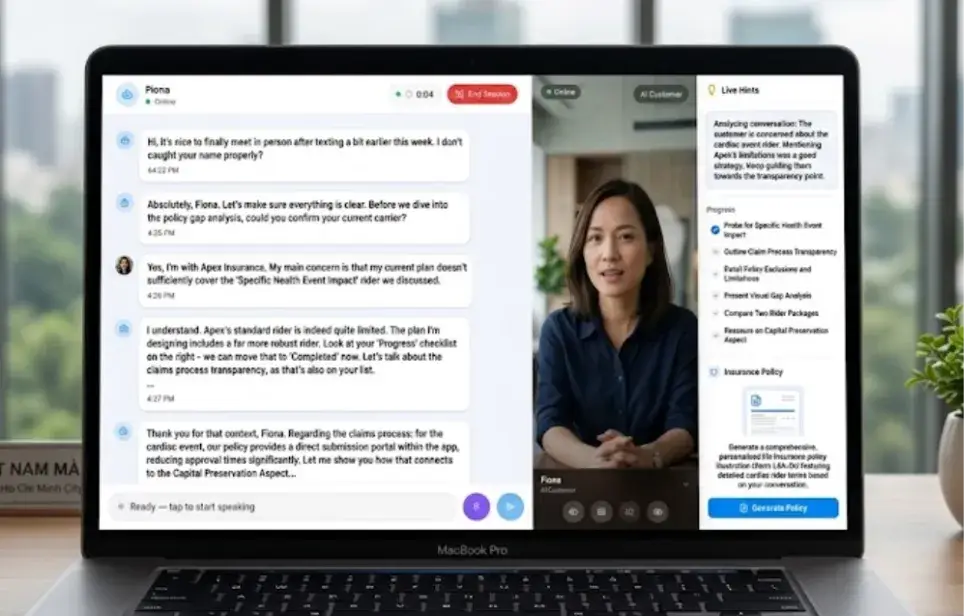
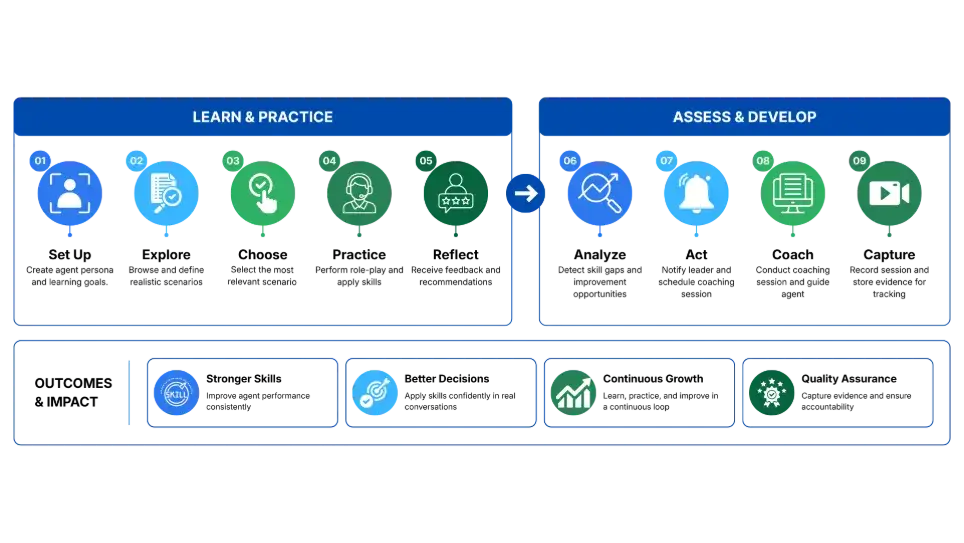
For skills that require applied practice rather than knowledge acquisition, AI simulation systems provide the volume of realistic practice that human-led training cannot deliver economically. The AI Coaching and Role-play Simulation System gives employees in sales, customer service, and recruitment roles unlimited practice repetitions in realistic scenario conditions, with automated scoring on structure, accuracy, and communication quality after each session.
Practice is what bridges the gap between knowing and doing. Employees who repeatedly apply skills in simulated scenarios develop greater job readiness than those who only complete theoretical training.
 Adaptive Assessment That Tracks Real Competency Over Time
Static post-course assessments test whether an employee can recall information immediately after receiving it. They do not test whether the employee retains that information weeks later or can apply it under operational conditions. Adaptive assessment systems use spaced repetition, scenario-based questioning, and performance-linked knowledge checks to track competency development over time rather than treating assessment as a one-time event at the end of a course.
Measuring Workforce Upskilling Outcomes More Effectively
Shifting from completion metrics to competency metrics requires changes to what the organization measures and how it connects learning data to operational performance data.
Competency Gap Closure as the Primary Measure
Instead of tracking whether employees completed a course, measure whether their assessed competency in the relevant skill area has changed. Before-and-after assessments against a defined competency framework produce data that directly answers the question leadership actually needs answered: is the workforce more capable than it was before the training investment?
This measurement approach requires a defined competency framework, baseline assessment data, and post-training assessment at a consistent interval. Organizations that have not defined role competency frameworks cannot measure gap closure, which is why competency framework development is typically the prerequisite step before meaningful personalization can begin.
Time-to-Competency for New Hires
For organizations with significant onboarding volume, time-to-competency is a more operationally relevant metric than time-to-completion. It measures how long it takes a new hire to reach the assessed competency threshold for their role, which correlates directly with when they begin contributing at full productivity and with early-tenure attrition rates.
Personalized onboarding programs that adapt to each new hire's starting point typically reduce time-to-competency compared to standardized programs, because experienced new hires can accelerate through material they already know while new-to-field hires receive the additional foundational support they need before advancing.
Connecting Learning Data to Performance Outcomes
The highest-value measurement in enterprise learning connects training data to operational performance data: do employees who achieve higher competency assessment scores in customer communication training produce better customer satisfaction outcomes? Do sales team members who complete AI simulation practice show higher conversion rates in their first month?
Connecting learning data with business performance requires consistent employee identifiers and clearly defined operational metrics. When these conditions are in place, L&D teams can demonstrate training impact using business outcomes rather than completion statistics.
Conclusion
Personalized learning platforms for enterprise improve workforce capability by delivering training that matches each employee's actual skill needs. As organizations invest in modern corporate training software solutions, AI-driven personalization and competency-based learning help create measurable workforce development outcomes.
TMA Solutions develops enterprise learning platforms that combine competency assessment, AI-driven personalization, and learning analytics to help organizations build scalable workforce development programs. Explore Smart Corporate Training, AI Coaching and other enterprise learning solutions to modernize employee training and improve measurable business outcomes.