Introduction
In the rapidly evolving landscape of modern education and corporate training, traditional "one-size-fits-all" learning models are reaching their limit. Classrooms and enterprise training programs often struggle to accommodate diverse learning speeds, background knowledge, and individual engagement levels. When instruction is standardized, fast learners become disengaged while struggling students fall behind.
The integration of AI-powered personalized learning systems is bridging this gap at scale. By combining adaptive learning algorithms, natural language processing (NLP), and real-time learning analytics, educational institutions and enterprise L&D (Learning & Development) teams can now deliver tailored educational pathways to thousands of learners simultaneously, without exponentially increasing instructional costs.
Current Market Trends in AI-Driven Education
The global adoption of AI across corporate Learning & Development (L&D) and higher education is accelerating rapidly, driven primarily by the rise of Generative AI tutors and adaptive micro-learning engines. Powered by Large Language Models (LLMs) and Retrieval-Augmented Generation (RAG), conversational AI assistants now act as 24/7 personal co-pilots for learners. Rather than relying on rigid, pre-recorded lectures, modern systems dynamically analyze an individual's immediate skill gaps to generate bite-sized, interactive content—such as multi-language flashcards, targeted scenario simulations, and instant practice quizzes—delivered precisely when needed.
At the executive level, this technology is accelerating a broader structural shift toward skills-based organizations. Enterprise leadership is increasingly moving away from tracking vanity metrics like "completed training hours," choosing instead to measure actual skill proficiency and practical competency. By embedding real-time learning analytics into daily workflows, organizations can continually monitor employee progress, identify operational skill deficits early, and align personalized learning paths directly with strategic business goals.
Why Enterprises & Institutions Urgently Need Personalized Training
Modern workforces and student bodies are more diverse in skill level, background knowledge, and learning speed than ever before. Forcing a standardized, "one-size-fits-all" curriculum onto a diverse cohort introduces severe operational inefficiencies across three major dimensions:
- Severe Knowledge Baseline Disparities: In a typical enterprise cohort, forcing advanced learners through basic material causes disengagement, while rushing struggling learners through complex concepts leads to high drop-out rates. According to Coursera’s insights on AI in education, personalized pathways prevent these drop-outs by scaffolding lessons to meet each individual's precise baseline competency.
- Accelerated Skill Decay & The Need for Rapid Upskilling: In fast-evolving industries like technology, finance, and smart manufacturing, skill sets become obsolete rapidly. Research from the Research Institute of America highlights that personalized learning can boost long-term knowledge retention by up to 60% compared to traditional expository training, enabling workers to target exact skill deficits without repeating multi-month courses.
- The Unsustainable Cost of Instructor Admin Workload: Educators and corporate trainers spend up to 40% of their time on manual grading, lesson planning, and administrative tracking. By delegating routine content structuring and automated grading to AI engines, institutions can redirect valuable human expertise toward high-touch 1-on-1 mentorship.
Traditional Learning vs. AI-Powered Personalized Learning
To understand the transformative impact of AI in enterprise education, consider how it systematically addresses the core limitations of legacy training models:
Strategic Dimension | Traditional Learning Framework | AI-Powered Personalized Learning | Operational & Business Value |
Curriculum Flow | Static, linear sequence applied uniformly to all learners. | Dynamic, continuously adjusting content based on real-time mastery. | Eliminates redundant modules; accelerates time-to-competency. |
Learning Speed | Fixed pacing determined strictly by the instructor/course calendar. | Self-paced; automatically accelerates or slows down per learner. | Boosts engagement; prevents fast-learner boredom & slow-learner dropouts. |
Feedback Mechanism | Delayed feedback (weeks after quizzes, exams, or assignments). | Instant, sub-second contextual feedback during interactive tasks. | Corrects misconceptions immediately, reinforcing long-term retention. |
At-Risk Detection | Post-course failure analysis (too late for intervention). | Real-time engagement analytics flagging learning friction early. | Allows instructors to step in with timely human support before drop-out. |
Content Authoring | Manual creation taking weeks or months per module. | GenAI-automated generation of quizzes, flashcards, & scenario simulations. | Cuts content development friction & costs by up to 60%. |
How TMA Solutions Enables Scalable AI Education (TMA Application)
Building scalable, intelligent learning platforms requires deep software engineering, cloud architecture, and AI integration expertise. As a top AI development company in Vietnam, TMA Solutions partners with global educational institutions, publishers, and enterprise L&D teams to deliver next-generation learning technology.
Featured Case Study: T-Learning Enterprise Platform
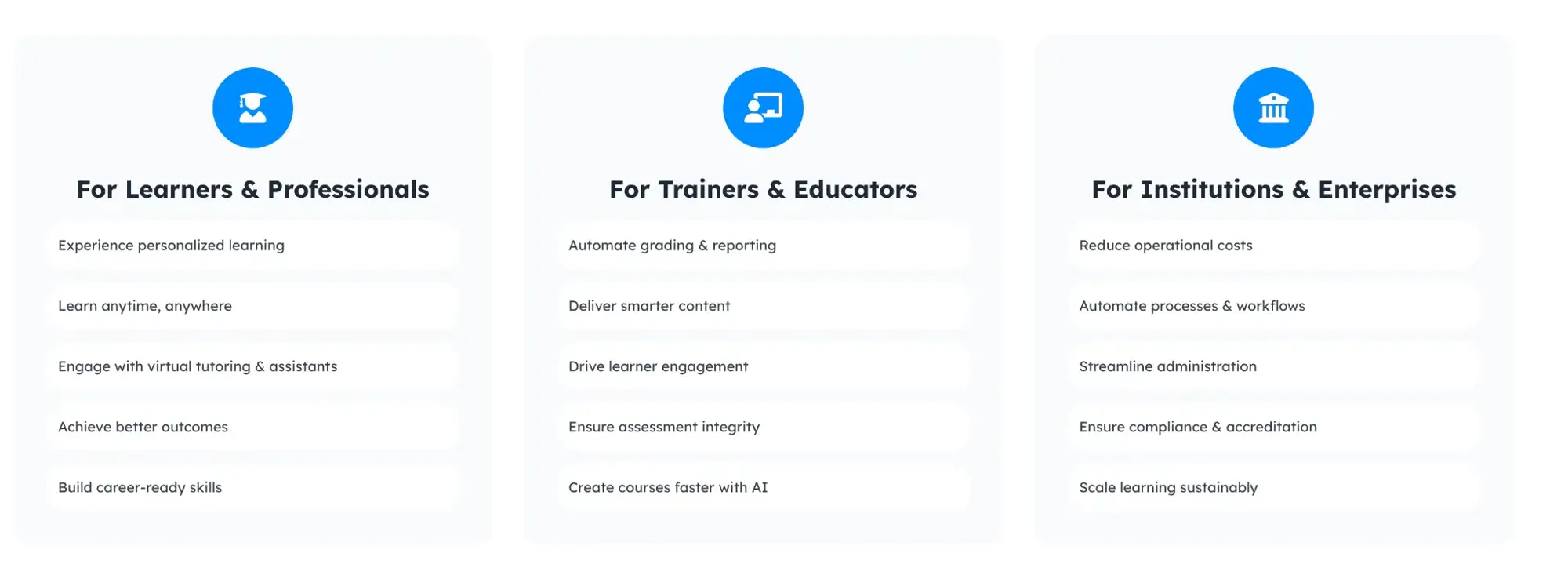
- The Operational Challenge: An international enterprise needed to deliver personalized workforce training across 15,000+ employees in 30 countries while reducing heavy administrative overhead and low course completion rates.
- TMA's AI Engineering Solution: TMA deployed its flagship T-Learning platform—an AI-powered Learning Management System (LMS) featuring an adaptive recommendation engine, an AI Quiz Builder, and real-time predictive analytics. The system automatically assesses baseline skill levels, generates dynamic personalized learning paths based on role-specific skill gaps, and flags struggling learners on a centralized management dashboard.
- Tangible Business Impact:
- 87% increase in overall training completion rates.
- 65% faster employee onboarding cycle.
- Significant annual cost savings in training administration and content preparation.
Conclusion
Personalized learning at scale is no longer an ambitious futuristic concept—it has become a strategic necessity for competitive enterprises and forward-thinking educational institutions. By transitioning from rigid, traditional instruction to adaptive AI frameworks, organizations can accelerate onboarding, bridge critical skill gaps, and optimize training budgets. Modernizing your enterprise learning infrastructure does not require replacing your current software investments all at once. Through modular AI integration and custom software engineering, platforms can be upgraded step-by-step.