Training completion can show that employees participated in learning, but it does not by itself demonstrate whether they developed the intended skills. As organizations invest more in workforce development, a personalized learning platform for enterprise can help connect learning activity with competencies, skill gaps, learner progress, and workforce development goals, making training effectiveness easier to monitor and evaluate.
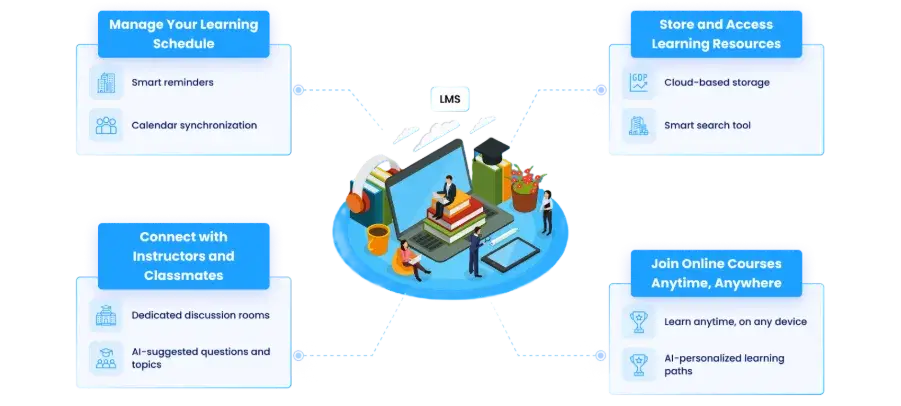
Why Training Metrics Often Fail to Reflect Business Performance
Enterprise learning programs generate vast data, but most of it focuses on training activity. Completion rates, attendance, and assessment scores indicate program engagement, yet they provide limited evidence of whether learning changes on-the-job performance.
This creates a gap between training activity, skill development, and the broader workforce outcomes organizations ultimately want to understand:
- Sales teams may complete product training, while deal conversion rates remain unchanged.
- Customer service reps may complete communication courses without seeing an impact on satisfaction metrics.
These activity-based metrics remain useful as partial indicators of progress, but they must be interpreted alongside operational context to reflect broader performance improvement.
From Training Completion to Business Outcomes
Measuring learning effectiveness requires more than tracking course completion. Organizations need to understand whether employees are developing the competencies targeted by each learning program and whether those capabilities align with their roles and development goals. A personalized learning platform for enterprise can provide this visibility by combining learning activity, assessment results, competency data, and learner progress.
The relationship between learning and business performance varies by function and should be interpreted carefully. Sales training may support sales readiness, manufacturing training may support operational capability, and customer service training may support service quality. However, these outcomes are influenced by many factors beyond learning alone, including process efficiency, available tools, and market conditions. Learning analytics helps clarify how workforce capability contributes to performance, rather than claiming training as the sole driver of change.
Why Data Quality Matters
The accuracy of learning evaluation depends heavily on data consistency. If employee records, roles, competencies, and business metrics are misaligned, connecting learning activity with operational outcomes becomes unreliable.
Consequently, learning analytics is an integration and data architecture challenge. Organizations require consistent data structures and system integration so that learning and workforce information can be combined and interpreted consistently across different business contexts.
The Disconnect Between Learning Systems and Workforce KPIs
Most enterprises track business performance using CRM, HR platforms, and operational tools, while traditional LMS platforms remain isolated, focusing strictly on learning records.
Feature / Capability | Traditional LMS | AI-Supported Enterprise Learning Platform |
Primary Metric | Completion rates, test scores | Learning progress, competencies, skill gaps |
System Architecture | Standalone learning environment | Integration with HR and enterprise systems |
Learning Pathway | Static course catalog | Role-based and personalized learning paths |
Feedback Loop | Periodic assessment and reporting | Ongoing recommendations and progress monitoring |
This separation limits the ability to understand how learning investments influence workforce capability over time.
Connecting Learning Data With Operational Context
An enterprise learning platform must go beyond tracking learners and incorporate context such as roles, competencies, and development needs. It can also integrate with relevant enterprise systems so learning data can be interpreted alongside workforce information and other organizational context, without turning the learning platform itself into a full business intelligence system.
An enterprise learning management tool can then connect learning records with roles, competency frameworks, and relevant performance indicators, enabling more meaningful workforce analysis that reflects both learning progress and organizational needs.
Mapping Learning to Relevant KPIs
Different functions require different definitions of learning effectiveness and workforce capability. Sales training aligns with revenue-related indicators where appropriate, technical training focuses on productivity or error reduction, and service training targets customer satisfaction.
Overconnecting learning to too many KPIs creates noise rather than insight. A targeted approach maps each learning program to specific capabilities and identifies the relevant operational metrics that reflect those capabilities in practice.
Creating a Common Workforce Data Layer
Inconsistent definitions across platforms lead to fragmented insights, particularly in multi-regional organizations. A unified workforce data layer aligns learning records, employee profiles, and business metrics into a single framework, establishing the standardization required to maintain analytical accuracy at scale.
What AI-Driven Personalized Learning Platforms Can Help Organizations Measure
AI enhances learning analytics by identifying patterns across datasets of learners, competencies, and performance signals. A personalized learning platform for enterprise combines learner profiles and competencies to support targeted growth:
- Individual Progress Analysis: Evaluates skill accumulation and competency development over time.
- Workforce Skill Gap Discovery: Detects systemic capability deficits across departments.
- Smart Career Guidance: Delivers AI-driven recommendations tailored to individual needs using intelligent systems.
- Practical Applied Feedback: Uses AI role-play simulations to test real-world application.
Measuring Individual Learning Progress
AI can provide a broader view of learner progress by bringing together assessment results, learning activity, and competency information over time. Smart Corporate Training supports personalized learning paths and recommendations based on learner profiles, roles, and development needs.
Identifying Workforce Skill Gaps
At an organizational level, AI aggregates data to identify skill gaps across functions during digital transformation. Instead of treating gaps as isolated issues, leadership can address systemic capability needs and prioritize strategic learning investments.
Supporting Personalized Learning Decisions
AI translates analytical insights into direct action by recommending relevant courses, assessments, or practice activities based on identified gaps. This creates a continuous loop: identify capability needs, deliver learning, measure progress, and refine future learning decisions. Smart Corporate Training (T-Learning) supports this model through personalized learning paths, AI-assisted recommendations, skill development tracking, and learner progress monitoring.
Measuring Practical Skill Development
Communication, language fluency, and sales negotiations require practical demonstration rather than static quizzes. AI-supported simulations provide contextual data for evaluating applied performance. AI Sales Roleplay & Simulation (T-C4SaleAgents) utilizes AI-based role-play to help employees practice real-world communication scenarios and receive structured feedback, enabling practical skill evaluation in job-relevant situations.
How Enterprise Learning Management Tools Improve Learning Analytics
An enterprise learning management tool provides the infrastructure for organizing learning activities, learner records, assessments, and progress data at scale. However, the value of this data depends on how well the learning environment connects with workforce information and supports consistent analysis.
From LMS Reporting to Learning Analytics
Traditional LMS reporting typically focuses on activity data such as course completion, attendance, assessment scores, and learning hours.
Learning analytics adds another layer by examining this information alongside learner profiles, roles, competencies, and development needs. This helps organizations move from simply tracking participation to understanding where employees are progressing and where capability gaps remain.
For example, an L&D team could use learning data to identify whether a particular group is struggling with a specific competency, whether employees are progressing through assigned learning paths, or which development areas require additional support.
Connecting Learning Data With Workforce Information
Learning data becomes more useful when it can be interpreted alongside relevant workforce information.
Integration with HR systems, identity platforms, competency frameworks, or other enterprise applications can help organizations maintain consistent employee and role information across the learning environment.
This does not mean that an LMS needs to become a complete business intelligence platform. Instead, the objective is to create a reliable flow of relevant data so that learning activity can be analyzed in the context of workforce development.
Supporting Different Levels of Learning Analysis
Learning analytics needs vary across the organization.
- Employees need visibility into their own learning progress, assessments, and development paths.
- Managers need a broader view of team progress and capability gaps.
- L&D teams need program-level data to evaluate participation, learning progress, and skill development.
- HR and leadership teams may need aggregated workforce capability information for broader development planning.
An effective enterprise learning environment should therefore support different levels of reporting while maintaining consistent definitions and data structures.
TMA’s Approach to Enterprise Learning
TMA Solutions’ Smart Corporate Training (T-Learning) applies these principles through learning management, personalized learning paths, progress tracking, skill development, analytics, and enterprise integration.
The platform is designed to support organizations in managing continuous workforce development, from assigning learning activities and tracking progress to identifying development needs and supporting personalized learning experiences.
A practical example is TMA’s IT Learning Management System case study, where the platform was used to support continuous skill development in an IT organization. The solution addressed challenges such as inconsistent training content, limited visibility into employee development and the need for more personalized learning paths across teams.
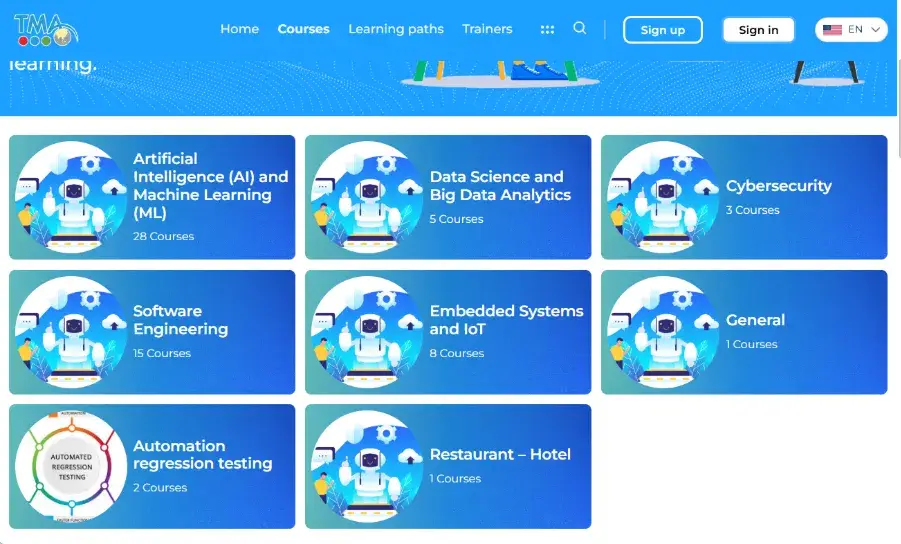
In this implementation, learning paths were tailored to roles and skill levels, supported by centralized management and recommendation features that improved consistency and visibility. This demonstrates how personalized learning and analytics can work together to improve workforce development at scale.
Conclusion
Measuring learning effectiveness requires more than tracking course completion, because completion alone does not reflect whether employees have developed meaningful capabilities. A personalized learning platform for enterprise can provide deeper insight by connecting learning activity with competencies, workforce needs, and operational outcomes in a structured way.
AI enhances this process through personalized recommendations, skill-gap analysis, and adaptive learning, but its effectiveness depends on strong data foundations, system integration, and clear measurement frameworks. Without these elements, even advanced analytics cannot produce reliable insights.
TMA Solutions’ Smart Corporate Training (T-Learning) demonstrates how enterprise learning platforms can combine personalization, analytics, and integration to support workforce development in a scalable and measurable way. Ultimately, the value of an enterprise learning platform is not determined by how many reports it can generate, but by how effectively it connects learning activity with competencies, skill development, and workforce needs.