AI agents are rapidly becoming a strategic investment for enterprises seeking to automate workflows, improve decision making, and enhance customer experiences. Unlike traditional automation tools, AI agents can understand context, interact with multiple systems, and execute complex tasks with minimal human intervention.
According to Gartner, by 2028, 33% of enterprise software applications will incorporate agentic AI capabilities, compared to less than 1% in 2024. This rapid adoption is creating growing demand for organizations that can design, develop, and deploy enterprise-grade AI agents securely and effectively.
However, selecting the right AI agent development company is often more challenging than choosing a software vendor. AI agents interact directly with business processes, data, and decision-making workflows, making technical expertise, industry knowledge, and long-term support critical success factors.
Business Functions That Can Benefit from AI Agents
AI agents are no longer limited to automating isolated tasks. Modern AI agents can understand context, interact with enterprise systems, and execute multi-step workflows, making them valuable across a wide range of business functions. By integrating with existing applications such as ERP, CRM, HRM, and knowledge management platforms, AI agents help organizations improve efficiency, reduce manual workloads, and accelerate decision-making.
Customer Service and Support
AI agents can automate customer interactions by handling routine inquiries, resolving common issues, and routing complex requests to human representatives. This enables organizations to deliver faster response times, improve customer satisfaction, and provide 24/7 support.
Sales and Marketing
AI agents help sales and marketing teams analyze customer data, qualify leads, generate personalized recommendations, and automate campaign management. These capabilities allow businesses to improve customer engagement while increasing conversion rates and sales productivity.
Human Resources
HR teams can leverage AI agents to streamline recruitment, employee onboarding, leave management, policy inquiries, and internal support services. By automating repetitive administrative tasks, HR professionals can focus on strategic talent development and employee engagement.
Finance and Accounting
AI agents assist finance departments by automating invoice processing, expense validation, financial reporting, reconciliation, and compliance checks. This reduces manual effort, improves data accuracy, and accelerates financial operations.
Supply Chain and Logistics
AI agents support logistics operations by monitoring inventory levels, forecasting demand, optimizing delivery routes, and coordinating warehouse activities. Real-time insights enable organizations to improve supply chain visibility and respond more effectively to operational disruptions.
IT Operations and Enterprise Knowledge Management
AI agents can assist IT teams by automating service desk requests, troubleshooting common technical issues, monitoring system performance, and managing internal knowledge bases. They also help employees quickly retrieve information from enterprise documents, reducing search time and improving organizational productivity.
As AI capabilities continue to evolve, organizations are increasingly deploying AI agents across multiple business functions to build more intelligent, connected, and scalable enterprise operations. Choosing an AI agent development company with cross-functional expertise ensures that AI solutions can be effectively integrated into existing business processes and deliver measurable long-term value.
Why Selecting the Right AI Agent Development Partner Matters
AI agents operate much closer to business processes than traditional software applications. They often access enterprise data, interact with customers, automate workflows, and support operational decision-making. As a result, implementation quality directly impacts business outcomes.
AI Agents Influence Critical Business Operations
Organizations are increasingly deploying AI agents across customer service, finance, supply chain management, healthcare, and enterprise operations. According to IBM's AI Projects to Profits study, enterprises expect AI workflows to increase from 3% today to 25% by the end of 2025, while 70% of executives believe agentic AI will play an important role in their organization's future. These findings demonstrate that AI agents are rapidly becoming a core component of enterprise operations and business transformation initiatives.
Operational Efficiency and Automation
Well-designed AI agents help organizations:
- Automate repetitive workflows
- Reduce manual processing effort
- Improve response times
- Increase workforce productivity
- Streamline operational processes
The effectiveness of these outcomes depends heavily on the technical capabilities of the development partner.
Data Security and Compliance
AI agents frequently access sensitive customer information and business data. Without proper governance, organizations may face challenges related to:
- Data privacy protection
- Regulatory compliance
- Access management
- AI governance
- Operational security
A qualified AI agent development company should understand both AI technologies and enterprise security requirements.
Long-Term Success Depends on Scalability
Many AI initiatives begin with pilot projects. However, successful organizations eventually expand AI adoption across multiple departments and business functions.
Future Growth Requirements
Organizations should evaluate whether the vendor can support future scaling requirements including:
- Multi-agent systems
- Enterprise-wide deployment
- Large-scale workflow orchestration
- Cross platform integration
- Long-term AI optimization
Sustainable AI Adoption
AI implementation is not a one-time project. Organizations require continuous monitoring, model updates, and workflow improvements to maintain performance over time.
Key Criteria for Evaluating an AI Agent Development Company
Selecting an AI agent development company should involve more than reviewing technical capabilities. Enterprises should assess a vendor's ability to align AI solutions with business objectives.
Evaluate Technical Expertise in Agentic AI
A strong development partner should demonstrate practical experience building enterprise AI systems rather than simply integrating existing AI tools.
Experience with Modern AI Technologies
The ideal partner should have experience in:
- AI agents and agentic AI systems
- Large Language Models (LLMs)
- Retrieval-Augmented Generation (RAG)
- Multi-agent architectures
- Workflow orchestration platforms
- Enterprise AI integration
These technologies form the foundation of modern AI agent ecosystems.
End-to-End Development Capabilities
A reliable vendor should support every stage of the AI lifecycle, including:
- AI consulting and strategy development
- Proof of Concept (PoC) creation
- Solution design and development
- Deployment and integration
- Monitoring and optimization
This ensures consistency throughout the project lifecycle.
Assess Industry Experience
AI implementation challenges vary significantly across industries. Organizations benefit from partners that understand industry-specific workflows, regulations, and operational challenges. For example, healthcare AI agents require different capabilities than AI agents developed for financial services or manufacturing environments.
Companies with industry-specific experience can better understand:
- Business workflows
- Regulatory requirements
- Security standards
- Operational challenges
Proven Project Portfolio
Case studies and successful implementations provide valuable evidence of a company's ability to deliver measurable business results.
Organizations should look beyond technology demonstrations and focus on real-world outcomes such as:
- Productivity improvements
- Cost reductions
- Workflow optimization
- Customer experience enhancement
The Value of Working with a Custom AI Agent Development Company
While prebuilt AI solutions can accelerate initial adoption, custom AI agents often provide greater long-term value by aligning more closely with enterprise requirements:
- Limited Business Alignment: Generic AI solutions may not fully support an organization's unique workflows and operational requirements.
- Restricted Integration: Prebuilt AI tools often face challenges connecting with existing enterprise systems and data sources.
- Tailored Workflows: Custom AI agents can be designed around industry-specific processes, governance policies, and compliance requirements.
- Greater Flexibility: Organizations can adapt and scale AI capabilities as business needs evolve.
- Competitive Advantage: AI solutions aligned with business objectives typically deliver stronger operational and strategic value.
- Higher ROI: Custom AI agents help maximize productivity gains and long-term business outcomes.
Characteristics of a Top AI Agent Development Company
The success of an AI initiative depends not only on the technology itself but also on the expertise of the implementation partner. Beyond developing AI models, organizations need partners that understand business processes, enterprise architecture, and long-term operational requirements.
A reliable AI development partner should be able to design scalable solutions, integrate them seamlessly into existing systems, and continuously optimize performance as business needs evolve.
When evaluating an AI agent development company, organizations should consider the following capabilities:
- Strong AI and software engineering capabilities: The partner should have expertise in AI, machine learning, Generative AI, and enterprise software development to build reliable and scalable AI solutions.
- Experience across multiple industries: Industry-specific knowledge helps ensure AI solutions are tailored to unique business processes, regulatory requirements, and operational challenges.
- Enterprise integration expertise: AI systems should integrate smoothly with existing enterprise applications such as ERP, CRM, EHR, and other business platforms to maximize operational efficiency.
- Security and governance knowledge: The partner should implement robust security measures, data governance policies, and responsible AI practices to protect sensitive information and support regulatory compliance.
- Long-term support and optimization services: AI systems require continuous monitoring, model updates, and performance optimization to maintain accuracy and adapt to changing business environments.
- Proven AI implementation success: Demonstrated experience through successful AI projects and real-world deployments provides confidence in the partner's ability to deliver measurable business value.
Rather than selecting a vendor based solely on technical capabilities, organizations should prioritize partners that combine engineering excellence with business expertise and a proven ability to deliver sustainable, measurable outcomes.
TMA Solutions: A Trusted Partner for Enterprise AI Agent Development
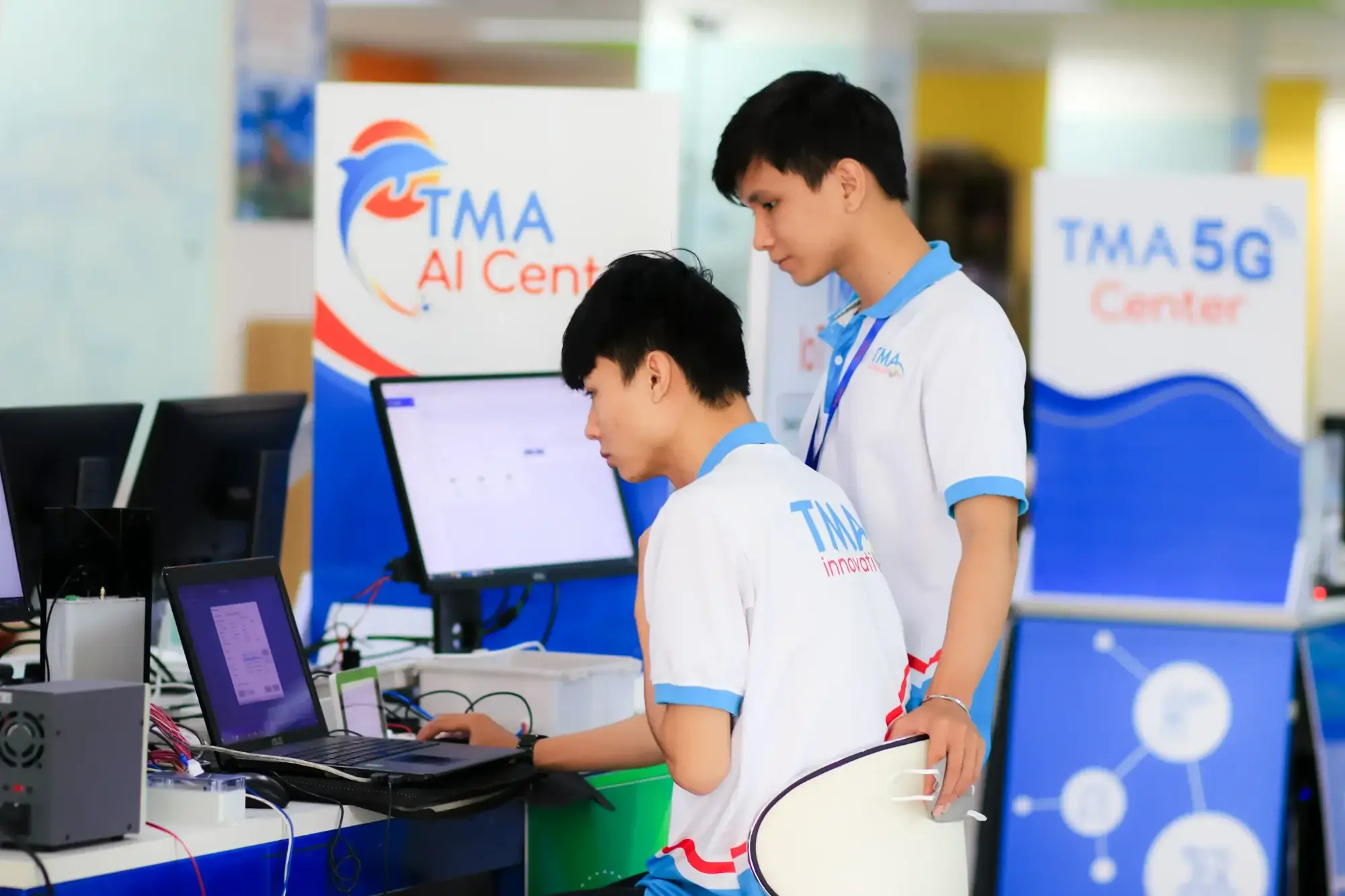
TMA Solutions helps organizations accelerate AI agent adoption through its AI Center and AI Agent Factory. Leveraging a no-code AI Agent Framework, TMA supports the development, deployment, and management of enterprise AI agents across diverse business environments.
Key capabilities include:
- Agentic AI Development
- Roadmap development for AI Agents and Agentic AI
- Setup of AI Agent development teams
- Tailored AI solutions for diverse industries
- Prototype and Proof of Concept (PoC) development
With extensive experience in enterprise software engineering and AI solutions, TMA Solutions helps organizations build scalable AI systems that align with business objectives and long-term digital transformation strategies.
Conclusion
Choosing the right AI agent development company is a strategic decision that can significantly influence the success of an organization's AI transformation journey. As AI agents become increasingly integrated into enterprise operations, businesses need partners that can deliver secure, scalable, and future-ready solutions.
By evaluating technical expertise, industry experience, security practices, and long-term support capabilities, organizations can identify a trusted partner capable of turning AI investments into sustainable business value. The right AI partner does more than build AI agents, it helps organizations create intelligent systems that drive efficiency, innovation, and long-term competitive advantage.