Introduction
The global elderly population is growing rapidly, creating increasing pressure on healthcare systems, nursing facilities, and caregivers. According to the World Health Organization, the number of people aged 60 and older will reach 2.1 billion by 2050, significantly increasing demand for long term healthcare and elderly support services.
To address these challenges, healthcare providers are investing in AI nurse assistants and intelligent healthcare platforms to improve operational efficiency, patient monitoring, and care quality.
AI technologies are helping elderly care facilities automate repetitive tasks, monitor patient health in real time, and support faster medical responses. As digital healthcare transformation accelerates, AI nurse assistants are becoming an important part of modern elderly care operations. This shift is also driving growing demand for wearable health data integration solutions and remote monitoring for elderly systems capable of supporting scalable healthcare services.
Improving Elderly Care Operations Through AI Nurse Assistant
Elderly care organizations often face staffing shortages, rising operational costs, and increasing patient care demands. Traditional care models alone are becoming more difficult to scale efficiently.
Reducing Administrative Workloads for Caregivers
Nurses and caregivers spend significant time handling documentation, scheduling, medication tracking, and patient monitoring activities. AI nurse assistants help reduce these repetitive workloads by automating operational tasks and improving access to patient information.
Common AI supported healthcare functions include:
- Appointment and medication reminders
- Automated patient monitoring
- Digital documentation support
- Health data analysis
- Emergency alert notifications
These technologies allow healthcare staff to spend more time focusing on patient care instead of administrative activities.
Supporting Continuous Patient Monitoring
Elderly patients often require continuous health monitoring because of chronic conditions and higher medical risks. AI systems combined with wearable health data integration solutions allow healthcare providers to monitor patient conditions in real time through connected devices and digital healthcare platforms. This helps organizations improve response times and detect potential health issues earlier.
How AI Nurse Assistants Improve Elderly Care Operations
AI nurse assistants and virtual nursing platforms significantly improve elderly care operations by automating administrative tasks, providing proactive health monitoring, and enabling highly personalized care. By easing staff workloads, these tools allow human caregivers to focus on critical clinical decisions and meaningful, compassionate interactions.
Remote Monitoring Improves Patient Safety
Remote monitoring for senior care is becoming increasingly important because many elderly patients require ongoing medical observation without continuous physical supervision. AI platforms can collect and analyze data from wearable devices such as heart rate monitors, sleep trackers, and movement sensors.
These systems help healthcare providers:
- Detect abnormal health patterns: Identifies early signs of health issues through continuous monitoring.
- Monitor medication adherence: Tracks medication schedules and supports treatment compliance.
- Track patient mobility: Monitors movement and activity levels to detect potential risks.
- Reduce emergency response delays: Sends real-time alerts for faster caregiver intervention.
- Improve long term patient management: Supports personalized care with ongoing health insights.
Remote monitoring for elderly patients also allows healthcare organizations to expand healthcare access while reducing pressure on hospitals and nursing facilities.
AI Helps Caregivers Make Faster Decisions
AI nurse assistants can analyze patient information and generate alerts when unusual health conditions are detected. This supports faster operational decisions and improves coordination between caregivers, nurses, and healthcare providers. According to Deloitte, healthcare organizations adopting AI technologies are already improving operational efficiency and reducing delays in patient service delivery. The 2026 US healthcare outlook reveals that over 80% of health executives expect agentic and generative AI to deliver significant value to hospital operations this year. As healthcare demand continues growing, intelligent healthcare systems are becoming essential for scalable elderly care operations.
The Role of Wearable Healthcare Technologies
Wearable healthcare technologies are becoming one of the most important components of modern elderly care systems.
Real Time Health Monitoring
Wearable devices continuously collect patient health information such as heart rate, oxygen levels, physical activity, and sleep patterns. When integrated into AI healthcare platforms, this data helps organizations monitor elderly patients more accurately and proactively. This is why wearable health data integration solutions are increasingly being adopted across healthcare and aged care environments.
Preventive Healthcare and Early Detection
AI systems can identify health risks earlier by analyzing long term patient data and detecting unusual behavioral or physiological patterns. This supports preventive healthcare strategies and helps reduce emergency hospitalizations among elderly patients. The combination of AI technologies and remote healthcare systems is therefore improving both operational efficiency and patient care quality.
How TMA Solutions Enables Wearable Healthcare Integration
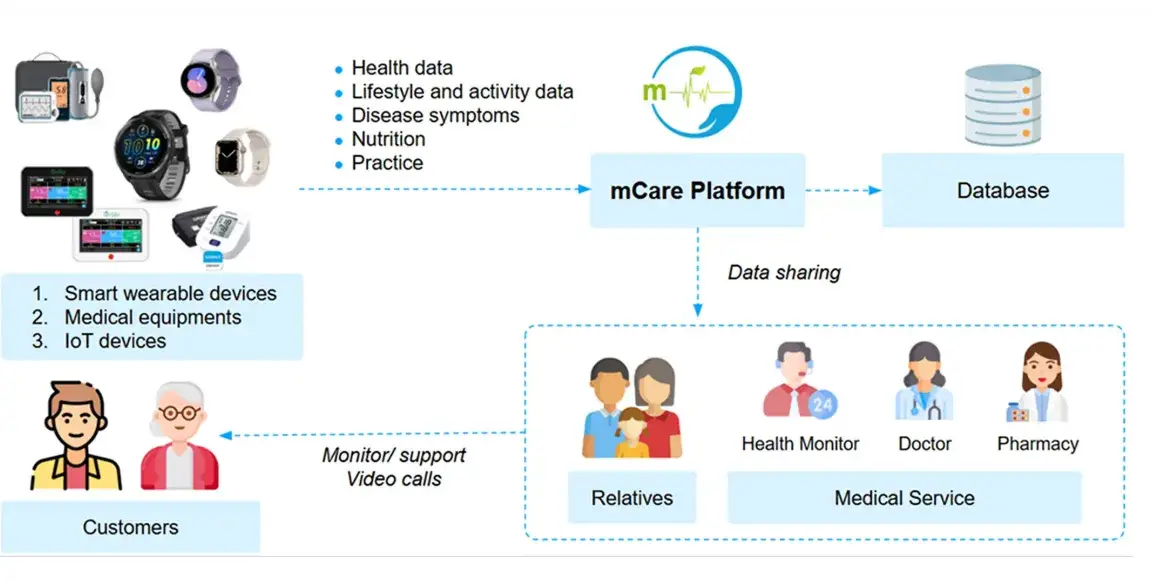
As wearable technologies become essential to modern elderly care, TMA Solutions enables healthcare providers to seamlessly integrate and manage health data from a wide range of connected medical devices. The company has successfully integrated more than 50 wellness, medical, and fitness devices, supporting a wide range of connectivity protocols including BLE, NFC, ANT+, 4G, Wi-Fi, ZigBee, and LoRaWAN. Through seamless device integration, intelligent data filtering, and rigorous data validation processes, TMA enables healthcare organizations to collect accurate real-time health data and transform it into actionable insights. These capabilities help elderly care providers improve patient monitoring, support early risk detection, and deliver more proactive, data-driven care services.
AI Healthcare Innovation in Vietnam
Vietnam is becoming an emerging destination for healthcare technology development and AI driven healthcare solutions.
Growth of AI Healthcare Ecosystems
Healthcare providers and technology companies are increasingly investing in digital healthcare transformation initiatives, intelligent automation, and AI platforms. This growth is strengthening the development of AI for aged care in Vietnam and expanding innovation across healthcare technology sectors.
Expanding AI Healthcare Capabilities
Vietnamese technology companies are also building expertise in:
- AI healthcare platforms
- Remote healthcare monitoring
- Intelligent automation
- Cloud based healthcare systems
- Wearable healthcare integration
As healthcare demand continues increasing globally, AI for healthcare from Vietnam is gaining attention because of the country’s growing engineering capabilities and competitive technology ecosystem.
Advancing Elderly Care with TMA Solutions Healthcare Expertise
As the demand for elderly care continues to grow, healthcare providers are seeking innovative technologies that can improve care quality while addressing workforce shortages and operational challenges. TMA Solutions leverages its healthcare expertise and AI capabilities to develop intelligent elderly care solutions that support proactive health management, remote monitoring, and independent living.
Through its mCare ecosystem and senior care services, TMA delivers comprehensive solutions designed specifically for elderly care providers, nursing homes, home care organizations, and healthcare institutions. Key capabilities include:
- Telehealth support: Enables virtual consultations for timely medical support from home.
- Remote health monitoring: Monitors vital signs, sleep patterns, and daily activities in real time to support proactive elderly care.
- Instant emergency alert: Detects health abnormalities and immediately notifies caregivers and medical professionals.
- Medication reminders: Delivers personalized medication reminders to help seniors stay on track with their treatment plans.
- Chronic disease monitoring: Supports chronic disease management through real-time monitoring and personalized health insights.
In addition, TMA's MateCare AI companion also helps seniors maintain daily routines, receive personalized reminders, and stay socially connected through voice-based interactions and intelligent assistance. By combining AI, IoT, and healthcare technologies, TMA enables elderly care providers to deliver safer, more efficient, and more personalized care while improving operational visibility and supporting long-term healthy aging.
Conclusion
AI nurse assistants are transforming elderly care operations by improving patient monitoring, reducing caregiver workloads, and supporting faster healthcare decisions. As healthcare systems continue modernizing digital infrastructure, AI platforms and remote monitoring technologies will become increasingly important for delivering scalable and efficient elderly care services. Organizations investing in wearable health data integration solutions and remote monitoring for elderly systems today will be better positioned to improve patient care quality and support long term healthcare sustainability in the future.