Introduction

Enterprises across global markets are accelerating the adoption of Artificial Intelligence (AI) Agents to improve operational efficiency, reduce repetitive workloads, and optimize internal business processes. Recent industry developments show that multinational corporations are increasingly shifting operational tasks from external vendors to internal AI driven systems in order to lower costs and shorten execution cycles. According to Reuters, companies in retail, manufacturing, and consumer goods sectors are already using AI technologies to automate campaign production, support operational decision making, and improve resource allocation.
This transition reflects a broader movement toward enterprise automation where organizations no longer view AI as an experimental initiative. Instead, AI Agents are becoming part of long term operational strategies designed to increase productivity and improve scalability across departments. As enterprises continue to modernize their infrastructure, many organizations are seeking support from an AI Agent development company from Vietnam to accelerate deployment while maintaining cost efficiency and technical flexibility.
The Growing Need for Operational Efficiency
Enterprises today are under growing pressure to reduce operational expenses without affecting service quality or business continuity. Rising labor costs, fragmented software ecosystems, and slower decision making processes are creating major barriers to sustainable growth. Traditional automation systems often struggle to adapt to dynamic workflows because they rely heavily on predefined rules and manual configuration. AI Agents are changing this operational model by introducing more intelligent and adaptive systems.
AI Agents Are Moving Beyond Traditional Automation
Unlike conventional software tools, AI Agents can process large volumes of enterprise data, understand context, and execute workflows with greater flexibility.
This allows organizations to automate operational activities that previously required continuous human supervision. AI Agents are increasingly being used across:
Customer support operations
Supply chain coordination
Financial reporting
Internal workflow management
Administrative processing
Rather than simply replacing repetitive tasks, these systems help enterprises improve operational consistency and reduce delays across departments. According to PwC’s 2025 AI research, organizations implementing agentic AI technologies have recorded productivity improvements and operational value increases of up to 66%.
Optimizing Enterprise Workflows Through AI Agents
One of the biggest reasons enterprises invest in AI Agents is the ability to reduce repetitive operational work while improving execution speed. Many organizations still rely heavily on manual data entry, document validation, email processing, and internal coordination tasks that consume significant time and labor resources.
AI Agents Improve Workflow Automation
AI Agents can automate repetitive operational activities while maintaining process accuracy and operational continuity. For example, enterprises are using AI Agents to:
Categorize customer support tickets
Process invoices and business documents
Schedule operational workflows
Monitor production environments
Generate business reports
Instead of forcing employees to spend hours on repetitive administrative work, intelligent systems allow teams to focus on strategic activities that generate higher business value. According to IBM, 99% of developers are actively exploring or developing AI Agents as organizations move beyond experimental AI initiatives into real operational environments.
Faster Operations Lead to Lower Enterprise Costs
Global enterprises are accelerating production timelines by up to 60% using AI factory capabilities and optimized supply chains, with productivity benchmarks highlighted by the World Economic Forum. Some organizations shortened execution cycles from several weeks to only a few hours after integrating AI technologies into operational workflows. These improvements directly contribute to lower operational costs, faster service delivery, and improved resource allocation. Beyond automation alone, AI Agents also improve decision quality by identifying inefficiencies and operational patterns in real time. Enterprises can optimize workforce allocation, reduce workflow delays, and minimize operational waste without significantly expanding headcount.
Enterprise Applications Across Industries
AI Agent adoption is expanding rapidly because operational challenges are becoming more complex across industries. Enterprises now require systems capable of processing information across multiple business environments while maintaining scalability and reliability.
Manufacturing and Logistics
Manufacturing companies are using AI Agents for predictive maintenance, production monitoring, and workflow scheduling. These capabilities help organizations reduce downtime, improve production visibility, and optimize resource management across operational environments.
Financial Services and Healthcare
Financial institutions are integrating AI Agents into compliance operations, document processing, fraud detection, and customer service systems.
Healthcare organizations are also implementing AI technologies for appointment management, administrative workflows, and documentation processing to improve operational efficiency while reducing manual workloads.
Retail and Customer Experience
Retail enterprises are using AI Agents to support inventory planning, customer engagement workflows, and demand forecasting. These technologies help businesses respond more effectively to changing customer behavior while improving operational efficiency across digital channels. As demand for scalable enterprise AI systems continues increasing, many organizations are evaluating partnerships with providers specializing in top AI Agent development in Vietnam because of the country’s growing expertise in enterprise software engineering and AI integration services.
Building Sustainable AI Operations
While operational cost reduction remains a major priority, enterprises are also focusing on long term sustainability when implementing AI systems. Successful AI adoption requires more than automation alone. Organizations must establish governance frameworks, maintain data quality standards, and ensure that AI systems align with business objectives. Enterprises that achieve strong operational outcomes typically begin with targeted implementations focused on measurable business challenges. Over time, AI Agents can expand across departments and support broader enterprise transformation initiatives.
Scalability, security, and interoperability are becoming essential requirements in enterprise AI adoption strategies. Companies that invest in flexible AI architectures are better positioned to adapt to evolving operational demands and changing market conditions. This shift explains why organizations increasingly prefer working with a custom AI Agent development company capable of designing scalable AI systems tailored to enterprise requirements instead of relying solely on generic automation platforms.
TMA Solutions as a Strategic AI Technology Partner
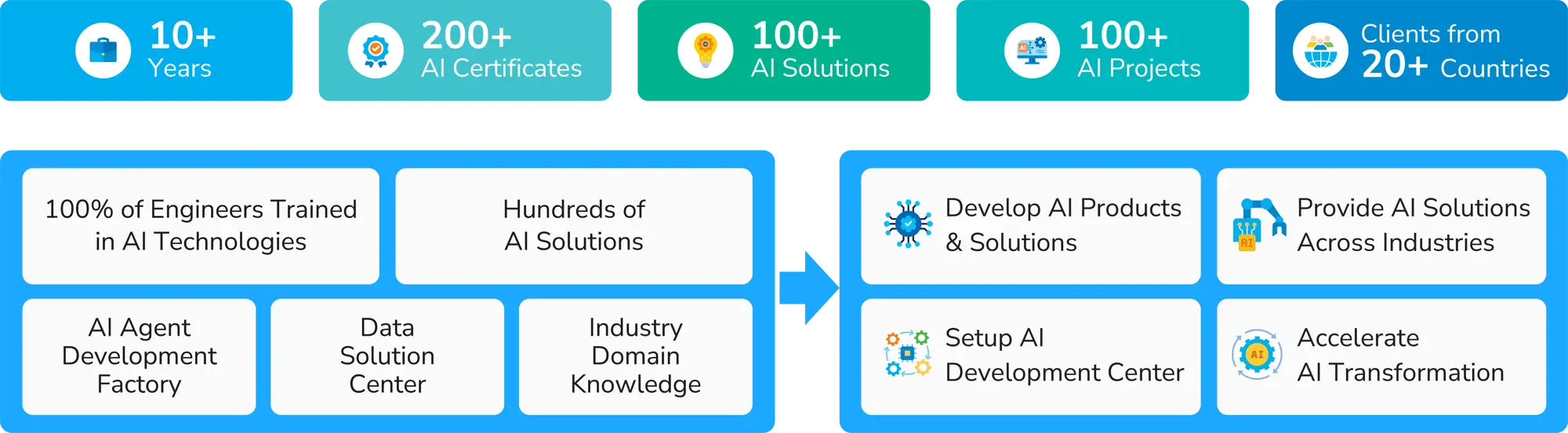
Enterprises pursuing operational efficiency often require technology partners with strong enterprise engineering capabilities and long term implementation experience. TMA Solutions is one of the leading technology companies in Vietnam with nearly 30 years of experience delivering enterprise software solutions for global clients.
Our company has invested heavily in AI, machine learning, and data sciences for more than 10 years through its AI Center and AI Agent Factory. TMA Solutions currently provides over 100 AI solutions and services supporting intelligent automation, Optical Character Recognition (OCR), Generative AI, Computer Vision, and AI driven customer support systems. For enterprises searching for a reliable AI Agent development company from Vietnam or evaluating top AI Agent development in Vietnam, TMA Solutions provides long term technology partnership capabilities aligned with enterprise digital transformation strategies.
Conclusion
AI Agents are transforming enterprise operations by reducing repetitive workloads, improving process efficiency, and enabling organizations to make faster operational decisions. Industry developments show that enterprises are moving beyond experimental AI adoption and integrating AI systems directly into core business operations.
As organizations continue to pursue operational efficiency and scalable digital transformation, the demand for enterprise AI expertise will continue to grow. Businesses seeking long term competitive advantages are increasingly collaborating with top AI Agent development in Vietnam to accelerate innovation while maintaining cost efficiency and operational flexibility. The next stage of enterprise transformation will not simply focus on automation alone. It will focus on building intelligent operational ecosystems where AI Agents continuously support decision making, process optimization, and sustainable business growth.