Hospitals run on data that cannot talk to itself: device readings stranded in proprietary formats, referrals faxed between systems, and clinical trials still collecting outcomes on paper. The market is responding — medical device connectivity is projected to grow from USD 7.93 billion in 2025 to USD 15.55 billion by 2033, while the broader Internet of Medical Things expands from USD 230.7 billion in 2024 toward USD 658.6 billion by 2030 [1][2]. For CTOs, CIOs, and product leaders, interoperability is now the constraint that decides whether clinical data reaches decisions. This guide maps the standards, the device integration patterns, and the delivery pipeline that makes them work.
Medical Device Integration: Connecting Devices to Clinical Systems
Medical device integration moves data from bedside monitors, wearables, and diagnostic tools into clinical systems where it drives decisions. A production pipeline has four layers: device connectivity over BLE, Wi-Fi, cellular, or serial; normalization into standard representations (HL7, DICOM, IEEE 11073 profiles, or vendor APIs where nothing else exists); real-time pipelines that stream, buffer, and route data with latency budgets appropriate to the clinical use — seconds for arrhythmia alerts, minutes for vitals trends; and clinical system delivery via EHR interfaces, dashboards, and alerting engines. Because each device family speaks its own dialect, the integration layer must be abstracted: our own platforms support 50+ medical devices and wearables precisely because the abstraction layer, not the device driver, is the reusable asset [3].
Standards Cheat Sheet: HL7 v2 vs FHIR vs DICOM vs IEEE 11073
Standard | What it does | Where it still wins | Where it hurts |
HL7 v2 | Event messaging: ADT, ORM, ORU feeds between systems | Ubiquitous in hospitals; interface engines support it everywhere | Pipe-delimited and site-customized; every interface is bespoke |
FHIR (R4/R5) | RESTful resources for clinical data exchange | Modern APIs, mobile apps, SMART on FHIR embedding | Partial vendor coverage; profiling effort still required |
DICOM | Imaging objects, studies, and device output | The only real choice for radiology and imaging devices | Heavy for non-imaging use; PACS integration complexity |
IEEE 11073 | Point-of-care medical device communication (incl. PHD profiles) | Standardizing data from bedside and personal health devices | Fragmented vendor implementation; gateway layers still common |
Practical rule: DICOM for images, IEEE 11073-family profiles for device streams, HL7 v2 for legacy hospital messaging, and FHIR for everything modern — with an interface engine translating between them.
Electronic Clinical Outcome Assessment (eCOA/ePRO)
Electronic clinical outcome assessment (eCOA) digitizes how patients and clinicians report outcomes in trials and care programs — ePRO questionnaires, clinician-rated scales, and performance measures captured on validated devices. Three engineering constraints separate compliant eCOA from a survey app: digital scale validation so electronic versions preserve the psychometric properties of the original instruments; 21 CFR Part 11 awareness — audit trails, electronic signatures, and access controls for records that regulators may inspect [4]; and multilingual deployment with culturally validated translations, because a scale translated without validation produces data regulators will reject. Sponsor-specific validation requirements vary by study and region: [Source needed].
Digital Prescription & Referral System
A digital prescription and referral system connects prescribing, dispensing, and specialist routing. E-prescription standards matter: structured, codified medication orders stream through FHIR MedicationRequest resources with pharmacy routing and interaction checks [5]. Referral routing is the harder problem — directing patients to specialists by availability, insurance coverage, and urgency while keeping the audit trail intact. Tamper-evidence completes the loop: prescriptions and referrals carry cryptographic signatures and append-only audit logs, so any modification is detectable — the digital equivalent of a sealed paper script, enforceable in disputes and audits.
Medical OCR & Document AI
Medical OCR turns the paper residue of healthcare — handwritten intake forms, referral letters, lab reports, claim attachments — into structured data. Modern pipelines are OCR + LLM, not OCR alone: the OCR layer extracts text and layout, then the language model parses it into fields with confidence scores. Accuracy benchmarks vary sharply by document class — typed lab reports extract reliably; handwritten forms and mixed-layout claims need validation rules and human review queues for low-confidence fields. The engineering discipline is the same as anywhere else healthcare: never let an extracted value reach a clinical decision without a validation path. TMA's OCR work in healthcare applications, including prescription digitization for clinic workflows, shows the pattern operating in production [3][6].
Clinical Workflow Automation in Healthcare Systems
Clinical workflow automation turns interoperability into operational capacity: referrals routed automatically with status tracking instead of manual chasing; orders propagated from EHR to fulfillment systems with exception alerts; results follow-up that escalates unactioned results by age and severity rather than hoping someone notices; and discharge workflows that assemble medications, appointments, and instructions into a single coordinated sequence. Because every automated step writes to the chart or triggers a clinical action, workflow automation demands the same audit discipline as any clinical system: deterministic logs, exception queues, and named owners for each automated path.
Automated Medical Follow-Up Workflows
Automated medical follow-up workflows run trigger-based journeys after encounters, procedures, and discharges: a discharge triggers a 48-hour check-in; an abnormal result triggers a nurse review task; a missed appointment triggers a reschedule sequence. The intelligence layer — AI triage of patient responses — decides whether a reply indicates recovery, a side effect, or an emergency, and routes accordingly. Because false reassurance is the dangerous failure, triage models must operate under confidence thresholds that escalate uncertainty to humans, with every response and routing decision logged.
Automated Patient Reminder System for Healthcare
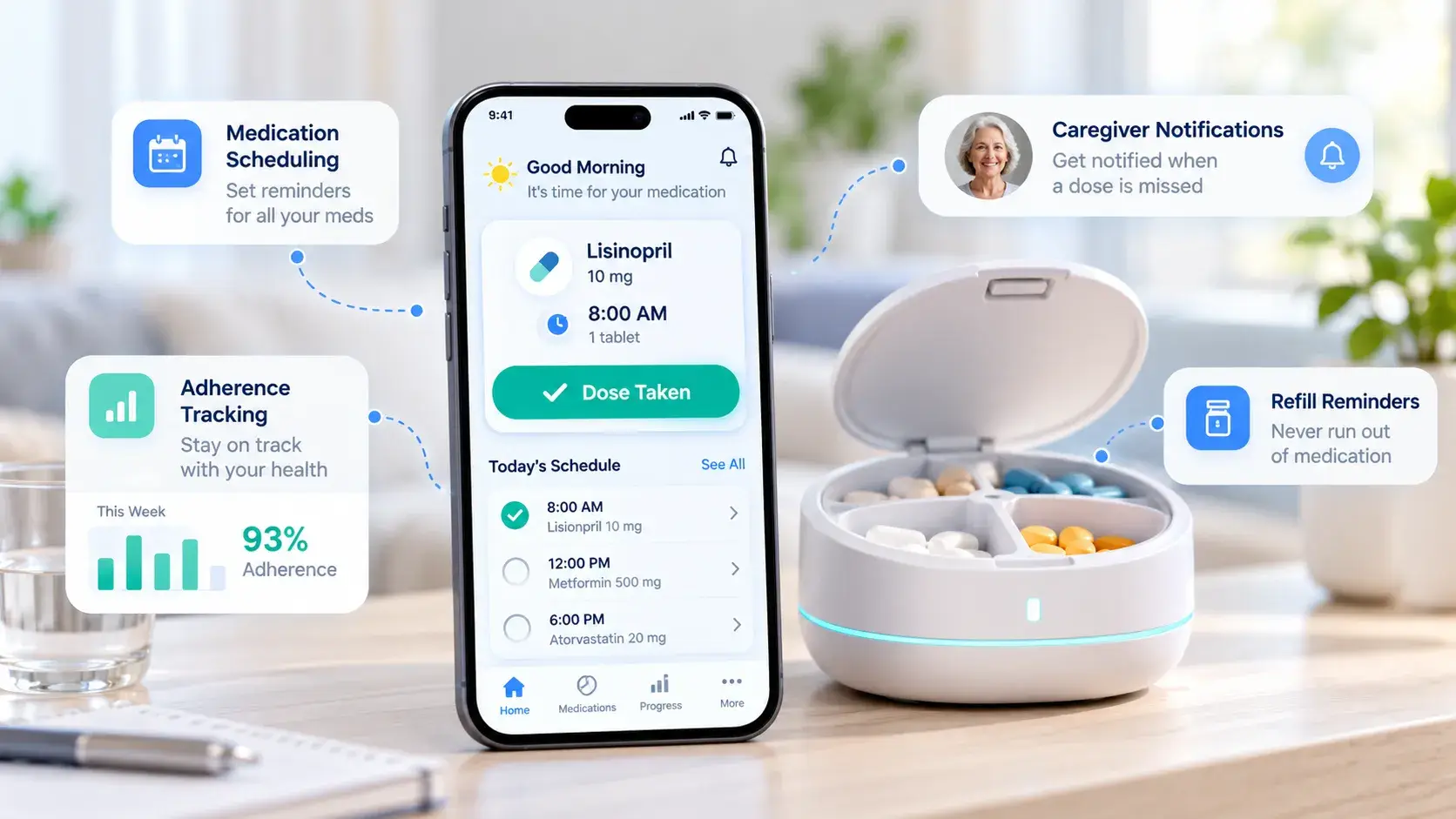
An automated patient reminder system for healthcare reaches patients on the channels they actually use: SMS for universality, WhatsApp and regional platforms (such as Zalo in Vietnam) for engagement and rich media, email for documentation, and voice bots for patients who don't read messages — a segment that matters disproportionately in elderly and low-digital-literacy populations. Channel selection is a clinical variable, not a marketing one: a medication reminder sent on a channel the patient never opens is a silent failure. Compliance carries through every channel: opt-in management, content review for PHI exposure, and conversation archives.
Enterprise Health Assessment Software
Enterprise health assessment software runs proactive health at population scale: checkup campaigns that schedule and track large employee or member cohorts; risk scoring that stratifies participants for follow-up intensity; and population analytics that report outcomes per site, condition, and intervention. Because campaigns produce structured data at volume, the integration layer matters as much as the assessment logic — results flow into EHRs for individuals and into anonymized analytics for populations, with consent and de-identification engineered into the pipeline rather than bolted on.
Security & Compliance for Connected Devices (IoMT)
Device identity. Every connected device gets a unique, cryptographically verifiable identity — MAC trust and shared passwords do not survive contact with a real hospital network.
Encryption end to end. Device-to-gateway and gateway-to-cloud traffic encrypted in transit and at rest; firmware signed and update-verifiable.
Network segmentation. IoMT traffic separated from clinical workstations and corporate networks, with monitored egress — unpatched devices are the most attractive entry point in healthcare.
Regulatory alignment. HIPAA-aware PHI handling for U.S. deployments [7]; IEC 60601/62304 awareness where devices or software carry clinical function; recall and incident processes defined before the first device ships.
Deployment Pipeline: From Devices to Clinical Systems
Inventory & contract mapping. Catalogue every device make/model and its data interface — vendor API, standards profile, or gateway only.
Connectivity layer. Provision network paths (segmented VLANs, cellular fallback), gateway firmware, and device identity management.
Normalization service. Map each data source into standard representations with a versioned mapping registry — changes ship without code forks.
Pipeline & validation. Stream ingestion with buffering, deduplication, and clinical validation rules before anything reaches the chart.
Clinical integration. Deliver via FHIR APIs, HL7 interfaces, and dashboards; test end-to-end with device-in-the-loop rigs.
Monitoring & lifecycle. Track message volumes, latency, and error rates per device class; manage firmware lifecycles and vendor deprecations.
FAQ
1. What is medical device integration and why does it fail?
It connects device data to clinical systems via HL7, DICOM, IEEE 11073, or vendor APIs. It fails when integrations are built per-device without an abstraction layer, breaking silently at firmware or vendor changes.
2. When should we use FHIR versus HL7 v2?
FHIR for modern APIs, mobile apps, and SMART on FHIR embedding; HL7 v2 for legacy hospital messaging where it remains ubiquitous. An interface engine translates between them in mixed environments.
3. What makes eCOA systems compliant?
Validated digital versions of outcome scales, 21 CFR Part 11-aligned audit trails and e-signatures, access controls, and culturally validated translations for every deployed language [4].
4. How accurate are medical OCR solutions?
Typed documents extract at production accuracy; handwriting and mixed layouts require OCR + LLM pipelines with confidence thresholds and human review queues before data enters clinical or billing records.
5. How do I evaluate an interoperability partner?
Ask for device matrices supported, FHIR/HL7 interface references, mapping-registry architecture, device-in-the-loop testing practices, and named ownership per interface — plus process maturity such as CMMI and ISO 27001.
Conclusion
Interoperability is the quiet infrastructure of every clinical AI and telehealth story — devices, standards, and workflows either connect cleanly or the data never reaches the decision. The winning architecture is layered: abstraction over device dialects, versioned mapping registries, standards-based delivery, and compliance engineered from sprint zero. TMA Solutions has built this class of system for years — 50+ supported devices, HL7/FHIR delivery across the U.S., Australia, Europe, and Japan, and measured clinical outcomes including a 33% reduction in 30-day readmissions in remote monitoring deployments [3][8] — backed by 29 years of engineering maturity (CMMI, ISO 9001, ISO 27001).
Ready to connect your devices and systems? Contact TMA Solutions at www.tmasolutions.com for an interoperability architecture review — bring your device inventory and EHR constraints, and leave with a delivery plan that maps every interface.
References
[1] Fortune Business Insights – Medical Device Connectivity Market Size & Share – 2026 – https://www.fortunebusinessinsights.com/medical-device-connectivity-market-114916
[2] Grand View Research – Internet of Medical Things (IoMT) Market Size Report, 2025–2030 – 2025 – https://www.grandviewresearch.com/industry-analysis/internet-of-medical-things-iomt-market-report
[3] TMA Solutions – Healthcare Software Solutions – 2026 – https://www.tmasolutions.com/industries/healthcare
[4] SCDM – Guidance for eCOA Development in Clinical Trials (incl. 21 CFR Part 11 references) – 2025 – https://www.jscdm.org/article/id/376
[5] HL7 International – FHIR Release 4/R5 Specification (MedicationRequest, ServiceRequest resources) – https://www.hl7.org/fhir/
[6] TMA Solutions – How Healthcare Providers Can Innovate Care Delivery Through Telehealth Platforms – 2026 – https://www.tmasolutions.com/insights/how-healthcare-providers-can-innovate-care-delivery-through-telehealth-platforms
[7] U.S. Department of Health & Human Services – HIPAA for Professionals – https://www.hhs.gov/hipaa/index.html
[8] TMA Solutions – Seamless Post-Surgical Home Care with Remote Monitoring – 2025 – https://www.tmasolutions.com/insights/seamless-post-surgical-home-care-with-remote-monitoring



.webp_2026-10-23-15-51-46-346.webp)