Introduction
Sleep apnea affects millions of people worldwide, yet it remains one of the most underdiagnosed conditions in healthcare. Repeated breathing interruptions during sleep are closely linked to cardiovascular disease, neurological disorders, and depression, but traditional diagnosis relies on clinical sleep studies that are costly, complex, and out of reach for most patients. AI wearable sensors are changing that, bringing accurate, continuous sleep monitoring directly to the individual.
The Limits of Conventional Diagnosis
The integration of wearable devices and artificial intelligence (AI) technologies has revolutionized the treatment and diagnosis of sleep apnea, enabling real-time monitoring and accurate analysis of sleep patterns, facilitating early detection and personalized interventions. Traditional methods like polysomnography (PSG), while precise, require specialized equipment and clinical settings that limit their scalability across large populations. The growing body of research into wearable-based alternatives is addressing this gap, moving sleep apnea detection out of the sleep lab and into everyday life.
AI and Wearables: A New Detection Architecture
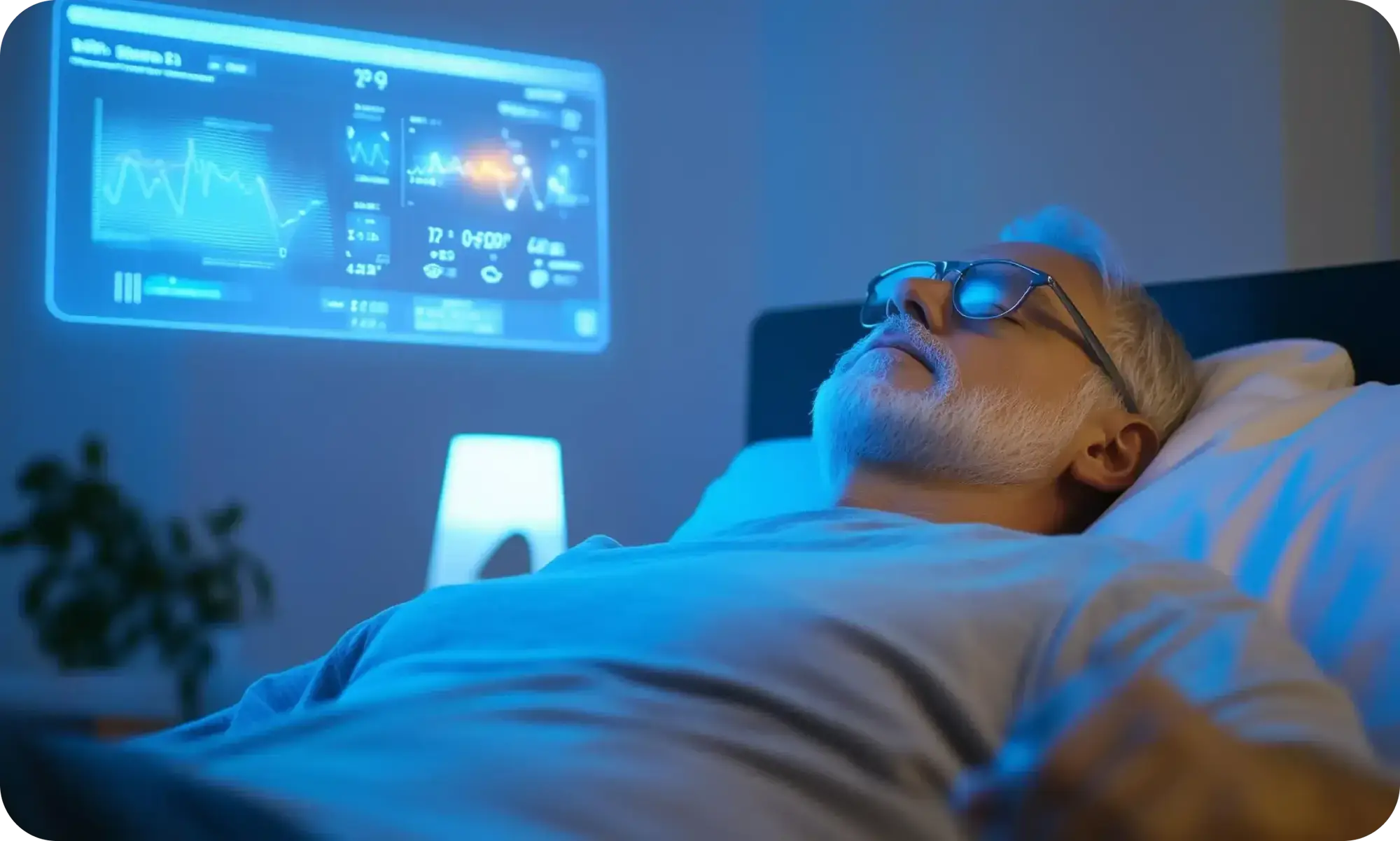
A systematic review published in the Journal of Medical Systems (2025), covering 249 studies from 2020 to 2024, reveals a clear convergence around a common diagnostic architecture: wearable devices including patches, smart rings, and wristbands integrated with convolutional neural networks (CNNs), producing promising results particularly when combined with transfer learning techniques. These devices capture physiological signals like ECG, photoplethysmography (PPG), oxygen saturation (SpO2), respiratory patterns, and body movement, which AI models then analyze to identify apnea events with clinical-grade accuracy.
Adding further momentum, researchers at Vanderbilt University recently published findings in Proceedings of the National Academy of Sciences (PNAS) (2025) on a skin-interfaced, wireless sleep monitoring device that moves beyond indirect wrist-based sensing. The device features a soft, skin-mounted mechanoacoustic sensor capable of directly measuring both respiratory and cardiac activity, capturing breathing rate, heart rate and variability, temperature, and body motion. Its onboard AI framework, LMA-SleepNet, analyzes over 140 features extracted from the signals and delivers personalized, interpretable sleep scores and disorder predictions directly to a user's phone or tablet.
Sleep Data as a Continuous Health Signal
What unites these advances is a shared principle: sleep is not a passive state but a continuous stream of biological data with direct diagnostic value. Breathing patterns, more than any other signal, proved to be the most reliable markers of REM sleep and wake transitions, something conventional consumer devices often miss. When AI is trained on multimodal data collected across full sleep cycles, it can detect not only apnea events but also patterns associated with cardiovascular risk, metabolic disorders, and neurological decline, long before symptoms become clinically apparent.
Transforming Sleep Data into Proactive Health Insights from TMA solutions
TMA Solutions' Sleep Apnea Detection is an AI wearable solution designed to help patients and clinicians detect, monitor, and manage sleep apnea and related disorders. The platform continuously tracks key sleep parameters, including heart rate variability, SpO2, and sleep stages, applying AI analysis to identify abnormal patterns and generate personalized health insights through intuitive visual dashboards. This solution supports earlier clinical intervention and more proactive care management, empowering both patients and healthcare providers to make informed decisions based on accurate, continuous sleep data.
What TMA Solutions' Sleep Monitoring Delivers
Our AI solution combines advanced analytics and sensor based technologies, offering the following key features to support accurate detection and proactive sleep health management:
Four Sleep Stage Analysis: Classifies sleep into four stages: Deep, REM, Light and Awake to identify disruptions and assess overall sleep quality.
Multi-Layer Trend Charts: Displays sleep changes weekly and monthly timelines through easy-to-read color-coded visuals for quick pattern recognition.
AI Health Insights Assistant: Analyzes sleep data to assess overall sleep quality and delivers personalized recommendations.
Abnormal Behavior Alerts: Identifies irregular sleep patterns by comparing nightly data against the user's personal sleep history for early risk detection.
Readiness Score: Forecasts daily energy and alertness levels based on the quality and patterns of the previous night's sleep.
Comparative Analytics Dashboard: Highlights relationships across sleep metrics to surface patterns linked to improved sleep quality outcomes.
How Our AI Sleep Monitoring Is Applied in Real Life
From early detection to long-term care, TMA Solutions enables smarter sleep apnea management through continuous AI monitoring:
Daily At-Home Sleep Monitoring: Enables patients to continuously monitor their sleep health at home.
Sleep Disorder Monitoring: Tracks and supports patients with insomnia, irregular sleep, and other sleep-related conditions.
Sleep Trend Tracking During Treatment or Lifestyle Changes: Monitors how sleep patterns shift in response to ongoing treatment or changes in daily habits.
Long-Term Health Monitoring for Chronic Conditions: Enables sustained sleep tracking for chronic illnesses patients.
Conclusion
AI wearables are transforming sleep apnea detection by making continuous, at-home monitoring more accessible and actionable. With deep expertise in AI and healthcare innovation, TMA Solutions is supporting people worldwide in transforming continuous sleep data into meaningful, life-improving health outcomes.