As organizations expand across stores, branches, warehouses, and service locations, maintaining consistent workforce capabilities becomes increasingly difficult. An enterprise learning management tool can help organizations coordinate learning at scale while maintaining consistent training standards, compliance visibility, and capability tracking across distributed teams.
Why Enterprise Training Complexity Increases as Organizations Scale
Workforce training becomes more complex as organizations expand their employee base, locations, roles, and operational requirements. The challenge is not only delivering more training, but also maintaining consistent standards and managing learning requirements across a workforce that may be distributed across hundreds of locations.
For organizations with large frontline teams, this complexity becomes particularly visible in day-to-day operations. Retail employees may need consistent service and product training across different stores, while logistics teams may require standardized safety, operational, and compliance training across warehouses and delivery locations.
Managing Training Complexity Across a Growing Workforce
As the workforce grows, organizations need to manage onboarding, mandatory training, role development, assessments, and certifications simultaneously. The challenge is therefore not simply delivering more content, but creating a structured way to manage learning requirements across different workforce groups.
An enterprise learning platform can provide a centralized environment for assigning learning, monitoring progress, managing compliance, and tracking workforce capabilities. Organizations can establish common standards while still adapting learning paths to specific roles, locations, and employee development needs.
Meeting the Growing Need for Continuous Workforce Development
The need for continuous workforce development is also increasing. According to the World Economic Forum's Future of Jobs Report 2025, 59 out of every 100 workers are projected to require reskilling or upskilling by 2030, making workforce learning an ongoing organizational capability rather than a one-time training activity.
Standardization does not mean every employee should receive identical training. Frontline employees, supervisors, managers, and specialists may share organizational requirements while developing different capabilities, making role-based learning an important part of enterprise workforce development.
The Risk of Inconsistent Workforce Training Across Distributed Teams
Distributed teams introduce another challenge because employees may receive different training depending on their location, manager, or access to local learning resources. Over time, these differences can lead to inconsistent service quality, uneven workforce capabilities, and limited visibility into whether organizational standards are being maintained.
For organizations with large frontline teams, the impact can extend beyond the learning function. Employees interact directly with customers, products, operational processes, and compliance requirements, so capability gaps can eventually become operational issues.
From Training Completion to Capability Consistency
Traditional training management often focuses on whether employees completed an assigned course. Completion is important, especially for mandatory training, but it does not necessarily demonstrate whether employees have developed the capabilities required for their roles.
A stronger approach connects learning programs with role-based competencies. Managers can then evaluate not only whether training was completed, but also whether employees are progressing toward the capabilities expected for their positions.
For example, a retail organization may require all customer-facing employees to complete product knowledge training. The learning environment can go further by organizing development around product knowledge, customer communication, service procedures, and other capabilities relevant to the role.
This shifts workforce learning from course administration to capability management. It also provides a more structured way to understand whether training requirements remain aligned with workforce needs.
Maintaining Compliance Across Distributed Teams
Compliance creates another layer of complexity at scale. Organizations may need to ensure that thousands of employees complete mandatory training within defined timeframes while maintaining reliable records across locations and business units.
An enterprise learning management tool can centralize training requirements, completion records, assessments, and certifications. This gives managers and learning teams a consistent view of compliance status and makes it easier to identify overdue or upcoming requirements.
The objective is not simply to generate more reports. It is to establish a reliable operational process for assigning, tracking, and maintaining workforce learning requirements across the organization.
How AI Improves Enterprise Learning Management Tools
AI can make enterprise learning platforms more responsive to individual workforce needs, particularly when organizations manage large numbers of employees with different roles, experience levels, and development requirements. However, AI should support the learning architecture rather than replace it, because effective personalization still depends on reliable data, relevant content, and clearly defined competency frameworks.
Personalizing Learning at Scale
Creating individual learning paths manually for thousands of employees is not practical. AI-supported recommendations can help identify relevant courses, assessments, and development activities based on available learner and competency information.
Two employees with the same job title may have different levels of experience or different development needs. A personalized learning environment can support different learning activities while keeping both employees aligned with the organization's broader requirements.
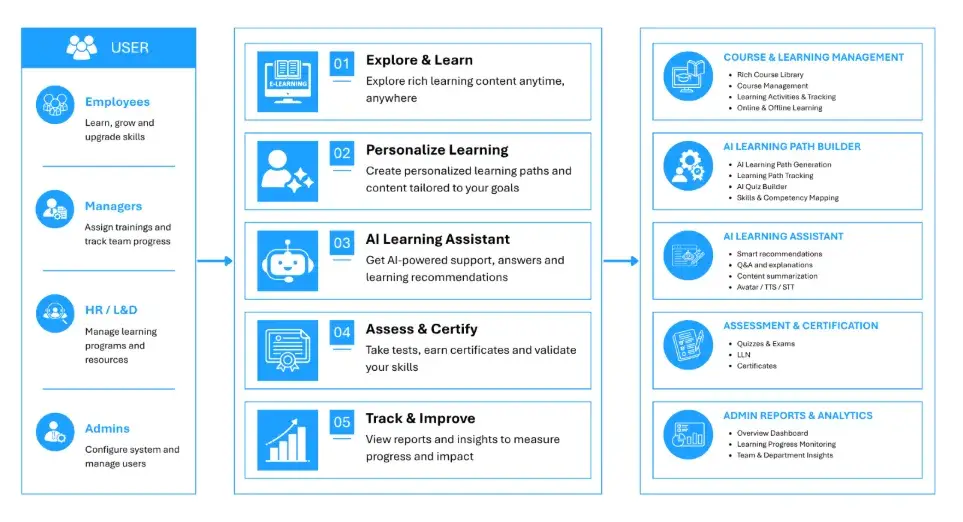
This balance between standardization and personalization is particularly important for large organizations. Smart Corporate Training (T-Learning), supports this approach through personalized learning paths, learner progress tracking, and competency development within an enterprise learning environment.
Identifying Workforce Skill Gaps
Learning and competency data can also help organizations identify recurring development needs across teams. Instead of reviewing employee records individually, learning teams can look for patterns across locations, roles, departments, or business units.
If employees across several locations consistently show the same development need, the issue may indicate a broader workforce capability gap rather than an isolated individual problem. Learning teams can then review relevant learning content or introduce targeted development activities.
This creates a more structured cycle of identifying capability needs, delivering learning, monitoring progress, and refining future learning interventions. For large workforces, such an approach can make upskilling more responsive to changing business requirements.
What Corporate Training Software Solutions Should Deliver for Frontline Teams
For distributed workforces, corporate training software solutions need to support more than online course delivery. They should provide the operational foundation for managing learning consistently across locations while giving employees, managers, and learning teams access to information relevant to their responsibilities.
Capability | Enterprise Requirement |
Centralized learning management | Manage courses, assessments, learning paths, and requirements across locations |
Role-based learning | Align learning with job roles, competencies, and development needs |
Compliance management | Track mandatory training, certifications, and deadlines |
Workforce analytics | Identify learning progress, capability gaps, and development trends |
Enterprise integration | Connect learning with HR and other enterprise systems |
Reporting | Provide employee, manager, and organization-level visibility |
AI-supported personalization | Recommend learning based on learner and competency data |
A scalable platform should also fit into the organization's existing technology environment rather than operate as an isolated learning database. Connecting learning records with relevant workforce information can improve data consistency and provide a stronger foundation for managing development across business units.
This is where different learning platforms can address different organizational needs. Education Management Suite can support a structured digital learning environment for education and training management, while Smart Corporate Training is positioned around corporate learning, personalized development, competency building, and workforce upskilling.
Rather than forcing every learning requirement into one system, organizations can consider how different platforms support different learner groups and learning scenarios. This approach can provide a more flexible foundation for organizations that manage both formal education and enterprise workforce development.
Building Scalable Learning Systems for Enterprise Workforce Transformation
Scaling workforce learning requires more than increasing the number of users on an LMS. Organizations need a learning architecture that can accommodate growing numbers of employees, locations, programs, competencies, and data sources without creating proportional increases in administrative complexity.
Establish a Common Learning and Competency Framework
The first step is to establish a common learning and competency framework. Organizations can define the capabilities required for key roles and map onboarding, compliance, and development programs to those requirements.
This creates a consistent foundation for workforce development across locations while allowing individual learning paths to reflect different roles and capability requirements. It also makes it easier to track whether employees are progressing toward the competencies expected for their positions.
Connect Learning With Workforce Data
The next step is connecting learning with workforce data. Employee profiles, organizational structures, roles, competencies, and learning records should remain consistent across connected systems.
This becomes increasingly important as organizations expand into new locations or business units. Integrating learning data with existing workforce systems can reduce fragmented records and provide a more consistent view of employee development across the organization.
Measure Learning Against Workforce Needs
Measurement should also be designed around workforce needs rather than the volume of available data. Compliance programs may focus on completion and certification, while capability development may require assessment results, competency progression, or practical performance indicators.
The objective is to select metrics that reflect the purpose of each learning program. This prevents organizations from relying solely on activity-based measures and creates a clearer connection between training activity and workforce capability.
Establish Governance Before Scaling AI
Finally, organizations need governance before scaling AI across the learning environment. Reliable data, clear competency definitions, appropriate privacy controls, and human oversight are necessary to ensure that AI-supported recommendations remain relevant and responsible.
Conclusion
Rapid workforce expansion makes training increasingly difficult to standardize, manage, and measure. An enterprise learning management tool can provide the foundation for coordinating learning requirements, compliance, competency development, and workforce visibility across distributed teams.
The right technology approach should also reflect the diversity of learning needs within an organization. Education Management Suite can support structured education and training environments, while Smart Corporate Training focuses on corporate workforce development and personalized upskilling, allowing TMA to address different learning scenarios rather than treating every use case as identical.
For organizations looking to build a more consistent and scalable approach to workforce development, explore TMA's Education solutions to evaluate how enterprise learning technology can support learning management, workforce upskilling, and long-term transformation.