Training investment is becoming harder to justify with completion rates alone. As organizations focus more on workforce transformation, an enterprise learning management tool needs to show not only who completed a course, but how learning data can reveal capability gaps, guide development, and support better workforce decisions.
 Why Learning ROI Has Become a Board-Level Priority
For many organizations, training is no longer just an HR activity. Reskilling and upskilling programs now support broader business goals such as preparing employees for new technologies and evolving job roles. As investment in learning grows, organizations need stronger evidence that these programs address real workforce needs.
Traditional LMS reports provide only partial evidence. Completion rates, training hours, assessment scores, and certifications show participation, but they offer limited insight into capability development. The key question is whether the organization is actually building the skills it needs.
This requires connecting learning data with roles, competencies, and development progress. When these relationships are measured over time, learning teams can move from activity reporting to capability analysis. As skills evolve rapidly due to technologies like AI, organizations must also understand where gaps exist and which learning interventions are effective.
The Limitations of Traditional Enterprise Learning Management Systems
Traditional LMS platforms are effective for managing core training operations such as course delivery, enrollment, assessments, and certification tracking. However, they become limited when learning must be understood in the context of the wider workforce.
In many organizations, employee data, organizational structures, and performance information are stored across separate systems. When learning data is isolated, it becomes difficult to interpret what training actually means for workforce capability.
Learning Data Needs Enterprise Context
A report showing course completion only confirms participation, not skill improvement or readiness for new responsibilities. Without context, it is unclear whether employees already had the required skills or still need further development.
Integrating LMS data with HR systems, identity platforms, and business tools provides this missing context. This allows learning data to be analyzed alongside roles and competencies, creating a more complete view of workforce development.
Completion Does Not Equal Capability
Completion is easy to measure but does not reliably indicate capability. One employee may complete a course without mastering the skill, while another may already be proficient and need more advanced learning.
A modern learning system must distinguish between participation, outcomes, and competency development. This requires combining assessments, learning records, and competency frameworks rather than relying on a single metric.
What Modern Enterprise Learning Management Tools Should Measure
A modern enterprise learning environment should provide several layers of information rather than relying on completion as the primary measure of success.
Metric Layer | Core Focus | Business Value |
Learning Engagement | Participation rates, course access, attendance, completion | Assesses initial program adoption and user reach |
Learning Performance | Assessment scores, competency achievements, certifications | Verifies knowledge retention and course-level success |
Skills & Competency | Skill gap analysis, role-based competency mapping | Ensures workforce capabilities match current & future demands |
Workforce & Operational Reporting | Team performance tracking, predictive skill gap reporting | Drives strategic decisions on workforce planning & training ROI |
Learning Engagement
The first layer concerns whether employees are participating in learning. Enrollment, attendance, course access, completion, and assessment participation can help identify whether a program is reaching its intended audience and whether employees are engaging with the learning experience.
These indicators are particularly useful for identifying adoption issues. If participation is low, even a well-designed program is unlikely to produce the intended capability outcomes. However, engagement should be treated as the starting point rather than the final measurement. High completion does not automatically indicate that the workforce has developed the required capabilities.
Learning Performance
The next layer examines what employees achieve during the learning process. Assessment results, competency achievement, certification status, and progress against learning objectives can provide stronger evidence of learning outcomes.
This creates an important distinction between completing an activity and demonstrating what was learned. For organizations managing large-scale workforce development, that distinction helps identify where additional learning, assessment, or practice may be required.
Skills and Competency
The most important layer connects learning with workforce capability. Organizations need to know whether employees possess the competencies required for their roles and future responsibilities.
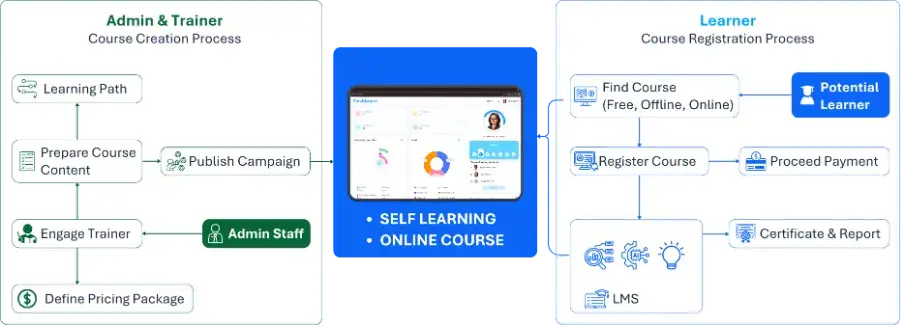
A learning platform can support this by linking employee profiles with competency frameworks and development paths. Smart Corporate Training (T-Learning) follows this model by offering role-based learning paths, skill gap analysis, and personalized course recommendations based on learner progress.
Workforce and Operational Reporting
Learning data becomes more valuable when viewed across different organizational levels. Managers need team insights, learning teams need program performance data, and employees need visibility into their own progress.
 An enterprise learning system should therefore connect individual learning activity with broader workforce reporting. T-Learning supports this with real-time tracking, team performance insights, and predictive reporting to support workforce decisions.
How AI Improves Personalized Enterprise Learning Experiences
Enterprise workforces have different roles, skill levels, experience, and development needs. AI can help organizations analyze these differences and provide more relevant learning recommendations without relying entirely on manual assessment.
AI-Supported Learning Recommendations
AI can analyze information such as employee roles, skills, learning history, and assessment results to identify relevant learning content and development paths.
Instead of assigning identical courses to every employee, organizations can use these insights to recommend learning activities based on individual needs and progress. This approach can make learning programs more targeted while giving employees greater flexibility in their development.
For example, an employee who has demonstrated strong product knowledge but needs to improve communication skills could receive practice activities focused on communication rather than repeating content they have already mastered.
 AI-Supported Skills Gap Analysis
AI can also help organizations identify patterns in workforce skills and highlight potential capability gaps across teams or roles.
At the individual level, this can show where an employee may need additional development. At the organizational level, aggregated data can reveal recurring skill gaps that may require broader training programs or changes to workforce development priorities.
This creates a continuous feedback loop: identify capability needs, provide relevant learning, measure progress, and refine development priorities.
AI-Supported Practice and Feedback
AI can support learning through interactive methods such as simulations, role-play, and adaptive assessments. These approaches allow employees to practice applying knowledge in scenarios that are closer to their actual work.
For example, AI-powered role-play can be used to practice workplace communication, customer interactions, or other scenario-based skills. TMA's AI-Powered Language Learning solution is an example of this approach, using AI-supported role-play and feedback for communication practice.
The broader value of these applications is not simply automation. It is the ability to provide more opportunities for practice and structured feedback while generating additional learning data that can inform future development.
Building a Data-Driven Enterprise Learning Ecosystem
AI personalization works best when learning data is connected to the broader workforce environment. An enterprise learning platform therefore needs to work alongside systems such as HR platforms, identity management, analytics tools, and other business applications.
Connecting Learning With Enterprise Systems
Integration allows learning records to be interpreted alongside relevant workforce information, such as employee roles, organizational structures, and competency frameworks.
For organizations using an enterprise learning management tool, this creates a more consistent data environment and reduces the risk of learning information remaining isolated from other workforce systems.
The goal is not to replace existing enterprise platforms, but to establish appropriate connections between systems so learning data can support broader workforce development processes.
Establishing a Reliable Learning Data Foundation
AI and learning analytics depend on consistent, reliable data. If employee profiles, roles, competencies, or learning records use different definitions across systems, the resulting analysis can become fragmented or difficult to interpret.
A reliable data foundation helps organizations connect learning, competency, and workforce information more consistently. It also provides a stronger basis for expanding analytics and AI capabilities as learning programs grow.
Supporting Continuous Workforce Development
Workforce development is increasingly an ongoing process rather than a one-time training event. Organizations may need a combination of courses, assessments, practical exercises, certifications, and other learning activities to support employees at different stages of development.
A personalized learning platform for enterprise can help organize these activities around employee roles and development needs while tracking progress over time.
TMA's Smart Corporate Training provides one example of this approach, combining learning management, personalized learning paths, progress tracking, and workforce development capabilities. Its role in this context is to illustrate how these principles can be applied within an enterprise learning environment, rather than suggesting that a single platform solves every aspect of workforce development.
Conclusion
Enterprise learning is shifting from course management to capability development. A modern enterprise learning management tool must connect learning data with skills, roles, and enterprise systems to deliver meaningful workforce insights. AI enhances this transformation through personalization, skills analysis, and adaptive learning, but only when supported by strong data and integration.
TMA Solutions’ Smart Corporate Training demonstrates this approach with personalized learning paths, analytics, and enterprise integration, helping organizations build scalable and data-driven workforce development systems.