Most enterprise AI failures happen not during experimentation but during scaling. The model performs well in the pilot. The data infrastructure collapses under production load. High-throughput streaming, real-time data freshness requirements, security controls across distributed sources, and the consistency demands of AI inference at scale expose every weakness in an architecture that was never designed for it. This article examines what separates an AI experiment from a production AI system at the data architecture level, and what reliable enterprise data integration looks like for organizations building toward operational AI.
What Is an Enterprise Data Integration Solution?
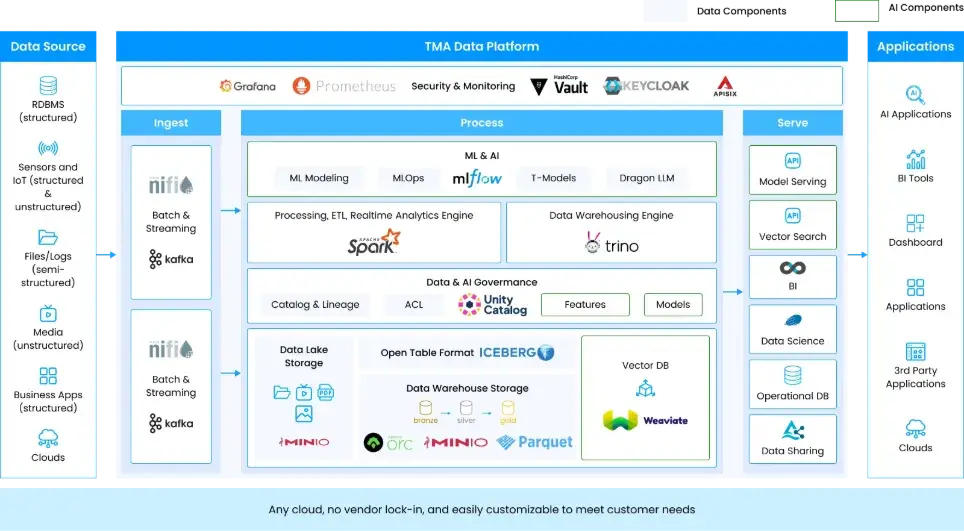
An enterprise data integration solution is the technical architecture that connects, consolidates, and prepares data from across an organization's system landscape for consumption by AI, analytics, and operational applications. At production scale, it encompasses ingestion pipelines from structured and unstructured sources, real-time and batch processing capabilities, distributed storage architecture, data quality enforcement, security and governance controls, and the serving layer that delivers data to AI models and downstream applications with the freshness and consistency inference requires.

Why Enterprise AI Pilots Often Fail During Scaling?
The Prototype-to-Production Gap
AI pilot success rates look reasonable on paper. The gap emerges when pilots attempt to move to production. Gartner estimates that a significant share of GenAI initiatives do not progress to enterprise-wide production because of infrastructure and governance challenges.
The reasons are architectural. A pilot typically runs against a curated, static dataset prepared by a data team specifically for the experiment. The model performs well because the data is clean, consistent, and complete. Production is different: data arrives continuously from multiple sources with varying schemas, update frequencies, and quality levels. The AI system must handle this heterogeneity in real time, under load, without degrading accuracy or latency.
When Throughput Exposes Hidden Failures
High-throughput environments surface architectural weaknesses that low-volume testing conceals. A pipeline that processes 10,000 records per hour without incident may encounter race conditions, lock contention, or memory pressure at 100,000 records per hour that cause data loss, duplication, or corruption. An AI system making decisions based on incomplete or inconsistent inputs produces errors that are difficult to detect because they do not trigger obvious system failures: the system keeps running, but the outputs are wrong.
Gartner estimates that poor data quality costs organizations an average of USD 12.9 million annually, with AI-dependent operations experiencing compounding costs as model errors propagate across automated decision chains. At production AI scale, the cost of an unreliable data foundation is not a technical inconvenience. It represents a direct financial exposure.
The Infrastructure Gap Between AI Experiments and Production Systems
Real-Time Data Freshness vs. Batch Latency
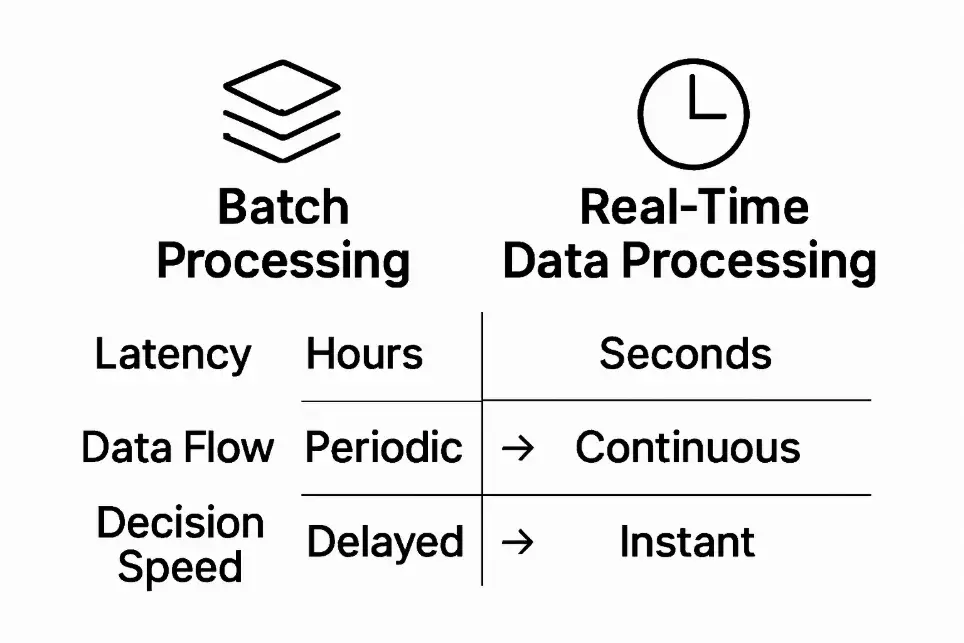
Most enterprise reporting runs on batch pipelines: data is extracted, transformed, and loaded on a schedule, typically overnight or hourly. This architecture cannot support AI use cases that require current data to make accurate decisions. A fraud detection model that operates on transaction data that is four hours old will miss fraud patterns that emerged in those four hours. A demand forecasting model that cannot see today's sales data cannot adjust replenishment recommendations for today's conditions.
Many production AI use cases require streaming ingestion that delivers data to the AI system within seconds of the originating event, not within hours. Supporting real-time AI usually requires an architecture designed for streaming from the outset rather than extending traditional batch pipelines.
Security and Governance at Integration Points
Enterprise AI systems typically require access to data that carries significant security and compliance obligations: customer records, financial transactions, health information, and proprietary operational data. When this data flows through an AI infrastructure, every integration point is a potential security exposure.
Production AI requires role-based access control, encryption, audit logging, and data residency controls across the entire data integration architecture.
Consistency Across Distributed Source Systems
Enterprise data does not live in one place. It is distributed across ERP systems, CRM platforms, operational databases, IoT streams, SaaS applications, and legacy systems that were built at different times with different data models. An AI system that needs a complete view of a customer, a product, or an operational state must reconcile data from multiple sources that define the same entities differently.
Without an integration layer that enforces consistent identity resolution, entity matching, and schema normalization across all sources, AI systems receive contradictory inputs. Two records that represent the same customer but were created with different identifiers appear as two different customers to the AI model. The model learns patterns from this fragmented picture and produces outputs that do not reflect operational reality.
What Reliable Enterprise Data Integration Solutions Require
A production-grade enterprise data integration solution addresses four architectural requirements that distinguish it from the batch ETL pipelines most organizations already have.
High-Throughput Streaming Ingestion
The platform must support continuous, high-volume data ingestion from multiple source systems simultaneously, handling sustained throughput without data loss or pipeline degradation. This requires infrastructure designed for streaming workloads from the ground up, not batch pipelines extended with streaming add-ons.
Automated Data Quality Enforcement
Data quality rules must be applied automatically at the point of ingestion, before data reaches the serving layer. Deduplication, schema validation, null handling, and reference data normalization must run as part of the pipeline rather than as a periodic manual process, ensuring that AI systems always receive data that meets defined quality standards.
Distributed Storage Architecture for Mixed Workloads
Enterprise AI requires different storage configurations for different workloads. Raw ingested data for exploration and model training requires different characteristics than curated, query-optimized data for real-time inference. A production integration solution supports Data Lake storage for raw and historical data, Data Warehouse storage for structured analytical workloads, and Data Lakehouse architecture when AI and reporting workloads must share the same data foundation without duplication.
AI-Ready Serving Layer
Data integration is not complete until the data reaches the AI system in a format it can consume. The serving layer delivers processed data to AI models and downstream applications through APIs and real-time data services, reducing integration effort for new AI use cases.
Building Secure and Scalable Enterprise Data Architecture
Production AI infrastructure must be designed for growth and security from the initial architecture, not retrofitted as the system scales.
Security by Design
Security controls implemented after deployment are more expensive to enforce and less reliable than those built into the architecture from the start. Production data architecture requires role-based access control at the data object level, encryption for data in transit and at rest, comprehensive audit logging of all data access and transformation events, and data lineage tracking that allows any data element in the AI output to be traced back to its source and the transformations applied to it.
TMA Data Platform implements these controls as foundational architecture components rather than optional add-ons, supporting compliance with GDPR, ISO 27001, and industry-specific regulatory frameworks across the organizations it serves.
Horizontal Scalability Without Re-Architecture
Enterprise data volumes grow unpredictably. An architecture that requires structural redesign at 3x or 5x the initial data volume creates a scaling ceiling that limits AI ambition. Production-grade platforms support horizontal scaling: adding processing capacity, storage, and serving layer nodes without changing the underlying architecture or disrupting running workloads.
The platform supports deployment across AWS, Microsoft Azure, Google Cloud, private cloud, and on-premises environments, giving organizations flexibility to expand without redesigning the architecture.
From Data Integration to Intelligence
Data integration creates greater value when it connects directly to AI applications that can analyze unified data and generate actionable insights. TMA's Insight Generation Model (IGM) is built on the data platform to help organizations transform integrated data into dashboards, predictive analytics, and AI-driven insights within a unified environment.
TMA Solutions provides enterprise data integration solutions and customized data platform development that help organizations build secure, scalable data architectures ready for AI, analytics, and real-time decision-making.
Frequently Asked Questions
Why do most enterprise AI pilots fail to reach production?
The most common cause is data infrastructure that was designed for batch reporting, not real-time AI inference. Pilots run against curated, static datasets that perform well in testing. Production systems require continuous data ingestion, real-time freshness, automated quality enforcement, and security controls at scale that batch-oriented architectures cannot provide without significant re-architecture. The model is rarely the failure point. The data pipeline underneath it is.
What distinguishes customized data platform development from deploying an off-the-shelf data integration tool?
Off-the-shelf tools handle common integration patterns and standard source systems. Customized development addresses the specific system landscape, throughput profile, security requirements, and AI use cases of the organization. This includes custom connectors for legacy or proprietary systems, infrastructure calibration to actual data volumes, and a serving layer configured to the consumption requirements of the organization's priority AI applications. The result is a platform that fits the operational environment rather than requiring the operational environment to adapt to the platform.
How should CTOs evaluate data integration partners for enterprise AI infrastructure?
Evaluation should cover five areas: demonstrated experience delivering data infrastructure at the throughput scale the organization requires, not just reference deployments at lower volume; native support for the source systems in the enterprise's current technology landscape including legacy databases; security architecture that meets the organization's regulatory and contractual obligations; deployment flexibility across cloud and on-premises environments without vendor lock-in; and engineering capability that spans the full stack from ingestion through to AI model serving, so that data integration and AI deployment are designed together rather than separately.
Conclusion
Enterprise AI depends on a data architecture that can integrate, govern, and deliver reliable data at production scale. Choosing the right enterprise data integration solution helps organizations build AI systems that remain accurate, secure, and scalable as business requirements evolve.
TMA Solutions develops customized enterprise data platforms that combine real-time integration, governance, and AI-ready architecture to help organizations move AI from pilot projects into production with confidence.