Enterprises investing in AI tools are discovering that the technology is the easier part of the transformation. The harder part is building a workforce that understands how to use those tools effectively, adapt as they evolve, and apply them to decisions that require human judgment alongside machine output. Corporate training software solutions designed for this challenge go well beyond content delivery. They build the continuous learning infrastructure that allows an enterprise to keep its workforce capability aligned with its technology strategy as both continue to change.
Why Workforce Capability Determines AI Transformation Success
When an enterprise deploys a new AI system, whether for demand forecasting, customer service automation, fraud detection, or operational efficiency, the return on that investment depends almost entirely on how well the people working alongside that system understand it. An AI that produces accurate outputs but whose outputs employees do not trust, cannot interpret, or do not know how to act on delivers no operational value.
This is the gap that most enterprise AI transformation strategies underestimate. Technology deployment is planned in detail: vendors are evaluated, infrastructure is procured, integration timelines are set. Workforce readiness is often treated as a communication initiative rather than a workforce development program. As a result, AI tools are deployed before employees are prepared to use them effectively, limiting adoption and reducing business value.
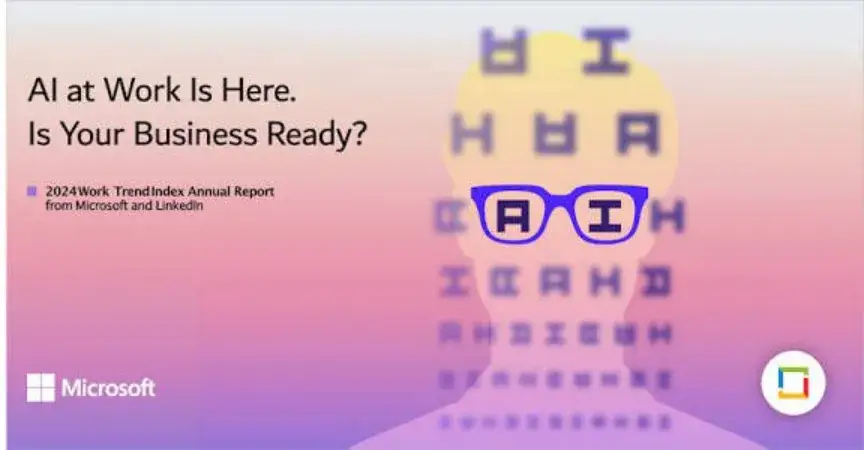
According to Microsoft's 2024 Work Trend Index, 79 percent of leaders say AI adoption is essential for remaining competitive, yet only 39 percent of people who use AI at work have received AI training from their employer. That gap cannot be closed through internal communication alone. It requires a deliberate and sustained learning environment that supports continuous workforce development.
The Compounding Cost of Capability Lag
When workforce capability falls behind the technology the enterprise has deployed, the cost is not only the underutilized technology investment. It also includes poorer decision-making, lower confidence in AI-assisted workflows, and missed opportunities to improve business processes. Unlike failed technology deployments, these capability gaps often develop gradually, reducing productivity and slowing AI adoption across the organization without a clear root cause.
The Growing Digital Skills Gap Inside Enterprises
AI Literacy as a New Foundational Skill
The skills required to work effectively alongside AI systems are not the same as the skills required to build them. An enterprise does not need every employee to understand machine learning architecture. It does need employees across functions to understand what AI outputs mean, when to trust them, how to identify when the system is producing unreliable results, and how to formulate questions and inputs that produce better outputs.
This is AI literacy: a practical, applied understanding of how AI tools work, what they are good at, and where human judgment must override or supplement them. It is different for every role and function, and it changes as the AI systems an enterprise deploys continue to evolve.
Organizations that invest in AI literacy programs are generally better positioned to accelerate AI adoption because employees gain the confidence and practical skills needed to apply AI in their daily work. The difference is not access to the technology. It is preparation to use it effectively.
Skills Development Cannot Be Episodic When Technology Changes Continuously
The challenge of digital upskilling is that it does not have an endpoint. AI tools update. New capabilities become available. New use cases emerge within the business. An organization that treats digital skills development as a one-time training event produces a workforce that was prepared for the technology as it existed at the time of training, not as it exists six months later.
Continuous learning infrastructure is not a program. It is a permanent organizational capability: the systems, content pipelines, and learning habits that allow the workforce to absorb new technical capability as it becomes relevant, rather than requiring a dedicated training initiative every time the technology changes.
What AI-Driven Corporate Training Software Solutions Should Deliver
Adaptive Content for Diverse Technical Starting Points
A workforce preparing for AI transformation is not a uniform group. Some employees are early adopters who already use AI tools personally and need only role-specific application training. Others have no exposure to AI and need foundational conceptual grounding before applied training is useful. Most fall somewhere in the middle.
Corporate training software solutions built for this environment diagnose where each employee actually is before assigning content. Assessment data drives content sequencing so that employees with prior exposure accelerate through what they already know, and employees who need foundational support receive it before being advanced to application-level training.
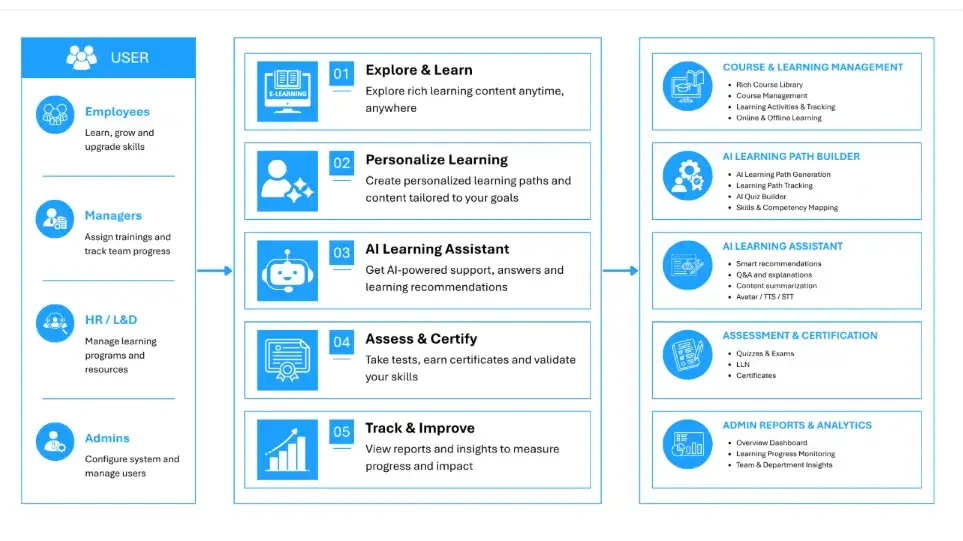
Smart Corporate Training supports role-based learning paths that map employees to competency requirements before training begins. This allows organizations to deliver learning based on each employee's current readiness instead of a fixed curriculum.

Role-Specific AI Use Case Training
Generic AI awareness training teaches employees that AI exists and has broad applications. Role-specific training teaches them what AI can do in their specific job context, which decisions it can assist with, and where it should not be substituted for human judgment.
A finance analyst learning to use AI for anomaly detection requires different training from a marketing manager using AI for campaign optimization. Enterprise learning management tools should support role-specific learning rather than delivering identical content across the workforce.
Practice Environments for Applied Skill Development
Understanding how AI works is not the same as being able to use AI tools confidently under operational conditions. Applied skill development requires practice in realistic scenarios where employees work through actual use cases, encounter the kinds of outputs that require interpretation, and develop the judgment to know when to act on AI recommendations and when to question them.
AI Coaching and Role-play Simulation System complements structured learning with AI-powered practice environments where employees apply new skills in realistic scenarios and receive immediate feedback. Assessment results feed back into personalized learning paths, helping organizations strengthen applied competency rather than simply increasing course completion.
How Enterprise Learning Management Tools Support Continuous Upskilling
Connecting Learning to the Technology Roadmap
An enterprise learning management tool built for continuous upskilling connects the organization's learning content calendar to its technology deployment roadmap. When a new AI system or tool is scheduled for deployment, the learning infrastructure can begin building workforce capability before the deployment date rather than running a post-deployment training scramble.
This forward-looking connection requires that the enterprise learning management tool integrates with the systems that hold information about the workforce: HR platforms, performance management systems, and role management tools. When a new role capability requirement is defined, the learning system can identify which employees need development in that area and begin routing relevant content to them automatically.
Smart Corporate Training integrates HR data, competency frameworks, and learning paths to automate training assignments as workforce requirements and technology roadmaps evolve.
Measuring Workforce Capability
Enterprise learning management tools that report primarily on completion rates create a misleading picture of workforce readiness. An organization where 90 percent of employees have completed an AI fundamentals course is not necessarily an organization where 90 percent of employees can use AI tools effectively in their roles. The completion rate tells you that employees opened and finished a program. It does not tell you whether their capability changed as a result.
Measurement systems designed for continuous upskilling track competency development over time: how employees perform on applied assessments before and after training, how quickly they progress through increasingly complex use cases, and how their assessed capability level correlates with observed performance on tasks that require AI tool proficiency.
Scaling Learning Delivery Without Scaling Administrative Cost
Manual training administration, including content assignment, completion tracking, reporting compilation, and development plan management, does not scale efficiently as the workforce grows or as the training program expands to cover new technology areas. Each new tool the enterprise deploys creates a new training requirement that multiplies across the entire affected workforce.
Enterprise learning management tools reduce this administrative overhead by automating content assignment based on role and competency data, tracking completion and performance automatically across the full workforce, and generating reporting that gives HR and operations leadership the visibility they need without requiring manual data compilation. Smart Corporate Training automates learning administration across distributed teams and business units, enabling organizations to scale AI upskilling programs without increasing administrative effort.
Building a Learning Culture That Scales Across the Organization
The technical infrastructure of corporate training software is a necessary condition for effective upskilling at scale. It is not sufficient. The organizations that sustain meaningful workforce capability development over time build a learning culture that treats capability development as an ongoing operational priority rather than a periodic HR initiative.
Learning Must Connect to Career Development
Employees invest in learning when they see a clear connection between that investment and their career trajectory within the organization. Corporate training software solutions that operate in isolation from performance management and career planning systems produce learning that employees treat as compliance rather than development. When competency frameworks support both learning and career progression, employees are more likely to see training as professional development rather than a compliance requirement.
Manager Engagement Determines Learning Effectiveness
The single most consistent predictor of whether enterprise training programs produce behavioral change is whether managers actively engage with the learning process: discussing what employees are learning, applying those discussions to real work decisions, and reinforcing the application of new skills on the job.
Enterprise learning management tools support manager engagement by providing visibility into team learning progress, surfacing insights about where team members are developing well and where they need additional support, and connecting learning activity to the performance conversations managers are already having. When managers have access to specific, actionable data rather than aggregate completion reports, their conversations with employees about learning can be substantive rather than procedural.
Continuous Iteration Based on Learning Outcomes Data
A learning culture that sustains itself over time uses the data generated by its learning infrastructure to improve the quality of that infrastructure continuously. Content that produces strong assessment performance improvements is identified and expanded. Content where performance data shows limited improvement signals a need for redesign or replacement. Learning paths that produce high completion but low applied performance are flagged for structural review.
This feedback loop between learning outcomes data and content strategy is what distinguishes an organization that is genuinely building workforce capability from one that is running training programs and hoping the capability follows.
Conclusion
Enterprise AI transformation depends not only on technology investment but also on the workforce's ability to adopt, apply, and continuously develop new skills. Corporate training software solutions that combine AI-driven personalization, competency assessment, HR integration, and learning analytics help organizations build the workforce capability needed to support long-term AI adoption.
TMA Solutions brings powerful capacities to building enterprise learning solutions that combine AI-powered personalization, competency assessment, learning analytics, and HR integration to support scalable workforce development. Explore Smart Corporate Training, AI Coaching and Role-play Simulation System, and other enterprise learning solutions designed to help organizations build continuous learning capabilities for AI-driven business transformation.