Introduction
In corporate learning & development (L&D) and higher education, traditional Learning Management Systems (LMS) face structural limits. Conventional platforms operate as flat, passive content repositories, delivering static courses at a fixed pace to every learner regardless of baseline skill, learning speed, or role demands. This "one-size-fits-all" model often leads to disengagement among experienced employees repeating familiar material, while struggling learners fall behind when knowledge gaps compound.
AI-powered adaptive learning systems represent an architectural shift from training as a scheduled event to training as a responsive, real-time ecosystem. By combining machine learning, natural language processing (NLP), and behavioral analytics, these systems continually interpret learner performance signals to dynamically adjust content sequencing, difficulty, and format based on demonstrated competency rather than a fixed curriculum schedule.
The Implementation Process: How to Build an Adaptive Learning System
Transitioning an enterprise from static course libraries to a fully adaptive learning architecture requires a structured, multi-phase engineering approach:
Phase 1: Competency Framework & Data Architecture Mapping
Rather than starting with a course catalog, adaptive systems begin by defining a structured competency framework. Core competencies are broken down into measurable skill nodes. In parallel, data pipelines are mapped to ingest real-time learner interactions: quiz latency, assessment scores, video pause patterns, and error frequency.
Phase 2: AI Engine & Algorithmic Integration
Once the data foundation is established, core AI modules are integrated into the LMS via APIs:
- Knowledge Tracing & Recommendation Algorithms: Algorithms evaluate baseline proficiency and dynamically map responsive learning paths, accelerating learners through familiar topics while automatically routing extra reinforcement to weak areas.
- Generative Content & Assessment Engines: GenAI pipelines automate the creation of contextual practice questions, flashcards, and multi-language learning assets, slashing content production bottlenecks.
- Conversational AI Tutors: LLM-powered virtual assistants are embedded to provide 24/7 contextual hints, answer questions, and facilitate realistic role-play simulations.
Phase 3: Deployment, Governance & Human-in-the-Loop Feedback
The system goes live with Human-in-the-Loop (HITL) safeguards. Instructors and L&D managers maintain central dashboard oversight to review AI-generated content, override automated recommendations when necessary, and receive early alerts on disengaged or struggling learners.
Key Business & Operational Benefits
Integrating AI-driven adaptive learning into enterprise training infrastructure yields measurable impact across several operational dimensions:
- Accelerated Time-to-Competency: By eliminating redundant modules for concepts employees already understand, organizations reduce overall onboarding and training timelines significantly.
- Higher Engagement & Knowledge Retention: Personalizing instruction prevents fast-learner boredom and slow-learner dropouts, boosting employee engagement scores by over 35% compared to flat content libraries.
- Reduced Content Development Costs: GenAI pipelines and automated quiz builders streamline course authoring, allowing instructional designers to build high-quality learning assets in minutes rather than weeks.
- Real-Time Skill Visibility: Real-time behavioral telemetry replaces annual surveys with continuous dashboards, giving HR and business leaders clear visibility into actual workforce skill gaps.
How TMA Solutions Powers Adaptive Learning
Building and scaling adaptive EdTech architectures requires deep software engineering, AI model tuning, and cloud infrastructure capabilities. As a leading AI development company, TMA Solutions partners with global educational institutions, language centers, and corporate training providers to build custom Next-Gen LMS ecosystems and Smart Classrooms.
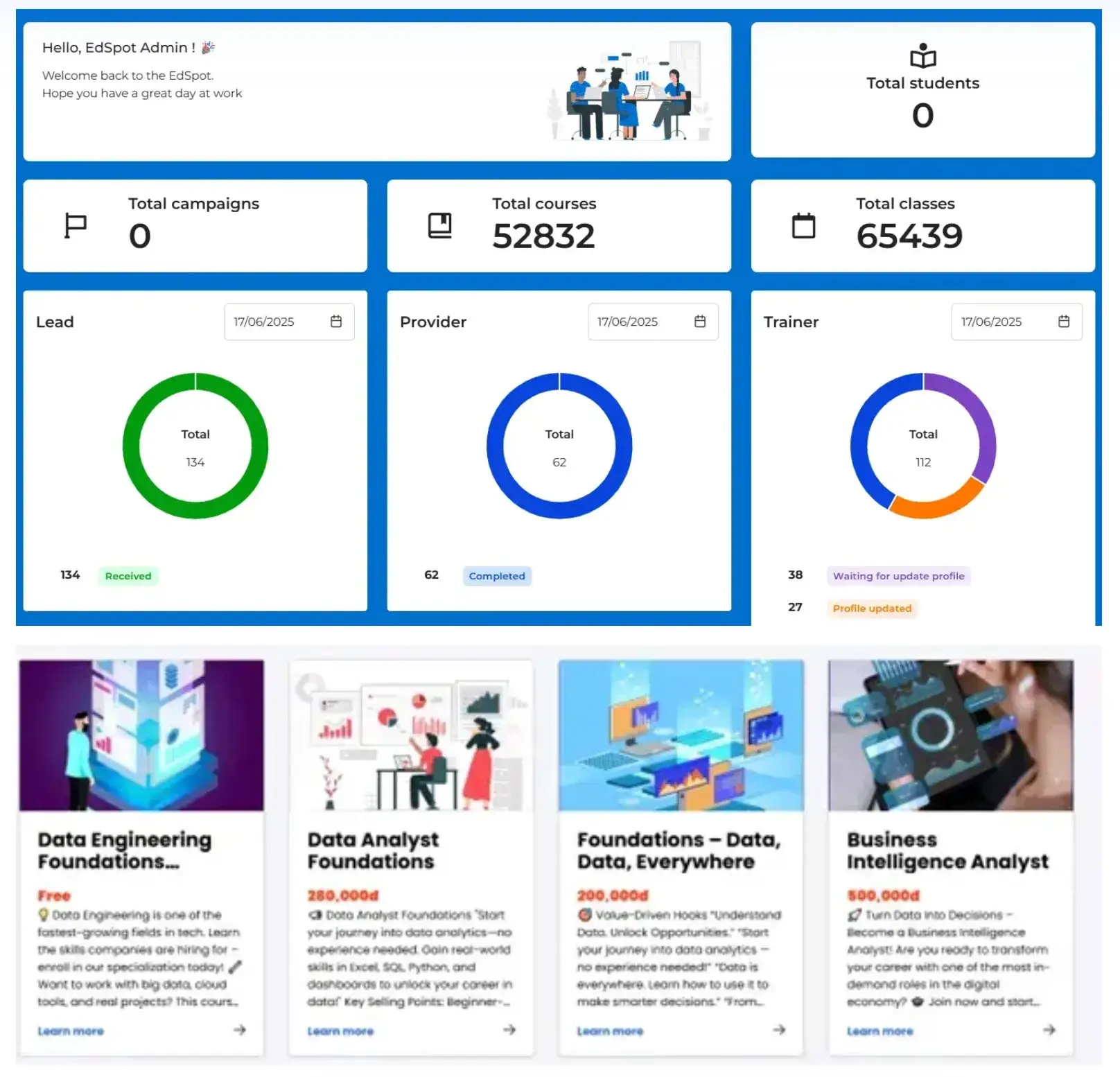
Featured Solution: Smart LMS & AI Language Learning Ecosystem
- The Operational Challenge: Educational institutions and vocational training providers face severe operational friction: static course materials, high dropout rates due to unaddressed knowledge gaps, slow content authoring cycles, and an inability to deliver 1-on-1 feedback to large student cohorts.
- TMA's AI Engineering Solution: TMA engineered an integrated Smart LMS and AI Learning Ecosystem featuring modular AI components:
- Automatic Learning Path Generation: AI algorithms assess initial proficiency, recommend relevant lessons, and dynamically adapt lesson sequences to close knowledge gaps in real time.
- Smart Virtual Assistants & 24/7 Tutors: Intelligent chatbots resolve concept doubts, provide instant assignment feedback, and eliminate the "office hours bottleneck" outside scheduled classes.
- AI Language Learning Platform (CEFR-Aligned): Delivers real-life conversational role-plays, instant speech/pronunciation feedback, and personalized study plans aligned with international standards like CEFR.
- Smart Assessment & Automatic Course Creator: Transforms raw documents into structured courses while enabling adaptive, auto-graded tests with instant feedback.
- Predictive Analytics Dashboard: Tracks engagement signals and behavioral patterns to forecast student dropouts early, allowing educators to step in with timely human support.
- Tangible Business Impact:
- 30% improvement in operational efficiency when deployed for accredited credit-eligible training courses in Australia by dramatically reducing content creation time and manual grading.
- Accelerated time-to-fluency and increased course completion rates across corporate academies and higher-ed institutions.
Conclusion
Building adaptive learning systems using AI is no longer a speculative trend—it has become an operational requirement for competitive enterprises and forward-thinking educational institutions. By transitioning from rigid, static course delivery to intelligent, responsive learning environments, organizations can bridge critical skill gaps, lower training costs, and drive measurable workforce performance. Modernizing your educational technology stack does not require replacing your existing LMS infrastructure all at once. Through custom software engineering and API-driven AI integration, adaptive modules can be integrated step-by-step.