Most enterprise AI projects do not fail at the idea stage. They fail at the engineering stage. Connecting a large language model to enterprise data, securing it against hallucination, integrating it with existing systems, and deploying it at scale requires a different class of software development expertise than building conventional applications. This article outlines what enterprise AI infrastructure actually requires, where most organizations encounter technical barriers, and what to look for in an AI IT services and software development partner capable of taking AI from prototype to production.
What Are AI IT Services and Software Development Solutions?
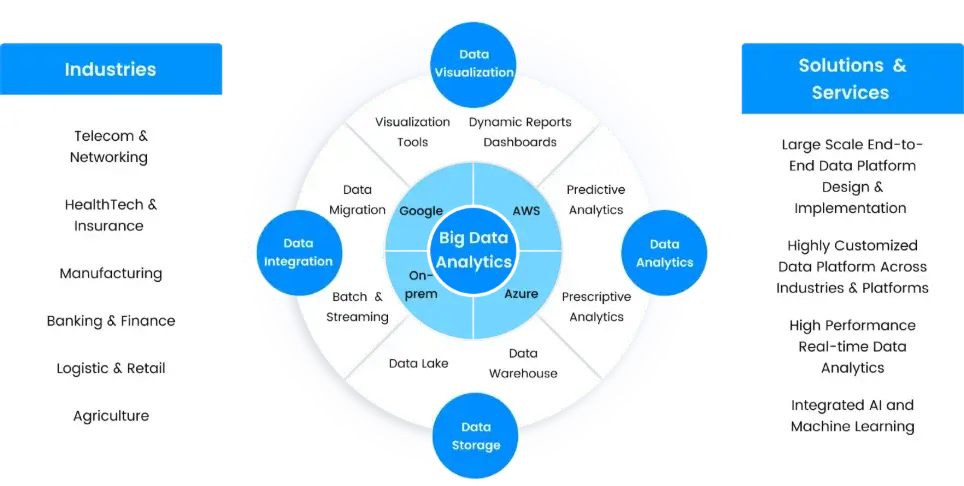
AI IT services and software development solutions are end-to-end technical services that help enterprises design, build, integrate, and deploy custom artificial intelligence systems within their existing technology environments. These services span the full delivery lifecycle: from AI readiness assessment and architecture design through to custom model development, agent engineering, enterprise system integration, and post-deployment monitoring and optimization.
The defining characteristic of enterprise AI development is specificity. The systems produced are grounded in the organization's own data, configured for its actual workflows, and engineered to the security, compliance, and performance standards its environment demands. A general-purpose AI product applied to enterprise problems almost always requires significant rework at the integration layer before it can function reliably in production.
Why Enterprises Struggle to Move AI Projects Into Production
The gap between AI experimentation and AI production is one of the most expensive problems in enterprise technology today. According to Gartner, at least 30% of generative AI projects are expected to be abandoned after proof of concept. The causes are not primarily commercial. They are technical and architectural.
The Grounding Problem
A general-purpose large language model trained on public data does not know anything about an enterprise's products, internal processes, customer history, or proprietary knowledge base. Connecting it to that context accurately and securely requires a grounding architecture: retrieval-augmented generation systems, vector databases, prompt engineering frameworks, and document processing pipelines that were not part of most enterprise technology teams' prior experience. Without proper grounding, AI systems produce responses that sound plausible but contradict company policy or draw on outdated information, eroding trust rapidly in both customer-facing and internal deployments.
The Integration Problem
Enterprise AI does not operate in isolation. A virtual assistant that cannot access CRM records, a project management agent that cannot update task status in the existing project tool, or a sales coaching system that cannot read pipeline data from the ERP are all technically functional but operationally useless. Integration with enterprise systems, APIs, databases, and workflow tools is where most proof-of-concept projects encounter friction they were not designed to handle.
The Security and Compliance Problem
Enterprise deployments of AI carry data security implications that consumer-grade applications do not face at the same level. Customer data, financial records, and internal strategy documents all have regulatory and contractual protection requirements. Deploying AI that touches this data without proper access controls, data residency management, audit logging, and output filtering creates compliance exposure that can exceed the value the AI delivers.
Resolving these three problems simultaneously, at production quality, is an engineering challenge that requires specialized capability. According to the World Economic Forum (2023), AI and machine learning specialists are among the fastest-growing roles globally, with demand significantly outpacing supply, which is why most enterprises turn to external AI IT services partners rather than attempting to build this capability entirely in-house.
The Growing Demand for AI IT Services and Software Development Solutions
The commercial pressure to deploy AI at the enterprise level is intensifying. According to McKinsey Global Institute (2023), generative AI could add between 2.6 and 4.4 trillion USD annually to the global economy, with the largest impact in customer operations, software engineering, marketing, and sales. Organizations that establish AI capabilities early are building compounding advantages in operational efficiency that will be difficult for late adopters to close.
This is creating sustained demand for AI IT services and software development partners with demonstrated capability across the full stack of enterprise AI delivery: model integration, agent architecture, workflow automation engineering, enterprise system connectivity, and production deployment.
What Enterprise AI Infrastructure and Development Actually Require
Building enterprise AI systems that function reliably in production requires capability across three technical domains that are rarely found in the same team.
Large Language Model Integration and Fine-Tuning
Most enterprise AI applications are built on top of foundation models from providers including OpenAI, Anthropic, Google, or open-source alternatives. The integration work involves selecting the appropriate model, implementing grounding architectures that connect it to enterprise knowledge sources, managing context windows efficiently, and engineering prompt structures that produce consistent, accurate outputs. For specialized use cases, fine-tuning on domain-specific data improves accuracy significantly but requires careful data preparation, training pipeline management, and evaluation methodology.
AI Agent and Multi-Agent System Development
AI agents do not simply respond to queries. They take actions: retrieving information, executing processes, updating records, triggering workflows, and coordinating with other systems to complete complex tasks. Building reliable agents requires tool definition, function-calling architecture, memory management, error handling, and guardrail implementation. Multi-agent systems that orchestrate multiple specialized agents across end-to-end workflows add further complexity in inter-agent communication and failure handling.
TMA Solutions specializes in designing and developing custom AI agents and virtual assistants that integrate deeply with existing CRM, ERP, and operational platforms. Each solution is built with enterprise-grade guardrails, robust data lineage, and governance frameworks tailored to the organization’s security and compliance requirements.
Enterprise Data Infrastructure as the AI Foundation
AI systems are only as reliable as the data they are built on. Before any agent, virtual assistant, or automation workflow can function accurately in production, the enterprise data layer must be unified, clean, and consistently structured. Fragmented data across disconnected ERP, CRM, and operational systems means AI models receive contradictory inputs, produce unreliable outputs, and require constant manual correction.
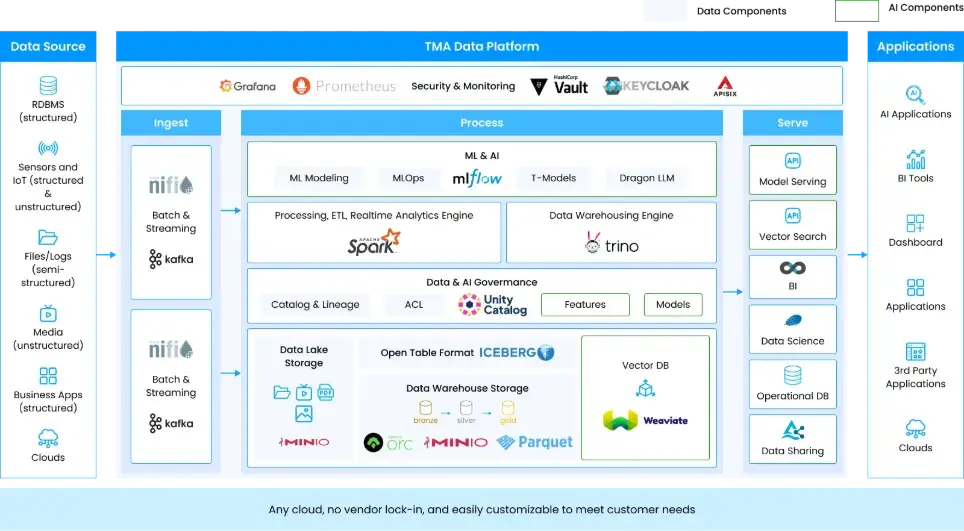 A purpose-built enterprise data platform addresses this at the infrastructure level. TMA Data Platform collects and processes data from multiple source systems that AI systems can consume reliably. TMA's Insight Generation Model (IGM) extends this further by operating directly on the unified data layer to produce automated chart generation, predictive model scoring, and ranked business insights. In practice, this means AI agents and intelligent workflows built on top of TMA's data infrastructure have access to clean, current, and contextualized data from day one, rather than spending the first phase of every project cleaning and consolidating inputs.
Enterprise System Integration, Deployment, and Governance
Production-grade AI development requires API design, database connectivity, real-time data pipeline construction, and security architecture that governs what the AI can access, read, and execute. Beyond initial deployment, a production AI system requires monitoring infrastructure, feedback loops, retraining pipelines, and a governance framework that maintains accuracy and safety as enterprise data changes and compliance requirements evolve. This operational layer is where the difference between a demo and a reliable production system is made.
AI Centers, Virtual Assistants, and Intelligent Workflow Automation
The most common enterprise AI deployment categories each carry distinct technical requirements.
provide a structured foundation for developing, deploying, and governing AI initiatives at scale. This typically requires shared infrastructure for model hosting and lifecycle management, governance frameworks for access control and monitoring, and standardized processes that allow multiple business units to adopt AI consistently.
Virtual assistant builder solutions differ from consumer chatbots in their requirement for enterprise knowledge grounding, multi-turn conversation management, and response accuracy. A virtual assistant supporting procurement processes must accurately reflect purchasing policies, while one supporting HR operations must remain aligned with current procedures and documentation. TMA's virtual assistant development service delivers conversational AI systems grounded in enterprise knowledge bases and configurable by business users without ongoing engineering intervention.
Project management agent solutions use AI agents to automate routine coordination tasks such as task assignment, progress tracking, deadline monitoring, and status reporting. By reducing administrative workload, these agents help project teams maintain visibility across initiatives, improve execution efficiency, and allow managers to focus on decision-making rather than manual oversight.
How Enterprises Choose the Right AI Technology and Development Partner
The selection of an AI IT services and software development partner affects not only the success of the initial deployment but also the organization's long-term AI capability. Four criteria distinguish partners with genuine enterprise AI engineering expertise from those with limited implementation experience.
Full-Stack AI Delivery Capability
An effective partner should demonstrate expertise across the entire AI delivery lifecycle, including model integration, AI agent development, enterprise system connectivity, security implementation, and production deployment. Providers that specialize in only one layer often require additional vendors to complete the solution.
Enterprise Security and Compliance Architecture
AI systems frequently process sensitive business data. A qualified partner should have a documented approach to data security, access control, audit logging, and regulatory compliance. For organizations operating in regulated industries, these capabilities are essential rather than optional.
Proven Enterprise Integration Experience
AI applications must work within existing business environments. Experience integrating with ERP, CRM, HR, and operational platforms is critical because AI systems that cannot access or interact with enterprise workflows rarely deliver meaningful business value.
Transparent Development and Governance Methodology
Enterprise AI projects should follow the same engineering discipline as any mission-critical software initiative. Clear processes for requirements definition, iterative development, testing, deployment, monitoring, and governance help reduce implementation risk and support long-term scalability.
Frequently Asked Questions
What is the difference between buying an AI tool and commissioning AI IT services and software development?
Buying an AI tool means acquiring a pre-built application with fixed capabilities. Commissioning AI IT services means engaging an engineering team to build systems designed for the organization's specific requirements, grounded in its own data, integrated with its existing systems, and governed to its security and compliance standards. Most enterprises require both: off-the-shelf tools for common tasks and custom-developed systems for workflows where generic solutions cannot meet accuracy or integration requirements.
How long does it typically take to deploy a custom AI agent for an enterprise use case?
Well-scoped use cases with accessible data and clear integration requirements can be deployed in production within eight to sixteen weeks. Use cases involving complex data preparation, multiple enterprise system integrations, or high compliance requirements typically take longer and benefit from a phased delivery approach that puts a functional version in production early while continuing to build out capability.
How do enterprises measure the return on investment from AI IT services and software development projects?
The most direct measures connect AI performance to the operational metrics the AI was built to improve: reduction in manual processing time, improvement in query response time, increase in conversion rates for AI-assisted workflows, or reduction in compliance administration overhead. Establishing baseline measurements before development begins makes it possible to quantify impact after deployment and demonstrate value to leadership.
Conclusion
Building reliable, production-grade AI systems is complex engineering work that most organizations cannot fully execute internally.
With over 13 years of enterprise software engineering experience, a dedicated team of AI specialists, and a proven track record of more than 150 enterprise projects across 20 countries, TMA Solutions delivers the full-stack AI IT services and software development partnership enterprises need to move successfully from AI pilots to production.