In global agricultural trade, maintaining produce quality across extended transport corridors is a critical operational mandate. For high-value perishable exports, such as durians, avocados, mangos, and dragon fruit, delivering goods at optimal maturity directly dictates market valuation, rejection rates, and profitability. Traditional quality assessment, long reliant on manual visual inspection and subjective sensory testing, is proving increasingly inadequate for modern, high-volume supply chains.
Driven by advances in computer vision, edge AI, and optical sensing, the market for AI-powered ripeness detection is experiencing rapid growth. Market analysis from industry researchers underscores an accelerating transition toward automated, non-destructive quality grading. By deploying deep learning models alongside hyperspectral sensors, agricultural exporters can achieve precise quality classification, eliminate post-harvest waste, and secure premium pricing in competitive international markets.
Market Drivers and Current Challenges in High-Value Produce Exports
Exporting fresh produce requires a precise balance between harvest timing and transport logistics. Conventional quality control practices introduce systemic friction that limits throughput and degrades profit margins.
Industry Bottlenecks in Manual Quality Assessment
- Subjective and Variable Grading: Human visual inspection relies on subjective interpretation. Worker fatigue, varying experience levels, and ambient lighting changes create inconsistent grading results within the same export batch.
- Throughput Constraints: Manual grading of individual fruit items creates severe operational bottlenecks during peak harvest seasons, constraining packing center output and risking delayed shipments.
- Inability to Assess Internal Quality: Surface visual inspection cannot evaluate critical internal biochemical parameters, such as sugar content (Brix), dry matter, flesh firmness, or hidden internal decay, without destructive sampling.
Post-Harvest Financial Risks and Logistics Vulnerabilities
- Elevated Post-Harvest Loss: Data from the Food and Agriculture Organization (FAO) indicates that up to 40% of fresh produce in developing export corridors is lost post-harvest, largely due to improper maturity grading and handling errors.
- Port Rejection and Price Penalties: Shipments that arrive overripe at overseas destination ports face immediate rejection by phytosanitary authorities or heavy price discounting, directly eroding exporter margins.
- Rising Operational Overhead: Increasing labor costs and workforce shortages at regional processing hubs raise operational expenses without delivering proportional quality guarantees.
Technical Architecture of AI-Driven Ripeness Detection Systems
Modern automated grading architectures integrate multi-modal optical sensing hardware with state-of-the-art deep learning networks to deliver real-time, non-destructive classification.
Deep Learning Models and Computer Vision
- YOLO and SSD Frameworks: Recent scientific research published in Discover Applied Sciences (Kamat et al., 2025; Springer) highlights the efficacy of multi-class object detection architectures like YOLO and Single Shot MultiBox Detector (SSD) for real-time ripeness identification under variable lighting.
- Vision Transformers and Lightweight CNNs: Hybrid models combining Vision Transformers (ViT) with Convolutional Neural Networks (CNNs) analyze complex surface color gradients, skin textures, and morphological patterns with classification accuracies exceeding 95%.
- Surface Defect Filtering: Machine vision algorithms differentiate natural skin blemishes from early-stage fungal lesions or mechanical bruising, automatically routing non-compliant items away from export lines.
Hyperspectral Imaging and NIR Spectroscopy
- Non-Destructive Internal Optical Scanning: Near-Infrared (NIR) spectroscopy penetrates the fruit cuticle to measure light absorption spectra, enabling non-contact assessment of internal chemical compositions without damaging the tissue.
- Biochemical Parameter Quantification: Spectroscopy models correlate spectral absorption directly with internal Brix levels, total soluble solids (TSS), titratable acidity (pH), and flesh firmness.
- Shelf-Life Prediction Engines: Algorithms combine internal biochemical profiles with historical cold-chain conditions to forecast remaining shelf life, aiding decisions on air freight versus sea freight routing.
Measured Business Impact and Economic ROI for Exporters
Integrating AI-powered ripeness detection into packing facility workflows transforms quality assurance from a reactive cost center into a strategic operational advantage.
Key Metric | Manual Visual Inspection | AI-Powered Automated System |
Classification Accuracy | 70% - 82% (Human variable) | 93% - 98% (Consistent) |
Line Throughput | 1,000 - 1,500 units/hr/worker | 15,000 - 30,000 units/hr/line |
Internal Attribute Scan | Destructive sample (1-2% batch) | 100% Non-destructive optical check |
Operational Downtime | High (Shift breaks required) | Minimal (24/7 continuous operation) |
Operational Efficiency and Labor Optimization
- 65% Reduction in Sorting Labor: Automated machine vision systems reduce manual sorting labor requirements by up to 65%, allowing facility managers to reallocate staff to specialized packaging and logistics tasks.
- Accelerated Batch Processing: Real-time Edge AI inference speeds up grading workflows by up to 80%, enabling higher daily volume handling without expanding physical facility footprints.
- Mitigation of Contract Claims: Precise sorting reduces destination port rejections and trade dispute claims by ensuring that only produce at the specified maturity window enters shipping containers.
Quality Standardization and Commercial Premium Realization
- Batch Homogeneity Assurance: AI systems group produce into tight maturity bands (e.g., 60% ripe for 20-day ocean transit vs. 85% ripe for immediate air freight), ensuring uniform ripening upon arrival.
- Regulatory and Standards Compliance: Digital inspection logs generated by AI equipment provide verifiable proof of quality compliance for strict import markets such as the EU, North America, Japan, and China.
- Premium Market Positioning: Consistent, certified quality allows agricultural exporters to command 15% to 25% higher price premiums compared to unstandardized bulk shipments.
Step-by-Step Implementation Framework for Processing Facilities
Deploying an AI-based ripeness assessment system requires a structured roadmap connecting dataset development, hardware integration, and operational synchronization.
Phase 1: Data Engineering and Custom Model Fine-Tuning
- Comprehensive Dataset Curation: Capture tens of thousands of high-resolution RGB, hyperspectral, and thermal images across varying lighting conditions, humidity levels, crop varieties, and maturity stages.
- Expert Data Annotation: Agronomists and computer vision engineers annotate training data with ground-truth laboratory measurements (Brix, penetrometer firmness scores, defect boundaries).
- Algorithm Fine-Tuning: Optimize deep learning weights using transfer learning to achieve high mean Average Precision (mAP) scores prior to physical line integration.
Phase 2: Hardware Integration and Line Synchronization
- Optical Equipment Installation: Mount industrial RGB-D cameras, NIR spectrometers, and calibrated LED arrays above existing conveyor channels.
- Pneumatic Actuator Synchronization: Connect Edge AI inference engines to pneumatic rejectors, air jets, or robotic arms to physically direct fruits into designated grading bins within milliseconds.
- Edge Computing Optimization: Deploy optimized model runtimes on industrial Edge AI processors (e.g., NVIDIA Jetson architectures) to maintain sub-10ms processing latency without relying on cloud connectivity.
How TMA Solutions Powers AI Agriculture and Export Quality Control
As a leader in technology innovation and digital transformation with over two decades of software engineering excellence, TMA Solutions has actively engineered end-to-end Agritech solutions that directly solve the quality and logistics hurdles faced by agricultural exporters.
T-Abyss NIR: Revolutionizing Durian Ripeness Assessment
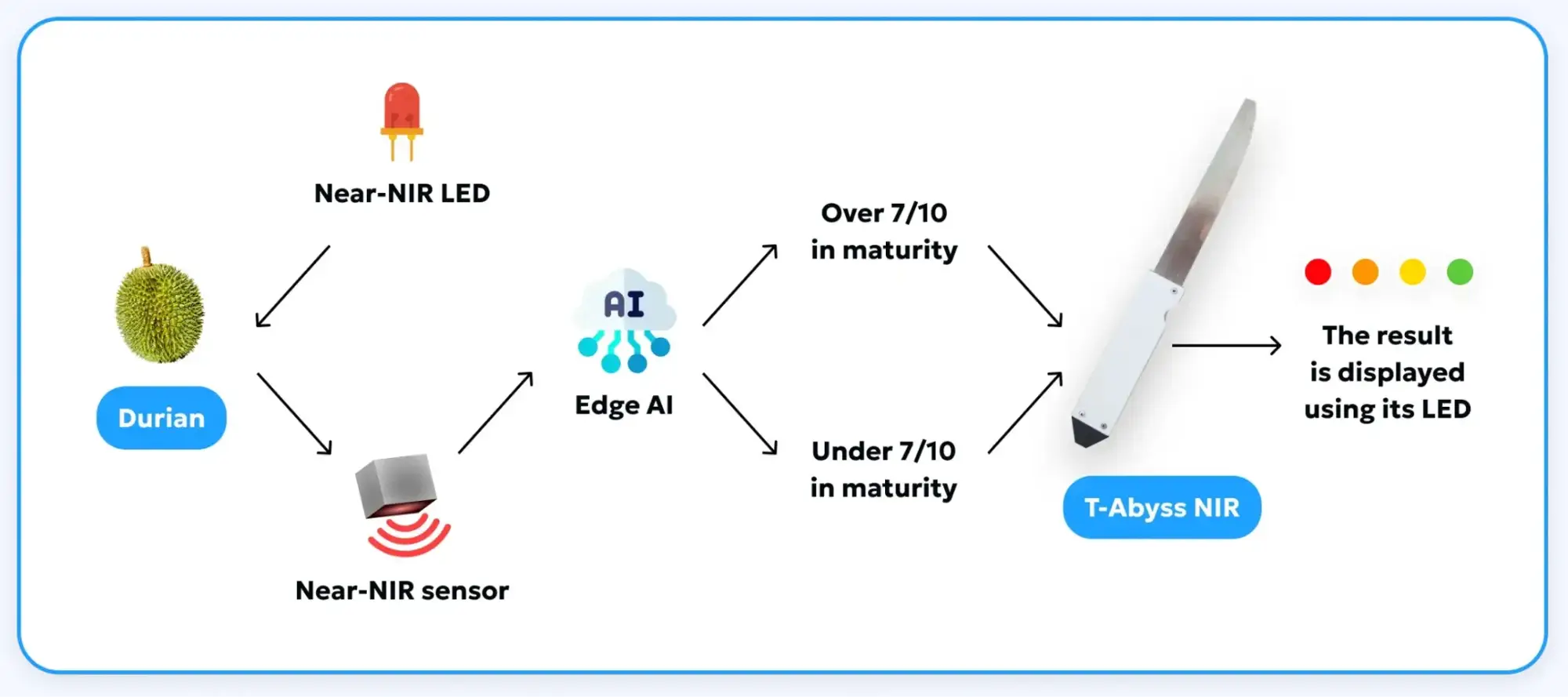
In Southeast Asia's high-value fruit market, traditional durian maturity testing relies heavily on subjective physical thumping, which frequently results in premature harvesting and rejected export shipments. TMA Solutions developed T-Abyss NIR, a smart, handheld testing device integrating quantum Near-Infrared (NIR) spectral analysis:
- 96% Real-World Accuracy: Tested under actual orchard and packing conditions, T-Abyss NIR evaluates internal fruit maturity without destructive cutting, achieving 96% classification precision.
- Non-Destructive Instant Feedback: Equipped with a real-time visual indicator, the device enables farm collectors and export warehouses to make instant, data-backed harvest decisions.
- Skill-Independent Operation: By removing subjective guesswork, the device empowers non-specialized staff to standardize durian quality across large-scale export batches.
End-to-End AgriHub Ecosystem & Digital Supply Chain
Beyond fruit quality inspection, TMA Solutions offers a comprehensive Smart Agriculture portfolio that bridges field-level AI with global supply chain traceability:
- Durian Quality Control & Automated Sorters: Deploying vision-based AI models and automated grading lines to evaluate external skin integrity, size classification, and maturity grouping for high-volume export facilities.
- TrustME Supply Chain Platform: Integrating blockchain-based traceability engines with IoT environmental monitoring (tracking temperature, humidity, and location during storage and transport) to meet EU, US, and Japanese phytosanitary import standards.
- Field Monitoring & Crop Protection: Utilizing drone-integrated computer vision and AI edge devices (such as T-Pest) for early pest detection and orchard health tracking in rice, durian, and coffee plantations.
Adopting AI-based ripeness detection is a direct catalyst for operational resilience and international market growth. By replacing manual guesswork with automated optical precision, agricultural exporters eliminate waste, protect margins, and establish sustainable B2B supply chains.
Conclusion
The global agricultural export landscape is undergoing a fundamental shift where quality assurance can no longer rely on manual guesswork. As international trade regulations tighten and buyer expectations for premium produce rise, adopting AI-based ripeness detection transitions from an innovative experiment to an indispensable business strategy. Automating quality inspection with computer vision and NIR spectroscopy eliminates human error, reduces post-harvest losses by up to 40%, and commands a 15% to 25% price premium by shielding exporters from costly port rejections.
Through field-proven innovations like T-Abyss NIR and the broader AgriHub ecosystem, TMA Solutions equips agricultural enterprises with the scalable hardware, software, and AI infrastructure needed to lead this transformation. By embedding AI precision directly into packing facilities and field collection workflows, exporters protect their profit margins, elevate brand reputation, and build resilient, sustainable B2B supply chains for the global market.