Home
Search
Found 797 results for “ “ keyword
icon
TMA Agentic AI Development in Vietnam: From Pilot to Production Enterprise AI pilots often perform well in controlled demonstrations but stall when they encounter real systems, permissions, data quality issues, and operational risk. McKinsey’s 2025 survey found that 23% of respondents were scaling an agentic AI system, while another 39% had begun experimenting with AI agents—evidence of strong adoption interest but limited enterprise-wide maturity. For CTOs, CIOs, product leaders, and sourcing managers, the question is therefore not whether an AI agent can complete a task. It is whether the organization can deploy agents that remain secure, observable, cost-controlled, and accountable while acting across enterprise systems. Why Agentic AI Is the Next Enterprise AI Wave Agentic AI is an architectural approach in which AI-enabled software can interpret a goal, create a plan, use tools, retain context, and take actions within defined boundaries. Unlike a conventional chatbot, an agent may query databases, call APIs, coordinate with other agents, or initiate a business workflow. This capability creates value when work spans multiple systems or requires iterative decisions. However, greater autonomy also expands the failure surface. An incorrect chatbot answer is inconvenient; an incorrect agent action could alter an order, expose restricted data, or trigger an unreliable downstream process. Because of this risk, production architecture must address four constraints: Decision reliability: Models can produce nondeterministic or unsupported outputs. Access control: Agents need enough authority to work, but not unrestricted system access. Operational resilience: API failures, duplicate actions, and context loss must be recoverable. Accountability: Teams need to reconstruct what the agent observed, decided, and executed. The NIST Generative AI Profile recommends managing AI risks across the lifecycle through governance, mapping, measurement, and continuous management. OWASP’s agentic AI guidance likewise identifies emerging threats associated with autonomous planning, tools, memory, and multi-agent interaction. Vietnam’s Strength in Deep-Tech AI Development Vietnam can support agentic AI programs through a combination of software engineering capacity, growing AI specialization, and experience with global delivery. The practical advantage is not simply labor cost. It is the ability to assemble cross-functional teams covering data engineering, model integration, cloud infrastructure, application development, quality engineering, and DevSecOps. That breadth matters because agentic AI is a systems-engineering problem. A successful implementation may require retrieval-augmented generation, event streaming, identity management, Kubernetes, API gateways, evaluation datasets, and human-approval workflows—not only prompt engineering. For North American enterprises, a Vietnam-based team can also extend development coverage across time zones. This model works best when ownership, overlap hours, architecture decisions, and escalation paths are explicit. What to Expect From an Agentic AI Partner A credible partner should begin with the business process and its risk boundaries, not with a preferred model. The core design sequence is: Capability → Technical constraint → Mitigation → Business outcome For example, an agent may automate service-ticket resolution. Its constraint is that it must not modify high-risk infrastructure based on uncertain reasoning. The mitigation is confidence-based routing, least-privilege tools, policy checks, and human approval. The result is faster handling of routine tickets without transferring unrestricted authority to the model. Multi-Agent Workflow Design Multi-agent systems divide work among specialized agents such as a planner, retriever, validator, and execution agent. This can improve modularity, but every handoff adds latency, token cost, and another failure point. Sound architecture should define: Which tasks genuinely require multiple agents Typed inputs and outputs for every handoff Shared-state and memory boundaries Maximum iteration, time, and spending limits Conflict-resolution and human-escalation rules Idempotency controls to prevent duplicate actions Model-routing policies based on risk, cost, and latency A deterministic workflow should remain deterministic. Agent autonomy is most useful where rules alone cannot handle the variability. Enterprise Integration and Observability Agents should access enterprise systems through governed adapters rather than direct, broad credentials. Relevant integration entities include APIs, SQL and NoSQL stores, event streams, vector databases, knowledge graphs, Model Context Protocol, and agent-to-agent protocols. Observability must extend beyond infrastructure uptime. Teams should trace prompts, retrieved evidence, tool calls, model versions, execution paths, latency, token consumption, policy violations, and human overrides. Sensitive data should be redacted or access-controlled within telemetry. A production-oriented delivery pipeline should include: Process discovery: Map users, decisions, systems, failure impact, and measurable success criteria. Architecture and threat modeling: Define agent roles, data boundaries, permissions, human checkpoints, and recovery behavior. Prototype development: Test the smallest valuable workflow with representative data and mocked integrations. Evaluation: Measure task completion, groundedness, tool-selection accuracy, latency, cost, and unsafe-action rates. Sandbox validation: Run adversarial, load, integration, and rollback tests in an isolated environment. Controlled deployment: Release through staged environments with versioning, approval gates, and canary traffic. Continuous operations: Monitor behavior, investigate traces, refresh knowledge, and re-evaluate after model or workflow changes. TMA Solutions’ Agentic AI Capabilities TMA Solutions’ published AI Agent Factory supports multi-agent orchestration, RAG and GraphRAG knowledge bases, monitoring, governance services, container-based cloud or on-premises deployment, and integrations using SQL, NoSQL, streaming, HTTPS, MCP, and A2A. Its broader AI practice reports hundreds of AI engineers, more than 100 available AI solutions, and 10 years of work across generative AI, AI agents, computer vision, edge AI, LLMs, OCR, and related technologies. This specialization sits within TMA’s wider delivery foundation: 29 years of experience, 4,000 engineers, clients from 30 countries, and 10 technology and solution centers. Its published quality foundation includes CMMI, Agile, RUP, ISO 9001, and ISO/IEC 27001. Together, these capabilities position TMA as a technology and innovation partner able to connect AI experimentation with enterprise software delivery, data platforms, cloud operations, testing, and long-term maintenance. Cost Advantages Without Compromising Quality Agentic AI economics should be evaluated through total cost of ownership, not hourly rates. The major cost drivers are engineering rework, inference consumption, integration complexity, production incidents, and long-term support. A Vietnam delivery model can improve cost efficiency when paired with reusable components, automated testing, disciplined architecture, and elastic team scaling. Lower staffing cost without these controls merely shifts expenditure into technical debt. Generic Low-Cost ODC Engineering Partnership Model Capacity measured mainly by headcount Capacity aligned with architecture and outcomes Prompt demos prioritized Production integration and evaluation prioritized Broad shared credentials Least-privilege, auditable tool access Testing focused on happy paths Behavioral, security, regression, and failure testing Ambiguous code ownership Defined ownership, documentation, and succession Reactive maintenance Continuous observability and optimization Best-Fit Agentic AI Use Cases The strongest initial use cases combine repetitive work, accessible evidence, reversible actions, and measurable outcomes: Knowledge assistants that retrieve cited enterprise information IT service agents that classify, investigate, and route incidents Software testing agents that generate and maintain test assets Document-processing agents with validation and exception handling Predictive-maintenance workflows connecting sensor insights to work orders Supply-chain agents supporting planning, exception detection, and coordination High-impact or regulated decisions should begin with recommendations and human approval rather than full autonomy. Lessons Learned From the Field The recurring failure is treating an agent as an isolated AI feature. Fragile CI/CD pipelines then allow prompt or model changes to reach production without regression evidence. Missing refactoring creates duplicated tools and inconsistent policies. Ambiguous ownership leaves no team accountable for data, prompts, integrations, or incidents. A mature partnership counters these problems with architecture ownership, reusable integration patterns, evaluation suites, security reviews, and explicit operational runbooks. It also treats model replacement as an expected lifecycle event. That engineering discipline is what separates sustainable agentic AI from a low-cost prototype factory. Partner With TMA Solutions for Agentic AI The strategic opportunity is not autonomous software at any cost. It is controlled autonomy that improves delivery speed and operational efficiency without weakening governance. TMA Solutions can help enterprise teams assess use cases, design multi-agent architectures, build secure integrations, validate agents in sandboxed environments, and operate them across cloud or on-premises infrastructure. Engage TMA to define a production-oriented agentic AI roadmap grounded in business value, measurable risk, and scalable engineering. Frequently Asked Questions 1. What is the difference between generative AI and agentic AI? Generative AI creates content. Agentic AI uses models, tools, memory, and workflows to pursue goals and take governed actions across systems. 2. When should an enterprise use multiple AI agents? Use multiple agents when specialized roles, independent validation, or parallel workflows provide clear value. Otherwise, a simpler deterministic workflow is usually easier to secure and operate. 3. How should agentic AI access enterprise applications? Use authenticated, least-privilege APIs or governed connectors. Separate read and write permissions, validate tool inputs, log actions, and require human approval for high-impact operations. 4. How can companies evaluate an agentic AI outsourcing partner? Assess production references, architecture depth, security practices, evaluation methods, integration capability, engineering scale, ownership model, and post-deployment support—not only hourly rates or prototype speed. 5. Can agentic AI run on-premises? Yes. Containerized agents and self-hosted components can support on-premises or hybrid deployment, subject to model availability, infrastructure capacity, integration requirements, and security architecture....
icon
TMA AI Agent Development Services for Enterprises: Move From Pilot to Production Enterprise AI programs rarely fail because a model cannot produce a plausible answer. They stall because the system cannot safely access business data, invoke enterprise tools, survive changing workflows, or prove what happened after an action. The urgency is real: Microsoft’s 2025 Work Trend Index found that 81% of surveyed leaders expected agents to be moderately or extensively integrated into their AI strategy within 12–18 months. For technology and sourcing leaders, the decision is not simply which large language model (LLM) to use. It is how to create measurable capacity without uncontrolled access, unreliable decisions, or new technical debt. From Copilots to Autonomous AI Agents A copilot summarizes, drafts, or recommends within a user interaction. An AI agent interprets a goal, plans steps, retrieves context, calls tools, evaluates results, and continues to a stopping condition. That changes the risk profile. A weak copilot answer can waste time; a poorly governed agent can alter a customer record, initiate a payment workflow, or expose sensitive information. Autonomy should increase by risk tier: read-only retrieval may run automatically, while irreversible actions require policy checks and human approval. TMA Solutions’ AI Agent Development Factory covers foundation models, RAG and GraphRAG, multi-agent orchestration, enterprise connectors, observability, governance, and container-based cloud or on-premises deployment. What Enterprise AI Agents Can Automate Strong candidates combine high volume, fragmented information, and clear decision boundaries. Teams should baseline cycle time, manual effort, errors, escalations, and transaction cost. Without that baseline, a demonstration cannot become a defensible business case. Knowledge work and decision support Knowledge agents can search governed repositories, compare policies, summarize cases, and cite records. Retrieval-augmented generation grounds responses in approved content; metadata filters enforce geography, document status, and user entitlements. Stale or conflicting documents can make fluent answers wrong. Mitigation requires ownership, ingestion monitoring, versioning, access-aware retrieval, citations, and abstention when evidence is weak. The outcome is faster research with reviewable provenance. ERP, CRM, and back-office workflows Agents can triage requests, enrich CRM records, reconcile documents, check inventory, create draft transactions, and coordinate ERP or warehouse work. APIs should expose narrow, typed functions such as get_order_status, not broad database access. Idempotency keys prevent duplicate actions; transaction limits constrain exposure; approval gates protect high-impact steps; and compensating actions support recovery. The agent must also know when to stop and transfer full context to a person. Core Architecture of Agentic AI Systems A production agent is a distributed system, not a prompt wrapped around an LLM. It needs identity controls, orchestration, a model gateway, enterprise knowledge, a tool registry, policy enforcement, state management, and telemetry. LLM orchestration and tool use The orchestration layer converts a goal into bounded steps and selects models by quality, latency, cost, data residency, and modality. Abstraction reduces lock-in, but prompts, tool behavior, context limits, and safety still require model-specific evaluation. Tools need validated schemas, short-lived credentials, least-privilege scopes, timeouts, retries, and circuit breakers. Critical transactions need durable workflow state. Multi-agent designs also need explicit roles and shared-state rules; otherwise, extra agents increase cost and failure modes. Human-in-the-loop controls and guardrails Human oversight should be an architectural control. NIST’s Generative AI Profile notes that generative AI may require different oversight levels, human review, tracking, documentation, and management supervision. Approval screens should expose the action, target, evidence, uncertainty, and rollback path. OWASP identifies prompt injection and excessive agency among major LLM application risks. Mitigations include separating instructions from untrusted content, allowlisting tools, validating outputs, enforcing authorization outside the model, red-teaming, masking sensitive data, and recording immutable audit events. TMA Solutions' AI Agent Development Approach TMA’s approach can be structured as a gated delivery pipeline: Discover: Map the workflow, systems, risks, decision rights, baseline, and acceptance criteria. Design: Select models, retrieval, tools, memory boundaries, hosting, threat controls, and human checkpoints. Pilot: Connect approved data and prove one valuable workflow with limited permissions. Test: Evaluate completion, groundedness, security, latency, cost, and edge cases in a sandbox. Deploy: Configure secrets, scaling, observability, rollback, and release approvals for cloud or on-premises operation. Operate: Monitor quality, drift, failures, cost, escalations, and business KPIs; version every agent component. TMA positions itself as a technology and innovation partner and Vietnam software outsourcing company with 29 years of experience, 4,000 engineers, clients in 30 countries, and 10 technology and solution centers. Its quality foundation includes CMMI, Agile, RUP, ISO 9001, and ISO/IEC 27001. These do not make an agent compliant by default; they support governed, long-term engineering. Dimension Generic low-cost ODC Engineering partnership model Success measure Headcount and output volume Business KPI plus reliability, risk, and cost Architecture Model-first prototype Workflow, data, integration, and control design Ownership Tickets distributed across resources Named owners for code, data, tools, and operations Quality Manual testing near release Automated evaluations, security tests, and release gates Operations Handoff after deployment Monitoring, incident response, rollback, and optimization Scaling Add developers Reuse platforms, standards, automation, and domain teams Industry Use Cases in Finance, Insurance, and Logistics In finance, agents can assemble evidence for analyst review, explain transaction exceptions, draft service responses, and route suspicious cases. They should not make unrestricted financial decisions. Segregation of duties, traceable sources, field-level access, deterministic calculations, and approval thresholds remain essential. In insurance, agents can intake submissions, extract policy data, compare documents, summarize claims, and prepare recommendations for authorized reviewers. Designs must preserve sources, distinguish facts from inference, and apply privacy-aware practices where applicable. In logistics, agents can query warehouse systems in natural language, report inventory or order status, and coordinate exceptions. TMA describes an implemented WMS AI agent that supported product-location, stock, order-status, and reporting queries; its published case summary reports a 30% increase in staff efficiency and a 50% reduction in information-search and reporting time. These are case-specific results, not universal forecasts. Lessons Learned from the Field The hardest problems appear after the demo. Generic ODC models can reward feature throughput while ownership, refactoring, evaluation coverage, and operational readiness remain ambiguous. The result is brittle prompts, duplicated connectors, fragile CI/CD, and late security controls. An engineering partnership versions prompts and policies, assigns owners, continuously tests adversarial cases, and reserves refactoring capacity. It also measures containment: whether the agent abstains, escalates, and recovers safely. These disciplines prevent teams from repeatedly repairing an unstable foundation. Design Secure, Scalable AI Agents With TMA Solutions Enterprise agent development converts business intent into controlled software actions. Durable value combines model capability with reliable data, narrow permissions, human authority, measurable operations, and continuous evaluation. TMA Solutions brings AI Agent Factory assets together with enterprise software delivery scale, specialized technology centers, and a mature quality foundation. Enterprise buyers can engage TMA to assess a priority workflow, define an ROI and risk baseline, and build a production roadmap that fits their architecture rather than forcing a generic agent into it. Frequently Asked Questions 1. What is the difference between an AI copilot and an AI agent? A copilot recommends or drafts within a user interaction. An agent can plan and execute multi-step work through tools. Greater agency requires stronger authorization, monitoring, testing, and human approval for high-impact actions. 2. How should enterprises select the first AI agent use case? Choose a high-volume workflow with measurable effort, accessible data, clear rules, and reversible actions. Baseline cycle time, cost, errors, and escalation rates before building; avoid starting with an ambiguous, high-consequence decision. 3. Can AI agents integrate with existing ERP and CRM platforms? Yes. Agents can use governed APIs and connectors to retrieve data or initiate workflows. Production designs should enforce schema validation, least privilege, transaction controls, audit logging, and human approval outside the LLM. 4. How do enterprises evaluate an AI agent development partner? Assess architecture depth, security engineering, domain capability, evaluation methods, integration experience, delivery governance, operational support, and scaling capacity. Ask for traceable proof, named ownership, and a lifecycle plan—not only a prototype or hourly rate. 5. How is AI agent performance measured in production? Track task completion, groundedness, escalation accuracy, latency, cost per task, tool failures, policy violations, and business outcomes. Segment results by workflow and risk tier, then version models, prompts, tools, and evaluation sets....
icon
TMA AI Healthcare Solutions from Vietnam Healthcare providers are under pressure to improve access, reduce administrative workload, and protect patient safety without adding more complexity to already stretched clinical teams. In the U.S., the National Academies notes that many physicians spend as much time in EHR-related clerical work as they do with patients, and that EHR usability, interoperability, alerts, and documentation burden are associated with clinician burnout [1]. That is why AI healthcare solutions now matter to CTOs, CIOs, product leaders, and sourcing managers. The priority is no longer “add AI somewhere.” The real question is how to build useful, secure, workflow-aware AI that reduces friction inside clinical operations while keeping humans in control. Technical Delivery Pipeline for Healthcare AI A pragmatic healthcare AI delivery pipeline should follow these steps: Define the workflow and risk class: documentation, intake, follow-up, analytics, triage support, or monitoring. Map data sources: EHR, patient portal, call center, medical devices, scanned forms, scheduling systems, and data warehouse. Establish privacy controls: data minimization, consent rules, PHI handling, access control, encryption, and audit logging. Design integration contracts: FHIR APIs, event streams, batch jobs, webhooks, and fallback workflows. Build the AI layer: speech-to-text, OCR, NLP, RAG, rules engine, classification, summarization, or agent orchestration. Add human review: clinician approval, exception queues, confidence thresholds, and escalation paths. Validate performance: accuracy, latency, usability, hallucination rate, security testing, and regression testing. Deploy through controlled rollout : pilot group, monitoring dashboard, feedback loop, rollback plan, and retraining process. Govern continuously: model drift checks, access reviews, incident reviews, compliance updates, and change management. Generic ODC vs. Engineering Partnership Model Evaluation Area Generic Low-Cost ODC Engineering Partnership Model Primary goal Staff augmentation at lowest rate Business and technical outcome delivery AI architecture Model-first experimentation Workflow-first, governed AI design Healthcare integration Limited EHR and data-contract ownership FHIR-aware integration, auditability, and maintainability Security Added late in the project Security-by-design and risk-based controls Quality Manual testing-heavy QA automation, regression testing, CI/CD, and release governance Ownership Ambiguous responsibility across tasks Clear product, platform, data, and DevOps ownership Long-term value Short-term velocity, possible technical debt Scalable delivery capability and maintainable systems Lessons Learned from the Field The biggest failure mode in healthcare AI is treating it like a demo instead of a clinical operations system. A proof of concept can summarize notes or extract forms quickly. Production is harder because the system must handle edge cases, downtime, permissions, user trust, and regulatory expectations. Generic low-cost ODCs often struggle when code ownership is unclear. Teams may deliver features but leave behind brittle pipelines, weak test coverage, duplicated logic, and limited refactoring. Over time, technical debt slows release cycles and makes clinical workflow changes expensive. A mature engineering partner works differently. The team clarifies domain assumptions, documents data contracts, separates model logic from workflow orchestration, builds repeatable CI/CD, and keeps security controls visible. For AI scribes, that means versioned prompts, clinician edit tracking, note-quality evaluation, and rollback. For EHR automation, it means integration testing, queue monitoring, and graceful fallback when APIs fail. Because healthcare workflows involve patients, clinicians, and compliance-sensitive data, disciplined engineering is not overhead. It is what allows AI to move from pilot to trusted daily use. How AI Can Reduce Burnout and Improve Outcomes AI can reduce burnout when it removes low-value work instead of adding another screen. The strongest candidates are repetitive, high-volume tasks: documentation drafts, patient summaries, intake routing, reminder workflows, form extraction, and follow-up coordination. The business impact is operational leverage. Clinicians gain more time for patient interaction, administrators spend less time chasing missing information, and leaders get better visibility into bottlenecks. However, AI should be evaluated with practical measures: documentation cycle time, clinician satisfaction, note correction rate, patient response rate, no-show trends, escalation accuracy, and support ticket volume. If these metrics are unavailable, mark baseline and post-launch performance. Develop Healthcare AI With TMA Solutions TMA Solutions is positioned to support healthcare AI programs that require more than isolated model development. Its Healthtech, AI, data, cloud, DevOps, testing, and security capabilities make it relevant for providers, payers, senior care operators, healthtech companies, and digital health platforms seeking scalable engineering support from Vietnam. For enterprise buyers, the right starting point is a focused AI discovery and architecture assessment: identify the workflow bottleneck, map data availability, define risk controls, and select a pilot that can prove operational value without overreaching. From there, TMA can support prototyping, integration, QA, deployment, monitoring, and long-term enhancement. FAQ What are TMA AI healthcare solutions? TMA AI healthcare solutions include AI-enabled healthcare analytics, EHR automation, remote monitoring, patient communication workflows, telehealth, device integration, and operational automation supported by TMA’s Healthtech and AI engineering capabilities. Can AI replace doctors in clinical documentation? No. AI should draft, summarize, and organize documentation for clinician review. The clinician remains responsible for validation, correction, and final approval before information enters the medical record. How should healthcare AI connect with EHR systems? Healthcare AI should use secure APIs, interoperability standards such as HL7 FHIR where applicable, role-based access, audit logs, and fallback workflows to avoid disrupting clinical operations. How do buyers evaluate a reliable healthcare AI outsourcing partner? Evaluate healthcare domain experience, security practices, integration capability, QA maturity, DevOps discipline, AI governance, team scale, documentation quality, and willingness to own long-term maintainability. Does TMA claim HIPAA or GDPR certification? Not from the provided source material. Use careful wording: TMA can support HIPAA-aware or GDPR-aware delivery practices where applicable, but certification claims require verified documentation. Conclusion Healthcare AI succeeds when it is engineered around real clinical workflows, not around AI novelty. For North American providers, the priority is reducing administrative burden, improving operational visibility, and deploying AI with privacy, security, auditability, and human oversight. TMA Solutions brings the scale, healthcare software experience, AI capability, and process maturity needed to help enterprise teams move from AI pilot to maintainable healthcare platform. To explore a practical roadmap, engage TMA Solutions for a healthcare AI discovery workshop, architecture review, or dedicated engineering team assessment. TMA Solutions' Healthcare AI Capabilities TMA Solutions positions itself as a technology and innovation partner and Vietnam software outsourcing company with 29 years of experience, 4,000 engineers, clients from 30 countries, and 10+ technology and solution centers, including https://www.tmasolutions.com/ AI and Healthtech [5]. Its quality foundation includes CMMI, Agile, RUP, ISO 9001, and ISO 27001 [5]. For healthcare specifically, TMA reports https://www.tmasolutions.com/industries/healthcare 700 healthcare engineers and 16+ years of healthcare software experience , supporting areas such as AI & health data analytics, remote health monitoring, device integration, telehealth, EHR, medication management, pharmacy automation, senior care, nursing home management, healthcare kiosks, and clinical research tools [6]. https://www.tmasolutions.com/technologies/ai-ml-and-data-sciences TMA’s AI/ML and Data Sciences capability page lists 10+ years of AI experience, clients from 20+ countries, 150+ AI certificates, 100+ AI solutions, and 100+ AI projects delivered [7]. Relevant AI capabilities include generative AI, AI agents, RAG-based LLM systems, OCR, NLP, speech recognition, computer vision, edge AI, cloud AI, and AI as a Service [7]. This combination matters because healthcare AI is not a single-model project. A production-grade solution typically combines cloud architecture, integration engineering, DevOps, QA, security, clinical workflow design, data engineering, and model operations. High-Impact AI Use Cases in Healthcare AI scribes for doctor documentation An AI scribe captures a clinical conversation, converts speech into structured notes, and prepares draft documentation for clinician review. The value is not simply transcription. A useful AI scribe must recognize clinical context, map content into SOAP or specialty-specific note structures, flag uncertainty, and avoid inserting unsupported clinical details. The technical constraint is accuracy under real clinical conditions: accents, interruptions, overlapping speech, specialty vocabulary, and incomplete patient histories. A safe mitigation strategy is a human-in-the-loop workflow where the AI generates draft notes, the clinician approves them, and the system logs every edit. The business outcome is reduced documentation friction without delegating medical judgment to software. EHR automation and clinical workflow automation EHR automation uses AI, rules engines, APIs, and workflow orchestration to reduce manual navigation across clinical systems. Common examples include patient summary generation, lab trend extraction, referral triage, prior authorization support, coding suggestions, and missing-document detection. For North American healthcare providers, interoperability is often the hard part. HL7 FHIR defines a standard for exchanging healthcare information electronically, with resources designed for clinical, administrative, medication, diagnostic, workflow, and financial data exchange [3]. Because of this, AI healthcare architecture should not treat the model as the center of the system. The center should be the clinical workflow, data contract, access policy, and audit trail. Patient reminders and follow-up workflows AI-supported patient communication can automate appointment reminders, medication prompts, post-discharge follow-ups, preventive screening outreach, and care-plan nudges. These use cases are attractive because they are operationally measurable and do not require the AI to make a diagnosis. The risk is over-automation. Poorly designed reminder systems create alert fatigue for patients and staff. A stronger approach segments patients by care pathway, risk level, preferred channel, consent status, and escalation rules. The AI can draft or route the next best communication, while care teams retain control over sensitive or high-risk cases. Building Safe and Useful Healthcare AI Data privacy, accuracy, and human oversight Healthcare AI should be designed around four controls: data minimization, role-based access, model evaluation, and clinical review. HIPAA’s Security Rule requires covered entities and business associates to protect electronic protected health information through administrative, physical, and technical safeguards, including confidentiality, integrity, availability, risk analysis, and workforce compliance controls [2]. This does not mean a vendor can casually claim “HIPAA-certified AI.” Instead, enterprise buyers should look for HIPAA-aware engineering practices where applicable: encryption, audit logs, least-privilege access, secure SDLC, incident response, data retention rules, and clear responsibility boundaries between provider, software vendor, cloud provider, and implementation partner. NIST’s AI Risk Management Framework also provides a useful lens for AI governance because it focuses on incorporating trustworthiness into AI design, development, use, and evaluation [4]. For healthcare, that translates into practical engineering requirements: test datasets, hallucination checks, traceability, model monitoring, bias review, rollback plans, and user feedback loops. Why Healthcare Providers Are Adopting AI Now Healthcare AI adoption is being driven by a practical constraint: clinical demand is rising faster than administrative capacity. EHRs, patient portals, remote monitoring devices, call centers, payer workflows, and care coordination systems generate data continuously. Yet much of the operational work around that data remains manual. AI can help when it is applied to specific workflow bottlenecks: documentation, patient intake, follow-up coordination, EHR summarization, form extraction, referral routing, scheduling, remote monitoring alerts, and clinical operations analytics. Because these workflows touch sensitive patient data, healthcare AI must be designed with security, privacy, auditability, and clinical review from the beginning. ...
icon
TMA AI Surveillance and PPE Detection for Factories Why Factory Safety Needs Real-Time Intelligence Manufacturing safety teams do not fail because they lack cameras. They fail because most camera systems only create evidence after an incident has already happened. In U.S. manufacturing, employers reported 332,600 nonfatal occupational injuries and illnesses in 2024, with 207,600 involving days away from work, job restriction, or transfer. For CTOs, CIOs, plant leaders, and sourcing managers, that makes factory safety a data, automation, and workflow problem, not only a compliance checklist. AI surveillance and PPE detection turn passive video into operational signals. The system identifies whether workers are wearing required helmets, safety vests, masks, gloves, or eye protection; detects entry into restricted zones; and triggers alerts before a supervisor discovers the issue manually. Because factories operate across shifts, lines, contractors, and high-risk areas, the value is not “more surveillance.” The value is faster intervention, consistent safety monitoring, and auditable incident response. OSHA requires employers to assess workplace hazards, select appropriate PPE, communicate PPE decisions, ensure proper fit, and train affected employees. AI does not replace those responsibilities. It strengthens execution by making safety rules observable in real time. PPE Detection and Industrial Safety Monitoring Use Cases A practical factory safety AI system combines computer vision, edge inference, video streaming, alert management, and plant workflow integration. The core macro-entity is AI video analytics for industrial safety. Its adjacent micro-entities include PPE detection, object detection, restricted-zone monitoring, edge AI, smart cameras, event classification, model retraining, MLOps, access control, alert routing, privacy governance, and cybersecurity. TMA Solutions is positioned to support this type of system as a Vietnam software outsourcing company and technology innovation partner with 29 years of experience, 4,000 engineers, clients from 30 countries, 10+ technology and solution centers, and a quality foundation including CMMI, Agile, RUP, ISO 9001, and ISO 27001. Its AI/ML and Data Sciences page lists computer vision, smart camera, edge AI, video streaming and analytics, manufacturing PPE detection, emergency notification monitoring, safety and security camera solutions, and worker/partner/vehicle access control among relevant capabilities. Helmet, Vest, Mask, and Restricted-Zone Detection Direct answer: PPE detection uses computer vision models to identify whether required safety equipment is visible on a person in a defined area and then classifies the scene as compliant, non-compliant, uncertain, or requiring human review. In a factory, the model must understand more than “person with helmet” or “person without helmet.” It needs site-specific context: Which PPE is required for each zone, role, or task Whether a vest is partially occluded by tools or equipment Whether a mask is missing, incorrectly worn, or not required for that area Whether a contractor, forklift operator, or visitor has different rules Whether a person crossed into a restricted zone briefly or remained there Because of these constraints, the architecture should combine object detection with zone mapping, camera calibration, confidence thresholds, and rule configuration. A generic model may perform well in a demo but fail under glare, dust, motion blur, reflective vests, or unusual camera angles. The mitigation strategy is controlled data collection, annotation from real factory footage where permitted, edge-case testing, and human-in-the-loop review before automated escalation. Emergency Alerts and Incident Workflows Detection is only useful when it reaches the right person quickly. A mature AI surveillance system should route alerts based on severity: Low risk: dashboard log for trend analysis Medium risk: supervisor notification with camera snapshot and location High risk: immediate alert to EHS, security, or line management Critical risk: escalation workflow connected to emergency response protocols For example, helmet non-compliance near a walkway may create a supervisor task. A worker entering a robot cell, forklift lane, chemical area, or machine guarding perimeter may trigger a higher-priority alert. Because false positives can create alert fatigue, the system should include configurable rules, confidence scoring, event deduplication, and review queues. Centralized Video Analytics for Manufacturing Sites For multi-line or multi-site manufacturers, the target architecture is usually hybrid: inference happens near the camera or on an edge gateway, while event management, dashboards, reporting, and model lifecycle management run centrally. A reference architecture includes: Smart cameras, IP cameras, or existing CCTV feeds Edge gateway with GPU, NPU, or optimized CPU inference Video pipeline using GStreamer, OpenCV, FFmpeg, WebRTC, or NVIDIA DeepStream where appropriate Computer vision models such as YOLO, Faster R-CNN, SSD, DETR, SORT, DeepSORT, or ByteTrack Event broker for alert publishing Central dashboard for safety officers and plant leaders API integration with EHS, access control, HR, ticketing, or manufacturing execution systems MLOps pipeline for model versioning, testing, deployment, monitoring, and rollback The business impact is clearer when framed as capability, constraint, mitigation, and outcome. The capability is real-time safety detection. The constraint is variable factory conditions. The mitigation is site-calibrated models and edge validation. The outcome is faster response, better auditability, and reduced dependence on manual video review. Integrating AI Surveillance With Factory Operations A practical deployment pipeline should be structured, staged, and measurable: Safety rule mapping : Define PPE rules, restricted zones, shift patterns, escalation paths, and audit requirements. Camera and network assessment: Review camera angles, frame rates, lighting, blind spots, bandwidth, and retention policies. Data governance setup: Define what footage is used, who can access it, how long it is retained, and whether faces or personal identifiers must be masked. Model selection and prototyping: Test object detection, tracking, and zone detection models against real site conditions. Edge deployment: Run inference close to the video source to reduce latency, bandwidth load, and unnecessary raw video transfer. Workflow integration: Connect alerts to dashboards, mobile notifications, EHS systems, access control, or incident tools. Pilot operation: Measure false positives, missed detections, alert response time, and supervisor usability. MLOps hardening: Add model registry, version control, test datasets, drift monitoring, rollback, and retraining process. Multi-site rollout: Standardize reusable components while allowing plant-specific rules and camera calibration. Continuous improvement: Review incidents, tune thresholds, refresh training data, and improve operational playbooks. This delivery approach is where TMA’s scale and process maturity matter. A low-cost vendor may deliver a model. An engineering partner must deliver the model, pipeline, deployment discipline, security controls, integration layer, monitoring, documentation, and long-term maintainability. Privacy, Compliance, and Responsible Deployment AI surveillance must be deployed carefully because it processes workplace video and may affect employees, contractors, and visitors. NIST’s AI Risk Management Framework emphasizes managing AI risks to individuals, organizations, and society, and incorporating trustworthiness into the design, development, use, and evaluation of AI systems. For factory surveillance, that means transparency, limited data collection, role-based access, audit logs, clear escalation rules, and human review for sensitive actions. Cybersecurity is equally important. NIST Cybersecurity Framework 2.0 helps organizations structure cybersecurity risk management around governance, identification, protection, detection, response, and recovery. Applied to AI surveillance, this means secured camera networks, encrypted transmission, hardened edge devices, patch management, least-privilege access, vulnerability scanning, and incident response planning. For North American manufacturers with global operations, privacy and compliance should be handled with jurisdiction-specific controls. Use cautious language: GDPR-aware delivery practices where applicable, HIPAA-aware workflows if health-related data is involved, and PCI DSS-aware security if payment systems are connected. Do not assume certification unless verified. Lessons Learned From the Field Generic offshore development centers often struggle with AI surveillance because the hardest work is not the first model. The real risk is operational decay. Common pitfalls include fragile CI/CD pipelines, unclear ownership between AI engineers and platform engineers, poor retraining discipline, weak test datasets, unmanaged model drift, and security added after deployment. In PPE detection, these gaps show up as false alarms, blind spots, unpatched edge devices, or dashboards that supervisors stop using. A stronger engineering partnership model treats the solution as a production safety system. That requires refactoring, test automation, release governance, model monitoring, data privacy review, and documented escalation workflows. TMA’s AI, Edge AI, Cloud, DevOps, IoT, Hardware, and Smart Manufacturing capabilities support this broader delivery model rather than a narrow proof-of-concept approach. Evaluation Area Generic Low-Cost ODC Engineering Partnership Model Primary focus Initial build cost Production safety outcome AI model ownership Model handoff Continuous lifecycle ownership Factory context Limited site adaptation Zone, camera, task, and workflow calibration DevOps Basic deployment scripts CI/CD, rollback, monitoring, release governance Security Often late-stage Designed into architecture Scaling Rebuild per site Reusable platform with site-specific configuration Buyer value Lower short-term cost Lower operational risk and better maintainability Build Safer Factories With TMA Solutions AI surveillance and PPE detection help factories move from reactive safety review to real-time safety intelligence. The strategic value is not simply detecting helmets, vests, masks, or restricted-zone entry. It is connecting detection to decisions: who receives the alert, what evidence is captured, how the incident is reviewed, and how the system improves over time. TMA Solutions brings the engineering scale, AI capability, delivery maturity, and long-term outsourcing experience needed to build and operate these systems responsibly. For enterprise buyers, the right next step is a structured discovery workshop: assess camera infrastructure, safety workflows, data governance, integration needs, and pilot success criteria before scaling across lines or sites. FAQ What is AI PPE detection for factories? AI PPE detection uses computer vision to identify whether workers are wearing required protective equipment such as helmets, vests, masks, gloves, or safety glasses in defined factory zones. Can AI surveillance replace safety officers? No. It supports safety officers by detecting events faster, reducing manual video review, and improving auditability. Human review remains important for policy decisions and sensitive escalations. How should manufacturers evaluate an outsourcing partner for AI surveillance? Evaluate AI experience, edge deployment capability, MLOps maturity, security practices, integration skills, quality certifications, and ability to support long-term model maintenance across multiple sites. What are the main technical risks? Common risks include false positives, missed detections, poor camera angles, lighting variability, model drift, weak alert workflows, unsecured edge devices, and unclear data retention policies. Does AI surveillance create privacy concerns? Yes. Responsible deployment requires data minimization, access controls, retention limits, employee communication, audit logs, and jurisdiction-specific privacy practices....
icon
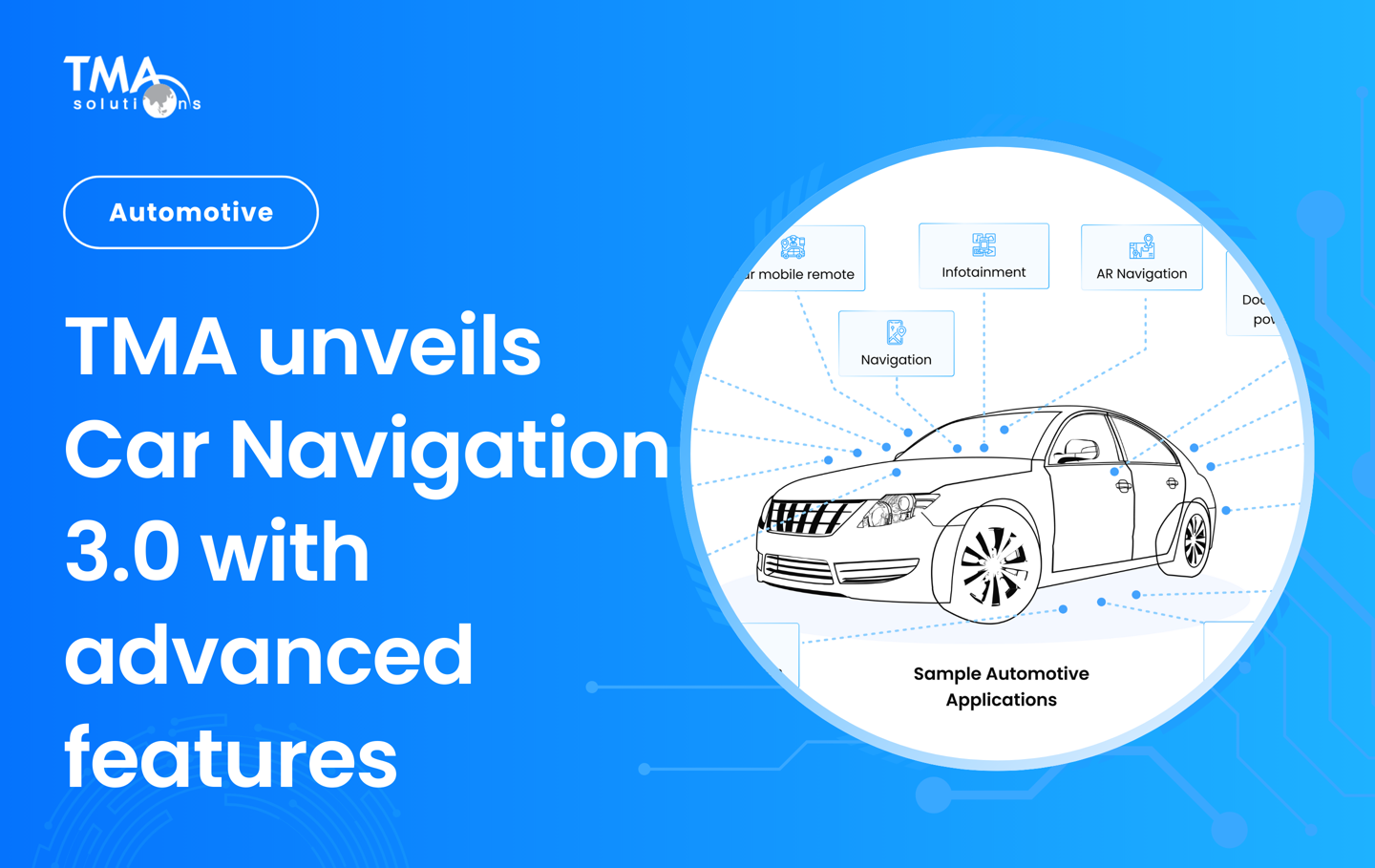
TMA unveils Car Navigation 3.0 with advanced features Ho Chi Minh City, November 7th, 2023* — TMA Automotive Software Center (TAC), a leading software developing center for automotive innovation, is thrilled to announce the release of Next Generation Car Navigation Platform version 3.0. This latest version represents a significant step forward in our commitment to providing drivers with an enhanced and seamless navigation experience. Next Generation Car Navigation Platform version 3.0 introduces several exciting new features that promise to redefine the way people navigate the roads: 1. Advanced Real-Time Traffic Updates Our improved traffic data system ensures that drivers receive the most up-to-date information on traffic conditions, allowing them to avoid delays and arrive at their destinations faster. The evaluation in such conditions as Rush hour, roadworks, or holiday delays is so precise that you are provided with information on current traffic conditions as they develop - on highways, major roads, and country roads as well as numerous inner-city routes. Our routing guidance always keeps you updated on the traffic situation as it develops and to the nearest 200m. The system also calculates what delays are to be expected and recommends detours. This will allow you to be precisely informed of the traffic situation on the planned route and potential alternative routes at all times. As a result, you can react to delays and road closures in good time and avoid them. 2. AI Integration Artificial Intelligence will play a pivotal role in the project, enabling smarter decision-making, personalized recommendations, and an intuitive driving experience. Our optimization algorithms can take into account individual user preferences, historical travel patterns, and real-time constraints to offer tailored route suggestions, making each driving experience unique. As users interact with the navigation system, the AI system can continuously refine its recommendations based on their behavior and feedback, enhancing the overall user experience. 4. Intuitive User Interface A redesigned user interface ensures a smoother, more user-friendly experience, with improved graphics, clearer instructions, and an overall more pleasant aesthetic. Users now can enjoy a visually stunning and modern design, making every glance at their navigation screen a delight. Our upgraded graphics ensure sharper maps and easy-to-read icons for a seamless journey. The new interface makes navigation a breeze, with clear instructions and intuitive controls. Our user-centric design means a hassle-free experience for drivers of all skill levels. They can easily find and use essential features, reducing the learning curve and putting them in control. The new User Interface has a unified look and feel across the platform, ensuring a familiar and cohesive navigation experience. 3. Enhanced Voice Control Car Navigation Platform version 3.0 now features even more intuitive voice control capabilities, enabling drivers to keep their hands on the wheel and eyes on the road while effortlessly managing their navigation. The system can understand natural language commands, respond to voice inputs, and provide information in a format that is easy for drivers to interpret while on the road. So this significant improvement allows drivers to interact with the navigation system entirely hands-free without diverting their attention from driving, reducing the risk of distractions. By using intuitive voice commands, users can keep their hands on the wheel, promoting safer driving practices. The expanded range of voice commands is available in version 3.0. Users can now perform a wider array of actions, from setting destinations to adjusting preferences, all through voice control. Beside that users can switch between map views, zoom in or out, and access additional information, all through voice commands, creating a comprehensive hands-free experience. 5. Safety and Efficiency TAC is committed to creating navigation systems that prioritize safety and energy efficiency, contributing to a greener and safer world. Our navigation systems prioritize safety, providing real-time updates to keep you informed about potential hazards and ensure a secure journey. Our systems are designed for energy efficiency, minimizing environmental impact, and contributing to a sustainable, eco-friendly driving experience. Users will be suggested for eco-friendly driving practices, helping you reduce your carbon footprint with every trip. "We're excited to embark on this journey towards redefining automotive navigation. Our aim is to develop a navigation platform that is not just informative but truly robust, and intelligent, making driving safer and more efficient," said Toai Truong, Director of TAC. A High-level diagram of Next Generation Car Navigation version 3.0 Next Generation Car Navigation Platform version 3.0 at TAC reflects the organization's commitment to innovation, sustainability, and enhancing the overall driving experience. With this endeavor, TAC seeks to lead the way in shaping the future of automotive navigation. About TMA Automotive Solution Center (TAC) TAC is a leading hub for automotive research and innovation. With a strong focus on cutting-edge technology and sustainable solutions, TAC is at the forefront of shaping the future of the automotive industry. We are proud to provide a suite of automotive software covering a wide spectrum of automotive software domains, including Electronic Control Units (ECU), Microcontroller Units (MCU), Human-Machine Interface (HMI), Model-Based Development, Car Navigation, Telematics, and Computer Vision. TAC's integrated approach to software development and innovation provides automotive manufacturers, suppliers, and OEMs with a one-stop solution for addressing the increasingly complex and interconnected software requirements of modern vehicles. ...
icon
TMA Cybersecurity Software Development Services: Build Secure Digital Products Without Slowing Delivery Enterprise software teams are under pressure to ship faster while reducing attack surface. That trade-off is becoming harder: Verizon’s 2026 DBIR reports that 31% of breaches now start with software vulnerabilities, making vulnerable systems a leading entry point for attackers. For CTOs, CIOs, product leaders, and sourcing managers, cybersecurity software development is no longer a late-stage testing activity. It is an engineering discipline that must shape architecture, delivery pipelines, code quality, identity design, cloud configuration, and operational resilience. TMA Solutions approaches cybersecurity software development as an engineering partnership, not a low-cost staffing exercise. With 29 years of experience, 4,000 engineers, clients from 30 countries, 10+ solution and technology centers, and a quality foundation including CMMI, Agile, RUP, ISO 9001, and ISO 27001, TMA brings scale and process maturity to secure software delivery. Why Cyber Resilience Is a Business Priority Cyber resilience means an organization can prevent, detect, respond to, and recover from cyber incidents while continuing business operations. In software delivery, that translates into secure architecture, controlled access, observable systems, tested recovery paths, and disciplined vulnerability management. Because modern applications depend on APIs, cloud services, open-source packages, mobile clients, CI/CD pipelines, and third-party integrations, the attack surface changes every sprint. A secure release last quarter can become exposed after a dependency vulnerability, misconfigured storage bucket, leaked secret, or weak service account permission. IBM’s 2025 Cost of a Data Breach Report places the global average breach cost at USD 4.4 million and highlights identity security, data security, AI oversight, security automation, and resilience as key action areas. For North American enterprises, the business case is direct: secure engineering reduces rework, supports regulatory readiness, protects customer trust, and improves delivery predictability. Secure-by-Design Software Development Secure-by-design software development embeds security decisions into requirements, architecture, implementation, testing, and operations. NIST SP 800-218, the Secure Software Development Framework, recommends adding secure development practices across SDLC models to reduce vulnerabilities, mitigate exploitation impact, and prevent recurring root causes. The practical model is: Capability: build secure applications across web, mobile, cloud, and enterprise systems. Technical constraint: delivery speed often pushes security review too late. Mitigation strategy: define security requirements, threat models, review gates, automated scanning, and vulnerability ownership from sprint planning onward. Business outcome: fewer late-stage defects, faster audit response, and lower production risk. TMA’s Security Application Development service aligns with this model through secure coding, cloud security, vulnerability management, DevSecOps, penetration testing, SIEM, threat intelligence, incident response, and identity and access management capabilities. Secure Coding, Threat Modeling, and Code Review Secure coding begins with understanding how a system can fail. Threat modeling should identify trust boundaries, sensitive data flows, privileged operations, dependency exposure, abuse cases, and recovery assumptions. For example, a fintech payment workflow needs different controls from an internal dashboard: transaction signing, idempotency, reconciliation, fraud signals, API rate limits, encryption, audit logs, and rollback paths become architectural requirements. Code review should then verify that the implementation matches the threat model. Reviewers should inspect authentication flows, authorization checks, input validation, error handling, logging, encryption usage, session management, secret handling, and dependency risk. OWASP ASVS provides a practical verification baseline for web application security controls and secure development requirements. DevSecOps and Application Security Testing DevSecOps moves security evidence into the delivery pipeline. The goal is not to block every release. The goal is to make risk visible early enough that teams can fix defects while context is still fresh. A secure delivery pipeline should include: Security requirements mapped to user stories and architecture decisions. Threat modeling for high-risk features, APIs, data flows, and third-party integrations. Branch protection, peer review, and secure coding checklists. Static application security testing, secret scanning, software composition analysis, and license checks. Dynamic testing, API testing, mobile testing, and penetration testing for risk-based releases. Infrastructure-as-code scanning and cloud configuration review. Container image scanning and runtime hardening. Vulnerability triage with severity, exploitability, ownership, remediation SLA, and exception approval. Release evidence, audit logs, rollback plan, and incident response handoff. TMA’s DevOps capability includes CI/CD, infrastructure as code, configuration management, cloud monitoring, logging, migration, and public cloud managed services, supported by a DevOps Center with 13 years of experience and more than 100 DevOps engineers. This matters because security controls only work at scale when they are repeatable. Cybersecurity Software Outsourcing Services Cybersecurity software outsourcing is not simply adding security testers to an offshore development center. It requires a delivery model that connects architecture, development, testing, cloud operations, compliance awareness, and governance. Dimension Generic Low-Cost ODC Engineering Partnership Model Security ownership Often treated as client-side responsibility Shared ownership across architecture, development, testing, and DevOps Code quality Feature output prioritized over maintainability Secure coding, refactoring, review discipline, and technical debt tracking Delivery pipeline Manual gates and inconsistent scanning CI/CD with automated security checks and evidence capture Governance Status reporting focused on hours and tasks Risk-based reporting, defect trends, vulnerability SLAs, and delivery metrics Scalability Headcount expansion without process maturity Structured ramp-up, training, quality systems, and domain-aligned teams TMA differentiates through engineering scale, process maturity, technical breadth, and long-term delivery capability. Its solution and technology centers cover areas such as Fintech, Healthtech, Telecom, Automotive, IoT, AI, Data, Hardware, Robotics, and 5G. For enterprise buyers, this breadth is useful because cybersecurity projects rarely stay inside one domain. A secure healthcare IoT platform may involve device integration, cloud architecture, mobile apps, analytics, identity, and operational monitoring. Identity, Access, and Compliance Considerations Identity is now a software architecture concern. Secure applications need least-privilege access, MFA, RBAC or ABAC, service-account governance, short-lived credentials, audit logs, and strong secrets management. TMA’s security capabilities include MFA, RBAC, IAM with Microsoft, Duo, and Okta, SIEM, vulnerability management, and penetration testing. Compliance should be handled carefully. For regulated industries, TMA can support GDPR-aware, HIPAA-aware, PCI DSS-aware, or sector-specific engineering practices where applicable, but buyers should validate certification, scope, and audit requirements for each engagement. NIST CSF 2.0 is a useful governance reference because it helps organizations understand and improve cybersecurity risk management . Use Cases in Finance, Healthcare, and Critical Infrastructure Finance: TMA’s finance software development experience includes fintech application development, banking integration, core banking-related applications, payments, capital markets, wealth management, SWIFT 15022/20022, FIX, Oasys, CTM, and AI in fintech. Security priorities include transaction integrity, identity proofing, fraud detection, access control, auditability, encryption, and secure API integration. Healthcare: TMA’s healthcare capability includes 16+ years of experience, 700 engineers, remote health monitoring, device integration, healthcare data analytics, telehealth, EHR, pharmacy automation, senior care, and medical device integration. Security priorities include patient data privacy, device trust, consent management, secure interoperability, and resilience for care continuity. Critical infrastructure: Telecom, IoT, edge systems, cloud platforms, and operational monitoring require secure-by-design architecture because outages can affect customers, operations, and public trust. TMA’s telecom, IoT, 5G, cloud, DevOps, and hardware capabilities create a foundation for multidisciplinary security engineering. Lessons Learned from the Field The common failure pattern in generic low-cost ODCs is not lack of talent. It is weak engineering governance. Teams ship features, but nobody owns refactoring. Pipelines pass, but they do not test security assumptions. Code is reviewed for syntax, but not abuse cases. Vulnerabilities are logged, but remediation ownership is unclear. Security becomes a report, not a delivery behavior. In mature delivery, the pattern changes. Architecture decisions are documented. CI/CD pipelines produce evidence. Security debt is tracked like product debt. Code ownership is explicit. Testing maturity improves across unit, integration, API, performance, and security layers. Cloud configurations are reviewed before production. Incident response is rehearsed, not improvised. This is where TMA’s scale and process foundation matter. A cybersecurity software partner must provide not only engineers, but also delivery discipline, training systems, architecture review, domain knowledge, and governance routines that survive team growth. Build Secure Digital Products With TMA Cybersecurity software development is about building products that can operate under real-world pressure: changing threats, expanding cloud environments, new AI usage, evolving compliance obligations, and rising customer expectations. TMA Solutions helps enterprise buyers design, develop, test, deploy, and maintain secure digital products through a combination of security application development, DevOps, cloud, fintech, healthcare, telecom, AI, data, IoT, and engineering delivery capability. For organizations seeking a Vietnam software outsourcing company with enterprise-scale engineering maturity, TMA offers a pragmatic path: secure delivery without losing momentum. To explore a secure software development partnership, engage TMA Solutions to assess your application roadmap, security priorities, delivery model, and scalable engineering needs. FAQ What are cybersecurity software development services? They are engineering services for designing, building, testing, and operating secure applications, including secure coding, threat modeling, DevSecOps, vulnerability management, IAM, cloud security, penetration testing, and secure architecture review. How does secure-by-design differ from penetration testing? Secure-by-design prevents vulnerabilities throughout the SDLC. Penetration testing validates security near release or during operations. Mature programs use both: prevention during delivery and independent validation before high-risk deployment. Can TMA support enterprise-scale secure software outsourcing? Yes. TMA has 29 years of experience, 4,000 engineers, clients from 30 countries, 10+ solution and technology centers, and quality foundations including CMMI, Agile, RUP, ISO 9001, and ISO 27001. What security standards can guide application development? Common references include NIST SSDF, NIST CSF, OWASP ASVS, OWASP Top 10, ISO 27034, CIS Controls, PCI DSS-aware practices, and organization-specific regulatory requirements. What should buyers evaluate in a cybersecurity outsourcing partner? Evaluate secure SDLC maturity, architecture capability, DevSecOps automation, vulnerability ownership, domain experience, cloud security skills, quality systems, communication discipline, and ability to scale without losing engineering governance....

icon
TMA Data Solutions in Digital Transformation Trends Explore TMA Data Solution https://www.tmasolutions.com/files/TMA-Data-Solution-Brochure.pdf Big Data & Analytics Brochure Industry Applications: Success Stories with TMA Data Platform In the retail sector, TMA built a centralized data system that enables businesses to segment clients in real time and launch personalized marketing campaigns, significantly increasing conversion rates. Centralized data platform for dynamic segmentation and personalized marketing Explore more: https://www.tmasolutions.com/case-studies/centralized-data-platform-for-dynamic-segmentation-and-personalized-marketing Case Study: Centralized data platform for dynamic segmentation and personalized marketing For global clients, TMA supported the integration of data from legacy systems into Azure Cloud, combined with advanced visualization and analytics using Power BI and AI. Optimizing data with Azure Explore more: https://www.tmasolutions.com/case-studies/optimizing-data-with-azure-dynamic-integration-legacy-migration-and-advanced-visualization Case Study: Optimizing data with Azure: dynamic integration, legacy migration, and advanced visualization In healthcare, TMA developed a real-time health data analytics solution to detect early risks and optimize treatment processes. Leverage Big Data for Healthcare analytics Explore more: https://www.tmasolutions.com/case-studies/leverage-big-data-for-healthcare-analytics Case Study: Leverage Big Data for Healthcare analytics Real Impact, Tangible Benefits Global studies have shown that businesses adopting data platforms similar to the TMA Data Platform have achieved measurable improvements across key performance areas: Supply chain optimization: Real-time insights help streamline sourcing and logistics, reduce inventory by 15–30%, and cut supply chain costs by up to 20% (Capgemini Research). Warehouse efficiency: Companies using smart warehouse tools see inventory carrying cost reductions of 20–30% and 15–25% fewer stockouts (Deloitte, McKinsey). Talent management: Predictive hiring and engagement analytics contribute to a 7% drop in employee turnover and up to 50% recruitment cost savings (Gallup, IBM, Unilever). Fraud detection: AI-driven fraud analytics reduce fraud losses by 30% and improve detection accuracy by up to 40% (PwC, McKinsey). Across industries—from finance to retail, healthcare to agriculture—the TMA Data Platform helps organizations enhance agility, make smarter decisions, and realize faster time-to-value. The result is not just improved operations, but clear ROI—reduced costs, improved accuracy, and increased competitiveness in a data-driven economy. TMA Data Platform: Empowering Businesses with Data To meet this growing need, our company offers the TMA Data Platform—a scalable solution designed to help businesses manage, analyze, and utilize data more efficiently. Acting as a centralized data hub, the platform integrates inputs from various systems, supports both real-time and batch processing, and provides actionable insights through live dashboards. It empowers teams to make faster decisions, reduce downtime, and boost equipment efficiency by up to 25%. Overview of TMA Data Processing Pipeline The platform is built for flexibility and security. It supports structured, semi-structured, and unstructured data—including ERP records, sensor data, and social media—and adapts to both cloud and on-premise environments. Features like AI/ML integration, low-code/no-code tools, and predictive analytics further enhance its value. In short, the TMA Data Platform is not just a data tool—it’s a business enabler. By turning fragmented data into real-time intelligence, it helps organizations improve performance, reduce costs, and accelerate their digital transformation with measurable ROI. Key Statistics As reported in a survey by CPA Australia revealed that 74% of Vietnamese businesses have a digital strategy, surpassing the Asia-Pacific average of 63%. Additionally, nearly 80% of Vietnamese respondents reported using AI in the past 12 months, compared to 69% in other surveyed markets. Key sectors like banking, retail, logistics, and manufacturing are leading the charge, driven by both necessity and opportunity. A core driver of success in these efforts is data—its timely capture, integration, and analysis. Effective data strategies are key to improving operations, speeding up decision-making, and gaining a competitive edge. Vietnam’s Digital Transformation: A Growing Imperative Vietnam is at a pivotal point in its digital transformation journey, showing strong momentum and rising demand for technology integration across sectors. The Ministry of Information and Communications reported that Vietnam's digital economy grew by over 20% in 2024, accounting for more than 18% of the country's GDP. This highlights how digital transformation is no longer optional but a must for businesses aiming to stay relevant and resilient. ...
icon
TMA Enterprise AI Development Services Enterprise AI projects rarely fail because a model cannot produce an impressive demonstration. They fail when organizations attempt to connect probabilistic models to fragmented data, regulated workflows, legacy applications, and strict service-level requirements. Gartner predicted that at least 30% of generative AI projects would be abandoned after proof of concept by the end of 2025 because of poor data quality, inadequate risk controls, escalating costs, or unclear business value. For CTOs, CIOs, product leaders, and sourcing managers, the priority is therefore not launching more pilots. It is building AI systems that can be governed, integrated, monitored, and improved in production. Why Enterprises Are Moving From AI Pilots to Production An AI pilot proves that a model can perform a task under controlled conditions. A production AI system must perform that task consistently while meeting requirements for security, latency, availability, cost, traceability, and human oversight. This distinction changes the investment decision. Enterprise leaders must connect each AI use case to a measurable operational outcome—such as reducing document-processing time, improving defect detection, or accelerating customer-service resolution—and define acceptable error rates before selecting a model. They must also account for the surrounding system. APIs, data pipelines, identity controls, business rules, observability, fallback paths, and user interfaces often require more engineering effort than the model itself. Because these components determine whether AI can safely participate in a business process, production planning should begin with architecture and governance rather than model selection. What Enterprise-Grade AI Development Requires Enterprise AI development is the disciplined process of designing, integrating, deploying, and operating AI capabilities within real business systems. It combines data engineering, application development, cloud or edge infrastructure, security, quality assurance, and MLOps. A practical architecture typically includes: Governed source systems and ingestion pipelines Data validation, lineage, labeling, and access controls Model training, foundation-model APIs, or approved open models Retrieval-augmented generation and enterprise knowledge stores Model gateways, prompt controls, and policy enforcement Application and workflow integration through APIs or events Evaluation, observability, human review, and rollback mechanisms Data readiness, governance, and responsible AI Data readiness is a production constraint, not a preliminary housekeeping exercise. In a Gartner survey of 1,203 data management leaders, 63% of organizations either lacked—or were unsure whether they had—the necessary data management practices for AI. Teams should define data ownership, permitted uses, retention rules, quality thresholds, and lineage before training or grounding a model. Sensitive fields should be classified and minimized. Retrieval systems need authorization-aware filtering so that an AI assistant cannot expose documents a user could not access directly. Responsible AI controls should be proportional to business risk. The NIST AI Risk Management Framework organizes risk activities around four functions: Govern, Map, Measure, and Manage. In implementation terms, this means documenting intended use, affected users, evaluation criteria, known limitations, escalation paths, and accountable owners. For generative AI, teams must also test hallucination, harmful output, prompt injection, data leakage, and unsafe tool use. The OWASP Top 10 for LLM applications identifies prompt injection, sensitive-information disclosure, supply-chain risk, and data or model poisoning among the principal application risks. MLOps, model monitoring, and continuous improvement MLOps extends DevOps to data, models, experiments, and production behavior. A model that passed offline evaluation can still deteriorate when input distributions, customer behavior, or operating conditions change. Google Cloud’s MLOps guidance emphasizes that continuous integration must validate code, data, schemas, and models. Production monitoring should identify performance degradation and trigger investigation or retraining. A production-ready delivery pipeline should: Define the business outcome, baseline, risk tier, and acceptance thresholds. Profile source data and establish quality, lineage, privacy, and access controls. Build a versioned experiment using reproducible code, prompts, datasets, and configurations. Evaluate accuracy, groundedness, bias, latency, security, and unit economics. Integrate the model through controlled APIs, queues, or workflow orchestration. Run automated tests for code, data, models, prompts, and infrastructure. Deploy through staged environments with canary releases and rollback support. Monitor model quality, drift, cost, latency, failures, and user feedback. Feed reviewed production evidence into retraining, prompt updates, or workflow redesign. TMA Solutions’ AI Development Capabilities TMA Solutions approaches enterprise AI as a technology and innovation partnership rather than a staff-augmentation transaction. Its official company profile reports 29 years of software delivery experience, 4,000 engineers, clients from 30 countries, and 10 technology and solution centers. Its quality foundation includes CMMI, Agile, RUP, ISO 9001, and ISO/IEC 27001. This scale supports multidisciplinary teams combining AI specialists with data, cloud, DevOps, cybersecurity, QA, application, telecom, healthcare, automotive, and embedded-system engineers. Custom AI software development TMA’s AI framework covers AI feature and product development, AI development centers, AI solutions, and AI as a Service. Published capabilities include machine learning, natural language processing, computer vision, OCR, speech processing, robotic process automation, and cloud AI. The architectural decision should follow the constraint: Use predictive ML when historical patterns can support forecasting or classification. Use computer vision when image or video evidence drives detection and inspection. Use retrieval-augmented generation when responses must be grounded in enterprise content. Use workflow automation when deterministic rules and AI judgment must operate together. Use human review when errors could materially affect customers, finances, safety, or compliance. Generative AI, edge AI, and AI-augmented engineering Generative AI can support knowledge assistants, document processing, customer service, content workflows, and developer productivity. Production implementations, however, require grounded retrieval, evaluation datasets, cost controls, and constrained actions. Edge AI is appropriate when latency, connectivity, privacy, or bandwidth makes centralized inference impractical. TMA’s published capabilities include cloud, on-premises, mobile, and edge deployments, including computer-vision and embedded AI technologies. TMA also describes an enterprise agent framework with knowledge ingestion, multi-agent orchestration, standardized connectors, and integration with existing enterprise systems. Agentic workflows should nevertheless enforce least-privilege access, explicit tool permissions, execution limits, audit logs, and approval gates. Common Enterprise AI Use Cases High-value use cases generally combine a clear decision point with accessible data and measurable outcomes: Manufacturing: defect detection, predictive maintenance, safety monitoring, and process optimization Healthcare: document extraction, operational assistants, remote-monitoring analytics, and decision support Telecom: anomaly detection, network diagnostics, traffic prediction, and service automation Financial services: document processing, mismatch detection, service assistants, and risk analytics Retail and logistics: recommendations, inventory alerts, visual search, shipment processing, and package inspection Enterprise operations : knowledge search, call-center assistance, reporting, onboarding, and workflow automation Any regulated or safety-relevant implementation requires validation against the buyer’s applicable legal, clinical, security, and operational requirements. Lessons Learned From the Field Low-cost ODC models can add capacity, but weak engineering governance often shifts hidden costs into later releases. Technical debt accumulates when teams optimize for feature throughput without reserving capacity for refactoring. Fragile CI/CD pipelines emerge when deployment knowledge remains with a few individuals. Code ownership becomes ambiguous when vendor and client responsibilities are not explicit. Testing gaps appear when teams validate model accuracy but ignore data drift, integrations, security, and rollback behavior. An engineering partnership mitigates these risks through shared architecture decisions, documented ownership, automated quality gates, production observability, and planned technical-debt reduction. The business result is not simply more development capacity; it is a system that can evolve without every model, data, or infrastructure change becoming a high-risk release. How to Choose the Right AI Development Services Company Evaluation area Generic low-cost ODC Engineering partnership model Success measure Resource utilization Business outcomes and production reliability Architecture Implements assigned components Evaluates assumptions and technical trade-offs Quality Functional testing near release Continuous code, data, model, and security testing Ownership Task-based responsibility Defined product, platform, model, and operational ownership Operations Handover after deployment Monitoring, incident response, and lifecycle support Scaling Adds developers Scales skills, governance, infrastructure, and delivery controls Enterprise buyers should request evidence of production AI experience, security practices, MLOps maturity, integration capability, technical leadership, and knowledge-transfer processes. They should also clarify intellectual-property ownership, data handling, model portability, escalation procedures, and exit provisions before delivery begins. Build Production-Ready AI With TMA Solutions The central question is no longer whether an AI model can complete a demonstration. It is whether the surrounding engineering system can deliver reliable, secure, and economically sustainable outcomes. TMA Solutions combines AI capability with enterprise software engineering, industry experience, global delivery scale, and established quality processes. Enterprise buyers can engage TMA to assess AI readiness, prioritize viable use cases, design the target architecture, and establish a controlled path from proof of value to production. Contact TMA Solutions to discuss an enterprise AI roadmap, architecture assessment, or dedicated AI development partnership. Frequently Asked Questions 1. What is enterprise AI development? Enterprise AI development builds AI capabilities into governed business systems, including data pipelines, applications, security controls, integrations, monitoring, and human oversight—not just model training. 2. How should an enterprise move an AI pilot into production? Define measurable acceptance criteria, establish data governance, automate evaluation, integrate security controls, deploy incrementally, monitor production behavior, and maintain a tested rollback path. 3. When should we use RAG instead of fine-tuning? Use RAG when answers must reference current, permission-controlled enterprise knowledge. Consider fine-tuning when the model needs stable domain behavior, terminology, formatting, or task specialization that prompting alone cannot provide. 4. How can buyers evaluate an AI outsourcing partner’s reliability? Review production references, architecture capability, security practices, MLOps maturity, quality standards, engineering scale, staff retention approach, governance model, and long-term support responsibilities. 5. Can an AI development team scale without weakening governance? Yes. Scale through reusable platform components, automated quality gates, clear ownership, standardized environments, role-based access, architecture governance, and shared observability—not by adding engineers without corresponding controls....