Healthcare software teams in North America are under pressure to modernize EHR workflows, remote monitoring platforms, patient engagement tools, and data analytics systems while controlling engineering cost and delivery risk. The challenge is not simply hiring more developers. Healthcare applications handle sensitive data, integrate with complex legacy systems, and must be designed with security and regulatory awareness from the first sprint. IBM reported that the global average cost of a data breach reached USD 4.4 million in 2025, reinforcing why healthcare software delivery cannot treat security as a late-stage checklist.
For CTOs, CIOs, product leaders, and sourcing managers, Vietnam healthcare software development outsourcing is increasingly relevant because it can expand engineering capacity without losing architectural control. The key is choosing a partner that brings healthcare domain knowledge, mature delivery governance, DevSecOps discipline, and the ability to scale beyond staff augmentation.
Why Healthcare Companies Outsource Software Development to Vietnam
Healthcare companies outsource software development to Vietnam to gain access to skilled engineering teams, cost-efficient delivery capacity, and long-term product development support. For HealthTech companies, the strongest use cases include platform modernization, mobile patient applications, data engineering, QA automation, cloud migration, and remote care solutions.
Because healthcare platforms often evolve around legacy databases, fragmented workflows, and third-party integrations, outsourcing only works when the offshore team can understand both the product architecture and the operating context. A simple ticket-taking model may help with short-term backlog pressure, but it often fails when the product requires refactoring, interoperability planning, cloud reliability engineering, or secure data handling.
Vietnam’s advantage is not only labor cost. For enterprise buyers, the stronger value is access to stable engineering teams that can support multi-year roadmaps across web, mobile, cloud, data, AI, testing, and maintenance. This matters because healthcare software is rarely “finished.” Regulations change, integrations expand, clinical workflows evolve, and security threats keep moving.
What to Look for in a Healthcare Software Outsourcing Partner
A healthcare outsourcing partner should be evaluated on domain capability, delivery maturity, security engineering, communication model, and scalability. The goal is not to find the lowest hourly rate. The goal is to reduce delivery risk while increasing engineering throughput.
Domain knowledge and delivery maturity
Healthcare software teams need to understand workflows such as patient onboarding, scheduling, clinical documentation, claims support, device data ingestion, pharmacy automation, care coordination, remote patient monitoring, and healthcare analytics. Even when the offshore partner is not responsible for clinical decisions, the team must understand how software defects can affect operational continuity and patient experience.
Delivery maturity should include:
- Clear product ownership and sprint governance
- Architecture review before major build decisions
- Definition of ready and definition of done
- Automated testing strategy
- Release management and rollback planning
- Technical debt tracking
- Documentation for APIs, data models, and deployment flows
Because healthcare platforms commonly combine cloud services, mobile apps, APIs, analytics layers, and third-party systems, architectural discipline becomes a business control. Poor modularity slows integration. Weak QA increases release risk. Unclear code ownership creates dependency bottlenecks.
Security practices and regulatory awareness
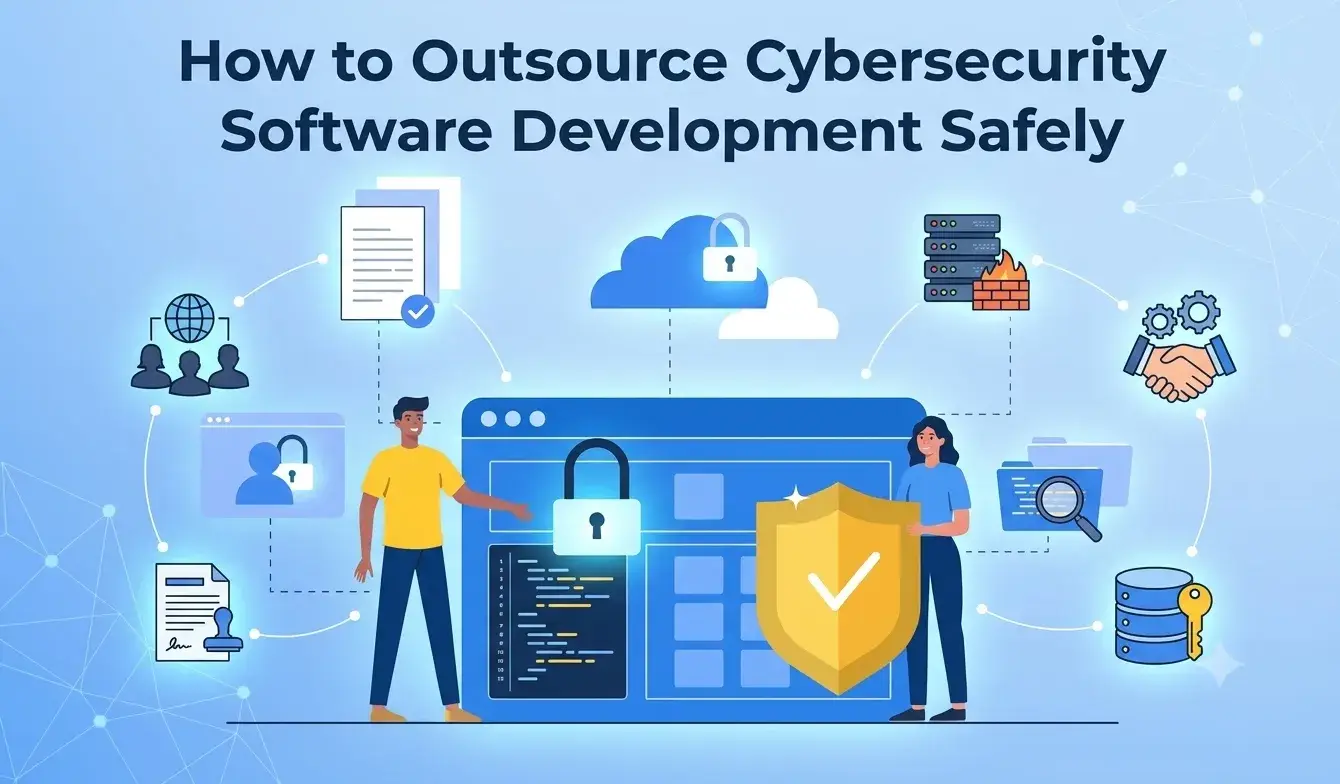
Healthcare outsourcing partners should demonstrate security-by-design practices, not just security testing at the end. In the US market, teams should be familiar with HIPAA-related expectations. HHS explains that the HIPAA Security Rule establishes administrative, physical, and technical safeguards for electronic protected health information, while remaining flexible and technology neutral. For outsourcing, that means the partner should support secure SDLC practices, access control, auditability, encryption, vulnerability management, and incident response coordination.
A practical healthcare delivery model should align with recognized security frameworks. NIST Cybersecurity Framework 2.0 helps organizations manage cybersecurity risk through governance and risk reduction practices. OWASP SAMM provides a software security maturity model for improving secure development programs. These frameworks do not replace legal compliance, but they help engineering teams make security operational.
Generic ODC vs. Engineering Partnership Model
Evaluation Area | Generic Low-Cost ODC | Engineering Partnership Model |
Primary objective | Fill roles at low cost | Deliver product outcomes with accountable engineering |
Architecture ownership | Often client-only | Shared architecture review and implementation planning |
Security | Periodic testing or checklist | Secure SDLC, threat modeling, CI/CD security, vulnerability tracking |
QA approach | Manual testing-heavy | Automation, regression strategy, performance testing, risk-based QA |
Technical debt | Often unmanaged | Logged, prioritized, and tied to roadmap impact |
Scaling model | Add headcount quickly | Scale by skills, domain context, leadership, and governance |
Business impact | Short-term velocity | Sustainable delivery speed, maintainability, and lower operational risk |
TMA Solutions’ 29 Years of Engineering Experience
TMA Solutions positions itself as a technology and innovation partner and one of Vietnam’s leading software outsourcing companies. TMA was established in 1997 and states 29 years of experience, 4,000 engineers, clients from 30 countries, and a quality foundation including CMMI, Agile, RUP, ISO 9001, and ISO 27001.
For healthcare buyers, scale matters only when paired with domain capability. TMA’s healthcare practice states 700 engineers and 16+ years of healthcare experience, serving clients from Australia, the USA, Europe, and Vietnam. Its healthcare expertise areas include AI and health data analytics, remote health monitoring, device integration, telehealth, home care, senior care, disability care, EHR, medication management, nursing home management, healthcare kiosks, pharmacy automation, fitness solutions, clinical research tools, and healthcare self-services.
This breadth is important because modern healthcare platforms are increasingly connected systems. A remote monitoring product may require device integration, mobile UX, cloud telemetry, rules-based alerts, analytics dashboards, and secure patient data workflows. A partner with cross-functional capability can reduce handoff friction between engineering disciplines.
Healthcare Software Services From Vietnam
TMA’s software development services cover the software development life cycle, including product enhancement, MVP development, R&D, proof of concept and prototype development, maintenance and support, porting, and migration. For HealthTech companies, this service mix maps well to the most common outsourcing needs.
Product development, modernization, testing and support
A mature healthcare software outsourcing engagement can support:
Product development: Patient portals, clinician dashboards, care management tools, telehealth apps, mobile health apps, healthcare workflow automation, and SaaS platforms.
Modernization: Legacy migration, monolith decomposition, API enablement, cloud migration, database modernization, and UI modernization.
Data and analytics: Healthcare data lakes, reporting dashboards, risk scoring, operational analytics, and AI-assisted workflow tools.
Testing: Functional testing, automation testing, regression testing, API testing, mobile testing, performance testing, and security testing. TMA states 800+ test engineers and 29 years of testing experience.
Security engineering: Vulnerability assessment, penetration testing, secure coding, cloud security, DevSecOps and CI/CD security integration. TMA’s security application development page references OWASP ASVS, MASVS, NIST SP 800-218, ISO 27034, CIS Control 16, PCI DSS, and related security tools.
Because healthcare applications must remain dependable after launch, support should include observability, incident triage, production defect analysis, dependency updates, test maintenance, and release planning.
Technical Delivery Pipeline for Healthcare Outsourcing
A healthcare outsourcing engagement should use a structured delivery pipeline:
- Discovery and architecture assessment
Review business goals, clinical or operational workflows, data sensitivity, integration points, legacy constraints, and regulatory expectations. - Solution design
Define target architecture, cloud model, API boundaries, data flow, identity model, audit logging, encryption approach, and integration strategy. - Security and compliance planning
Map data types, access roles, threat scenarios, secure coding rules, CI/CD controls, test environments, and evidence collection needs. - Agile delivery setup
Establish team structure, sprint cadence, backlog ownership, documentation standards, code review process, and escalation channels. - Build and integration
Develop services, mobile/web interfaces, data pipelines, device integrations, EHR-related connectors, and admin workflows. - Quality engineering
Run unit tests, API tests, integration tests, regression tests, performance tests, accessibility checks, and security scans. - Release and deployment
Use controlled environments, deployment automation, configuration management, rollback plans, monitoring, and release notes. - Operations and continuous improvement
Track incidents, technical debt, user feedback, security vulnerabilities, and roadmap changes through a continuous improvement loop.
Outsourcing Models for HealthTech Companies
HealthTech companies can choose different outsourcing models depending on product maturity and internal capacity.
A dedicated offshore development team works well when the client has product ownership and needs stable engineering capacity. A project-based model fits defined scopes such as MVP development, migration, QA automation, or analytics implementation. A managed delivery model is useful when the client wants the partner to own delivery execution under agreed governance.
For enterprise healthcare buyers, the best model is often hybrid: client-side product and compliance leadership combined with TMA-side engineering, QA, DevOps, and technical leadership. This keeps strategic control close to the business while extending execution capacity.
Lessons Learned from the Field
The biggest risk in healthcare outsourcing is not distance. It is weak engineering governance. Generic low-cost ODCs often create hidden cost through unclear ownership, minimal refactoring, fragile CI/CD pipelines, manual regression bottlenecks, and security checks performed too late.
In a mature delivery model, technical debt is visible. CI/CD pipelines are treated as product infrastructure. Code reviews evaluate maintainability, not just syntax. QA automation is designed around business-critical workflows. Security is embedded through access control, dependency scanning, secrets management, secure coding, and penetration testing where appropriate.
Because healthcare systems are integration-heavy, practical teams also document assumptions. If an API changes, if a device sends malformed data, if an analytics job fails, or if a user role is misconfigured, the system should degrade predictably. This kind of engineering discipline is what separates a long-term technology partner from a staffing vendor.
Start Your Healthcare Software Team in Vietnam
TMA Solutions can support healthcare organizations that need to expand software delivery capacity while maintaining quality, security awareness, and architectural discipline. TMA’s official case study listing includes a healthcare data and analytics example involving Azure, legacy migration, data integration, and visualization. Where detailed KPIs are not publicly available, enterprise buyers should request relevant case studies, reference architectures, sample team structures, and security process documentation during vendor evaluation.
For North American healthcare companies, Vietnam healthcare software development outsourcing is strongest when used as a strategic engineering extension: one that combines product development, modernization, testing, DevOps, data, and security practices under clear governance.
FAQ
What is healthcare software development outsourcing?
It is the use of an external engineering partner to design, build, test, modernize, or support healthcare software, including patient apps, EHR-related systems, analytics platforms, telehealth tools, and remote monitoring solutions.
Is Vietnam a good destination for HealthTech outsourcing?
Yes, when the vendor has healthcare domain experience, mature delivery governance, strong QA, security-aware development, and scalable engineering capacity. Vendor evaluation matters more than location alone.
How should healthcare companies evaluate outsourcing partner reliability?
Assess years of operation, engineering scale, healthcare experience, quality standards, security practices, client references, delivery governance, technical leadership, and ability to support long-term maintenance.
Can an offshore team support HIPAA-related software projects?
Yes, if roles, access, data handling, security controls, and contracts are carefully defined. Vendors should use HIPAA-aware delivery practices where applicable, but buyers should validate legal and compliance responsibilities.
What work can be outsourced first?
Good starting points include QA automation, modernization assessment, cloud migration support, analytics dashboards, mobile app modules, API development, and maintenance of non-core components with clear documentation.
Conclusion
Vietnam healthcare software development outsourcing can help North American healthcare companies improve delivery speed, scale engineering capacity, and modernize complex platforms. The strategic value comes from choosing a partner with healthcare domain knowledge, process maturity, security-aware engineering, and the ability to support long-term product evolution.
TMA Solutions brings 29 years of software outsourcing experience, 4,000 engineers, healthcare delivery capability, quality foundations, and broad technical centers to support enterprise healthcare software initiatives. To explore a healthcare software team in Vietnam, engage TMA Solutions for a technical consultation, delivery model discussion, or architecture-focused outsourcing assessment.