Introduction
Artificial Intelligence (AI) is transforming logistics at an unprecedented pace, surpassing other innovations in recent decades. From warehouses and delivery fleets to planning and customer service, AI automation brings efficiency, scalability, and cost savings. Yet, it also raises critical questions: Will AI replace logistics jobs? Or will it create new opportunities for the workforce?
This article explores the impact of AI on the logistics workforce, examining both benefits and challenges, and highlights how companies can balance automation with employment growth. Drawing on recent data and case studies, this article provides insights for logistics leaders navigating this shift.
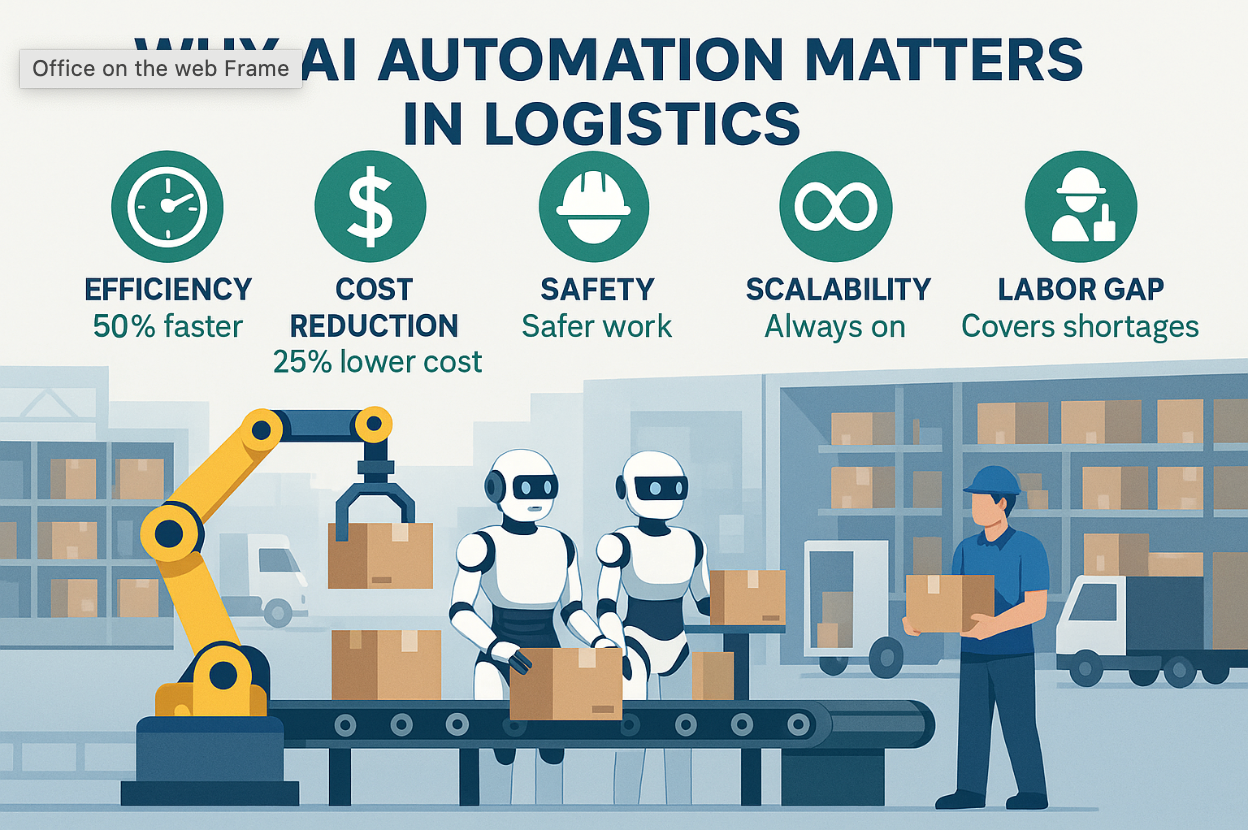
Why AI Automation Matters in Logistics
The logistics sector employs millions globally, but it faces two major pressures: booming e-commerce demand and persistent labor shortages. AI-driven automation offers a solution.
Key benefits include:
- Higher efficiency: AI-powered robots cut warehouse processing time by up to 50%.
Cost reduction: Amazon’s robotics have reduced fulfillment costs by ~25% (per Amazon's 2024 sustainability report). - Improved safety: Automation reduces heavy lifting and repetitive strain injuries.
Scalability: Systems can operate 24/7, handling seasonal peaks without proportional staffing increases. - Labor gap coverage: AI helps offset shortages in truck drivers and warehouse workers, where the U.S. alone faces a projected deficit of 160,000 drivers by 2030 (American Trucking Associations, 2024).
ShapeHow AI is Changing Logistics Roles
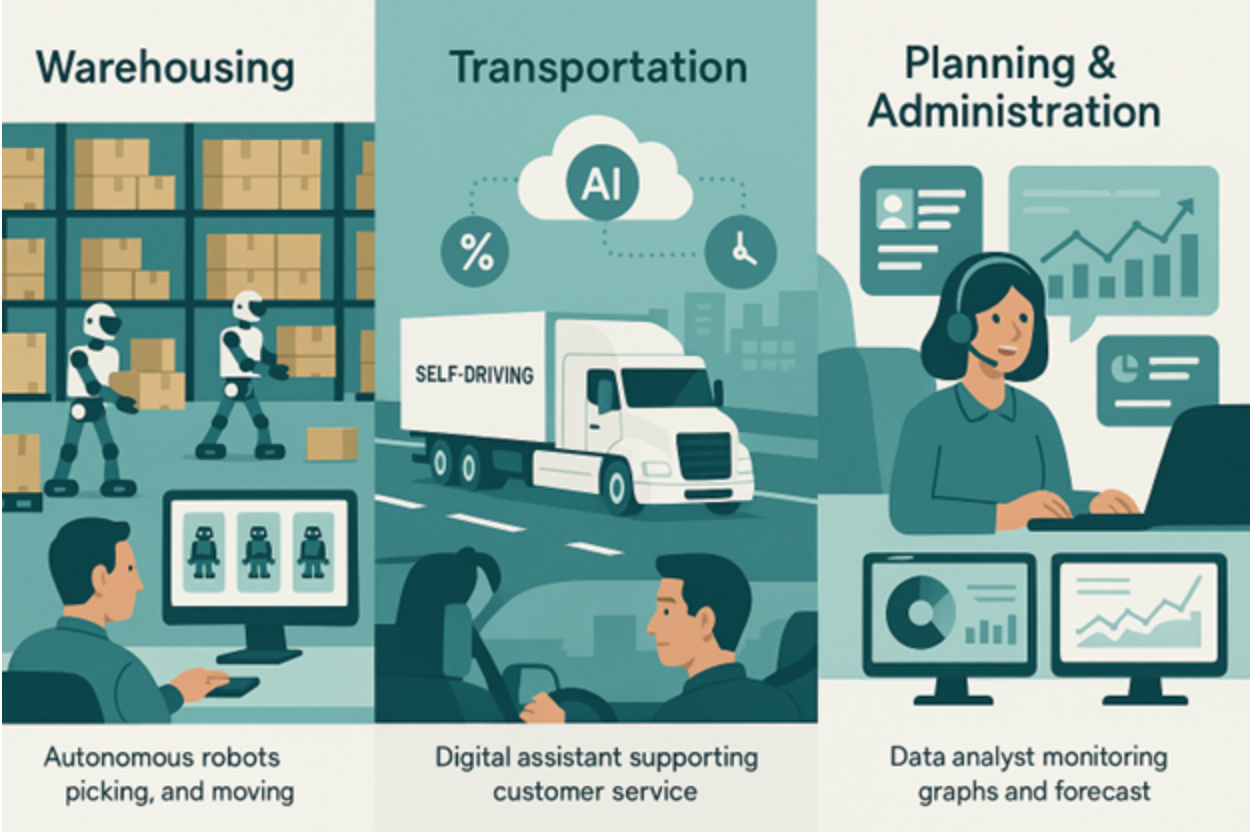
Warehousing
Autonomous robots now perform picking, packing, and transport tasks. Highly automated warehouses can operate with 25% fewer workers than manual ones (DHL Trend Research, 2023—verified for 2025 updates). At the same time, new jobs emerge in robot operation, maintenance, and systems monitoring. For instance, Amazon's deployment of its 1 millionth robot in 2025 has approached parity with human workers, yet it has also created roles in AI oversight and robotics engineering.
Transportation
AI is reshaping freight transport. Self-driving trucks could displace up to 400,000–500,000 U.S. long-haul jobs in advanced automation scenarios, but adoption remains gradual due to regulatory and technical hurdles. In the near term, humans remain critical for city driving, oversight, and exception handling. AI route optimization already helps companies cut travel time and fuel costs.
Planning & Administration
AI streamlines forecasting, documentation, and customer service. Research shows up to 90% of routine logistics manager tasks are automatable (e.g., via tools like predictive analytics), while mechanics and technicians face low automation risk. The shift reduces clerical roles but boosts demand for data analysts, AI supervisors, and decision-makers.
Automation vs Employment: A Balanced View
Risks
- Workforce reductions: Amazon’s automation has reduced warehouse staff needs by 20–25%.
Job displacement: Recent studies predict that automation could affect 50–70% of trucking jobs in advanced scenarios by 2030 (e.g., Oxford Economics, 2024 update). - Inequality risks: Routine, low-skill roles are most vulnerable.
Economic Impacts: Slower global growth is expected to displace 1.6 million jobs globally.
Opportunities
- New jobs: The World Economic Forum projects net job growth, with 170 million new roles emerging by 2030 (displacing 92 million).
- Role transformation: Amazon claims AI has created 700+ new job categories in robotics, AI supervision, and process engineering.
- Industry growth: For logistics specifically, roles in AI ethics, sustainability integration, and human-AI interface design are on the rise.
- Economic Impacts: 40% of employers expect to reduce workforce where AI automates tasks, but this often leads to upskilling and new opportunities.
The Core Challenge: Skills
About 50% of all employees will need reskilling by 2025. The mismatch between displaced roles (e.g., warehouse pickers) and new roles (robotics technicians) is the biggest barrier. By 2025, with AI integration maturing, logistics firms that prioritize ethical AI deployment will gain a competitive edge.
How Companies Can Adapt
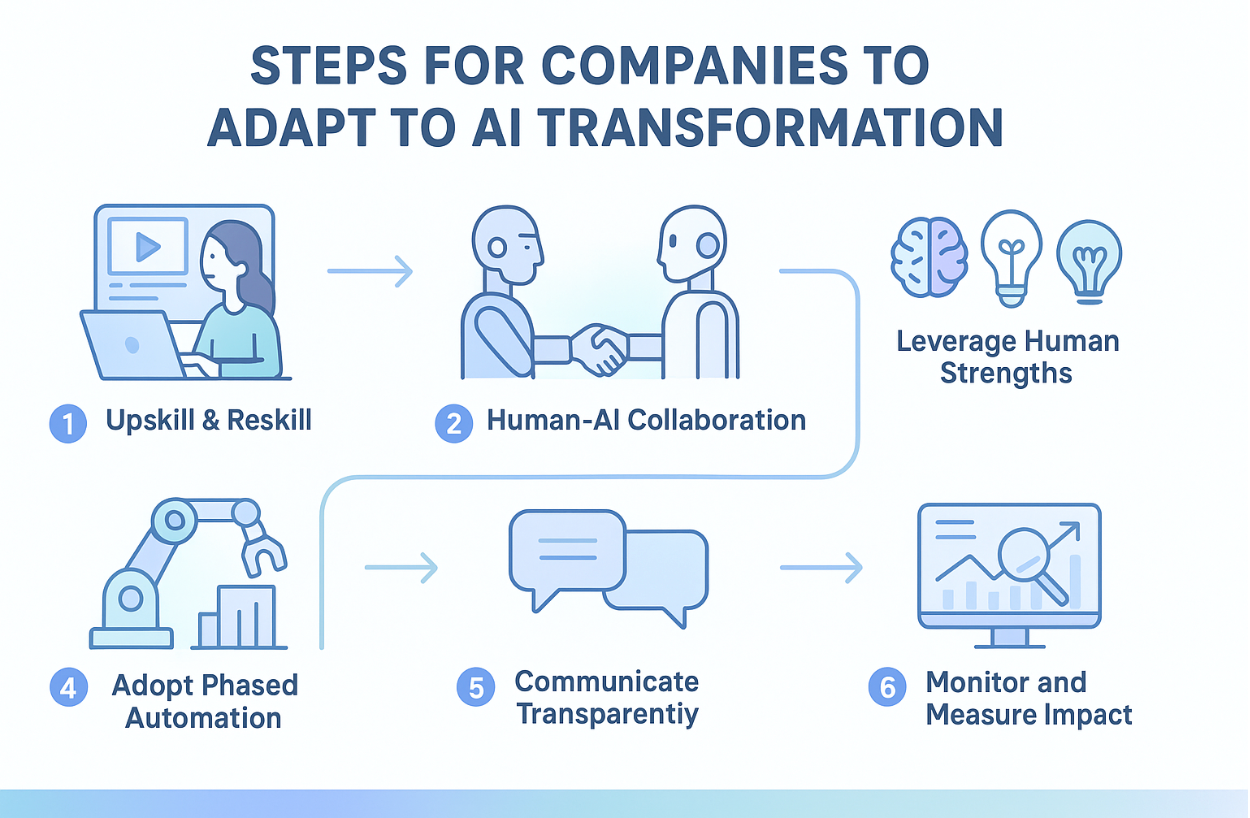
The impact of AI on logistics is inevitable, but its consequences for workers are not predetermined. Companies that act proactively can turn potential disruption into an opportunity to empower their workforce while reaping efficiency gains. To succeed, leaders need a clear roadmap that combines technology adoption with human development. Below are six practical approaches:
- Upskill & Reskill: Invest in training programs to move workers into new tech-enabled roles. Amazon has reskilled 700,000+ employees globally through programs like Upskilling 2025.
- Redesign Jobs for Human–AI Collaboration: Reframe roles so humans focus on exceptions, creativity, and decision-making while AI handles repetitive tasks.
- Leverage Human Strengths: Prioritize skills that are hard to automate: leadership, negotiation, creative problem-solving, and adaptability.
- Adopt Phased Automation: Start with pilots, measure impact, involve employees, then scale. This reduces disruption and builds buy-in.
- Communicate Transparently: Explain why automation is adopted, how it impacts roles, and create a culture where innovation is seen as opportunity.
- Monitor and Measure Impact: Regularly assess automation's effects on productivity, employee satisfaction, and retention using metrics like turnover rates and skill gap analyses.
TMA Solutions: Case Studies in AI-Driven Logistics
Real-world examples from TMA Solutions demonstrate how AI can enhance efficiency while supporting workforce transitions. As a leading software outsourcing company in Vietnam with over 4,000 engineers, TMA Solutions offers comprehensive services including software development, software testing, innovation as a service, digital transformation, and hardware integration. These services help logistics organizations worldwide integrate AI-powered automation, machine learning solutions, Edge AI, AI Agents development, and AI Agents solutions for Enterprise with IoT and cloud-based systems to boost efficiency and enable employees to transition into higher-value roles. TMA's expertise spans AI Demand forecasting in logistics, AI logistics automation, generative ai logistics, shipment tracking, supply chain management, last mile delivery, warehouse management system, load calculator, and smart warehouse solutions, ensuring seamless human-AI collaboration.
Here are several real-world examples:
- Warehouse Management System (WMS) with AI Agent: An AI-powered automation WMS enhanced warehouse operations by automating routine workflows and providing intelligent recommendations for staff, improving both efficiency (by 30%) and workforce engagement. This service leveraged TMA's digital transformation expertise to reduce errors and upskill operators in AI monitoring.
🔗 Read Case Study - Optimizing Inventory in Real Time with Azure Demand Forecasting: Azure-based AI Demand forecasting in logistics consolidated sales and market data, enabling accurate demand prediction and reducing planner workload by 25%. Through TMA's innovation as a service, this solution integrated machine learning solutions to free up employees for strategic planning.
🔗 Read Case Study - Optimizing Warehouse Management with Centralized Inventory and Real-Time Monitoring: Centralized warehouse system with live monitoring reduced errors and improved operational efficiency by 40%. TMA's software development services ensured hardware integration for seamless IoT data flow, creating new roles in system maintenance and incorporating smart warehouse solutions.
🔗 Read Case Study - Transforming Freight Management with Enhanced Delivery & Inventory Solution: Freight management platform with real-time shipment tracking and mobile integration streamlined delivery and visibility, cutting costs by 20%. TMA's AI logistics automation services automated freight matching, allowing drivers to focus on complex routes and enhancing last mile delivery.
🔗 Read Case Study - Optimizing Service-Point Operations: Enhancing Efficiency and Client Experience in Logistics: TMA built a real-time inventory tracking and transaction monitoring system to optimize service-point operations, enhancing efficiency and client experience by 35%. This drew on TMA's software testing services to ensure reliability in supply chain management.
🔗 Read Case Study
Final Thoughts
AI is not a question of robots or humans, but robots with humans. In logistics, the winners will be companies that:
- Harness AI for efficiency and scalability.
- Invest in reskilling to retain and empower their workforce.
- Redesign jobs for human–AI collaboration.
The path forward requires balancing automation benefits with workforce well-being. Companies that achieve this balance will lead the industry in performance and set an example for sustainable innovation.
ShapeAI is already redefining logistics. The question is: how ready is your workforce?
👉 Contact TMA Solutions at https://www.tmasolutions.com/contact-us to explore how we can help you integrate AI, boost efficiency, and ensure your people thrive in the automation age.


