Telemedicine has rapidly evolved—driven by key telemedicine trends—from a niche solution to a critical component of modern healthcare. This technology is redefining how care is delivered, making healthcare more accessible, efficient, and patient-centric. In this article, we’ll explore the benefits of telemedicine, address the technology challenges, and highlight key trends and innovations expected to shape the future of virtual healthcare.
Benefits of telemedicine
Telemedicine trends have become indispensable parts of modern healthcare, driven by the need for accessible and cost-effective care. Here’s an analysis of the key benefits that are reshaping the healthcare landscape:
Addressing healthcare workforce shortages
The ongoing shortage of healthcare professionals, particularly in rural and underserved regions, has highlighted the importance of telemedicine.
Virtual care helps bridge this gap by enabling providers to deliver care remotely, ensuring patients in remote areas can access specialized services such as psychiatry, oncology, and urology without requiring in-person visits. This model extends the reach of healthcare systems while optimizing the workload of existing medical staff.

Labor cost efficiency
The healthcare workforce shortage, compounded by the surge in patient demand during the pandemic, has driven up staffing costs significantly. Telemedicine helps healthcare organizations control these expenses by reducing the need for additional on-site staff.
A recent study revealed that telehealth services can reduce system-wide costs by over 50%, offering a more sustainable solution to managing operational budgets.
Enhanced access to specialty care
Telemedicine is uniquely positioned to address gaps in specialty care by connecting patients with specialists who may be geographically distant.
Many healthcare systems now use virtual consults to fill part-time demands for specialty services, eliminating the need to hire full-time providers for limited cases. This on-demand model improves patient access to timely care without straining resources.
Mitigating provider burnout
Telemedicine offers a reprieve for overburdened healthcare providers, helping reduce the likelihood of burnout. By incorporating virtual care solutions, healthcare systems can redistribute workloads, making it easier for physicians to manage their schedules and reduce time-intensive in-person visits.

However, staffing virtual care programs with adequately trained telehealth providers remains a challenge that requires strategic planning, including the use of locum tenens physicians specialized in virtual care delivery.
Telemedicine technology challenges
Expanding telehealth services presents healthcare organizations with technological and operational challenges that must be addressed for successful implementation. Understanding current telemedicine trends is crucial for navigating these challenges. This analysis details the main telehealth challenges.
System fragmentation and lack of standardization
During the pandemic, many hospitals adopted telehealth solutions quickly and independently, leading to a fragmented ecosystem of disconnected platforms.
This lack of cohesion resulted in systems that do not easily integrate with core hospital functions such as scheduling, billing, and electronic health records (EHR). Addressing this fragmentation requires a shift toward a unified telehealth platform that supports seamless integration and provides system-wide control.
Security and platform integration
A significant challenge in telehealth technology is ensuring that the solution is highly secure and integrates with existing digital tools. Telehealth platforms must align with healthcare requirements for privacy, data encryption, and compliance (e.g., HIPAA).
Additionally, platforms should support workflows such as virtual rounding and patient billing while maintaining scalability for future expansion. Finding a solution that balances security, interoperability, and scalability can be a complex undertaking for healthcare organizations.
Meeting consumer expectations for a digital-first experience
Today’s "digital natives" expect healthcare access to be as convenient as any other online service. The challenge lies in creating a seamless "digital front door" experience where patients can easily book appointments, receive virtual consultations, and be routed to specialists if needed—all through a unified app or platform.
Healthcare providers must invest in intuitive user interfaces and personalized experiences to meet these expectations.

Identifying telehealth use cases
One of the thorniest issues for health systems is determining where telehealth adds the most value compared to in-person visits.
Organizations must map out every step of the patient care journey to pinpoint touchpoints where telehealth improves outcomes and efficiency. This comprehensive journey mapping requires an in-depth analysis of specialty services and patient interactions to ensure telehealth is used optimally.
Telehealth staffing challenges
Determining the right staffing model for telehealth services is a significant challenge. Health systems must decide whether to:
- Use their internal physicians, which offers control over protocols and costs but may strain already limited resources.
- Use the telehealth providers included with their adopted technology, which can reduce internal burdens but may limit customization and clinical oversight.
- Partner with third-party agencies or locum tenens services to fill staffing gaps, though this may introduce higher costs and potential variability in care quality.
Balancing these staffing options requires careful planning to avoid overburdening internal teams and to maintain care consistency.
Telemedicine trends and technologies in 2025
As healthcare embraces digital transformation, telemedicine continues to evolve with groundbreaking trends and technologies. Below is an expert analysis of the top telemedicine trends of 2025, highlighting how they are shaping patient care and healthcare delivery.
Remote patient monitoring (RPM) for home-based healthcare
Overview
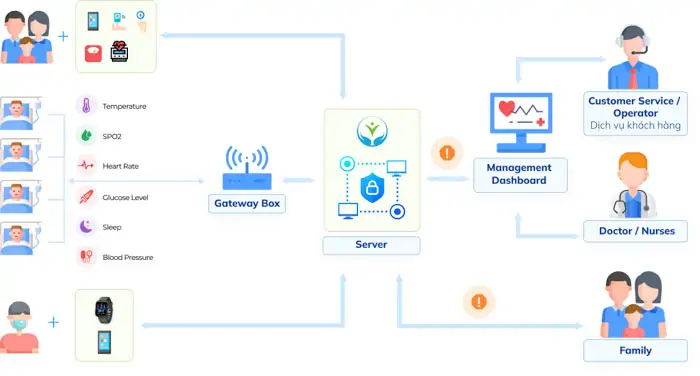
Remote Patient Monitoring (RPM) revolutionizes chronic disease management, post-surgical recovery, and elderly care by enabling continuous health tracking outside clinical settings. RPM-related claims volumes have risen approximately 1,300% from 2019 to 2022, and a 2022 study found that the percentage of physicians using remote monitoring devices grew from 12% in 2016 to 30% in 2022.
Key benefits
- Real-Time Data Collection: Wearables like ECG monitors, pulse oximeters, and smart scales track vital signs continuously.
- Immediate Alerts: RPM sends instant notifications to healthcare providers when abnormal metrics are detected.
- Patient Empowerment: Custom mobile health apps (mHealth) enable patients to access health dashboards and engage in their care.
- Convenience: Reduces the need for frequent in-person visits, supporting home-based care.
Case example
TMA Solutions' platform for heart failure patients employs vital sign monitoring, including real-time tracking of heart rate, blood pressure, and other relevant metrics, within its cloud-based RPM system. This allows for early detection of warning signs and prompt alerts to providers, significantly reducing hospital readmissions.
Personalized digital therapeutics (DTx)
Overview
Digital Therapeutics (DTx), a key component of emerging telemedicine trends, leverages data-driven, personalized treatment plans to manage chronic illnesses like diabetes and mental health disorders. By integrating real-time data from wearables and patient-reported outcomes (PRO), DTx platforms support continuous and tailored healthcare.
Key components
- Remote Therapeutic Monitoring (RTM): Tracks health data to adjust treatment in real-time.
- Patient-Reported Outcomes (PRO): Allows patients to log symptoms, providing insights into treatment effectiveness.
- Virtual Rehabilitation: Offers virtual programs and self-guided therapy for managing physical and mental health.
- Psychoeducation Platforms: Mental health DTx platforms like SilverCloud and Woebot Health provide cognitive behavioral therapy (CBT)-based modules for mood management.
- Clinical Decision Support Systems (CDSS): Helps providers make data-informed decisions, improving care quality.
Artificial intelligence (AI) in telemedicine
Overview
AI is transforming telemedicine with smart diagnostics, predictive analytics, and personalized care recommendations. Major players like IBM, Google Cloud AI, and Microsoft are leading advancements in cognitive computing.
Applications of AI in telemedicine
- Diagnostics and Imaging: AI-based tools enhance diagnostic accuracy by up to 40%, aid early disease detection, and automate image segmentation to streamline medical research processes.
- Predictive Analytics and Cognitive Computing: Forecast health risks through cognitive computing and analyzing data patterns to predict early interventions and personalize treatment plans.
- Intelligent Patient Monitoring: Integrates with wearables to provide real-time alerts and automated health coaching.
- AI-Powered Decision Trees and Care Coordination: AI guides clinical decisions, assists care coordination, and suggests follow-ups, accelerating decision-making and improving healthcare accessibility and cost-effectiveness.
- Digital Twin Health Modeling: AI builds virtual patient replicas using real-time data to predict health issues, simulate treatment outcomes, and fine-tune care plans for precise, personalized interventions.
Example
AI-powered chatbots stream patient inquiries, save doctors valuable time, and enable faster care routines.

Big data and analytics in telehealth
Overview
Big Data enables data-driven healthcare, with the global healthcare data volume increasing from 2,300 exabytes in 2020 to 10,800 exabytes by 2025, representing an annual growth rate of 36%. This is one of the telemedicine trends that fuels insights that improve patient outcomes and operational efficiency.
Key use cases:
- Predictive Analytics: Big Data can identify patterns in historical data, enabling early intervention and preventing potential health issues.
- Personalized Medicine: Techniques like digital phenotyping and clinical outcome tracking allow for customized treatment plans based on individual health data, including genetics, lifestyle factors, and real-time biometrics collected from wearables.
- Remote Patient Monitoring: Big Data empowers continuous patient monitoring through wearable data analysis. Anomaly detection algorithms identify irregularities and trigger alerts for timely intervention by healthcare providers.
- Population Health Management: Data fusion techniques combine information from various patient groups, revealing trends that can optimize preventative strategies and resource allocation across populations.
- Operational Efficiency: Big Data helps predict resource needs and streamline telehealth workflows through prescriptive analytics.
Example
The U.S. Department of Veterans Affairs uses Big Data to monitor veterans' health remotely, reducing hospitalizations through early interventions.
Telepharmacy
Overview
Telepharmacy enhances access to medication services by enabling remote consultations, automated refills, and digital prescription transfers, particularly in underserved regions.
Key features:
- Virtual Consultations: Improves access to medication information and ensures patient safety.
- Automated Dispensing: Uses smart cabinets to dispense medications in remote areas.
- Medication Therapy Management (MTM): Offers predictive insights to prevent medication-related complications.
- Prescription Synchronization & Refill Management: Automates refill reminders, improving medication adherence.
- Advanced Digital Tools: Telepharmacy uses integrated data, digital labeling, and real-time support to provide adaptive, patient-specific care.
Augmented reality (AR) and virtual reality (VR) in telehealth
Overview
As part of current telemedicine trends, AR/VR technologies are elevating telehealth with immersive experiences for patient care, training, and rehabilitation. The U.S. AR/VR healthcare market is projected to reach approximately $11.2 billion by 2030, with a compound annual growth rate (CAGR) of around 28.12% during the forecast period from 2022 to 2030.
Key applications
- Training & Education: AR/VR offers simulated training for healthcare professionals using real-world scenarios such as 360° video and spatial computing.
- Chronic Care Management: VR platforms deliver therapeutic experiences for managing chronic conditions (e.g., lower back pain).
- Rehabilitation: AR assists with virtual ward rounds and precise anatomical visualization.
- Telesurgery: Enables remote surgical consultations with precise guidance.
- Surgical Planning & Assistance: AR provides real-time 3D imaging for surgical visualization.
Example
The Department of Veterans Affairs uses VR to treat PTSD and chronic pain, demonstrating the technology's potential for mental health care.

Wearables and telehealth mobile apps (mApps)
Overview
Wearables and telehealth apps, key elements of current telemedicine trends, enable continuous health monitoring and real-time communication with healthcare providers. The global wearables market is projected to increase by USD 106.44 billion, growing at a compound annual growth rate (CAGR) of 18.08% between 2023 and 2028.
Key Features
- Remote Patient Monitoring: Collects and transmits biometric data for chronic condition management and early detection.
- Chronic Care Management: Continuously monitors vital signs and alerts providers to deviations from normal ranges, enabling timely interventions.
- Lifestyle tracking: Tracks activity, sleep, and diet, offering personalized health recommendations.
- Data Integration: Syncs wearable data with electronic health records (EHRs) for comprehensive care, data-driven workflows, and predictive analytics.
- Rehabilitation & Recovery: Tracks patient progress during physical therapy and post-surgical recovery.
Popular Devices
- Apple Watch: Provides ECG and blood oxygen tracking.
- Dexcom G6: Continuous glucose monitoring for diabetes patients.
- Whoop Strap: Tracks recovery and strain metrics for athletes.
Conclusion
Telemedicine trends are set to redefine healthcare delivery, improving patient outcomes and expanding access to care. However, addressing challenges such as data security, digital literacy, and connectivity is crucial for its long-term success. By adopting innovative solutions like AI, RPM, and personalized digital therapeutics, the healthcare industry can unlock the full potential of virtual care.
For healthcare providers and stakeholders, staying informed about the latest trends and best practices is key to navigating the future of telemedicine successfully.


.webp_2026-10-01-18-27-07-971.webp)
.webp_2026-10-01-18-17-11-290.webp)
.webp_2026-10-01-18-08-26-854.webp)
.webp_2026-10-01-17-47-32-240.webp)