Software development frameworks provide structured yet flexible environments, streamlining the development lifecycle and enabling teams to meet diverse business needs. By enhancing productivity and fostering innovation, these frameworks play a pivotal role in shaping the future of software design and development.
In this comprehensive guide, we’ll explore 15 popular software development frameworks. Whether you’re building a web application, mobile app, or data science solution, this guide will help you navigate the modern software development landscape with confidence.
Benefits of utilizing a software framework
Software development frameworks are essential tools that simplify and streamline the development process. Below are the comprehensive benefits of utilizing a software framework:
- Easier development and maintenance
Frameworks offer a stable and well-defined structure for building software systems, along with reusable code libraries. This significantly reduces the time and effort required to develop applications, allowing developers to focus on enhancing the quality and speed of their work. The structured approach also simplifies maintenance by providing a clear organization of code.
- Code reuse
One of the primary advantages of using a framework is the ability to reuse code. Instead of rewriting commonly used functions or classes for different applications, developers can include them in the framework and use them repeatedly. This saves significant time and effort, streamlining the development process.
- Consistent code structure
Frameworks enforce a consistent structure and coding style throughout a project. Developers can follow standard procedures for connections, configurations, and workflows, improving overall productivity. This consistency also makes it easier for new developers to understand and contribute to the codebase quickly, ensuring seamless collaboration. Furthermore, many frameworks support multiple programming languages, facilitating transitions between projects and reducing learning curves.

- Enhanced security
Most frameworks are designed with built-in security features and best practices, allowing developers to build secure applications by default. They help mitigate common vulnerabilities like SQL injection, cross-site scripting, and other security risks, reducing the need for extensive manual safeguards.
- Cost-efficiency
While not immediately obvious, using a framework can substantially lower development costs over time. Access to prebuilt libraries and tools eliminates the need to create foundational functionality from scratch. This efficient use of resources allows developers to allocate more time to critical tasks, accelerating project completion and optimizing overall productivity.
- Cross-platform compatibility
Frameworks for mobile and web development often support cross-platform functionality, enabling developers to create applications that work seamlessly across multiple operating systems, such as Windows, macOS, and Linux, with minimal code adjustments.
- Scalability
Frameworks are typically designed to accommodate application growth, ensuring that performance and stability are not compromised as user demands increase. Developers can easily scale their projects without reengineering the foundational structure, making frameworks ideal for long-term projects.
- Community support
Popular software development frameworks often have large, active user communities that provide extensive documentation, forums, and resources. Developers can rely on these communities for guidance, troubleshooting, and updates on the latest best practices. This support network ensures that teams can address challenges efficiently and remain up to date with advancements.
Drawbacks of relying on software frameworks
While software frameworks provide numerous benefits, they are not without drawbacks. Developers must consider these potential limitations carefully to ensure an informed decision when adopting a framework.
- Steep learning curve
Adopting new software development frameworks often comes with a significant learning curve. Complex frameworks, in particular, can be difficult to master, leading to frustration and wasted time, especially for developers unfamiliar with the framework’s intricacies. This can delay development and reduce productivity during the initial adoption phase.
- Lock-in
Once a framework is chosen and integrated into a project, it can be challenging to switch to a different one. Framework lock-in occurs when migrating away from the selected framework becomes costly and time-consuming due to the effort required to rewrite or adapt the codebase. Choosing the wrong framework initially can have long-term consequences for the project.
- Limited customization
Frameworks, while convenient, are inherently less flexible than custom code. They often impose predefined structures and conventions that may not cater to unique or complex requirements. Developers might face difficulties addressing edge cases or implementing unconventional solutions, leading to the need for workarounds or significant restructuring of the codebase.
- Increased dependency on third-party libraries
Frameworks frequently rely on third-party libraries to provide essential functionality. While these libraries reduce development effort, they also introduce dependencies that require careful management. Keeping up with updates and ensuring compatibility can be time-consuming and may introduce new bugs or compatibility issues. If critical libraries become unavailable or outdated, it can jeopardize the project’s progress and stability.
Selecting the right development framework for your needs
Choosing the right software development framework is a crucial step in ensuring the success of your software project. With so many frameworks available, a thoughtful and strategic approach is essential to identify the one that aligns best with your requirements.
One of the first considerations is the programming language supported by the framework. If you don’t have a specific preference, exploring popular languages like Java, Python, or Ruby can be a good starting point. The decision between open-source and paid frameworks is also significant. Open-source frameworks often have large user communities, frequent updates, and contributions, while paid options may provide more reliable support and polished features, albeit with less flexibility or customization.

A framework backed by a strong community can greatly enhance the development experience. Active communities provide tutorials, forums, and resources, making it easier to find help when needed. The size and maturity of the community also reflect the framework’s reliability and proven success over time.
Examining case studies or example applications can offer valuable insights into how a framework performs in real-world scenarios. This research helps set clear expectations about its functionality and compatibility with your development methods. Official framework websites or repositories dedicated to software frameworks are excellent places to find such resources.
Ultimately, the best way to determine if a framework is suitable is to test it within your specific project context. Hands-on experience allows you to evaluate how well it fits your needs. If it doesn’t meet your expectations, you can always pivot to another option.
Categories of Software Development Frameworks
Achieving success in software development depends on understanding the variety of frameworks available. Each framework is designed to address specific requirements, offering unique features tailored to diverse development needs.
Below, we explore the different types of software development frameworks that are essential to modern development practices.
Frameworks for frontend development
Frontend frameworks enhance development by promoting code consistency, simplifying maintenance, and ensuring scalability. They are particularly valuable in creating high-performance, user-centric applications that adapt to the rapidly evolving web development landscape. These tools are integral to modern development practices, helping teams deliver quality solutions while saving time and resources.
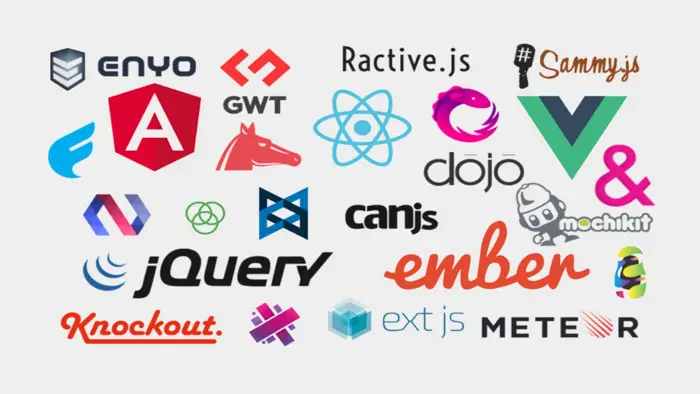
Some of the most popular frontend frameworks include:
- Angular: A TypeScript-based framework by Google, ideal for scalable, enterprise-grade applications. It supports modular development, ensuring consistency and performance for large projects.
- React: Developed by Facebook, React excels in creating smooth and dynamic user interfaces with its component-based architecture and virtual DOM for optimized performance.
- Vue.js: Known for its simplicity and flexibility, Vue.js offers an easy learning curve and powerful tools, making it a great choice for small to medium-scale projects.
Frameworks for Backend development
Backend frameworks are essential in software development, focusing on server-side tasks like managing database interactions, server configurations, and core application logic. These frameworks ensure robustness, security, and efficiency, forming the backbone of web applications by providing the necessary infrastructure for smooth functionality.
Some of the most popular frontend frameworks include:
- Django: A high-level Python framework that emphasizes security and scalability. Its "batteries-included" philosophy provides built-in tools like ORM for database management and an automatic admin interface for easy administration, making it ideal for rapid development.
- Ruby on Rails: Known for its convention-over-configuration approach, Rails accelerates development by reducing complexity. It integrates RESTful design principles and automated testing, making it particularly suited for agile development environments.
- Express.js: A minimalist Node.js framework perfect for APIs and web applications. Its flexibility and seamless integration with databases and frontend technologies make it a versatile choice for scalable server-side solutions.
Comprehensive full-stack frameworks
Full-stack frameworks provide complete solutions for software development, encompassing both frontend and backend capabilities. These frameworks streamline the development process by offering a unified approach, ensuring seamless integration between various development stages. By enhancing versatility and efficiency, full-stack frameworks play a pivotal role in boosting productivity and overall application performance.
- Spring Boot: A Java-based framework simplifies enterprise application development with automated configuration, dependency management, and an embedded server. Its built-in security features and robust libraries make it ideal for scalable, high-performance applications.
- Laravel: A PHP framework is celebrated for its elegant syntax and productivity-boosting features like routing, caching, and ORM (Eloquent). It combines flexibility with robust testing and security tools, catering to projects of varying complexity while maintaining high code quality.
- ASP.NET Core: Across-platform framework by Microsoft, is built for modern web applications. Its lightweight, modular architecture ensures high performance, while scalability and advanced technology integration make it ideal for high-traffic, robust solutions.
Frameworks for mobile application development
Mobile app frameworks are essential tools designed to streamline the software development lifecycle for mobile platforms. These frameworks provide developers with specialized tools and libraries for creating both native and cross-platform applications efficiently. As the demand for mobile applications continues to grow, these frameworks play a critical role in meeting modern development needs.
- Flutter: Google’s open-source UI toolkit enables fast development with a single codebase for iOS and Android, offering flexibility, speed, and high performance.
- React Native: Developed by Facebook, this framework uses React and JavaScript to build cross-platform apps efficiently, with features like live reloading and strong community support.
- Xamarin: Microsoft’s C#-based framework allows code sharing across platforms, integrates with Visual Studio, and ensures high performance through access to native APIs.
Frameworks for data science and machine learning
Data Science and Machine Learning frameworks are specialized tools designed to facilitate complex analytics, predictive modeling, and AI solution development. They provide robust libraries and tools for processing large datasets, building machine learning models, and deploying AI applications efficiently. These frameworks are fundamental in advancing software development in data science and artificial intelligence, enabling both researchers and developers to streamline workflows and focus on innovation.
- TensorFlow: Developed by Google, TensorFlow is a versatile open-source library ideal for deep learning and large-scale neural networks. Its scalable architecture supports deployment across various platforms, making it indispensable for advanced AI and machine learning projects.
- PyTorch: Created by Facebook, PyTorch is known for its dynamic computational graph and ease of use. It excels in deep learning and natural language processing, providing a developer-friendly environment for quick experimentation and iterative development.
- Sci-kit-learn: A Python-based library, Sci-kit-learn specializes in classical machine learning algorithms such as clustering and regression. Its simplicity, integration with Python libraries, and comprehensive functionality make it a staple for data analysis and machine learning tasks.
Software development frameworks simplify application design by handling low-level complexities, allowing developers to focus on project-specific features. They reduce coding effort, minimize bugs, and accelerate development, saving both time and money.
Though learning frameworks may take time, their value grows with familiarity, enabling faster and more efficient future projects. By leveraging the right framework, developers can boost productivity and deliver high-quality solutions with ease.


.webp_2026-10-01-18-27-07-971.webp)
.webp_2026-10-01-18-17-11-290.webp)
.webp_2026-10-01-18-08-26-854.webp)
.webp_2026-10-01-17-47-32-240.webp)