Introduction
In an era of unprecedented data growth, businesses demand robust, scalable infrastructure to transform raw information into actionable insights and drive critical decisions. While traditional on-premise data warehouses struggle with scalability and high costs, cloud data warehouses offer superior flexibility, cost-efficiency, and simplified management. Among the leading solutions, Snowflake, Amazon Redshift, and Google BigQuery stand out as powerful contenders, each with distinct architectures and capabilities. This article will provide a comprehensive comparison of these three cloud giants, exploring their technical nuances and business implications to guide your enterprise in choosing the optimal data warehousing solution.
Platform Overview
Snowflake: The Data Cloud Pioneer
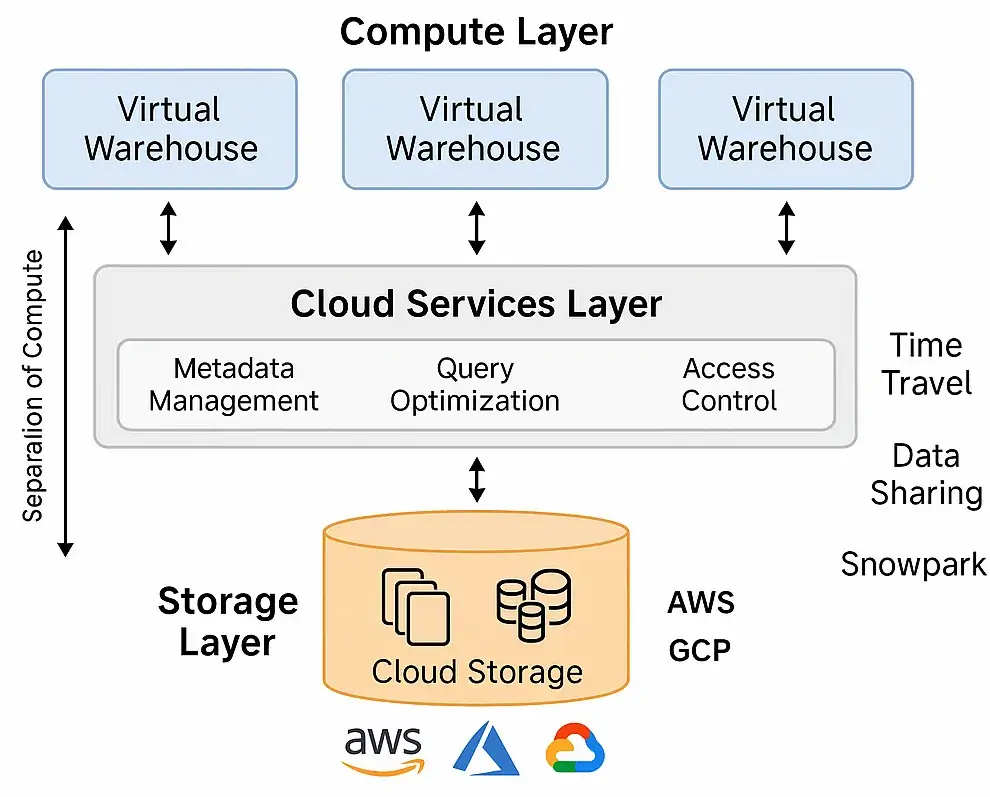
Snowflake is a leading Cloud-based Data Warehouse and Analytics system delivered as SaaS, branding itself as "The Data Cloud". It offers businesses exceptional flexibility, ease of use, and robust data sharing, significantly reducing infrastructure management with near-zero administration. Supporting ANSI SQL for both structured and semi-structured data, its unique multi-cluster, shared data architecture completely separates compute and storage. This enables independent, automatic scaling of "virtual warehouses" for optimal performance and cost-efficiency, even for numerous concurrent users. Snowflake's captivating cloud-native design boasts multi-cloud support (AWS, Azure, GCP) and provides flexible pay-as-you-go (per-second) or pre-purchased billing options.
Amazon Redshift: AWS’s Robust Data Warehousing Solution
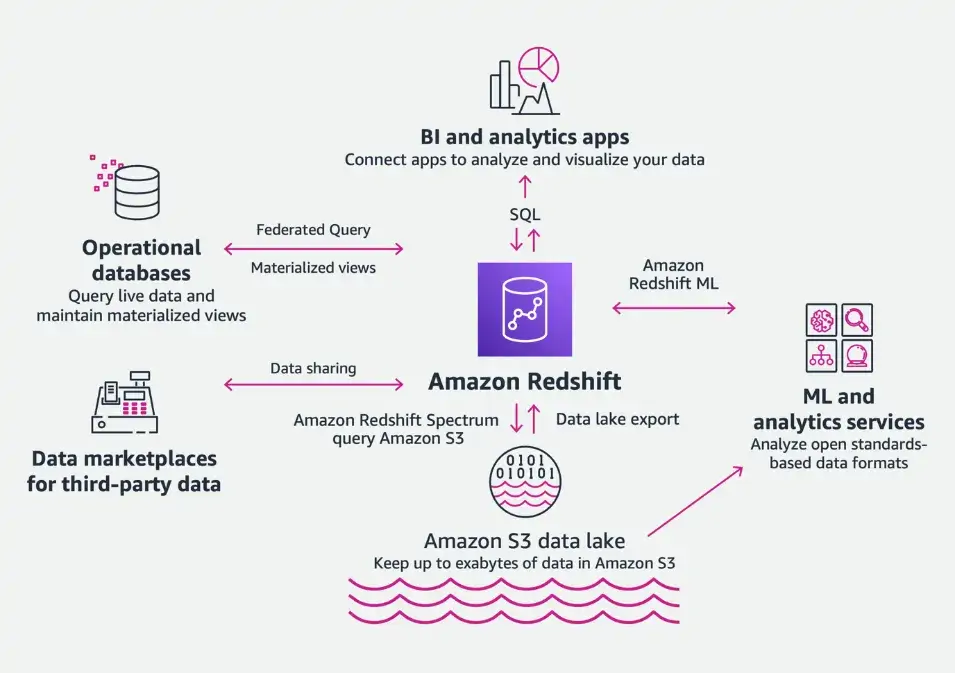
Amazon Redshift is the go-to choice for businesses deeply integrated within the AWS ecosystem, offering powerful data warehousing with strong native integrations and cost optimization within that environment. Its technical foundation lies in a Massively Parallel Processing (MPP) architecture built on PostgreSQL. Users can select from various node types (dense compute, dense storage) and optimize performance with different data distribution styles. Key technical features include Redshift Spectrum for querying data directly in Amazon S3 and deep integration with AWS services like Lake Formation.
Google BigQuery: The Serverless Analytical Powerhouse
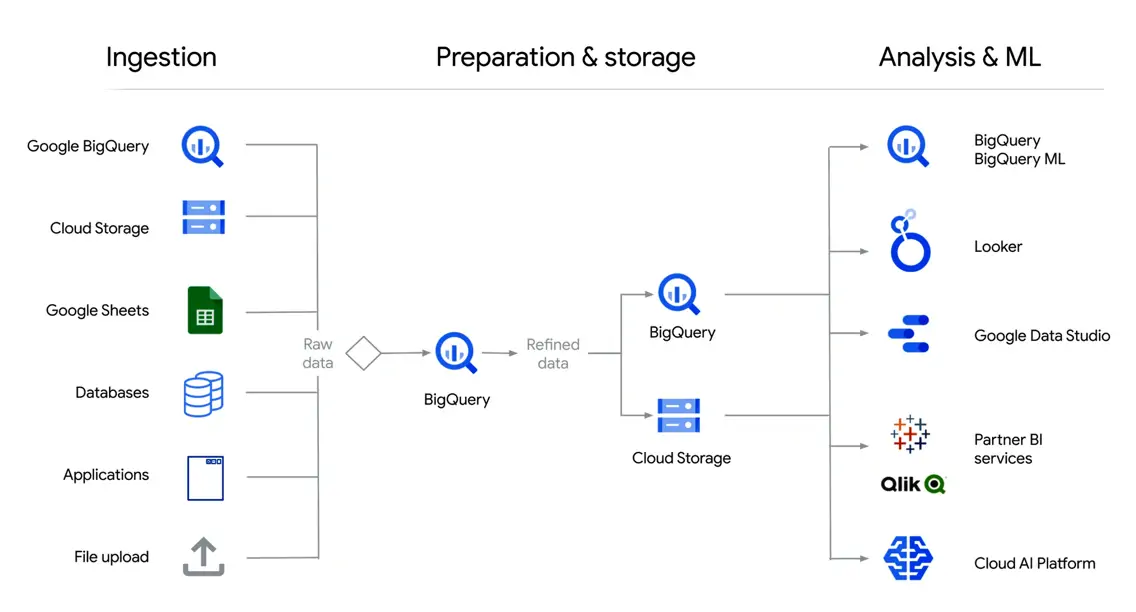
Google BigQuery is a fully serverless, cloud-based data warehouse and analytics web service, purpose-built for processing petabytes of data with exceptional simplicity and powerful real-time analytics. It eliminates the need for any infrastructure management, automatically allocating computing resources as needed, making it ideal for agile business models, supporting ANSI SQL for large-scale data querying (billions of rows). This design enhances query efficiency and data aggregation. It integrates seamlessly with other Google Cloud services, especially for AI/ML workloads, and offers robust streaming inserts for immediate data processing. Its flexible billing model is based on data scanned, with "slots" available for flat-rate pricing.
Platform Comparison
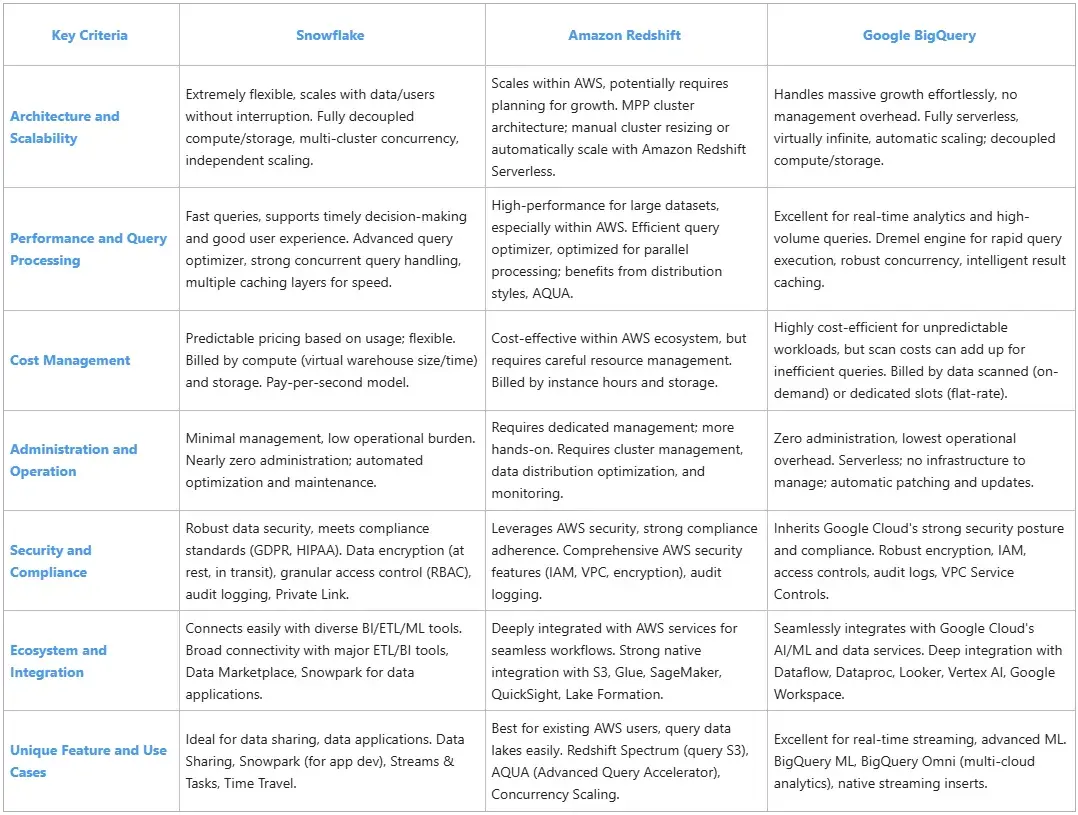
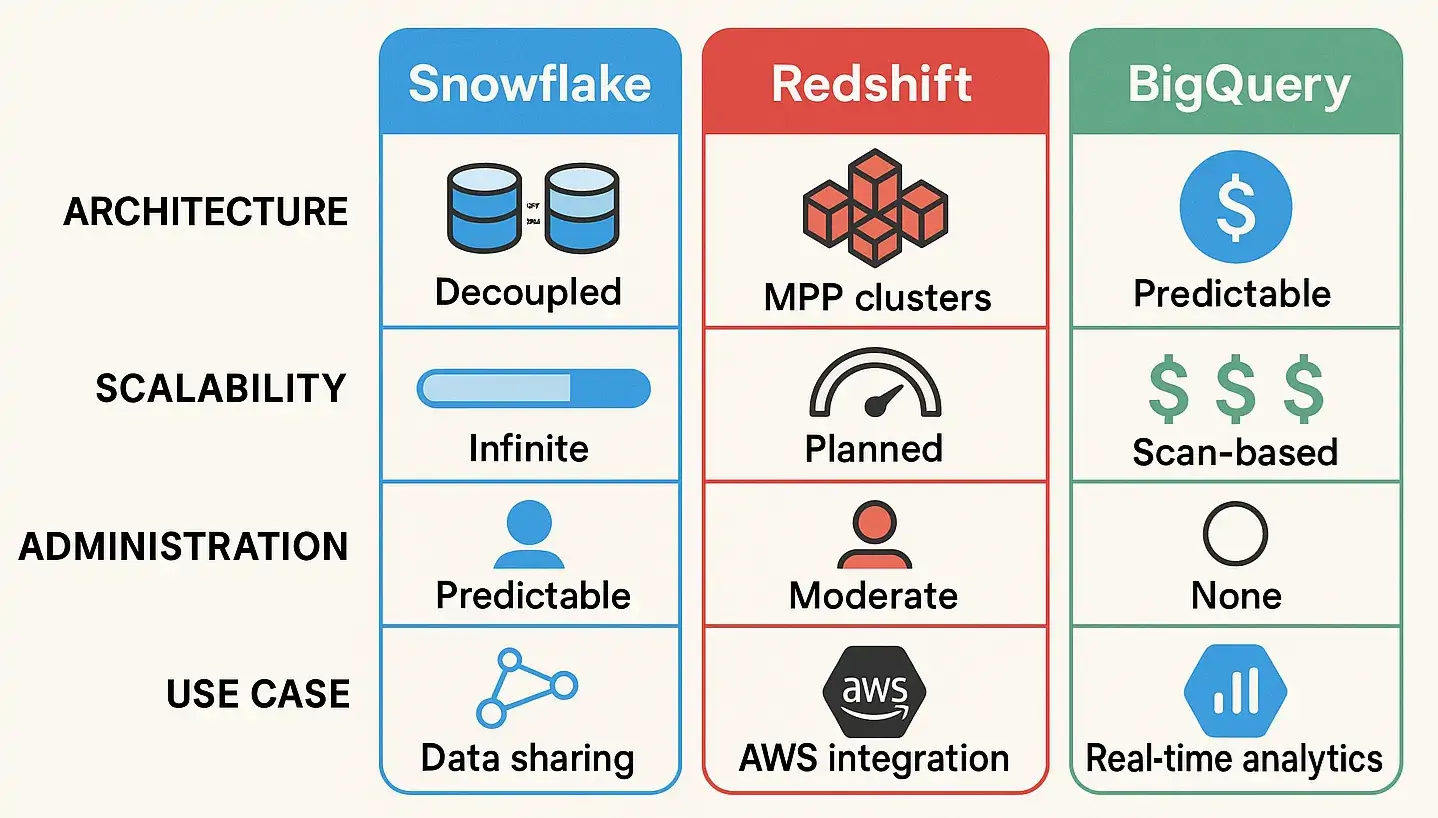
The following table provides a detailed side-by-side evaluation of Snowflake, Amazon Redshift, and Google BigQuery across key criteria critical for selecting a cloud data warehouse.
Which One Is Right for Your Business?
Choosing the optimal cloud data warehouse among Snowflake, Amazon Redshift and Google BigQuery isn't a one-size-fits-all decision. The ideal platform hinges on your specific business context and technical requirements.
Business-Driven Selection Criteria
To make an informed choice, consider these key business factors:
Current and Projected Budget: Understand the pricing models and how they align with your financial plans and future growth.
Existing Technical Team & Adaptability: Assess your team's familiarity with cloud technologies and their capacity to learn new platforms.
Management Preference: Determine your organization's appetite for managing infrastructure versus preferring fully managed, serverless solutions.
Current Cloud Strategy: Are you already deeply invested in the AWS, GCP, or a multi-cloud environment? Leveraging existing cloud relationships can offer significant benefits.
Pace of Innovation & Development Needs: How quickly do you need to iterate, build new data products, and integrate advanced analytics or machine learning?
Specific Recommendations for Different Scenarios
Based on these criteria, here are tailored recommendations:
Choose Snowflake if: You prioritize maximum flexibility and limitless scalability, prefer minimal infrastructure management, or have a strong multi-cloud or data sharing strategy. Its decoupled architecture allows for independent growth of compute and storage, making it incredibly agile.
Choose Amazon Redshift if: Your organization is deeply embedded within the AWS ecosystem, your technical team is proficient with AWS services, you aim for cost optimization within AWS, or you require tighter control over your infrastructure. Redshift integrates seamlessly with other AWS services, making it a natural fit for existing AWS users.
Choose Google BigQuery if: You value simplicity and completely serverless operations, require powerful real-time analytics capabilities, or are heavily invested in the Google Cloud ecosystem and its AI/ML tools. Its "no-ops" approach and instant scalability are ideal for rapid development and large-scale, ad-hoc queries.
Partnering with TMA Solutions
TMA Solutions, a leading software distributor in Vietnam with over 20 years of experience, delivers enterprise-grade technology solutions tailored to complex data challenges. As a strategic technology partner, TMA empowers organizations to harness structured and unstructured data effectively. With an extensive portfolio of technologies, services, and industry expertise, TMA provides end-to-end solutions that align seamlessly with the data management best practices outlined in this comparison. By partnering with TMA, businesses can leverage expert guidance to implement Snowflake, Amazon Redshift, or Google BigQuery, ensuring optimal performance and alignment with strategic goals.
At TMA Solutions, we go beyond theoretical guidance by partnering with businesses through concrete solutions validated by numerous successful projects. The following cases show how TMA Solutions has collaborated with clients across various industries.
Streamlining Operations with Azure Data Factory
Dynamic Data Integration: Utilize Data Factory to connect multiple data sources, both on-cloud and on-premise, and extract data into a centralized Data Lake for advanced processing.
Data Management: Employ data services to move data from various sources to the Data Lake for cleansing, consolidation, and mining, while building pipelines to handle data from different products
Cloud-based and AI-driven Solution
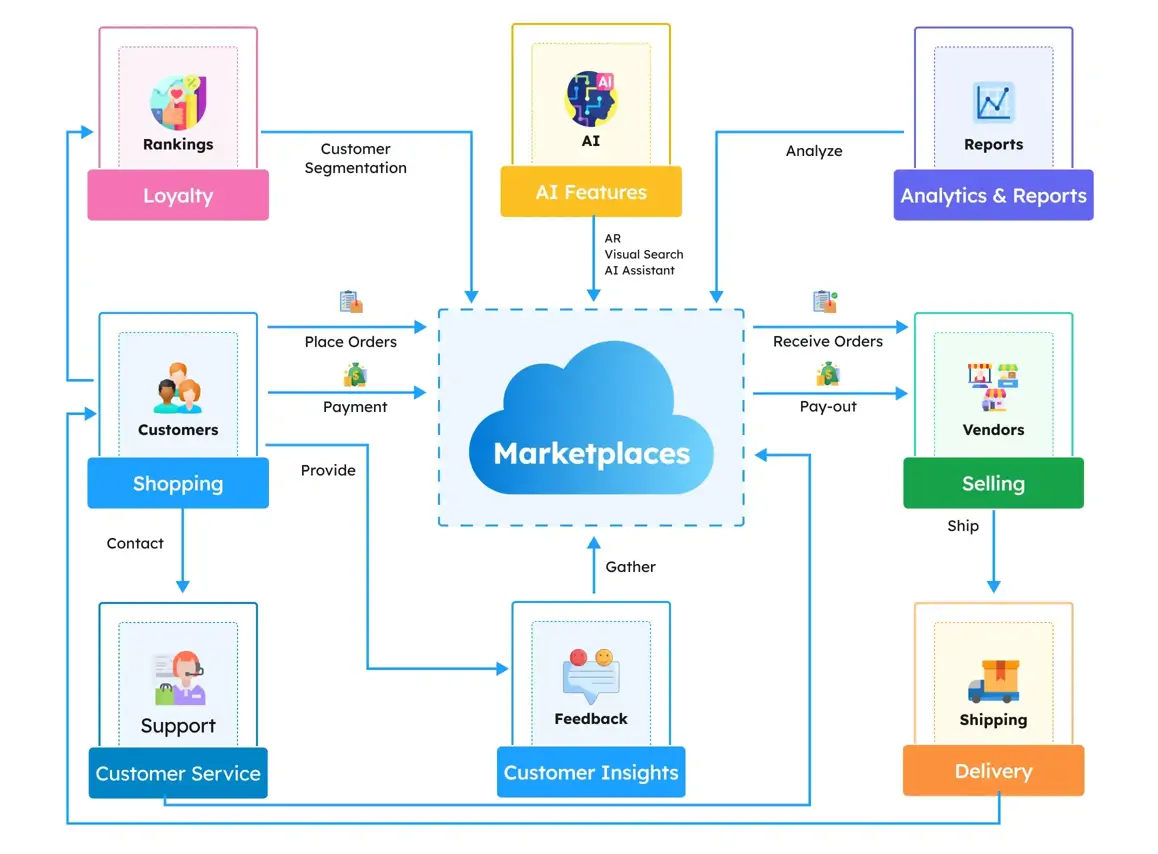
Cloud Infrastructure: Implemented a scalable cloud system with auto-scaling and load balancing to handle traffic spikes.
Third-Party Integration: Seamlessly integrated payment gateways, logistics providers, and CRM systems to streamline operations.
AI-Driven Client Support: Developed a 24/7 support portal with AI assistance for improved service quality.
Personalized Shopping: Enhanced user experience with customized product recommendations based on client behavior.
Conclusion
Snowflake, Amazon Redshift, and Google BigQuery each deliver unique strengths to meet diverse enterprise needs. Snowflake excels with its flexible, multi-cloud architecture and near-zero administration, ideal for agile, data-sharing-focused organizations. Amazon Redshift offers robust performance and cost efficiency for AWS-centric businesses, seamlessly integrating with AWS services. Google BigQuery stands out for its serverless simplicity and real-time analytics, perfect for Google Cloud users leveraging AI/ML capabilities. The best choice depends on your budget, cloud strategy, technical expertise, and operational goals. To ensure the right fit, evaluate your requirements and conduct proof-of-concept trials.
Don’t let indecision slow your data journey. Connect with our experts today to explore how we can help you unlock your data’s full potential.


.webp_2026-10-01-18-27-07-971.webp)
.webp_2026-10-01-18-17-11-290.webp)
.webp_2026-10-01-18-08-26-854.webp)
.webp_2026-10-01-17-47-32-240.webp)