Introduction
Real-time data processing provides instant insights from streaming data, critical for applications such as financial trading, fraud detection, IoT monitoring, and personalization. This guide compares five key tools—Apache Kafka, Apache Flink, Apache Spark Streaming, Apache Storm, and Azure Stream Analytics—evaluating their architecture, performance, scalability, usability, and use cases to assist technical teams in selecting the optimal solution.
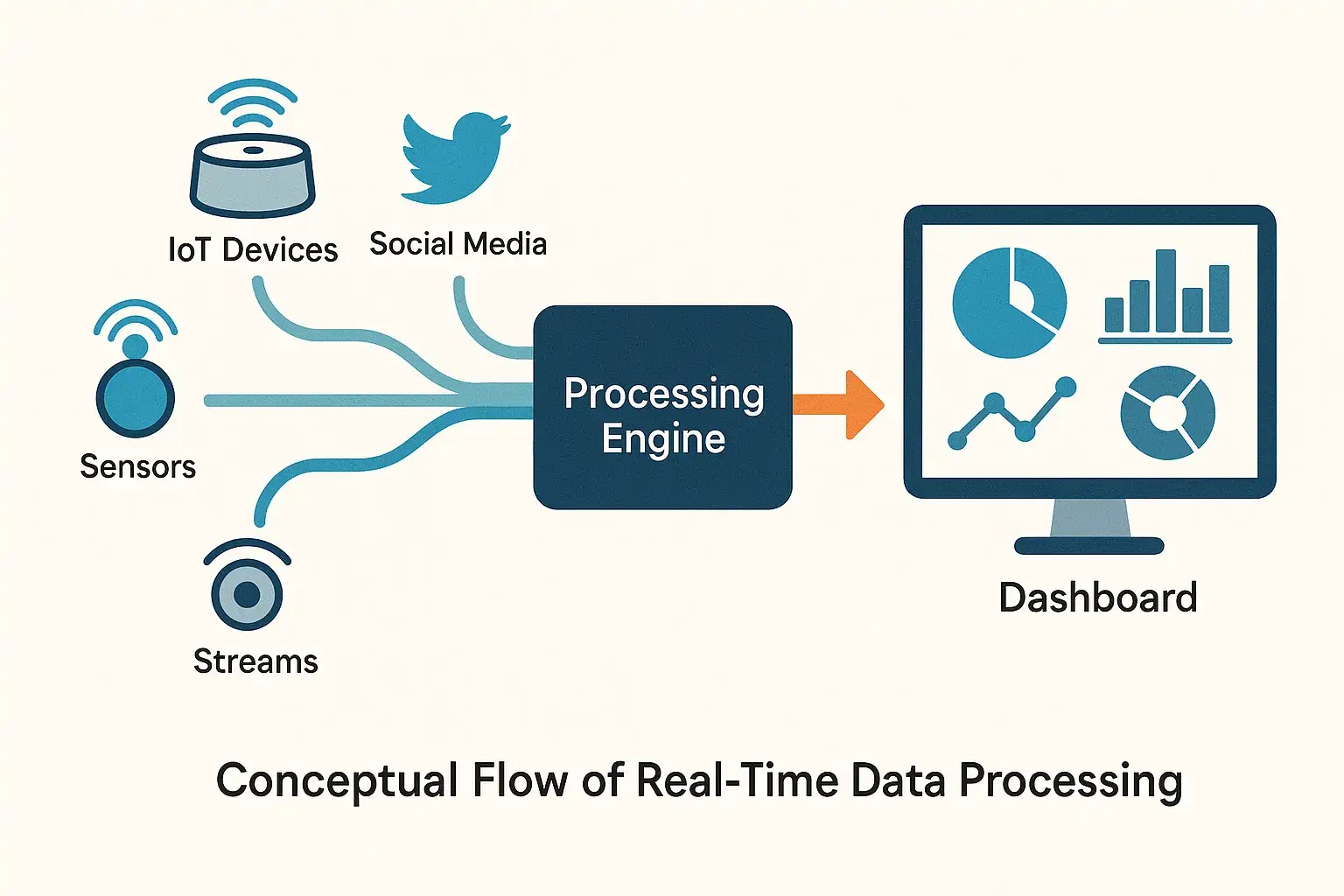
What Is a Real-Time Data Processing Tool
A real-time data processing tool ingests and analyzes continuous data streams with minimal latency (milliseconds to seconds), enabling immediate reactions in critical applications like fraud detection or live recommendations.
Tools Generally Fall Into:
- Ingestion: Tools like Apache Kafka collect and distribute data.
- Processing: Tools such as Apache Flink and Apache Spark filter, aggregate, and apply models to data.
- Hybrid: Azure Stream Analytics exemplifies hybrid tools, combining both ingestion and processing capabilities on managed platforms.
Key Features Include:
- Low Latency: Processes data in near real-time, often within milliseconds.
- Scalability: Handles increasing data volumes through distributed architectures.
- Fault Tolerance: Ensures reliability through replication or checkpointing.
- Flexibility: Supports diverse data sources (e.g., IoT devices, logs, social media) and processing models (e.g., event-time, windowed computations).
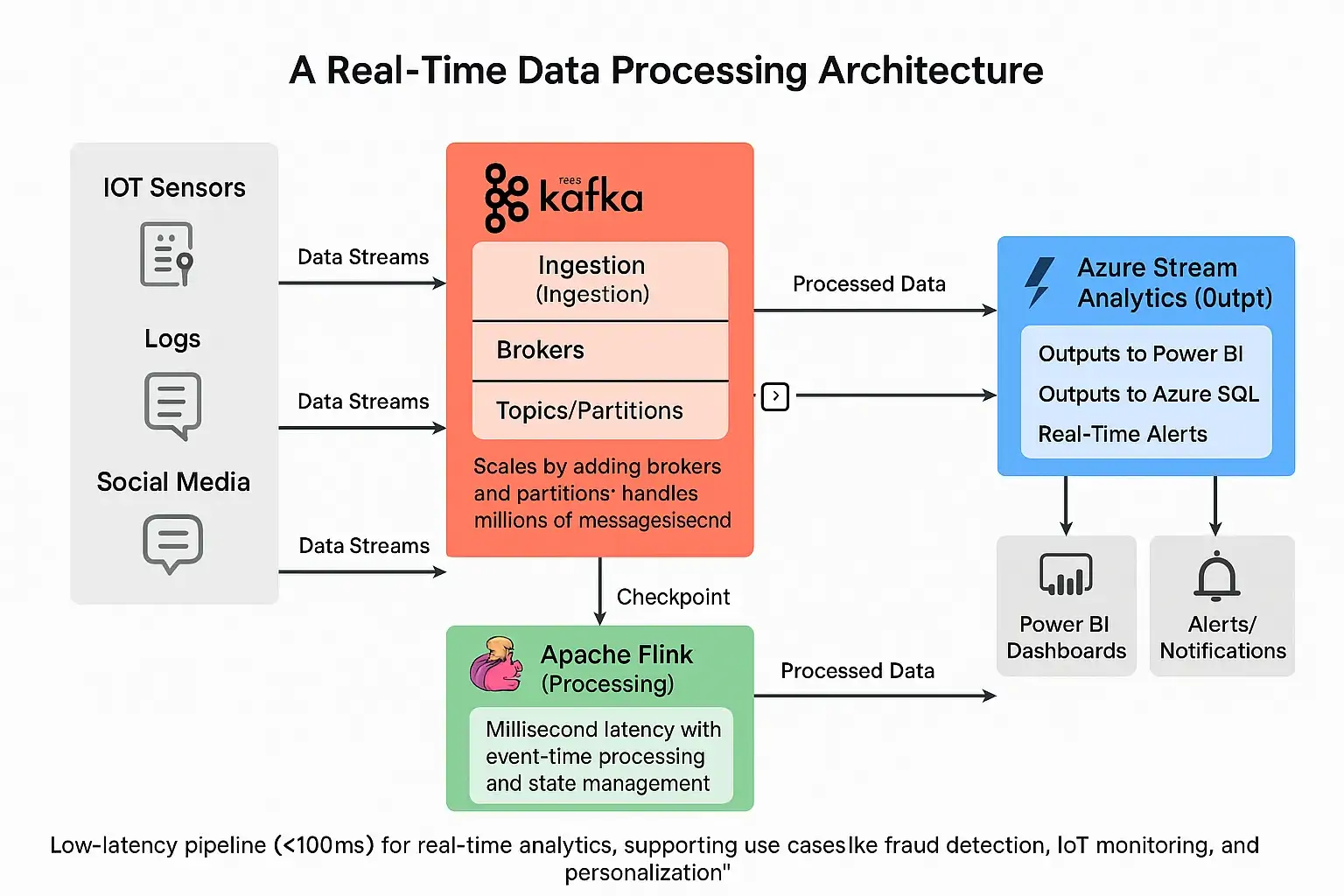
When Is It Needed?
Real-time data processing is not just a technological trend, but also an essential need in many industries. Here are some typical scenarios:
Fraud Detection in Banking and Finance
- Identifying unusual activity: The system immediately flags transactions that deviate from a client's typical spending patterns and login behavior.
- Instant alerts and verification: Alerts are sent instantly to the client for verification, allowing for quick action.
- Preventing potential fraud: By temporarily holding suspicious transactions, the system can prevent financial losses due to fraud.
Personalizing Client Experience in E-commerce
- Track user behavior in real-time: This includes actions like viewing products, time spent on pages, and recent searches.
- Provide immediate, relevant suggestions: Based on a client's recent activity (e.g., viewing wireless headphones), the system instantly updates their homepage with personalized recommendations. These might include discounted items from favorite brands, highly-rated products in the same category, or related accessories.
- Boost conversion rates and enhance client experience: By analyzing and responding to user behavior in real-time, the system can increase sales and make clients feel "understood".
Monitoring and Control in IoT (Internet of Things)
- Prevent serious breakdowns: By detecting anomalies like excessive hydraulic pressure and high mold temperature and immediately acting (reducing speed, alerting maintenance), the system prevents equipment failure.
- Avoid prolonged production line shutdowns: Timely intervention based on real-time data helps maintain continuous operation.
- Optimize manufacturing efficiency: Proactive issue resolution ensures smoother production and better overall efficiency.
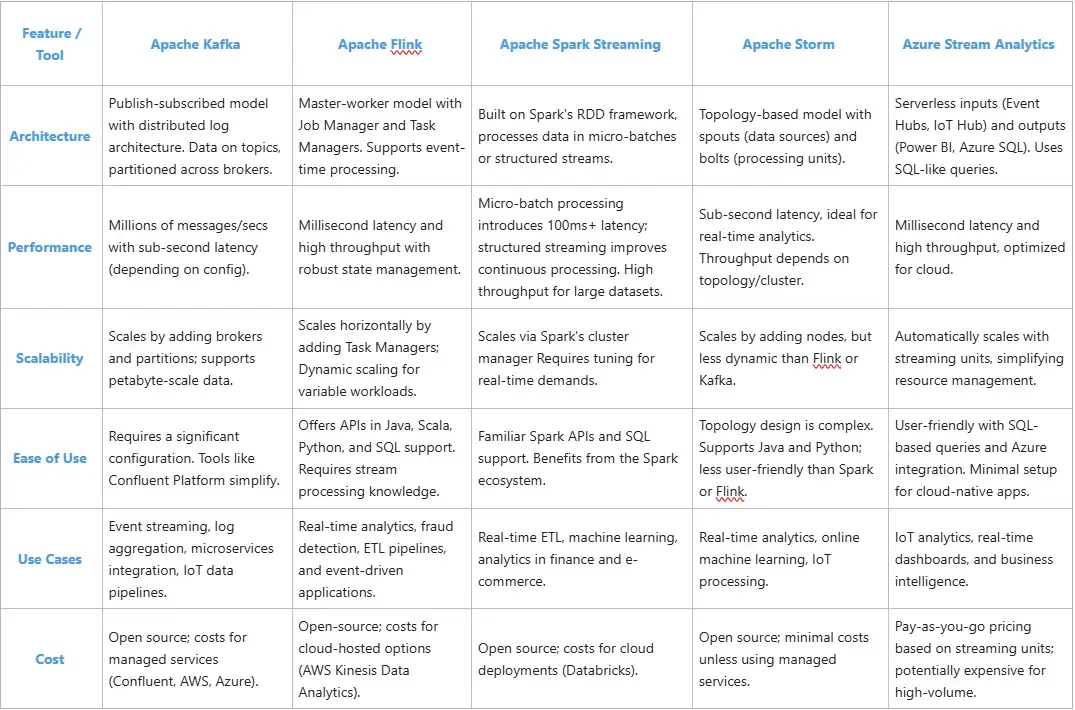
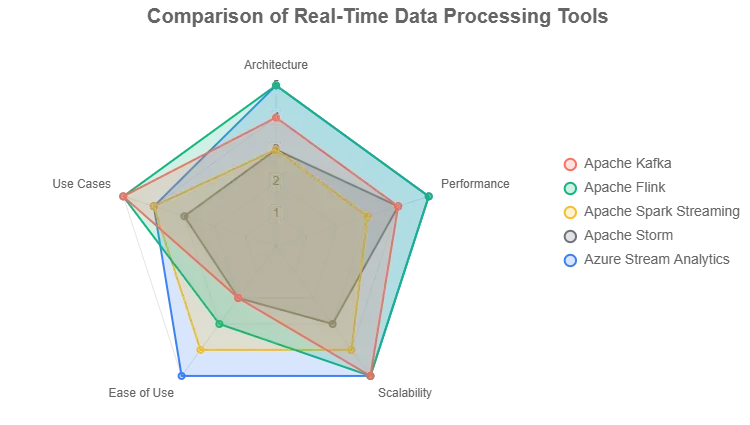
Comparison of Real-Time Data Processing Tools
The following table provides a comparative summary of the discussed real-time data processing tools:
Challenges in Real-Time Data Processing
Building a real-time data processing system presents several key technical hurdles, such as:
- Managing high-speed, large-volume data requires scalable architectures like Kafka and Flink.
- Ensuring low latency (<100ms) demands optimized pipelines and fast protocols.
- Handling imperfect data (missing, noise) needs cleaning and validation techniques.
- Complex analytics like anomaly detection demand highly efficient processing engines.
- State management across events increases system complexity, solvable with tools like Flink.
- Excessive costs for infrastructure and expertise can be mitigated with cloud services like Azure Stream Analytics.
Trending in Real-Time Data Processing
Real-Time Machine Learning
Combining Real-Time Data Processing with Machine Learning enables instant analysis, prediction, and response. These powerful applications like:
- Fraud Detection: Spotting anomalies and alerting to them in seconds.
- Personalization: Adjusting recommendations based on real-time user behavior.
It boosts accuracy, user experience, and efficiency in finance, e-commerce, manufacturing, logistics, and automated control.
Edge Computing and IoT
The rise of IoT drives Edge Computing, processing data on devices to:
- Minimize latency for near-instant responses.
- Save bandwidth in low-connectivity areas.
- Ensure availability during network disruptions.
Key uses include smart manufacturing, transportation, security, and healthcare.
Serverless Streaming
This approach enables running streaming data pipelines without the need to manage servers, offering:
- Automatic scaling based on data traffic
- Lower costs through pay-per-use pricing
- Faster development by allowing teams to focus on processing logic rather than infrastructure
Examples include AWS Lambda with Kinesis, Google Cloud Dataflow, and Azure Stream Analytics.
Why Choose TMA?
TMA Solutions is one of the TOP Vietnam software distributors has 20+ years of experience delivering enterprise-grade technology solutions. Our strengths in big data, cloud, and industry-specific consulting make us a trusted partner for digital transformation projects. The following case studies are examples of our successful projects in real-time data management:
Optimizing Inventory in Real-time Through Azure
- Data Integration and Forecasting: Consolidate sales, inventory, and market data, applying machine learning for demand forecasts.
- Real-Time Visualization: Enable dynamic, real-time data visualization and scalable system deployment to handle growing data requirements.
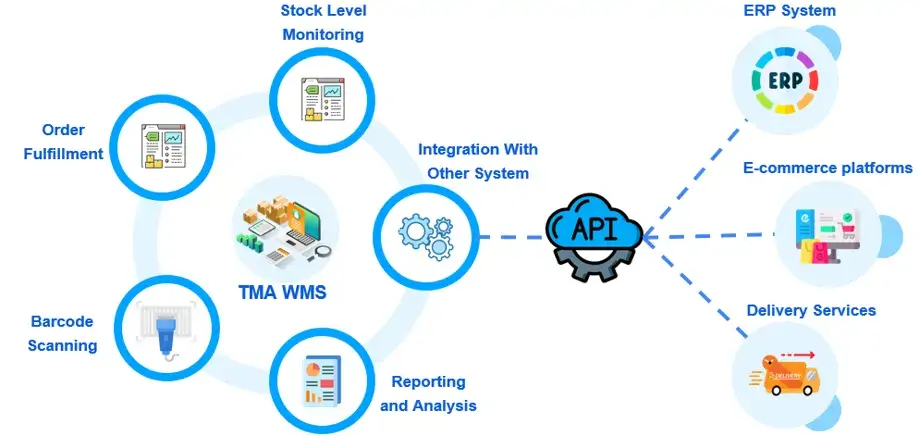
Warehouse Management with Centralized Inventory and Real-time Monitoring
- Centralized Inventory Management: Implement a robust system that offers a unified view of inventory across all locations, improving accuracy and control.
- Automated Order Fulfillment: Streamline processes for picking, packing, and shipping, significantly enhancing delivery speed and client satisfaction.
- Enhanced Reporting Features: Develop comprehensive reporting tools that provide valuable insights for effective decision-making and operational improvements.
- Real-Time Monitoring Capabilities: Integrate real-time stock tracking to ensure optimal inventory levels and reduce the risk of stockouts.
Conclusion
Real-time data processing is critical for industries requiring instant insights, from finance to IoT. Apache Kafka excels in high-throughput data ingestion, Apache Flink offers unmatched low-latency processing, Apache Spark Streaming suits complex analytics, Apache Storm provides flexibility for real-time tasks, and Azure Stream Analytics simplifies cloud-native deployments. Selecting the right tool depends on your latency needs, scalability requirements, team expertise, and infrastructure preferences. For expert guidance on implementing these tools, contact TMA Solutions at https://www.tmasolutions.com/contact.


.webp_2026-10-01-18-27-07-971.webp)
.webp_2026-10-01-18-17-11-290.webp)
.webp_2026-10-01-18-08-26-854.webp)
.webp_2026-10-01-17-47-32-240.webp)