Software project management means balancing scope, timeline, budget and quality while requirements may change at any point in the project. To keep these factors under control, the team needs a clear plan and a good way to track progress and solve problems. This guide explains how to manage a software project, from planning and resource allocation to progress tracking and product handover.
1. What is project management in software development?
Software project management is the process of planning, organizing, tracking and coordinating resources to deliver a software product on scope, on time, on budget and at the expected quality. The project manager connects the client, the development team, the test team and other stakeholders so that everyone works toward the same goal.
2. How software projects differ from traditional projects
Compared with traditional projects in construction or manufacturing, software projects have three main differences:
- The product is invisible: Software deliverables are inherently intangible. Unlike physical construction or manufacturing assets, functional progress cannot be evaluated visually, requiring rigorous measurement via working software demos, feature completion metrics, and automated test coverage.
- Requirements change often: Clients often change their requirements when they see the real product or when the market changes. For this reason, the plan must be flexible enough to change during the project.
- There are many technical dependencies: Modules, APIs and external systems depend on each other. A small change in one part can affect many other parts and the overall schedule.
_2026-10-29-17-45-36-454.webp)
Software project management brings the client, the development team and the test team together around one shared goal
3. Importance of project management in software development
Without good management, software projects can easily go over budget, miss deadlines and fail to deliver the expected value. According to research by McKinsey and the University of Oxford on more than 5,400 IT projects, large IT projects run 45% over budget and 7% over time on average, and deliver 56% less value than expected. The PMI Pulse of the Profession 2020 report also shows that organizations waste 11.4% of their investment on average because of poor project performance.
On the other hand, good project management helps a business reduce these losses through five main benefits:
- On-time and on-budget delivery: A clear plan and regular tracking help the team notice early when the schedule or costs go off track. As a result, the manager can make changes before the problem becomes serious.
- Scope control: The team reviews every new request for cost, time and priority before adding it to the project. This approach helps prevent scope creep, when the project scope grows out of control.
- Early risk detection: The manager creates a risk list at the start and updates it at each stage. The team can then deal with technical, staffing or external risks before they affect the project.
- Quality assurance: The team sets quality standards, code review rules and testing processes from the start. As a result, the product meets requirements before it reaches users.
- Aligned stakeholders: Regular reports and demos give the client, senior management and the technical team a clear view of the project status. All parties make decisions based on the same information.
_2026-10-29-17-45-36-626.webp)
Project management helps control the schedule, budget, scope and risks of a software project
4. 5 stages of project management in software projects
A software project usually goes through five management stages. Four stages happen in order, while monitoring and control runs alongside execution during the whole development period.
_2026-10-29-17-45-36-754.webp)
The 5 stages of software project management, with monitoring and control running alongside execution
Initiation and discovery
The project team works with the client to define the goals, the business value and the overall scope of the product. The team also assesses major technical, budget and time risks at the start.
Output: a project charter, an initial scope and an initial risk list.
Planning
The manager breaks down the work with a Work Breakdown Structure (WBS), sets the timeline and assigns resources to each work item. The team also agrees on key metrics for progress, quality and budget.
Output: a project plan, a WBS, a schedule, a resource plan and a set of KPIs.
Execution and development
The development team writes code, builds prototypes and tests often to find bugs early. Each finished feature is tested before it joins the main product, and the team can also use independent software testing services.
Output: working software versions, test reports and technical documents.
Monitoring and control
Operating concurrently with execution rather than sequentially, Monitoring and Control continuously tracks team velocity, mitigates scope creep, and enforces quality standards across the SDLC.
Output: regular progress reports, a change log and an updated risk list.
Closure and handover
The team deploys the product to the production environment and gets acceptance from the client. The team then holds a retrospective meeting to learn lessons, and hands over the system, documents and access rights to the maintenance team.
Output: a live system in production, an acceptance record, handover documents and lessons learned.
To manage all five stages well, the project team needs real experience, a clear process and enough people in each role, from analysis and development to testing. If a business does not have its own in-house team, it can work with a partner that can handle the full project life cycle to save time and reduce risks.
Đặt button: Need a team that manages the full life cycle for you? Explore TMA's software development services.
5. Software project management methodologies
Each project management methodology suits a different type of project, team size and level of requirement change. The table below gives a quick summary for comparison.
Methodology | Best for | Team size | Level of requirement change |
Agile – Scrum | New products that need step-by-step releases | Small to medium (the Scrum Guide suggests 10 people or fewer per team) | High |
Agile – Kanban | Maintenance, support and ongoing work | Small to medium | High, changes can happen at any time |
Waterfall | Projects with a fixed scope and strict rules | Any size | Low |
Hybrid | Projects that need budget approval upfront but still need flexibility during development | Medium to large | Medium |
RAD | Applications that need a fast launch and early user feedback | Small | High |
DSDM | Projects with a fixed deadline and budget | Medium to large | Medium, scope changes based on priority |
Agile (Scrum and Kanban)
Scrum structures delivery into time-boxed iterations (sprints of 1 to 4 weeks), incorporating daily stand-ups to surface technical blockers and ending with working product demos to capture immediate stakeholder feedback.
Kanban does not use fixed sprints. Instead, work flows continuously across a board with columns such as To do, In progress and Done. Each column has a work-in-progress (WIP) limit to prevent overload and to help the team spot bottlenecks.
Waterfall
Waterfall follows steps in a fixed order: requirements → design → build → test → deploy. Each step must be complete and approved before the next one starts. This methodology suits projects with a fixed scope, clear requirements and a need for detailed documents.
Hybrid
Hybrid combines the strengths of Waterfall and Agile. The team plans the project carefully at the start, as in Waterfall, with the overall scope, budget and major milestones. After that, development runs in flexible sprints, as in Agile, so the team can still make changes when requirements change.
Rapid application development (RAD) and DSDM
RAD focuses on fast prototypes and continuous user feedback, instead of a long period of detailed planning. The application improves step by step through many rounds of prototypes.
DSDM (Dynamic Systems Development Method) is an Agile framework that grew out of RAD. DSDM fixes time, cost and quality at the start, and then adjusts the scope with the MoSCoW prioritization rule: Must have, Should have, Could have and Won't have this time.
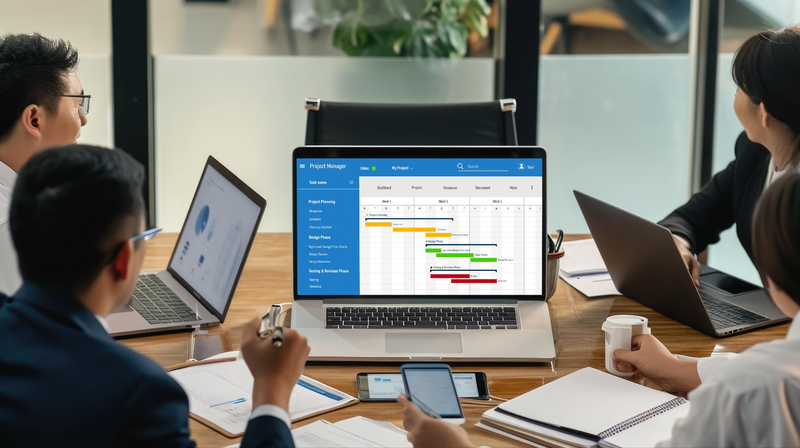
Common software project management methodologies include Agile, Waterfall, Hybrid, RAD and DSDM
6. How TMA Solutions manages software development projects
TMA Solutions is a Vietnamese software development and outsourcing company, founded in 1997 and based in Ho Chi Minh City. The company provides software development, testing, digital transformation and AI services to clients in 30 countries, and has managed many large and complex software projects for international clients. Below are the key points in how TMA organizes and manages projects.
- Experience and scale: TMA has 29 years of experience and a team of 4,000 engineers, and has developed more than 1,000 applications for clients in 30 countries.
- Intensive Agile process: TMA applies Agile in a strict way to offshore software development projects. This process supports effective project management, fast delivery and continuous improvement after each development cycle.
- Strong quality foundation: TMA's processes follow CMMI, Agile, RUP, ISO 9001 and ISO 27001 standards and practices. As a result, quality and information security stay under control throughout the project.
- Built-in testing: Development services can come with TMA's software testing services to control quality at every stage.
- Teams by expertise: TMA has 10 technology and solution centers, such as Telecom, Fintech, Healthtech, Automotive and AI. Project teams can therefore bring in the right experts for each industry.
- Global presence: Besides Vietnam, TMA has offices in Canada, the US, Germany, Singapore, Australia and Japan, which makes it easy to work with clients in many regions.
- Flexible service models: MVP development, PoC and prototype, product enhancement, maintenance & support, porting & migration.
_2026-10-29-17-45-36-794.webp)
TMA Solutions manages software projects with an Intensive Agile process for clients in 30 countries
If you are preparing a new project or want to improve the way you manage your current projects, TMA's team can work with you to assess the scope, choose the right methodology and plan the delivery.
7. Frequently asked questions about project management in software development
What is L1, L2, and L3 in project management?
In project management, L1, L2 and L3 usually refer to the levels of detail in a project schedule (schedule levels). According to the classification by AACE International:
- Level 1: a high-level schedule for the whole project, with major work items and key milestones, for the client and senior management.
- Level 2: each work item from Level 1 is broken down further, usually by phase or work area.
- Level 3: a more detailed schedule, suitable for controlling the whole project on a daily basis.
In software operations and support, L1, L2 and L3 also refer to levels of technical support. L1 receives requests and solves basic issues, L2 handles more complex technical problems, and L3 is the expert or development team that fixes bugs at the source code level.
What does a software project manager do?
A software project manager is responsible for delivering the project on scope, on time, on budget and at the right quality. The main tasks include:
- Work with the client to define goals and scope
- Plan the project, break down the work and assign resources
- Track progress, manage risks and control changes
- Connect the development team, the test team and other stakeholders
- Report on project status and organize acceptance and handover
Software project management helps a business turn ideas into products that arrive on time, stay on budget and meet user needs. To do it well, a business needs to understand the special features of software projects, go through all five stages from discovery to handover, and choose a methodology that fits the project size and the level of requirement change.
With 29 years of experience and an Intensive Agile process, TMA Solutions can manage the full project life cycle for your business. Talk to TMA's team for advice on the right approach for your project.
Contact information:
TMA SOLUTIONS - The leading software development company in Vietnam Email: sales@tmasolutions.com Website: https://www.tmasolutions.com/ Linkedin: TMA Solutions TMA Tower address: Street #10, Quality Tech Solution Complex (QTSC), Trung My Tay Ward, Ho Chi Minh City. |


.webp_2026-10-29-17-36-36-492.webp)
.webp_2026-10-29-17-14-09-878.webp)