How can enterprise blockchain solutions revolutionize your industry and drive business growth? Enterprise blockchains are modernizing industries by making them more efficient, secure, and transparent. From supply chain management to finance, this technology offers solutions to real-world problems. Let’s discover how enterprise blockchain can transform your business in this article.
What sets enterprise blockchains apart from other blockchain types?
The key difference between enterprise blockchains and others lies in smart contract capability. Enterprise blockchains are designed to support robust, flexible smart contracts, enabling businesses to automate processes and build custom systems. This functionality is crucial for creating scalable and efficient solutions.

In contrast, blockchains like Bitcoin lack this flexibility, limiting their use to simple digital asset transactions. For businesses, the ability to customize and scale with advanced smart contracts is what makes enterprise blockchains a standout choice.
Exploring the types of blockchain networks
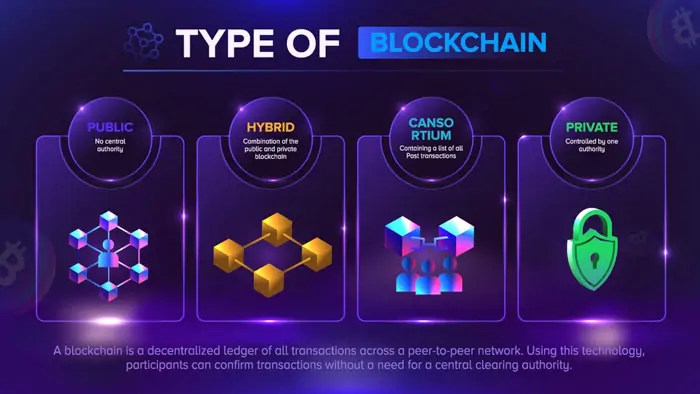
The blockchain ecosystem is rich and varied, encompassing a multitude of network types. Let's delve into the four primary types of blockchain networks.
Public (open) blockchains
Public blockchains are open peer-to-peer networks that anyone can join without requiring approval. For instance, the Ethereum blockchain allows anyone with the necessary hardware and software to participate as a node.
Public blockchains like Casper Network, Cardano, and Polkadot offer smart contract capabilities, making them suitable for enterprise use. However, networks like Bitcoin and Litecoin, while public, lack the advanced smart contract functionality businesses often require.
Private (restricted access) blockchains
Private blockchains are controlled and managed by a single entity, such as a company or institution. Participation in the network is restricted to authorized users.
Businesses can create their own private blockchains, customizing them to suit specific needs. However, this approach requires significant resources and may raise concerns about transparency and security, given the centralized control.
Consortium or federated blockchains
Consortium blockchains are governed by a group of entities, such as corporations or institutions, that collaboratively manage the network. Membership requires approval from existing members, ensuring a controlled but collaborative environment.
Prominent examples include Corda by R3, Fabric by Hyperledger, and B3i. These enterprise blockchains are often used in industries like finance and insurance, where cooperation between stakeholders is essential.
Hybrid blockchains
Hybrid blockchains combine elements of public and private networks. They operate on a permissionless public blockchain platform while allowing businesses to create private sub-networks (mini blockchains) for specific projects.
Examples like Polkadot and Kusama support custom private blockchains, known as parachains, that benefit from the security and stability of the overarching public blockchain.
How enterprise businesses leverage blockchain technology?
Blockchain technology revolutionizes enterprise operations by providing a decentralized ledger for secure and transparent transaction recording. It employs Distributed Ledger Technology (DLT) to ensure data integrity and eliminate single points of failure, crucial for business reliability. Smart contracts automate processes and agreements, reducing manual errors and enhancing efficiency by executing predefined rules without intermediaries.
Unlike public blockchains, enterprise networks use consensus mechanisms like Practical Byzantine Fault Tolerance (PBFT) or Proof of Authority (PoA), which prioritize speed, security, and resource efficiency. This combination of technologies enables businesses to streamline operations, maintain transparency, and scale effectively.
Key advantages of enterprise blockchains
Enterprise blockchain solutions offer a multitude of benefits that can significantly enhance business operations. Let's delve into three key advantages:
Enhanced transparency and accountability
Enterprise blockchains are designed to be tamper-evident, making them highly secure for storing sensitive information. The decentralized structure reduces the risk of fraud and data breaches, ensuring that business-critical data remains protected. This enhanced security builds trust among partners and clients alike.
Strengthened data security
Blockchain enterprise solutions are designed to be tamper-evident, making them highly secure for storing sensitive information. The decentralized structure reduces the risk of fraud and data breaches, ensuring that business-critical data remains protected.

Using blockchain solutions for enterprises enhanced security builds trust among partners and clients alike.
Scalability and user-friendly design
Blockchain solutions for enterprises are built to handle high transaction volumes while remaining user-friendly. By automating processes and eliminating intermediaries, these solutions reduce manual effort and operational costs.
The result is faster transaction times and streamlined workflows, making blockchain an adaptable and scalable tool for businesses of all sizes.
Industries harnessing the power of enterprise blockchain
Transforming many industries with efficiency improvements is the breaking up of enterprise blockchain technology. Here's an overview of sectors actively adopting this technology:
Finance and banking
Blockchain is transforming the financial sector by enabling secure, efficient transactions and enhancing fraud prevention mechanisms. Banks use blockchain for trade finance, ensuring transparency in cross-border transactions and providing a reliable, immutable platform for recording financial activities. This reduces fraud risks and accelerates transaction processes.
Supply chain management
In supply chain management, enterprise blockchain solutions ensure transparency and traceability from production to the end consumer.

By recording each step of a product's journey, businesses can verify authenticity, monitor quality, and improve accountability. It also streamlines logistics by providing real-time insights, enhancing efficiency and reducing costs.
Healthcare
Healthcare organizations leverage blockchain to securely manage and share patient data. Blockchain's decentralized structure ensures that sensitive information remains private and tamper-proof while facilitating data sharing among providers. This improves patient care, reduces administrative inefficiencies, and accelerates medical research by providing trusted access to accurate data.
Steps to implement enterprise blockchain solutions
Integrating enterprise blockchain technology solution into your enterprise requires a clear and strategic approach. Below are 7 streamlined steps to guide you through successful implementation:
Step 1: Identify business needs and objectives
Clearly define the business problem or opportunity you want to address with blockchain. For example, improving supply chain transparency or streamlining financial transactions.
Step 2: Define the network participants
Identify the key stakeholders who will be part of the blockchain network. This might include suppliers, manufacturers, distributors, retailers, and clients.
Step 3: Choose the appropriate blockchain type
Choose a suitable blockchain platform based on your specific needs. Popular options include Hyperledger Fabric, R3 Corda, and Ethereum. Consider factors like scalability, security, and developer support.
Step 4: Develop a proof of concept (PoC)
Define the network's structure, including the consensus mechanism (e.g., Proof of Work, Proof of Stake) and the roles and permissions of participants. Develop smart contracts to automate business processes and enforce rules.
Step 5: Integrate with existing systems
Integrate the blockchain solution with your existing IT infrastructure, such as ERP systems, CRM systems, and other relevant software. Use APIs and middleware to ensure seamless data flow.
Step 6: Test and deploy
Thoroughly test the blockchain solution to identify and address any issues. Deploy enterprise blockchain solutions in a production environment, either on-premises or in the cloud.
Step 7: Establish governance
Implement governance processes and policies to manage the network. Define roles, responsibilities, and decision-making procedures.
Step 8: User adoption and training
Train network participants on how to interact with the blockchain solution. Provide user-friendly interfaces and tools to facilitate adoption.

Step 9: Implementing a scalable, secure, and compliant
Continuously monitor the performance and security of the blockchain network. Gather feedback from participants and make necessary adjustments to improve the solution.
Overcoming challenges in enterprise blockchain adoption
Implementing enterprise blockchain presents several challenges that organizations must navigate to achieve successful adoption. Key challenges include:
Regulatory and compliance issues
Blockchain disrupts traditional concepts of data ownership and jurisdiction, often leading to regulatory and legal challenges. Organizations must navigate complex legal landscapes, ensure compliance with data protection laws, and adhere to industry-specific regulations, making implementation more challenging.
Integration with legacy systems
Many enterprises rely on legacy systems and databases that must integrate with blockchain solutions.

Achieving seamless interoperability between blockchain networks and existing technologies requires careful planning, API development, and standardization of data formats, which can be time-consuming and technically demanding.
Scalability concerns
As blockchain networks grow, they may face scalability issues, including slower transaction processing and increased resource consumption. Implementing enterprise blockchain solutions like sharding, layer-2 protocols, and parallel processing can help address these challenges.
Data privacy and security
Balancing transparency with privacy is crucial, especially in industries handling sensitive data. Employing advanced encryption techniques, zero-knowledge proofs, and selective disclosure can protect confidential information.
Cost implications
Enterprise blockchain implementations involve substantial upfront costs, including infrastructure development and ongoing maintenance.
Demonstrating a clear return on investment (ROI) and convincing stakeholders of the value blockchain can bring is often a critical challenge for enterprises.
Governance and consensus
Establishing governance in enterprise blockchains, especially in consortiums or federated networks, can be tricky. Defining stakeholder roles, responsibilities, and decision-making processes requires coordination and clear agreements.
Additionally, selecting the right consensus mechanism to balance decentralization, security, and performance adds another layer of complexity.
Adoption and network effects
Integrating blockchain into existing business processes often demands significant changes, from system overhauls to employee training.
Moreover, achieving user buy-in and adoption among stakeholders can be difficult, especially when the technology is unfamiliar or disrupts established workflows.
Why TMA Solutions for enterprise blockchain?
By leveraging blockchain technology, TMA Solutions delivers innovative and scalable solutions that transform financial services while ensuring security and efficiency.
- Simplified deployment and usability: TMA Solutions simplifies the process of implementing blockchain technology in fintech applications. With user-friendly tools and automated processes, we enable businesses to quickly set up and manage blockchain networks.
- Support for multiple protocols: We offer support for a variety of blockchain protocols, allowing fintech enterprises to select the most suitable option for their unique needs. This flexibility ensures that our solutions are tailored to maximize effectiveness and innovation.
- Enhanced security and compliance: In the heavily regulated fintech sector, security and compliance are critical. TMA Solutions provides blockchain solutions with robust security features and compliance tools, ensuring adherence to the highest data protection standards and regulatory requirements.
- Scalability and performance for financial applications: Our blockchain solutions are designed to scale with your business, accommodating growth and increasing transaction volumes. TMA Solutions ensures that your blockchain networks maintain optimal performance even as demand expands.
- Seamless integration with financial systems: We prioritize smooth integration with existing financial systems and workflows, minimizing disruption during adoption. Our solutions enhance operational efficiency while maintaining compatibility with your current infrastructure.
By choosing TMA Solutions for blockchain-powered fintech solutions, businesses gain access to innovative, secure, and scalable technologies that drive transformation and deliver a competitive edge in the financial industry.
Conclusion
The benefits of enterprise blockchain solutions vary from security to operational efficiency. Although there exist challenges, the innovation and growth potential surpass challenges. The more industries adopt blockchain, the clearer its transforming power will become. Are you ready to explore the potential of blockchain for your business? Let's discuss how we can leverage this technology to drive your success.


.webp_2026-10-01-18-27-07-971.webp)
.webp_2026-10-01-18-17-11-290.webp)
.webp_2026-10-01-18-08-26-854.webp)
.webp_2026-10-01-17-47-32-240.webp)